Inspiration
Disasters keep making the news, but what comes after rarely does. Most people expect the first problem after a disaster to be the house. A few days later, it turns out to be money: a hotel bill that grows every night, a paycheck that's late because the employer closed, a car payment due Friday, and an insurance claim that won't pay for weeks. To get that claim paid, a family has to remember everything they owned, in a home that's now underwater or gone.
On the other side, insurers and responders get thousands of claims at once. The families who need help most are often the quietest ones. They haven't filed, haven't answered the phone, and have the least savings to fall back on. The worst day of someone's life shouldn't also be the day they get lost in a queue.
We wanted one calm place that helps a family prove what they lost, fund the gap until the claim pays, and navigate every decision in between. On the insurer side, we wanted a view where no one is overlooked.
What it does
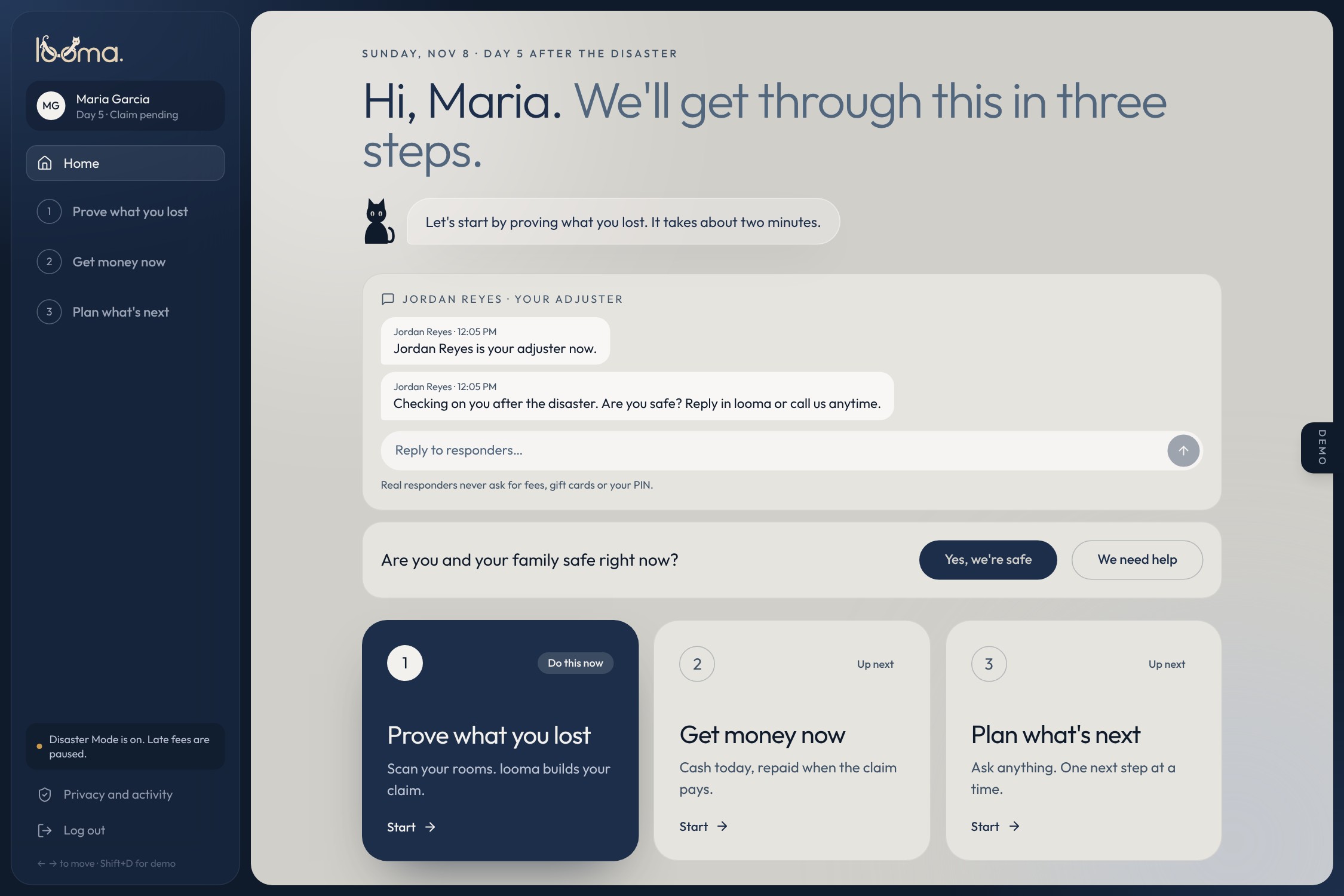
looma. is a disaster recovery app with a family side and a responder side. It's built around one demo family, the Garcias, on day 5 after a disaster.
1. Prove it
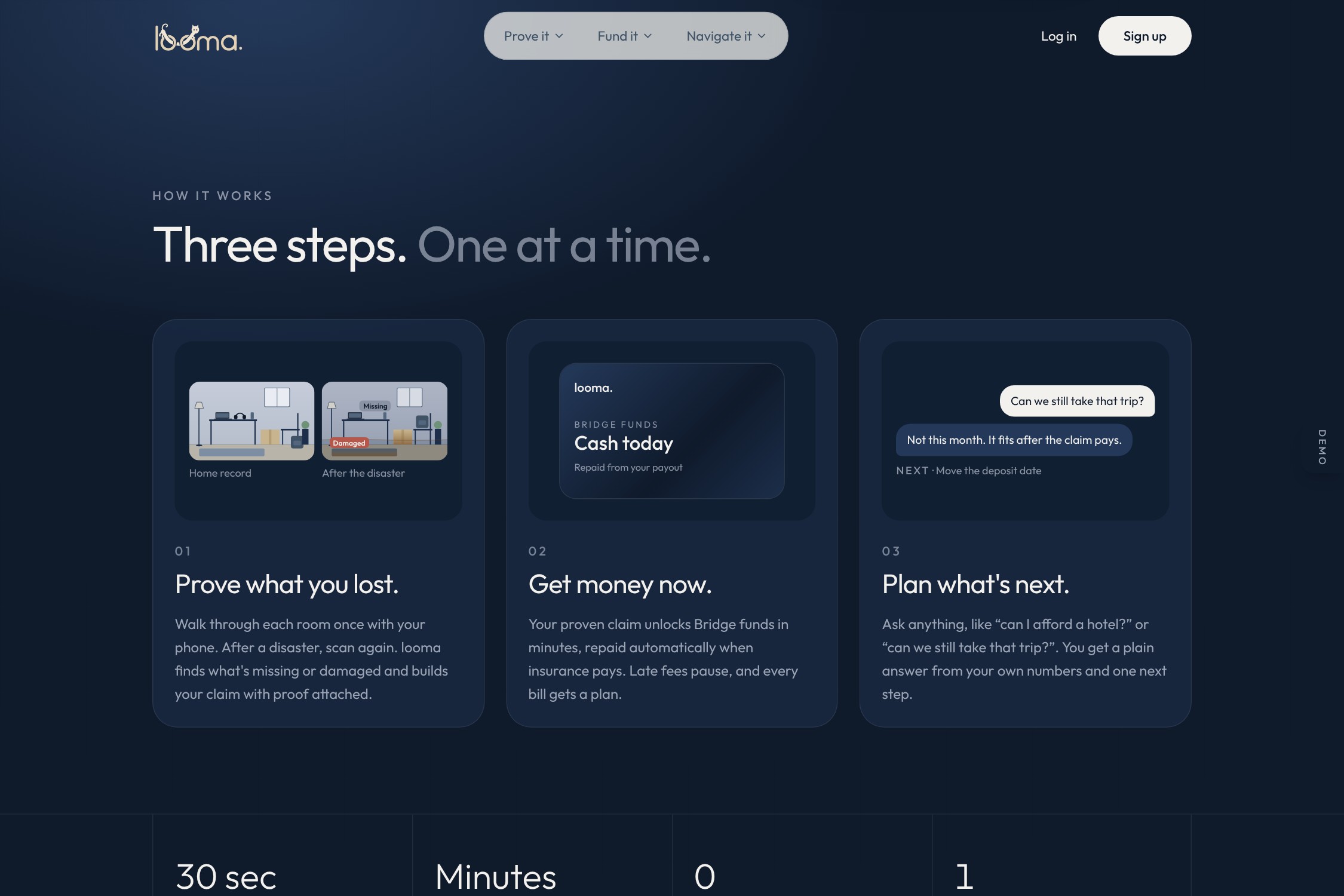
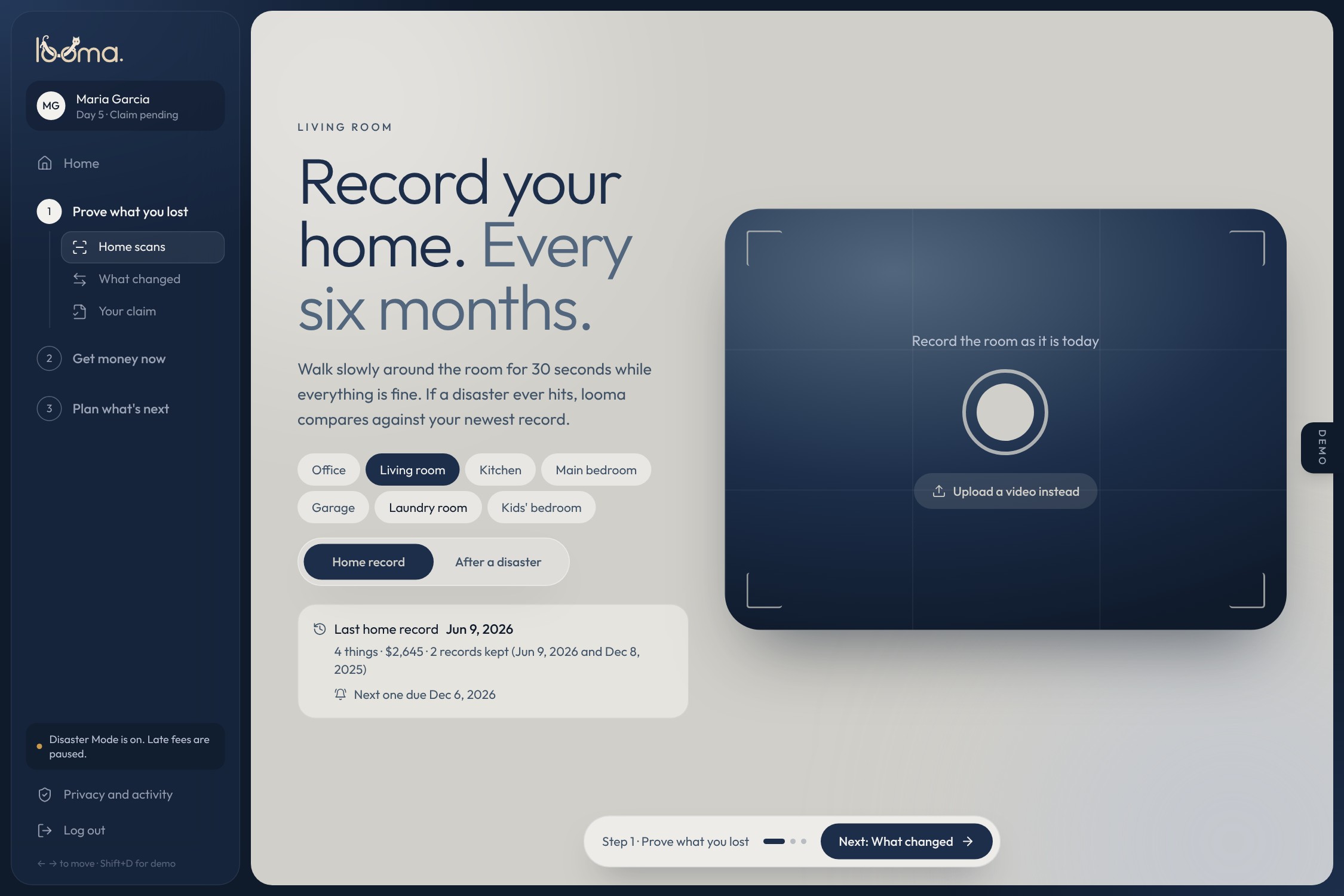
- Home scans every six months. You walk each room for 30 seconds while everything is fine. Gemini lists every item, its condition and a price range. looma keeps a history of these home records and reminds you when one is due.
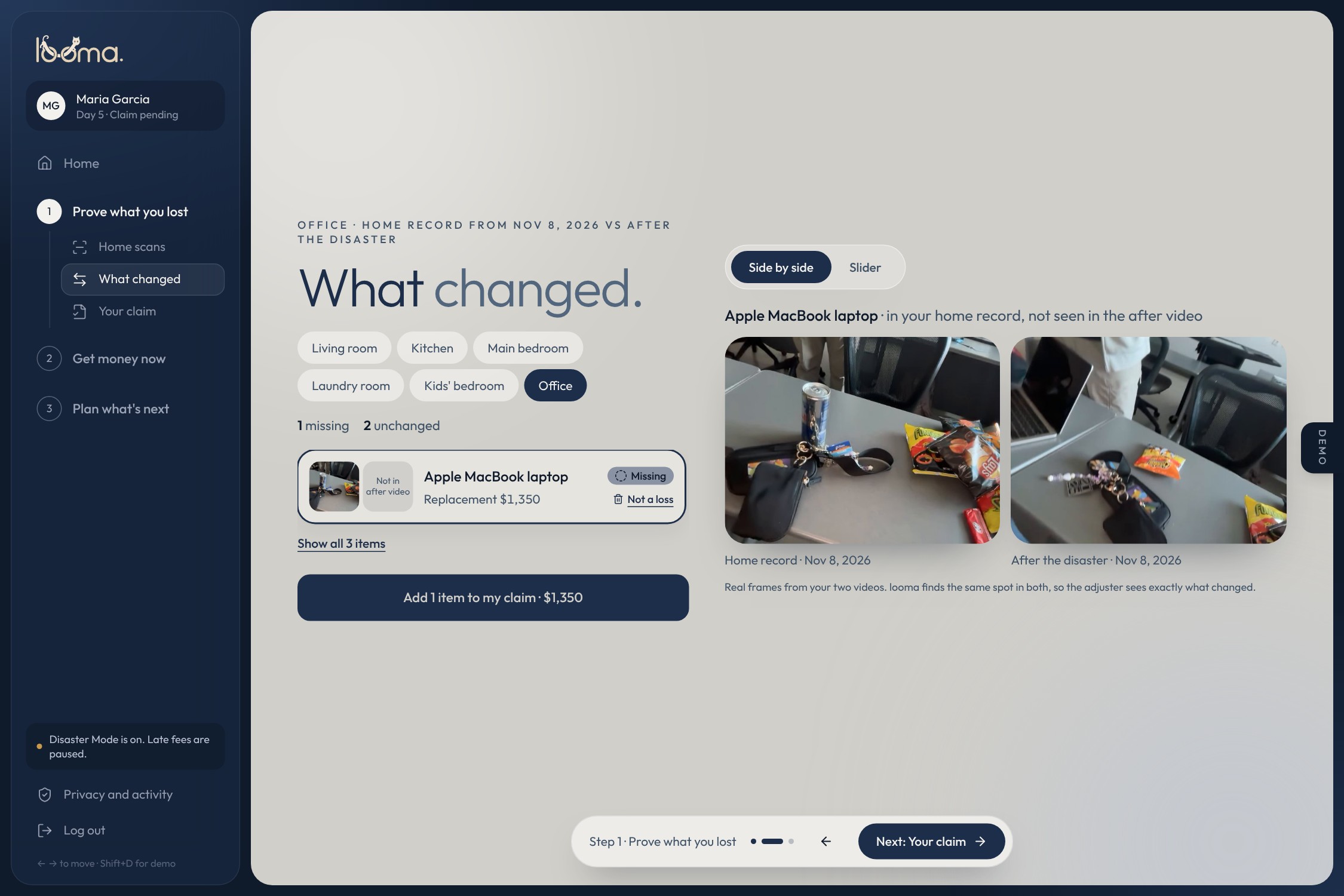
- After a disaster, you scan the room again. looma compares the two videos item by item and builds a loss list from real frames of your own videos. Each item gets a close-up from the home record, plus the same spot in the after video, found with OpenCV feature matching. You see exactly where the laptop used to be.
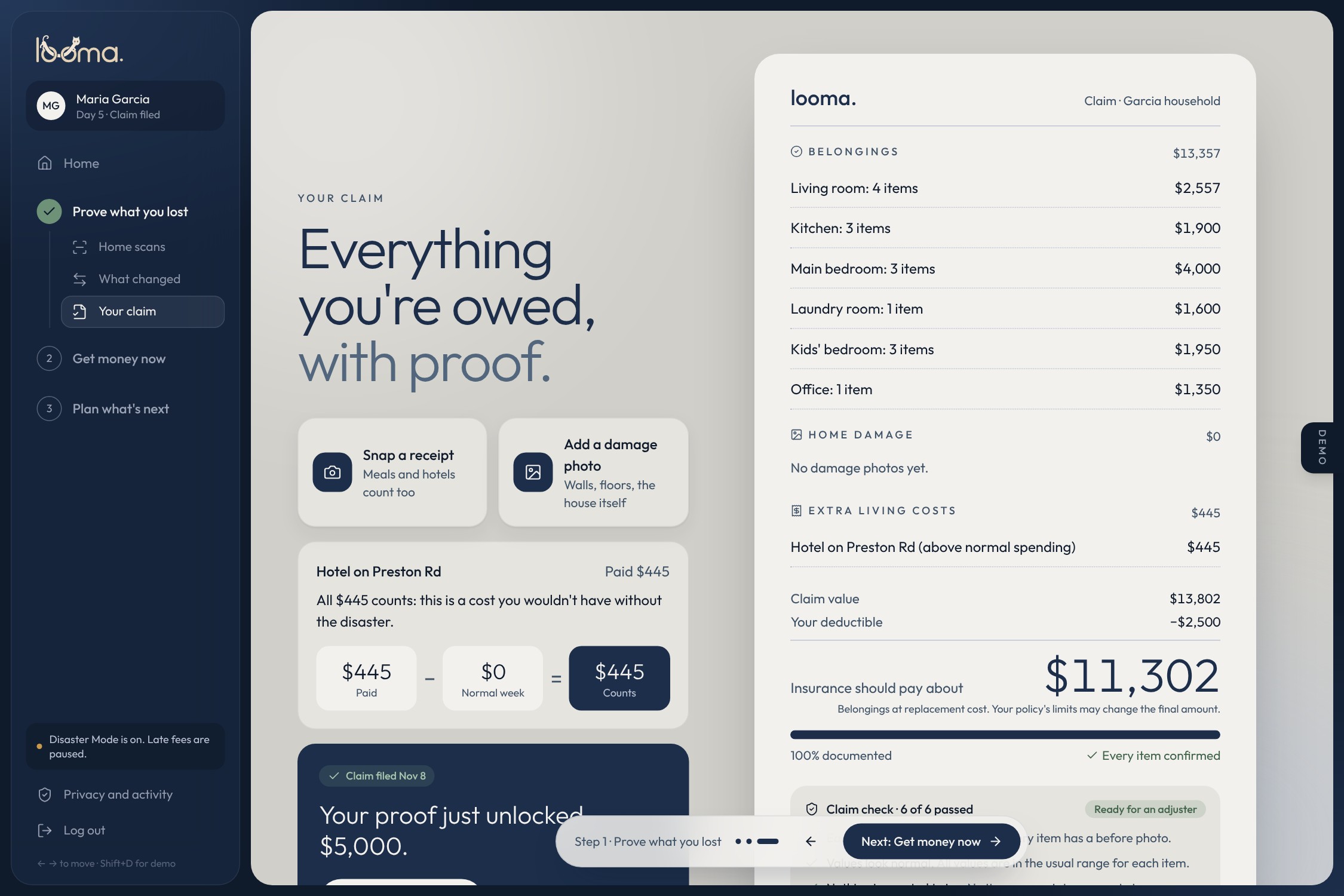
- Claim check. Six plain-code checks run before an adjuster ever sees the claim: every item appears in a before scan, values are in a normal range, nothing is counted twice, photos are clear, receipts count only extra costs, and the family reviewed every item. Nothing is rejected automatically; the family and the adjuster see the same list.
2. Fund it (built on Nessie)
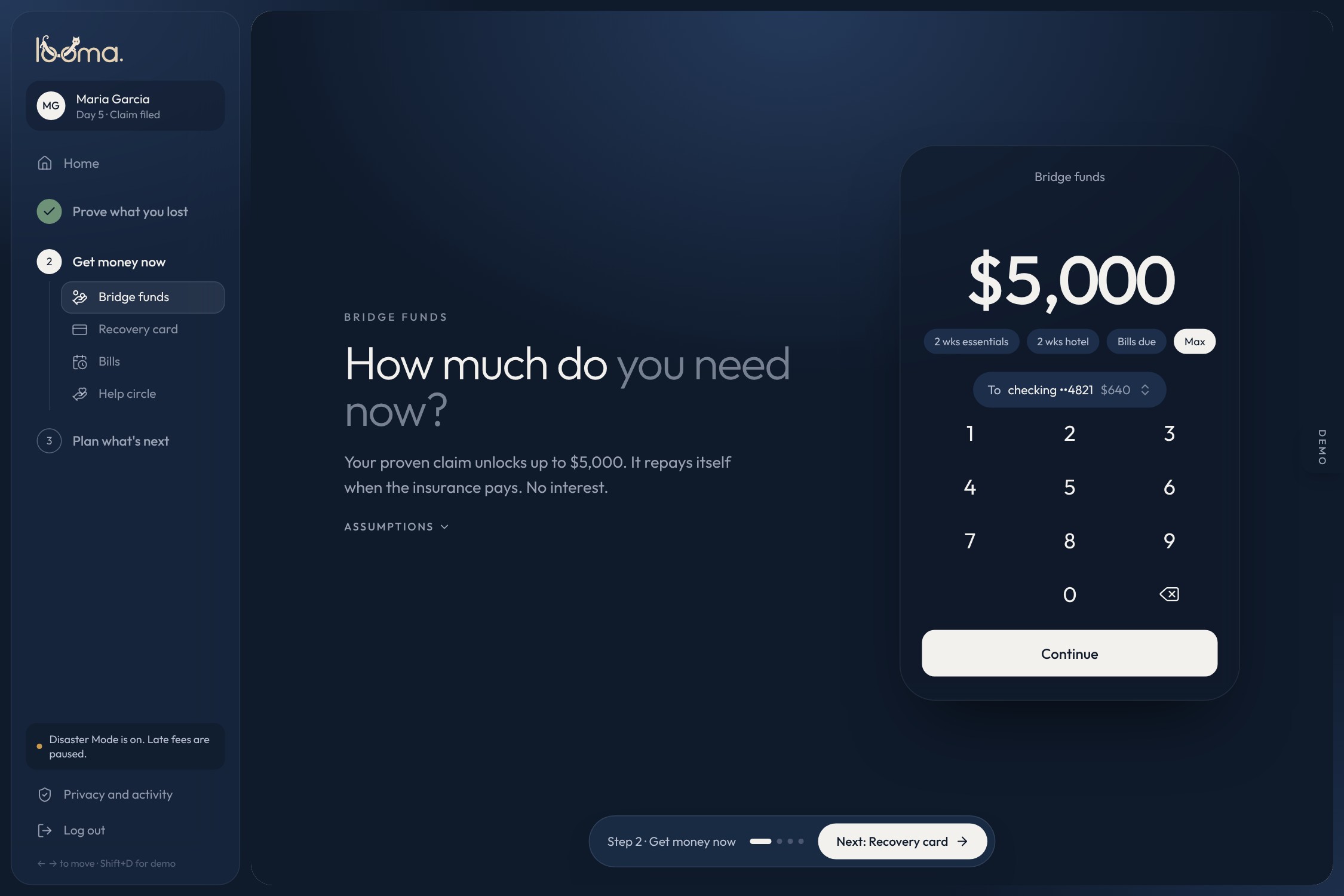
- Bridge Funds: cash in minutes against a filed, verified claim, repaid automatically when the insurance pays.
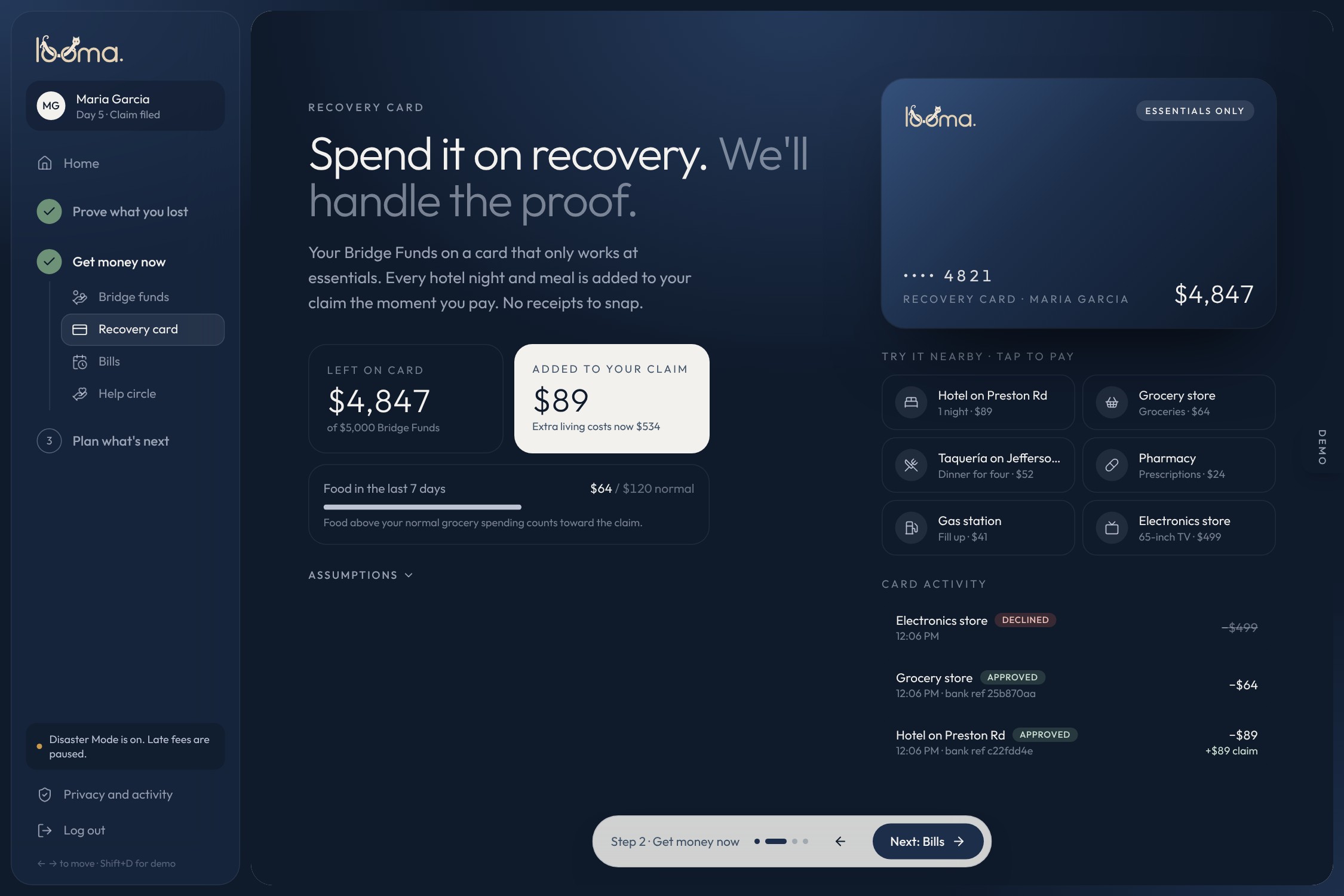
- Recovery Card: Bridge Funds on a virtual card that only works at essentials (hotels, groceries, pharmacies, gas). Every approved purchase is a Nessie purchase and becomes claim proof automatically, with no receipt to snap.
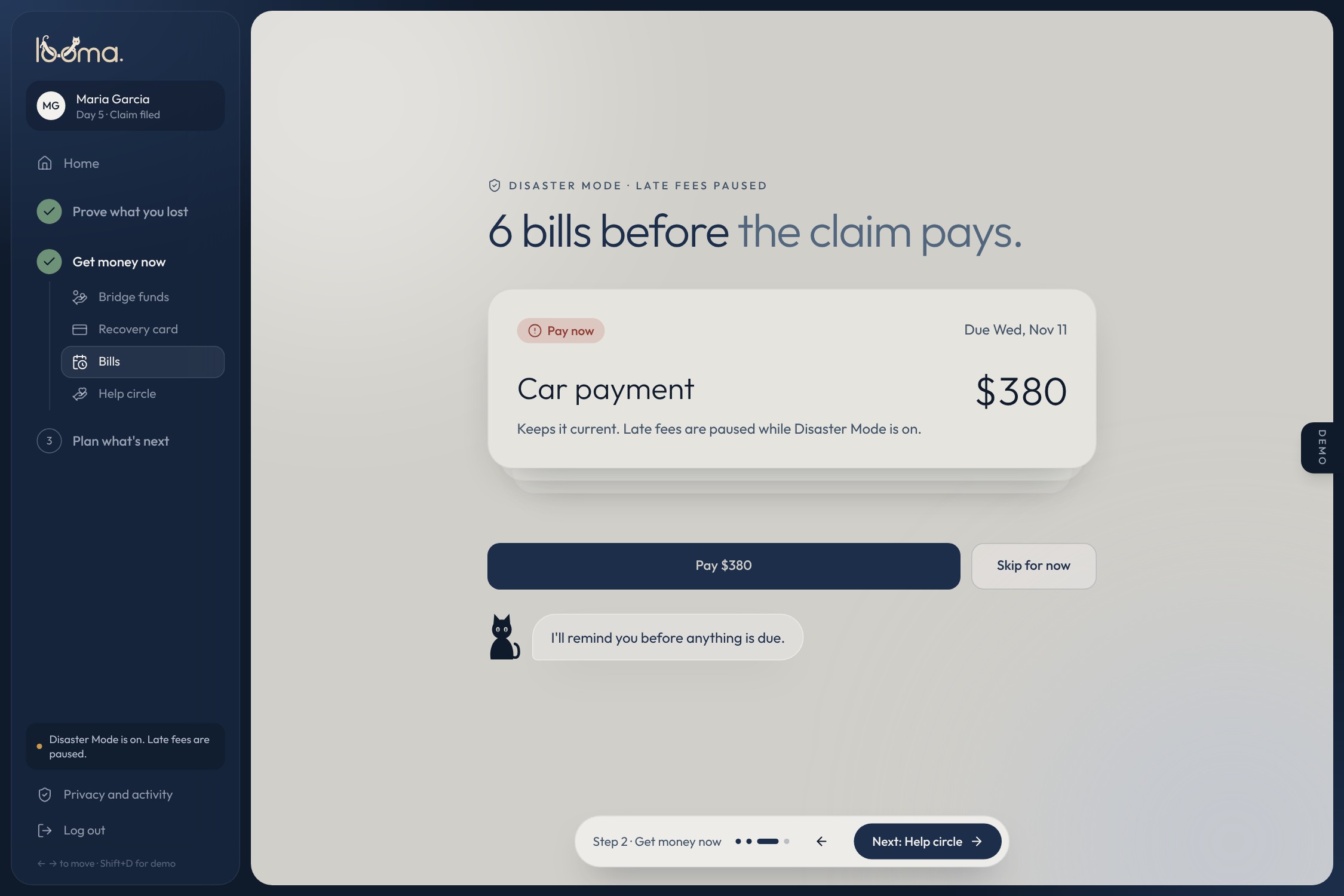
- Disaster Mode pauses late fees and sorts every bill due before the payout into pay now, move or call about. Help circle lets family and friends send money as Nessie transfers, and Cash access finds the nearest working ATM, skipping the ones knocked out by the disaster.
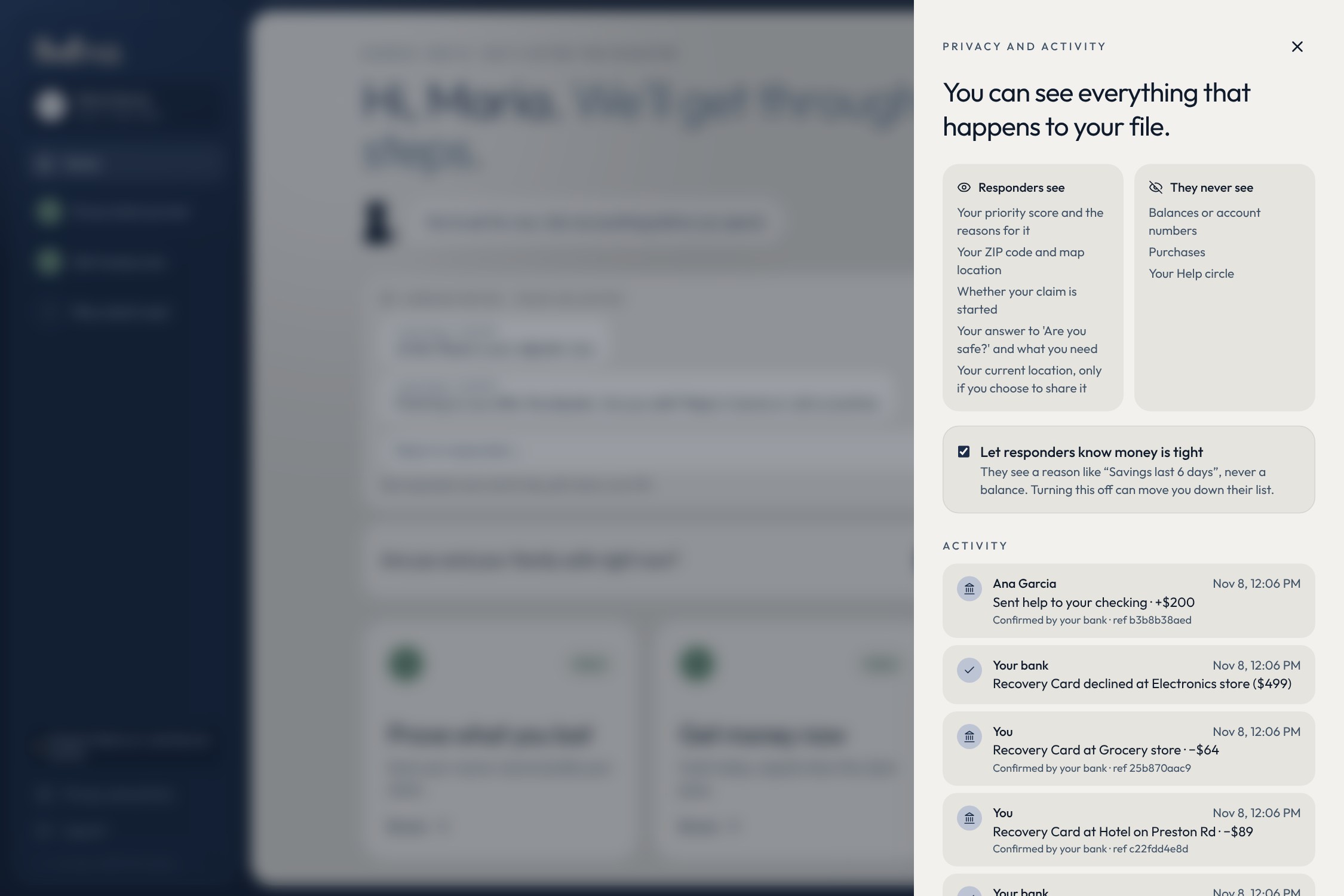
- Every money move shows "Confirmed by your bank · ref …" with its real Nessie transaction ID.
3. Navigate it
No dashboards. One question at a time:
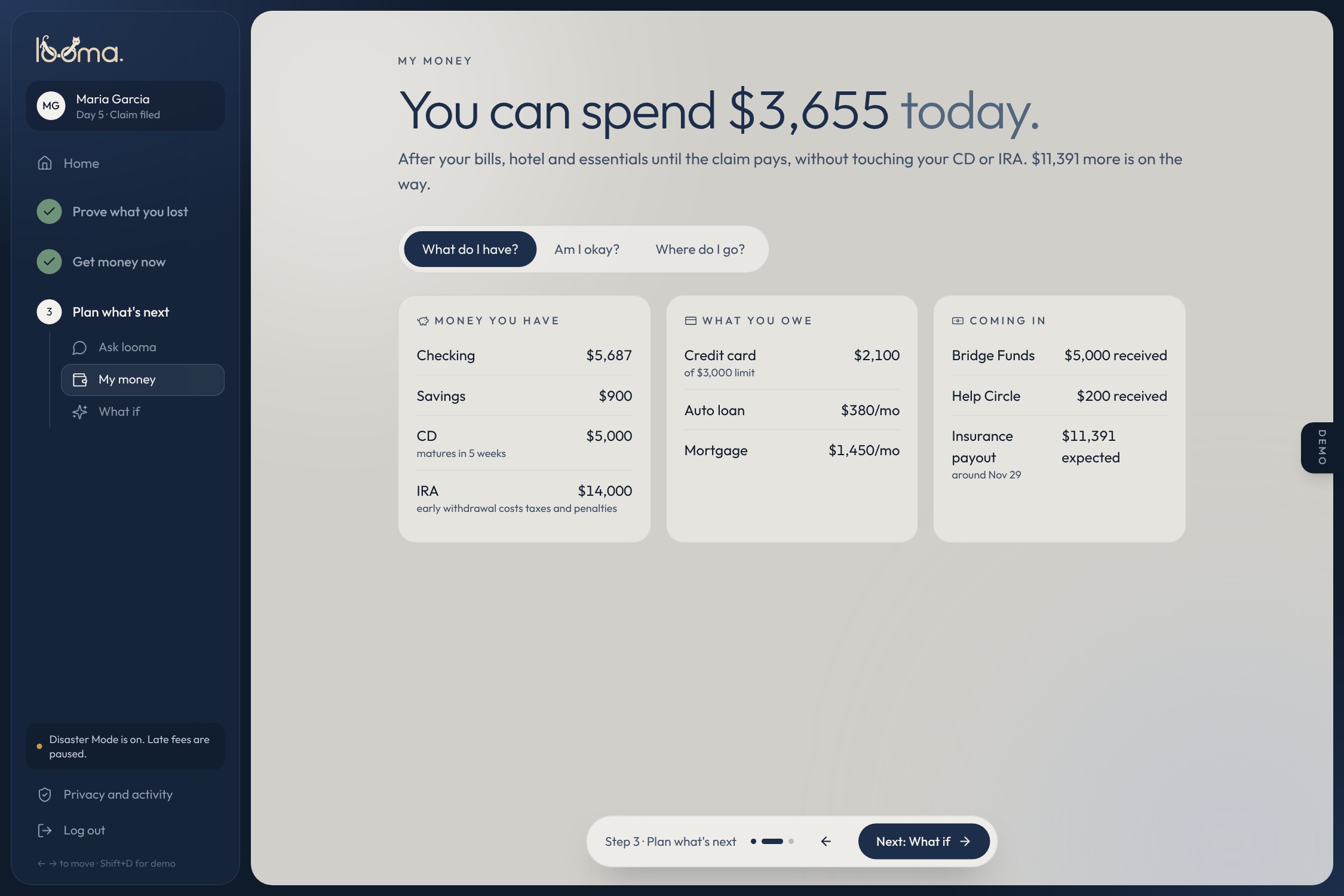
- What do I have? All 8 account types (checking, savings, CD, IRA, credit card, loans, mortgage) and 4 health indicators.
- Where do I go? A money ladder: which money to use first and which to protect (don't break the CD, don't touch the IRA).
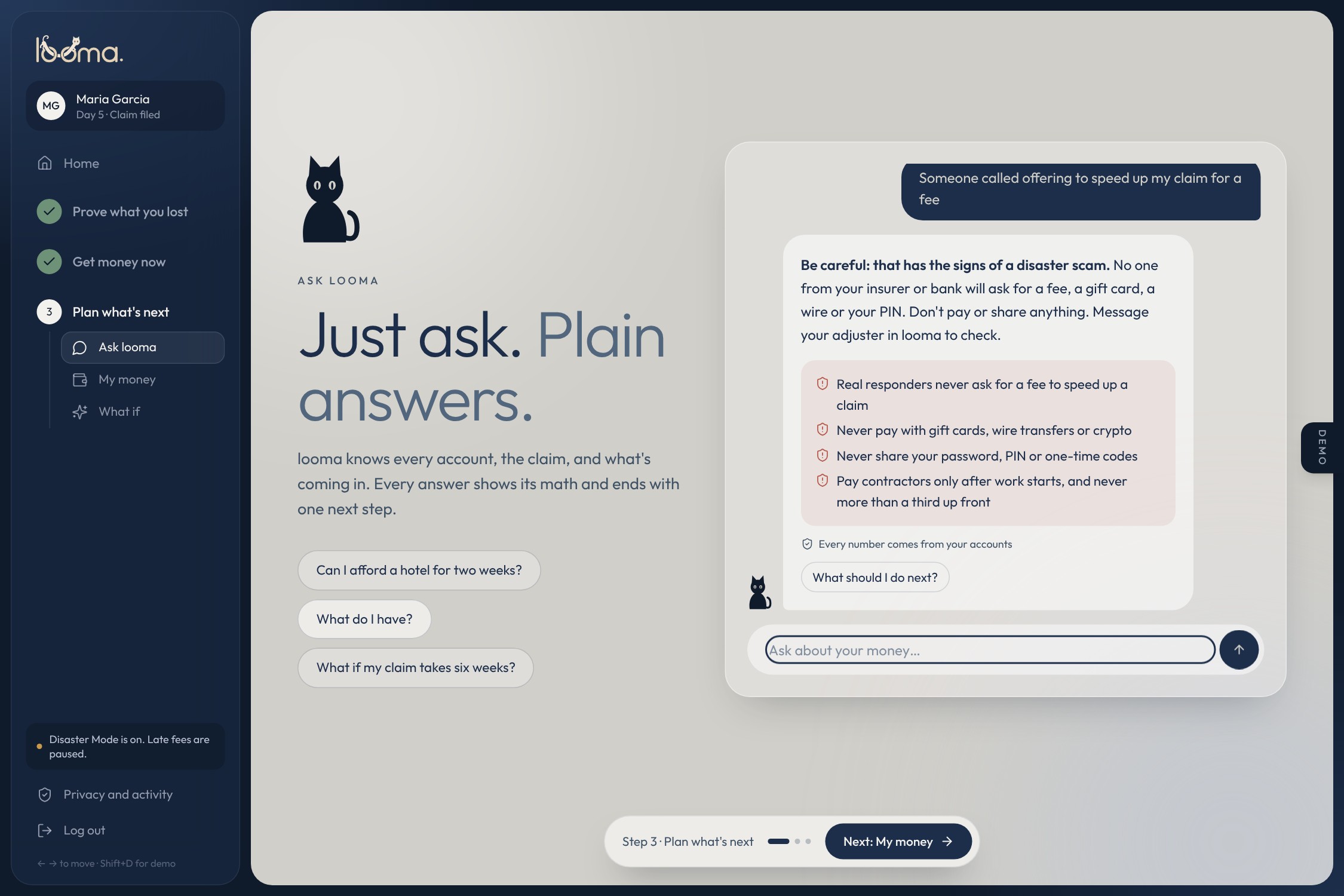
- Can I still take that vacation? Ask looma answers in plain words, shows its assumptions, and ends with one next step.
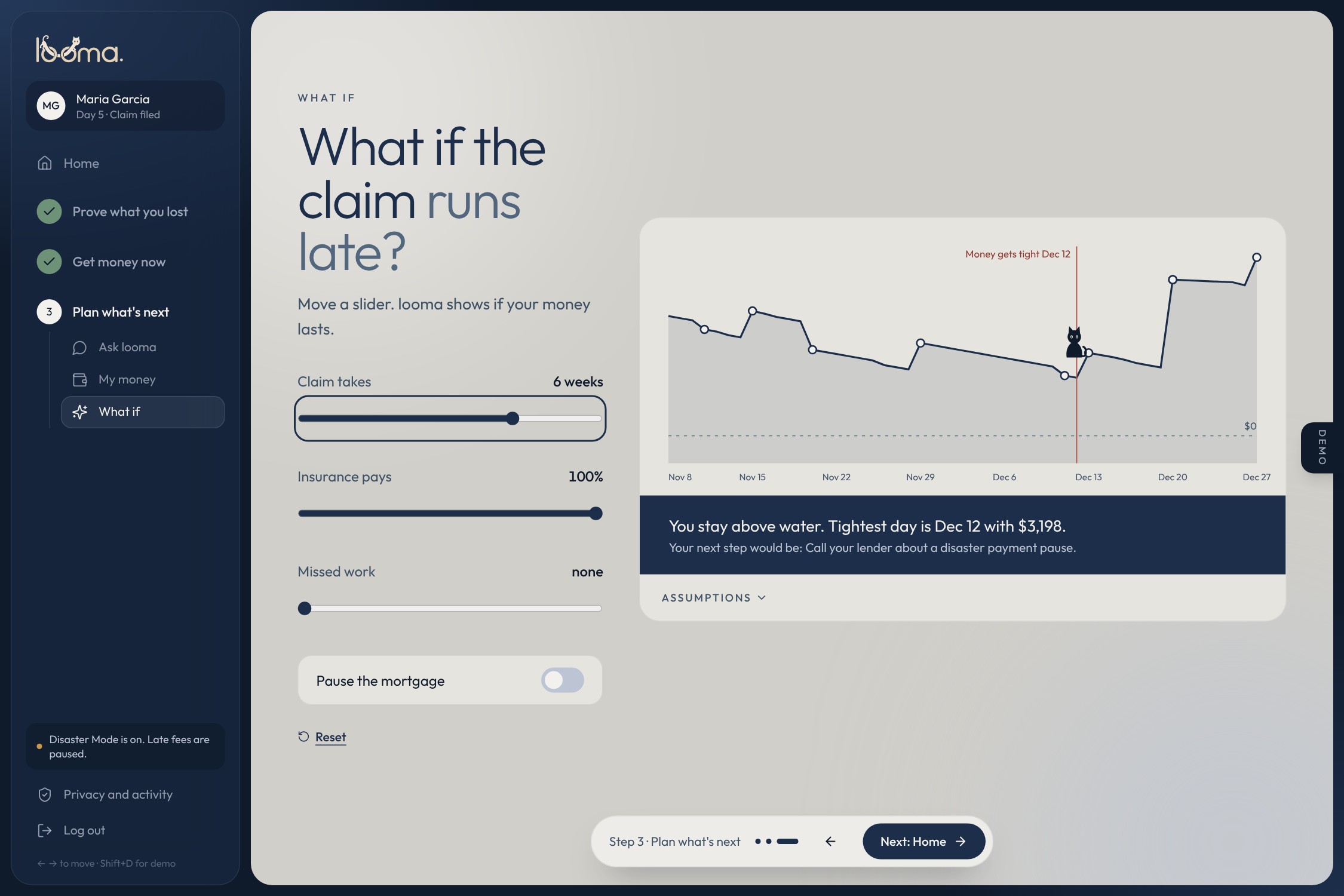
- What if the claim takes six weeks, insurance pays 70%, or I miss two weeks of work? Move a slider and watch the day-by-day balance.
- Scam shield: "Someone called offering to speed up my claim for a fee" gets a clear warning, not advice.
The responder view: no one overlooked
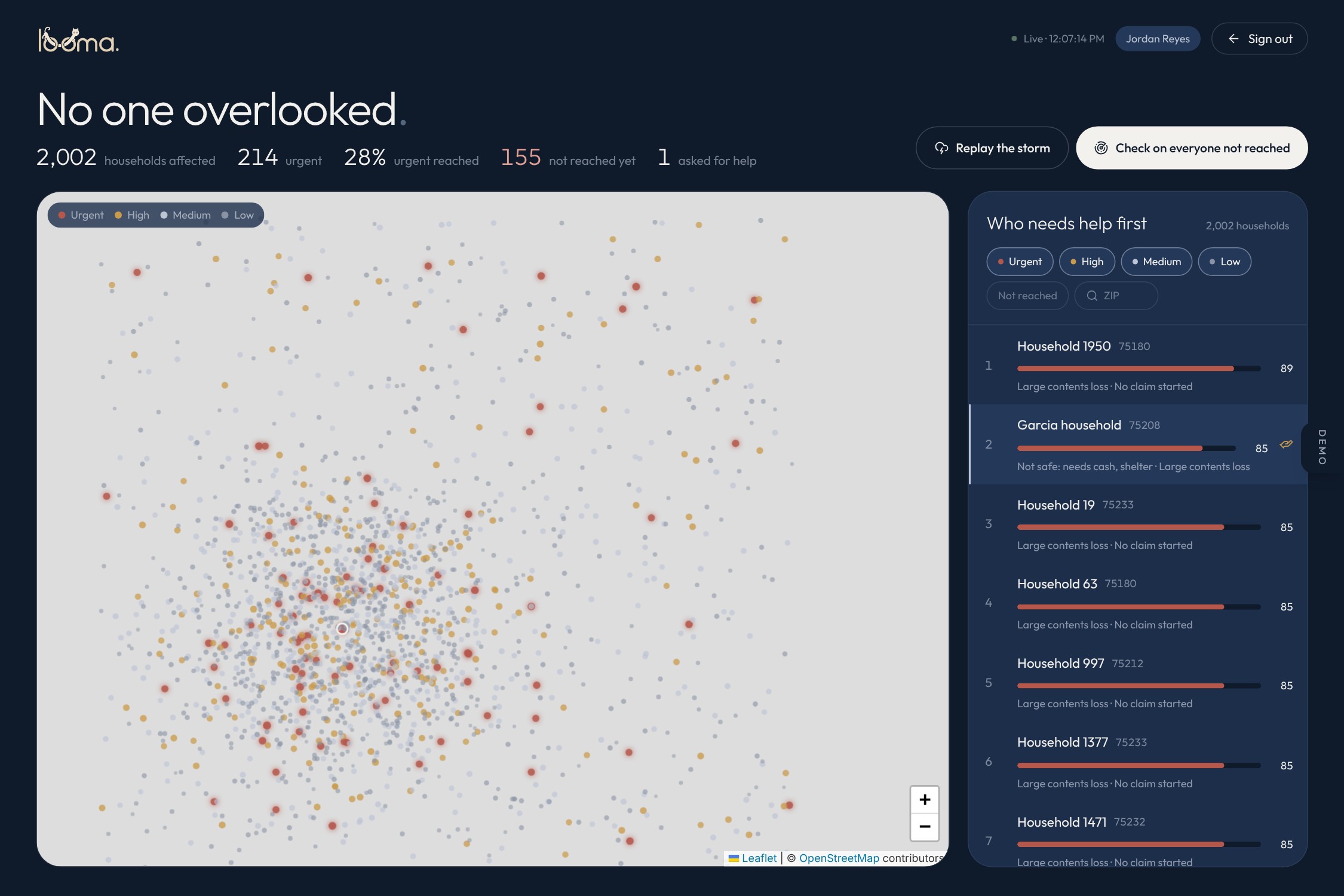
Responders see thousands of households on a real street map, ranked by Recovery Priority:
$$ \text{Priority} = \min\Big(100,\; \underbrace{40 \cdot \min\big(1, \tfrac{\text{loss}}{\$15{,}000}\big)}{\text{severity}} + \underbrace{F}{\text{fragility} \,\le\, 30} + \underbrace{S}{\text{silence} \,\le\, 30} + \underbrace{N}{\text{asked for help} \,\le\, 20}\Big) $$
- Scores only move people up. Fragility is opt-in, and responders see reasons ("Savings last 6 days", "No claim started"), never balances.
- A family can answer "Are you safe?" with what they need (shelter, food, cash, a ride), and they rise to the top right away.
- Responders can assign an adjuster, send a check-in, or press "Check on everyone not reached" to contact every urgent household no one has reached. In our demo that takes urgent coverage from 27% to 100% in one click.
- Every responder action is signed with their name and appears in the family's own activity log.
How we built it
- Frontend: Next.js 15 (App Router), TypeScript, Tailwind v4, Framer Motion and Leaflet. We designed it like an app, not a dashboard: one focused page at a time, smooth transitions, a five-color palette, and a black cat mascot whose body weaves through the two o's of our logo.
- Backend: FastAPI with a rules engine where all money math is plain, tested Python. That covers the forecast, money ladder, next steps, Bridge Funds, claim math, priority score and claim check.
- AI: Gemini watches the room videos, reads receipts and damage photos, draws boxes around items, and rewrites answers in warm language. It never does math. Every dollar amount in an AI answer is checked against our own numbers, and if Gemini invents one, we show our original wording instead.
- Computer vision (OpenCV): blur and lighting checks while you scan, decoding browser recordings into real frames, and ORB feature matching with a RANSAC homography to find the same spot in the before and after videos and move the item's box there.
- Banking: the Capital One Nessie API for customers, accounts, purchases, merchants, bills, deposits, withdrawals, transfers and ATMs.
- Data: MongoDB, or an in-memory store when there's no database. 2,000 synthetic households fill the responder map.
- Every outside service has a mock mode, so the whole app runs offline for a demo. 23 backend tests cover the demo story and every trust rule.
A few rules from the engine:
$$ \text{Bridge limit} = \min\big(0.4 \cdot \text{verified losses},\; 60 \text{ days of essentials},\; 0.5 \cdot (\text{expected payout} - \text{deductible}),\; \$5{,}000\big) $$
$$ \text{Extra living cost that counts} = \max\big(0,\; \text{receipt total} - \text{normal spending for those days}\big) $$
Track integration
State Farm. State Farm asked how AI can find the most urgent needs when thousands are hit at once, so no one is overlooked. looma's responder map ranks 2,000+ households by loss severity, financial fragility, silence and family-reported needs, showing reasons, never balances. Families answer "Are you safe?" to rise instantly, Gemini-built proof photos speed claims, and one click sends a check-in to every urgent household no one has reached, taking coverage from 27% to 100%.
PNC. PNC asked how AI can help someone see their whole financial picture and feel confident about their next move. Instead of a dashboard, looma answers one question at a time: What do I have? shows eight account types and four health indicators. Where do I go? ranks which money to use first and which to protect. Ask looma, our conversational coach, answers "Can I still take that vacation?", and the What if simulator forecasts each day until payout.
Capital One. Capital One asked us to reimagine banking with the Nessie API. looma turns a filed, verified claim into Bridge Funds in minutes, deposited through Nessie and repaid automatically from the payout. The Recovery Card spends those funds only at essentials, and each tap is a Nessie purchase that becomes claim proof. Disaster Mode pauses late fees, the Help circle sends Nessie transfers, Cash access finds working Nessie ATMs, and every money move shows its bank reference.
Challenges we ran into
- Black proof photos. Browser recordings (
.webmfrom MediaRecorder) have no seek index, so every "frame at 4.2 seconds" came back as the first frame, which is black while the camera warms up. We now decode each video once, keep a real frame every half second, skip black frames and brighten dim ones. - Showing the same spot before and after. People never walk the exact same path twice. We used ORB features and a homography to find the matching view in the after video and move each item's box into it.
- Keeping AI honest with money. Language models are good with words and unreliable with numbers. We split the work: code computes every number, Gemini only words it, and a number guard enforces the split.
- Privacy between the two sides. At first the family app downloaded the full responder ranking and the responder view loaded a family's balances. We split the data so each side loads only what it's allowed to see, and wrote tests that fail if a balance ever leaks.
- "No dashboards." Fitting eight account types, a claim, bills and a forecast into calm, one-question-at-a-time screens took more design work than any feature.
- Three tracks, one story. Proof unlocks money, money buys time, and time needs a plan. Making each sponsor's challenge feed the next one, instead of building three apps, was the hardest design decision.
Accomplishments that we're proud of
- A full end-to-end story with real data flowing through every screen: scan → claim → Bridge Funds → Recovery Card → bills → coach → responder map. The family and responder sides update each other live.
- Real proof photos from your own videos, with the missing item's old spot found automatically.
- Trust built in: a claim check, a scam shield, a number guard on AI answers, bank references on every money move, an activity log the family can read, and a privacy choice that is explained, not hidden.
- One click that makes sure every urgent household has been reached.
- An interface that feels like a calm app on someone's worst day, not a control panel.
What we learned
- In a disaster, trust is the product. Families need to see why a number is what it is, who looked at their file, and that nobody can quietly lower their priority.
- AI works best as a careful assistant to deterministic code, not a replacement for it, especially where money is involved.
- Real-world media is messy. Browser video formats, dark rooms and shaky hands broke our first approach, and fixing them taught us more computer vision than any tutorial.
- Designing for stress means fewer numbers, one next step, and plain words.
What's next for Looma
- Real accounts and sign-in for families and responders, with roles enforced on every responder route.
- Live disaster feeds (for example FEMA declarations and weather alerts) to turn on Disaster Mode by ZIP code automatically and start the responder sweep.
- A mobile app with home-scan reminders, offline recording and multiple languages, starting with Spanish.
- Insurer integration so a looma claim, with its proof photos and claim check, goes straight into an adjuster's system.
- A pilot with a local community organization in North Texas to test the Help circle and the responder sweep with real people.
Built With
- fastapi
- framer-motion
- google-gemini
- javascript
- mongodb
- nessie-api
- numpy
- opencv
- playwright
- pytest
- python
- react
- typescript
- uvicorn


