-
-
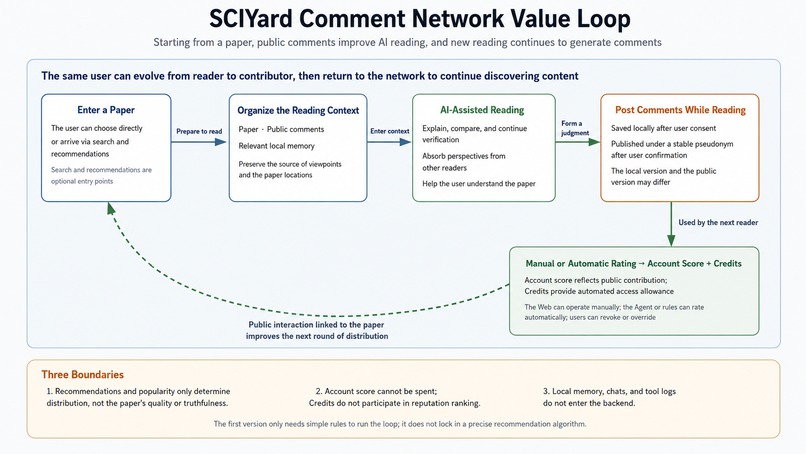
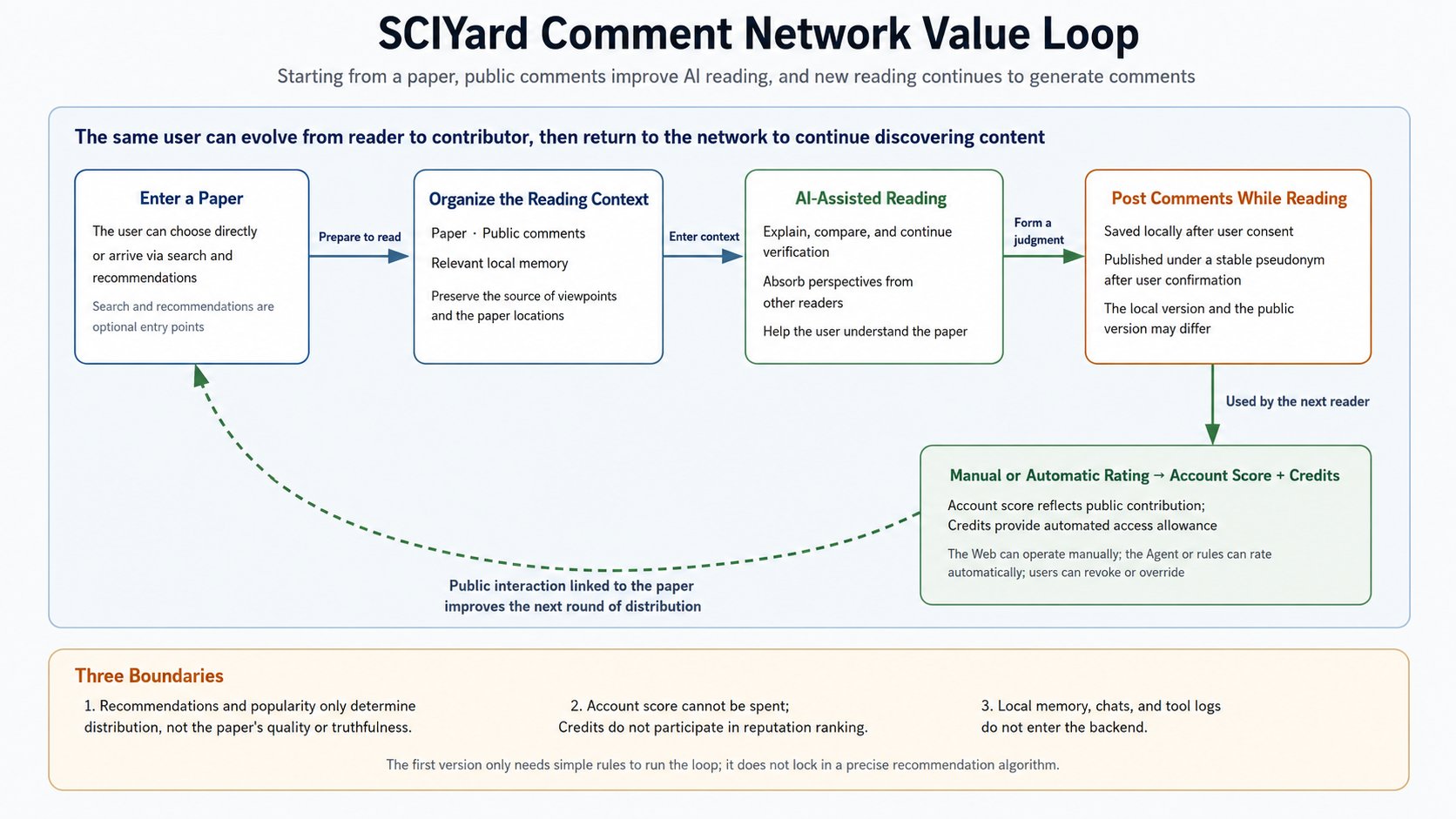
sciyard product loop
-
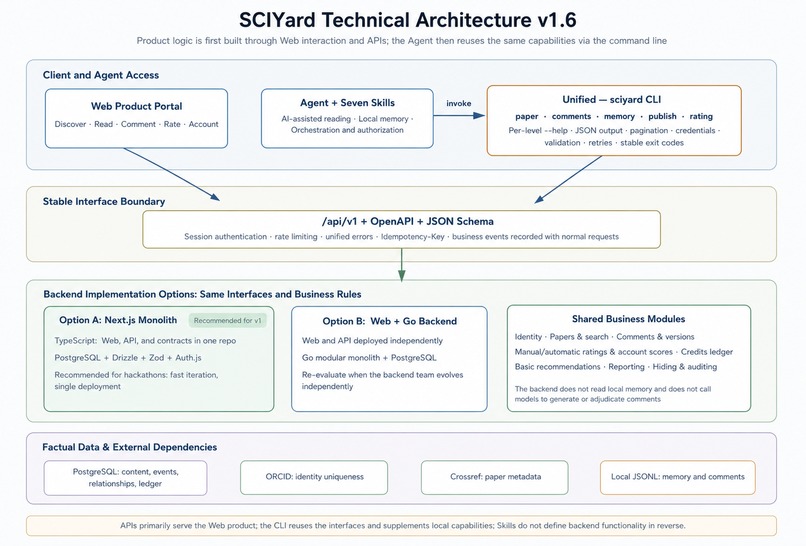
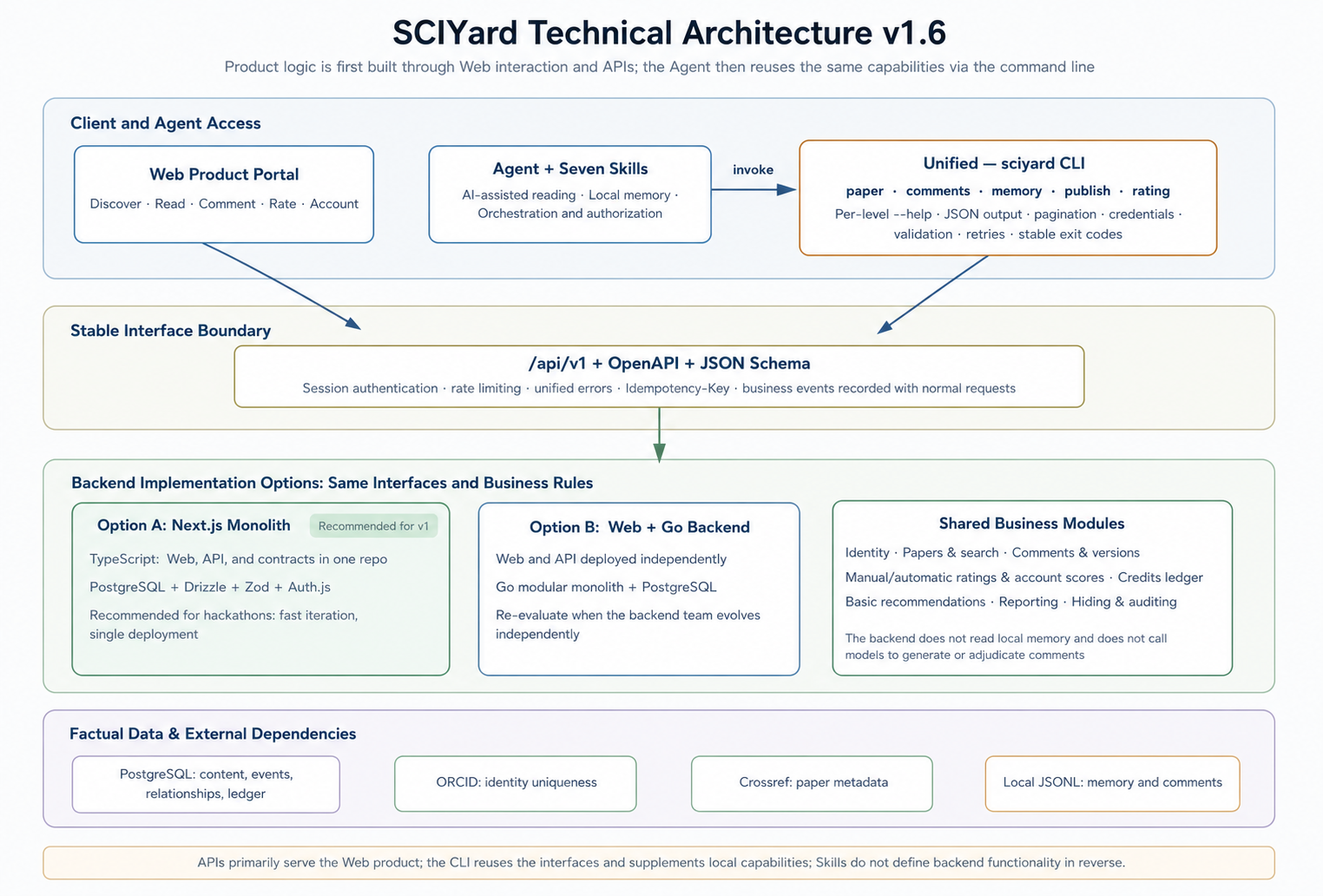
sciyard technical architecture
Inspiration
A paper does not stop mattering when it is published, but most research discussion still disappears into private notes, lab chats, and one-off reviews. Researchers told us they need practical answers: What is the core idea? What is genuinely new? Which module actually matters? Is the code reproducible? Are the comparisons fair? What failed for other people?
SciYard turns those scattered judgments into durable, traceable research context.
What it does
SciYard is an agent-native research commons with two connected experiences:
- A paper discussion web app for public comments, usefulness ratings, reports, paper discovery, and recommendations.
- A Codex plugin with seven coordinated skills for onboarding, reading, private memory, distillation, publishing, and rating.
A researcher can open a paper in Codex, retrieve only the community context relevant to the current question, combine it with private local notes, and prepare a structured public comment. Publishing is deliberately safe: SciYard shows an exact preview and requires explicit, hash-bound confirmation before a write can occur.
The working demo includes 15 AI papers, 60 synthetic users, 100 structured comments, roughly 2,000 usefulness ratings, deterministic invitation-based judge access, and ORCID OAuth support for real researcher identity.
How we built it
The repository is a complete vertical product rather than a prompt-only prototype:
- A Next.js 16 + React 19 web experience.
- A Node.js API and PostgreSQL/Drizzle data layer.
- A contract-first OpenAPI + JSON Schema interface shared by Web and Agent clients.
- A deterministic Node CLI behind the Codex skills, so model reasoning never bypasses authorization, validation, idempotency, or publication confirmation.
- Secure agent sessions using macOS Keychain or Windows DPAPI, plus ORCID OAuth with PKCE.
- A one-command local demo that installs dependencies, starts an embedded PostgreSQL runtime, migrates and seeds the database, builds the app, and launches the complete stack without Docker.
How we used Codex and GPT-5.6
Codex with GPT-5.6 was the primary engineering environment for the project. We used it to move from researcher interviews and product requirements to executable contracts, implement complete feature slices across the plugin, frontend, backend, database, and tests, and repeatedly audit the result against security and interaction requirements.
GPT-5.6 is also the reasoning layer of the SciYard plugin experience: it interprets a researcher's current intent, decides which narrow context to retrieve, synthesizes private notes with public evidence, and prepares readable drafts. Deterministic tools retain control of identity, API calls, local memory, validation, and final publication.
Challenges
The hardest part was making an agentic experience trustworthy. A research assistant must be helpful without silently publishing, leaking local memory, inventing community consensus, or confusing browser and agent credentials. We separated reasoning from effects, made every public write explicit and idempotent, kept private memory local, and used the same domain API for both the Web and Codex interfaces.
A second challenge was judgeability. SciYard has several moving parts, so we built deterministic seed data and a single local startup command to make the full research loop reproducible.
Accomplishments
- A working end-to-end Web + Codex research workflow.
- Seven composable skills backed by tested deterministic tools.
- Public comments, usefulness ratings, recommendations, reporting, credits, local memory, and safe publish/update flows.
- Unified ORCID and invitation identity across browser and agent clients.
- Cross-platform secure session persistence.
- A documented, testable demo with synthetic data and no external database setup.
What we learned
Good research software needs more than summaries. The useful unit is a traceable judgment tied to a paper, evidence, and a specific researcher question. We also learned that agent autonomy becomes more useful—not less—when the boundary around irreversible actions is explicit and mechanically enforced.
What's next
Next we will add stronger full-text evidence links, code and dataset availability signals, structured reproducibility reports, verified researcher profiles, and production deployment. The long-term goal is a living layer of post-publication knowledge where every paper has an afterlife.
Built With
- codex
- drizzle-orm
- gpt-5.6
- json-schema
- next.js
- node.js
- openapi
- orcid-oauth-2.0
- postgresql
- react
- typescript
- vitest


Log in or sign up for Devpost to join the conversation.