-
-
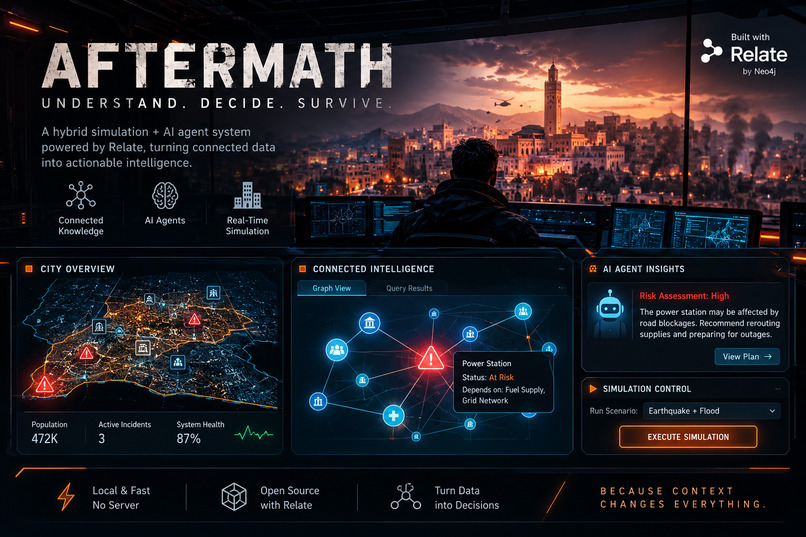
AFTERMATH: A cinematic vision of connected intelligence, AI agents and simulations transforming urban crisis data into actionable decisions.
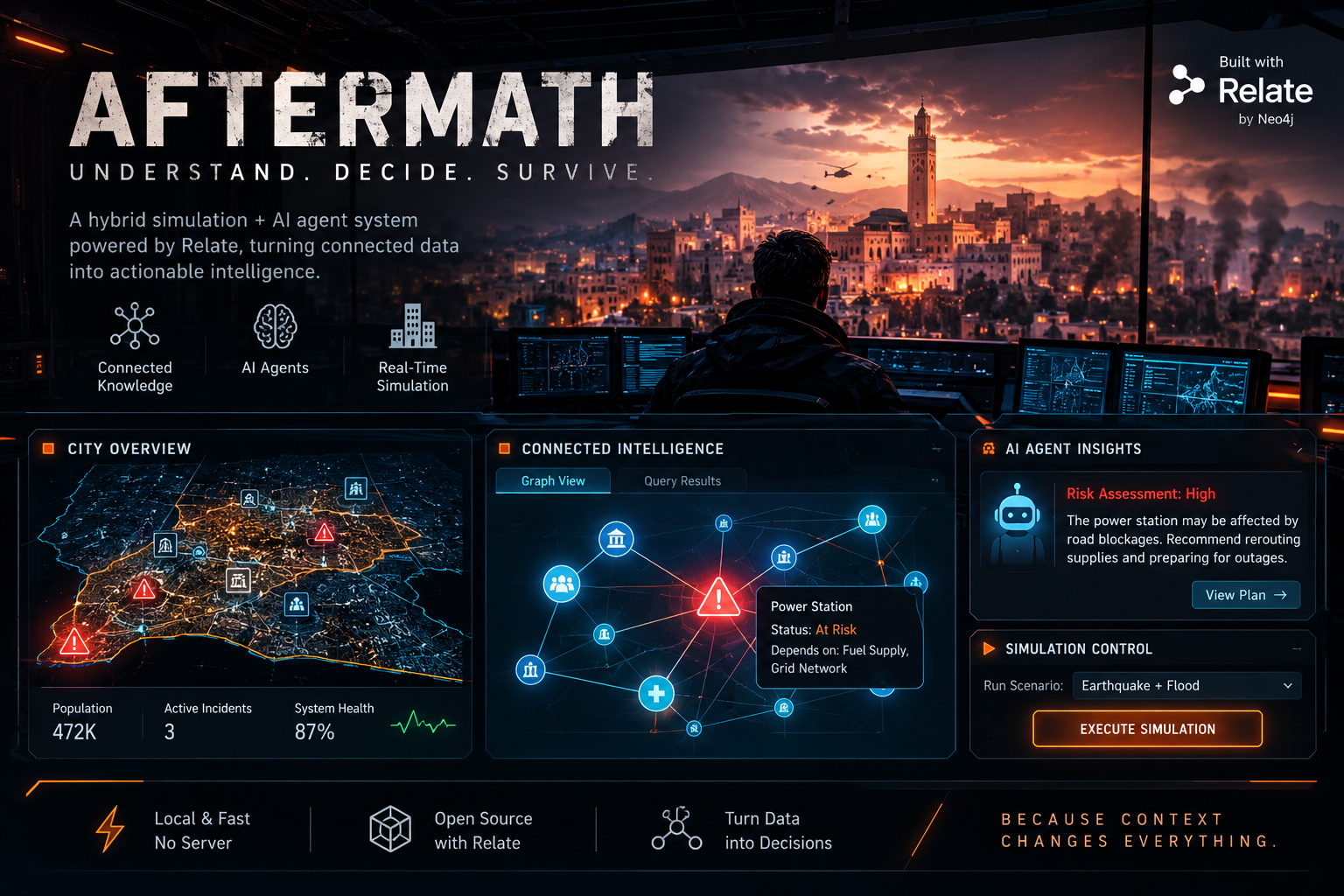
AFTERMATH
One incident. A thousand consequences.
A bridge closes. A hospital loses access. Emergency supplies are delayed. Entire neighborhoods become harder to reach.
The most dangerous consequences of an urban incident are often not the immediate ones. They emerge through chains of dependencies that are difficult to see, understand, and anticipate.
AFTERMATH is an AI-powered urban resilience engine that models cascading infrastructure failures, explores their indirect consequences, and evaluates possible response strategies before they happen.
Instead of treating infrastructure as a collection of isolated assets, AFTERMATH represents a city as an interconnected knowledge graph. Roads, bridges, hospitals, power stations, water facilities, emergency depots, and neighborhoods are connected through physical and operational dependencies.
Powered by Relate, this graph becomes the foundation for understanding how one incident can propagate across an entire urban system.
The inspiration
We wanted to explore a simple but important question:
What if decision-makers could understand the consequences of a disaster before those consequences unfold?
Urban infrastructure is deeply interconnected. A flooded road may seem like a local problem, but its indirect effects can include reduced hospital accessibility, disrupted emergency logistics, and increased exposure for vulnerable neighborhoods.
Traditional dashboards often show what is happening. AFTERMATH aims to reveal what could happen next.
How it works
AFTERMATH combines graph-based reasoning, deterministic simulation, and specialized AI agents.
1. Model the city with Relate
We represent infrastructure and urban dependencies as a persistent graph. Relate allows us to explore relationships, trace multi-hop dependencies, and identify assets and communities potentially affected by an incident.
2. Detect cascading consequences
When an incident occurs, the system explores the graph to identify direct and indirect impacts. It distinguishes physical connectivity from operational dependencies, helping uncover consequences that would otherwise remain hidden.
3. Simulate alternative futures
Our deterministic simulation engine evaluates different intervention strategies. Rather than generating speculative recommendations, it calculates scenario outcomes using explicit parameters such as asset criticality, propagation factors, redundancy, accessibility, and service exposure.
4. Coordinate AI agents
Specialized agents support incident analysis, graph exploration, scenario interpretation, and verification. The agents explain the results and help decision-makers understand the reasoning behind them. The simulation engine remains the source of truth for quantitative outcomes.
5. Compare interventions
AFTERMATH evaluates alternative responses and presents their trade-offs, potential benefits, and affected infrastructure. Decision-makers can compare scenarios instead of relying on a single recommendation.
The demonstration
Our prototype uses a fictional Moroccan-inspired city, Madinat Al Amal, with a synthetic urban infrastructure network.
In our demonstration, severe rainfall causes a major bridge to become impassable.
AFTERMATH traces the resulting dependencies, identifies potentially affected hospitals and neighborhoods, and evaluates alternative interventions, such as emergency access redirection and temporary supply points.
The goal is to demonstrate how graph intelligence can turn an isolated incident into an understandable picture of cascading urban consequences.
All demonstration infrastructure and impact data are synthetic. Simulated outcomes are exploratory scenarios, not real-world predictions.
Why Relate?
Relate is not simply a database behind a chatbot. It is the foundation of AFTERMATH's understanding of the city.
The graph allows the system to preserve relationships between infrastructure assets, incidents, dependencies, evidence, interventions, and simulation results.
This connected context makes multi-hop reasoning and impact tracing possible, while maintaining a transparent path between an incident and its potential consequences.
What we are learning
Building AFTERMATH is an exploration of how graph databases, simulation systems, and AI agents can work together without confusing generated explanations with verified results.
One of our central design decisions is to keep quantitative simulation deterministic while using LLM-powered agents for interpretation and coordination.
We are also exploring how to represent uncertainty, distinguish direct impacts from indirect possibilities, and make complex infrastructure dependencies understandable through an interactive interface.
Challenges and next steps
The main challenge is balancing realism, explainability, and computational simplicity.
A graph can reveal relationships, but not every relationship has the same operational significance. A simulation can estimate potential consequences, but its assumptions must remain visible. And an AI agent should never invent an impact simply because it sounds plausible.
Our approach is to make assumptions explicit, preserve evidence and provenance, and keep simulation results reproducible.
AFTERMATH is built around one conviction: understanding how systems fail is the first step toward making them more resilient.
One incident. A thousand consequences. Before they happen.
Built With
- ai-agents
- artificial-intelligence
- cytoscape.js
- data-visualization
- decision
- fastapi
- graph-algorithms
- graph-databases
- knowledge-graphs
- llms
- maplibre
- multi-agent-systems
- neo4j
- next.js
- python
- react
- relate
- simulation
- typescript
- urban-resilience
