-
Concept Art
Inspiration
I've always been drawn to games that combine exploration, survival, and meaningful player choices. I wanted to create a survival experience that captured the feeling of venturing into the unknown, bringing home hard-earned resources, and slowly building something worth protecting.
The idea for Afterlight Salvage came from my interest in engineering, modular systems, and the concept of people surviving among the ruins of a fallen civilization. Rather than surviving in a traditional wilderness, players survive in the skies, exploring abandoned floating structures while maintaining a small airborne settlement that gradually becomes their home.
I also wanted to design something that would work especially well on Meta Horizon Worlds and on mobile devices. That meant focusing on cooperation, short play sessions, clear interactions, and social experiences rather than complex controls or traditional combat.
What it does
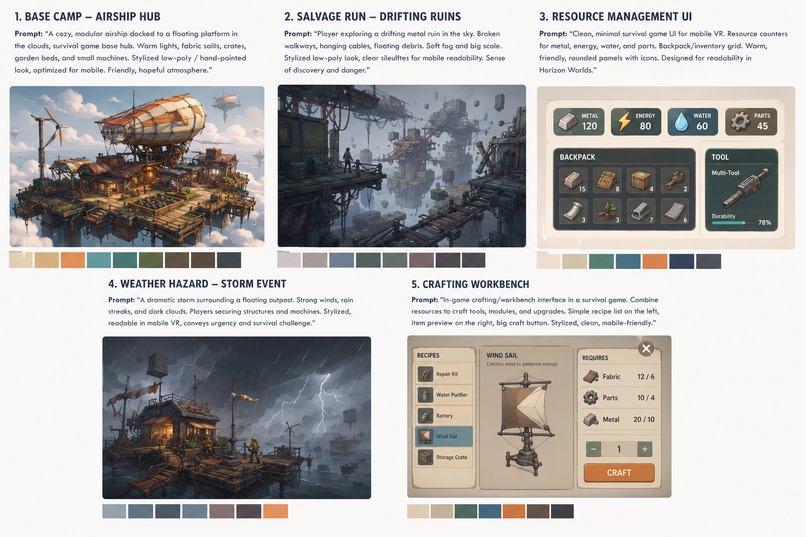
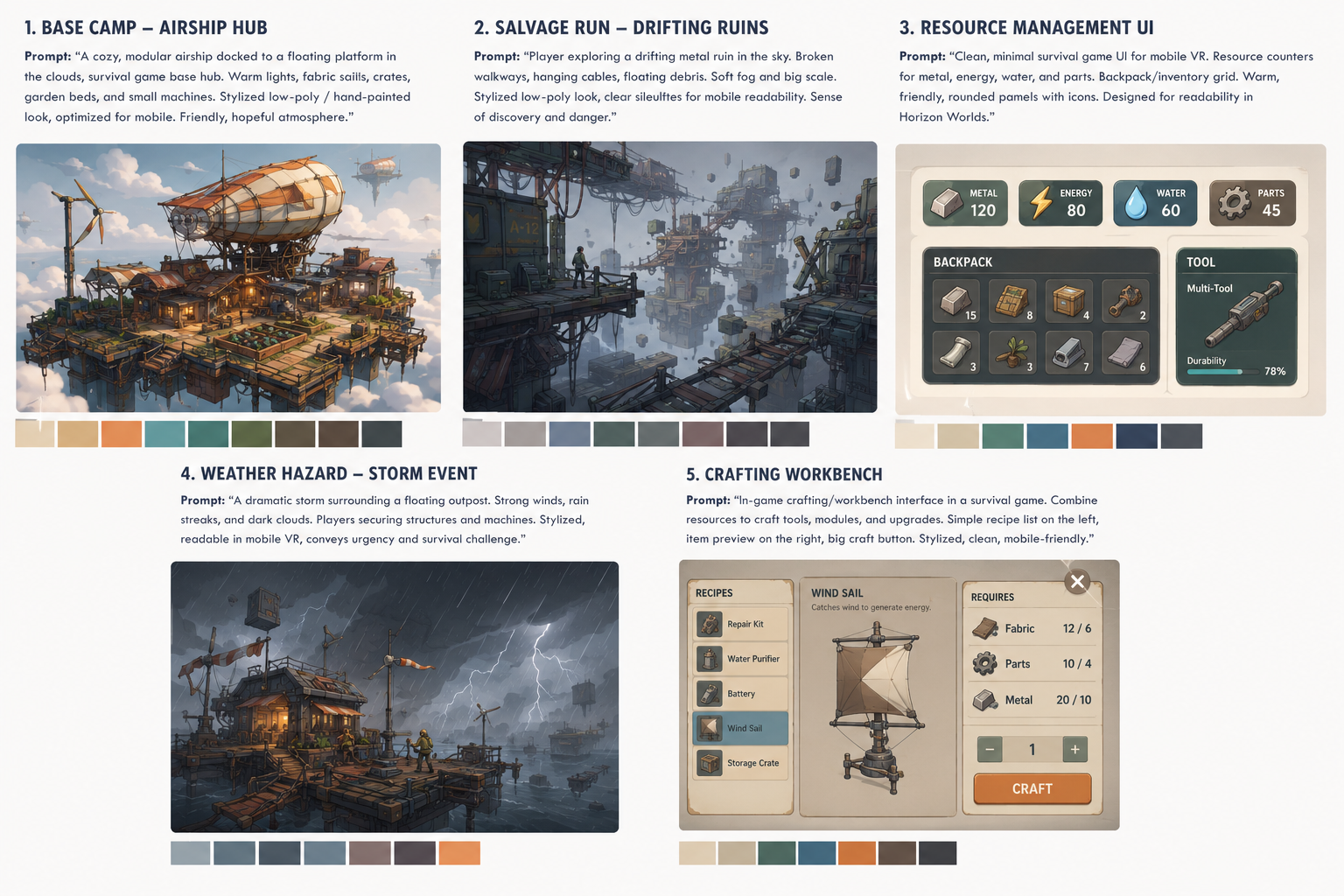
Afterlight Salvage is a cooperative survival and resource management game set among drifting ruins high above the clouds.
Players begin with a small floating outpost and must work together to keep it operational. They venture out on salvage expeditions to abandoned sky ruins, gathering metal, parts, energy cells, water, and other valuable resources.
Resources brought back to the settlement can be used to:
- Expand and upgrade the home platform
- Craft tools and utility structures
- Improve storage and efficiency
- Prepare for increasingly dangerous weather events
- Unlock access to new regions and salvage opportunities
Every expedition presents a tradeoff: push deeper into the ruins for greater rewards, or return home safely before storms, failing equipment, and dwindling supplies force a difficult decision.
How we built it
The project was designed specifically around the strengths and limitations of Meta Horizon Worlds.
Rather than relying on complex physics simulations, the design focuses on:
- Cooperative exploration
- Resource gathering loops
- Environmental hazards
- State-based world systems
- Simple, mobile-friendly interactions
The game was developed through an iterative design process beginning with core gameplay pillars, player journey mapping, and paper prototyping. Systems were then expanded into progression loops, economy balancing, and production planning.
Special attention was given to keeping interactions readable and accessible across VR and mobile devices while still providing meaningful strategic decisions and long-term progression.
Challenges we ran into
One of the biggest challenges was designing a survival experience that feels deep while remaining approachable on mobile devices.
Meta Horizon Worlds also places important constraints on performance, interaction complexity, and session length. Because of this, many traditional survival mechanics had to be simplified or reimagined.
Another challenge was creating meaningful resource management without overwhelming players with excessive menus or micromanagement. The final design focuses on a small number of interconnected systems that create interesting choices while remaining easy to understand.
Balancing risk versus reward during expeditions was another major design challenge, since this tension forms the core of the player experience.
Accomplishments that we're proud of
We're especially proud of creating a survival concept that feels both social and optimistic.
Instead of focusing on isolation, Afterlight Salvage is about cooperation, rebuilding, and creating a home together.
Other accomplishments include:
- Designing a survival loop tailored specifically for Meta Horizon Worlds
- Creating a mobile-friendly cooperative experience
- Building a progression system centered around meaningful player choices
- Developing a visual direction that feels distinctive while remaining achievable for a small team
What we learned
Working on Afterlight Salvage reinforced how important platform-focused design is.
Rather than trying to force traditional survival mechanics into Horizon Worlds, we learned that embracing the platform's strengths, social play, accessibility, and short session lengths, resulted in a stronger overall experience.
We also learned that limitations can often lead to better design decisions. Simplifying systems forced us to focus on what truly makes survival games compelling: exploration, risk, cooperation, and the satisfaction of slowly building something meaningful.
What's next for Afterlight Salvage
The next step is to move from pre-production into playable prototyping.
Initial development would focus on:
- Building the core expedition loop
- Implementing resource gathering and return mechanics
- Creating the home settlement upgrade system
- Testing cooperative gameplay with players
- Iterating on progression and balance
Longer term, we would like to expand the game with:
- Additional biomes and floating regions
- Dynamic weather systems
- Seasonal events
- Expanded settlement customization
- Community-driven challenges and cooperative objectives
Our goal is to create a social survival experience that players can return to regularly with friends as they continue to grow and protect their home in the skies.


Log in or sign up for Devpost to join the conversation.