AFTERLIFE — Your Life, Handled Quietly
Inspiration
Life is full of small administrative tasks that appear after important events. Moving to a new home can mean updating documents, changing services, organizing records, managing deadlines, scheduling appointments, and communicating with different people. The difficult part is not completing one task—it is realizing everything that the original event caused.
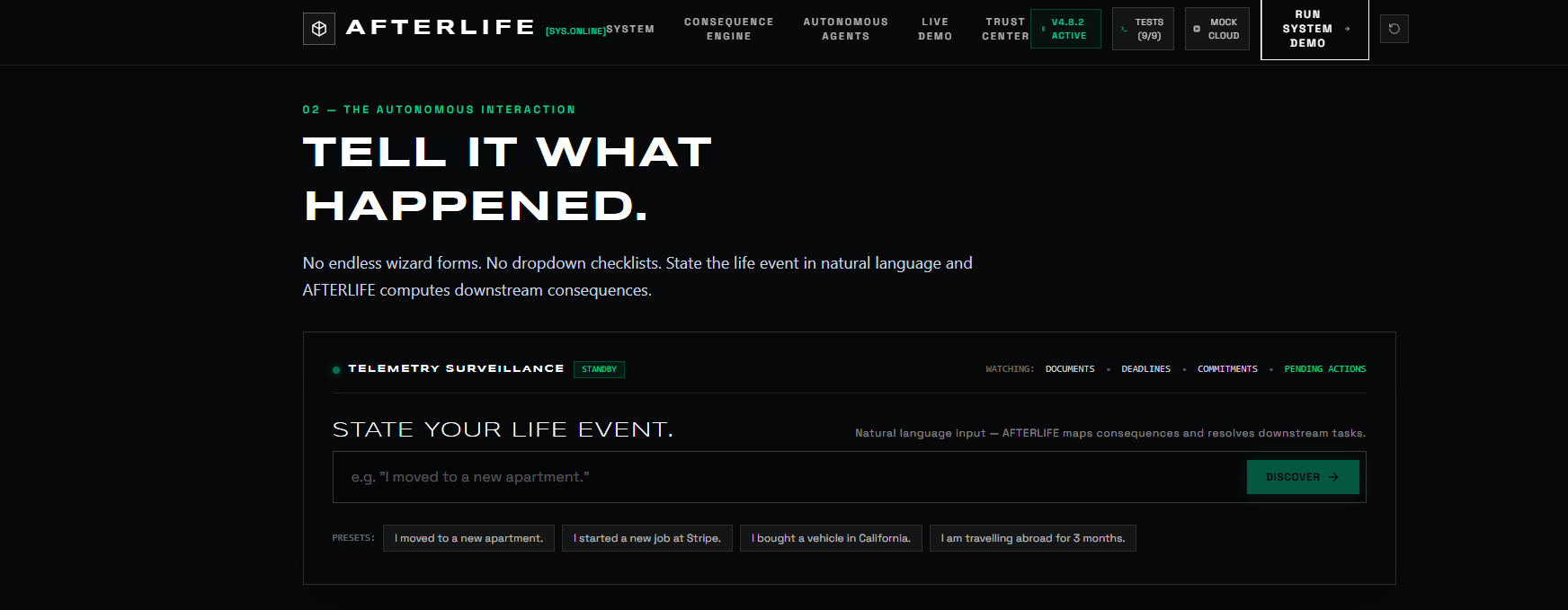
We wanted to build an AI agent that could understand this problem differently. Instead of waiting for users to give it a long checklist, AFTERLIFE starts with what happened and figures out what needs to happen next.
The core idea is simple:
EVENT → CONSEQUENCES → ACTIONS → VERIFICATION → DECISION
For example, a user can say, “I moved to a new apartment.” AFTERLIFE identifies the consequences of that event, creates the required actions, handles safe repetitive work autonomously, verifies completed actions, and interrupts the user only when their judgment or approval is genuinely required.
What We Built
AFTERLIFE is an autonomous life-administration agent designed to work quietly in the background.
Its Consequence Engine is the central idea. Rather than treating a request as an isolated task, the agent creates a consequence graph that connects an event to the actions, deadlines, dependencies, and decisions that follow from it.
The system is organized around specialized agents:
- Orchestrator Agent — coordinates the complete workflow.
- Context Agent — understands the user's available information and situation.
- Consequence Agent — discovers what the event may trigger.
- Document Agent — extracts and organizes relevant information.
- Planning Agent — converts consequences into actionable tasks.
- Action Agent — performs safe, repetitive operations.
- Decision Agent — identifies situations requiring human judgment.
- Verification Agent — checks whether actions actually succeeded.
The agent follows a continuous loop:
UNDERSTAND → DISCOVER → PLAN → EXECUTE → VERIFY → ESCALATE
AFTERLIFE does not try to automate everything blindly. Actions are separated into safe autonomous operations, approval-required operations, and blocked operations when information or authorization is missing. This keeps the human in control while still allowing the agent to remove repetitive work.
How We Built It
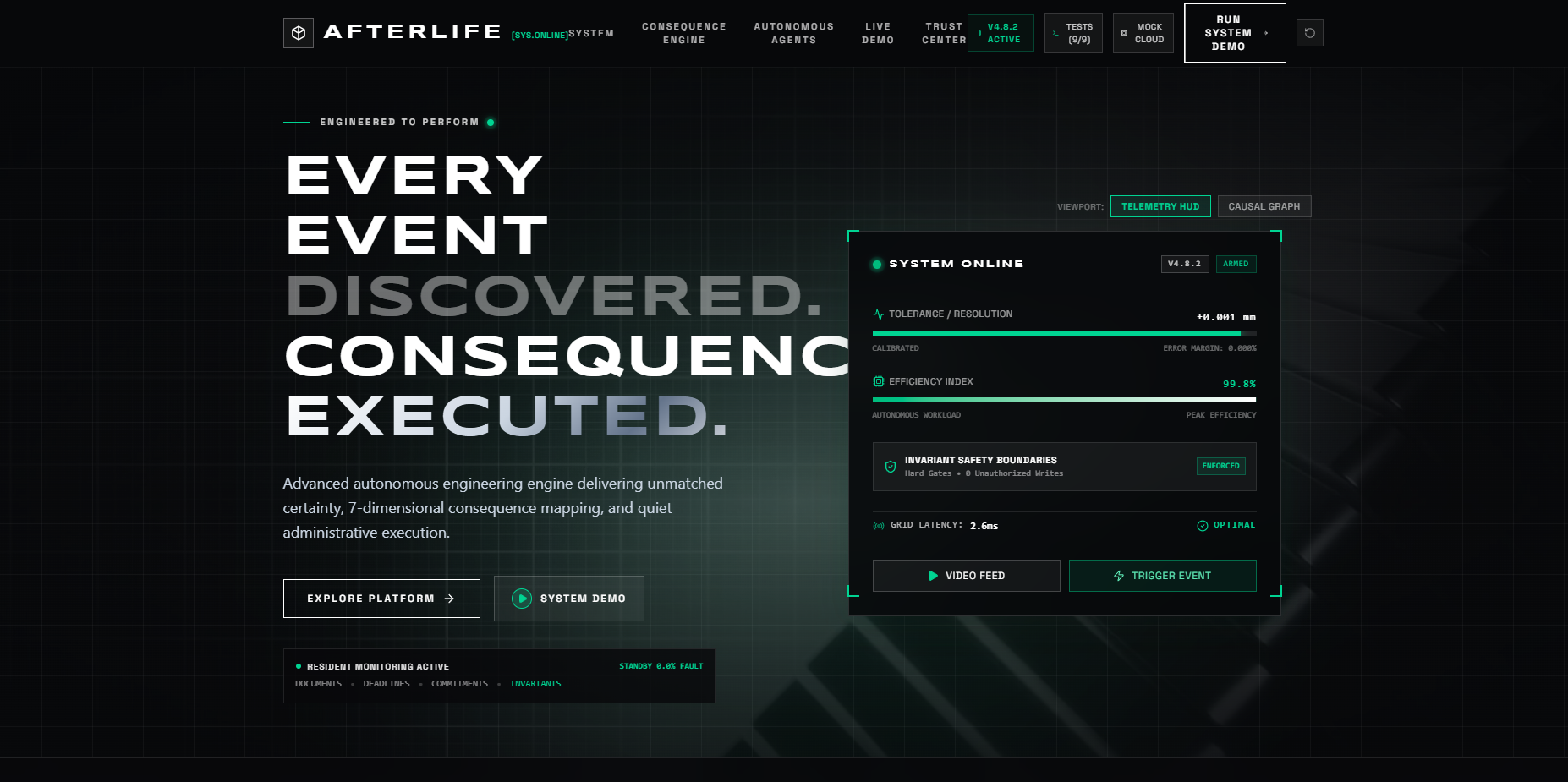
The application combines an immersive frontend with an agent-driven backend. The frontend is built with Next.js, React, TypeScript, Tailwind CSS, and Framer Motion, creating a cinematic interface where users can see events, consequences, tasks, decisions, execution status, and verification results.
The backend uses Python, FastAPI, SQLite, and the Strands Agents SDK to coordinate the agent architecture and persistent state.
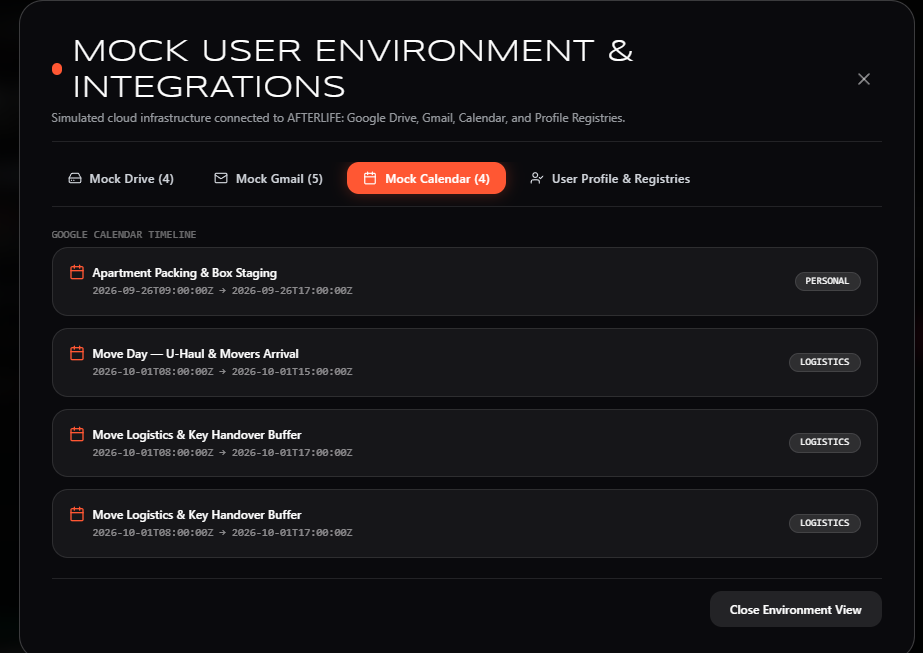
We also designed simulated integrations for documents, tasks, calendar, communication, user context, approvals, and verification so the complete autonomous workflow can be demonstrated safely and deterministically.
A persistent execution state allows AFTERLIFE to continue from partial completion instead of treating every interaction as a completely new conversation.
What We Learned
The biggest lesson was that building an autonomous agent is not simply about giving an LLM more tools. The difficult part is designing when the agent should act, when it should ask, and when it should stop.
We learned to treat autonomy as a controlled system rather than unrestricted automation. The agent needs context, clear action boundaries, verification, persistent state, and human approval at the right points.
We also learned that a good agent should not merely produce an answer. It should be able to take responsibility for a workflow, track what it has done, understand what remains, and recover when something fails.
Challenges
One of our biggest challenges was designing the Consequence Engine. A single life event can produce many indirect consequences, and not every possible consequence should become an action. We needed the system to distinguish useful actions from unnecessary ones.
Another challenge was creating reliable human-in-the-loop boundaries. Some operations can safely happen automatically, while others involve communication, commitments, sensitive information, or meaningful decisions. AFTERLIFE therefore uses approval gates instead of assuming that maximum automation is always better.
We also had to handle failures and partial execution. Real-world workflows do not always complete successfully, so the system was designed to retry safe operations, continue independent tasks, record results, and surface problems that genuinely require human attention.
Why AFTERLIFE Is Different
Most assistants are request-driven: the user asks for something, and the AI responds.
AFTERLIFE is event-driven.
The user does not need to know every task that follows an event. They simply tell the agent what happened. AFTERLIFE reasons about the consequences, creates the workflow, executes what it safely can, verifies the results, and brings the human back into the loop only when their decision matters.
You live the event. AFTERLIFE handles the aftermath.
Built With
- agentic
- agents
- ai
- amazon-web-services
- automation
- autonomous
- context-aware
- css
- fastapi
- framer
- generative
- human-in-the-loop
- large
- motion
- multi-agent
- next.js
- python
- react
- sdk
- sqlite
- strands
- systems
- tailwind
- typescript
- workflow

Log in or sign up for Devpost to join the conversation.