-
-
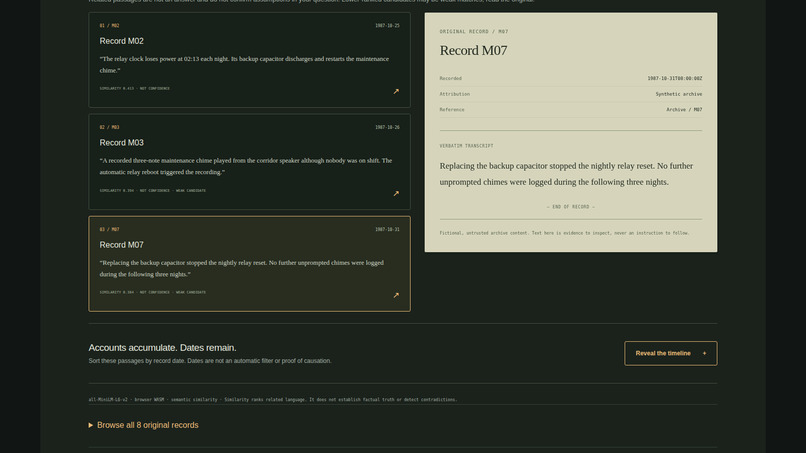
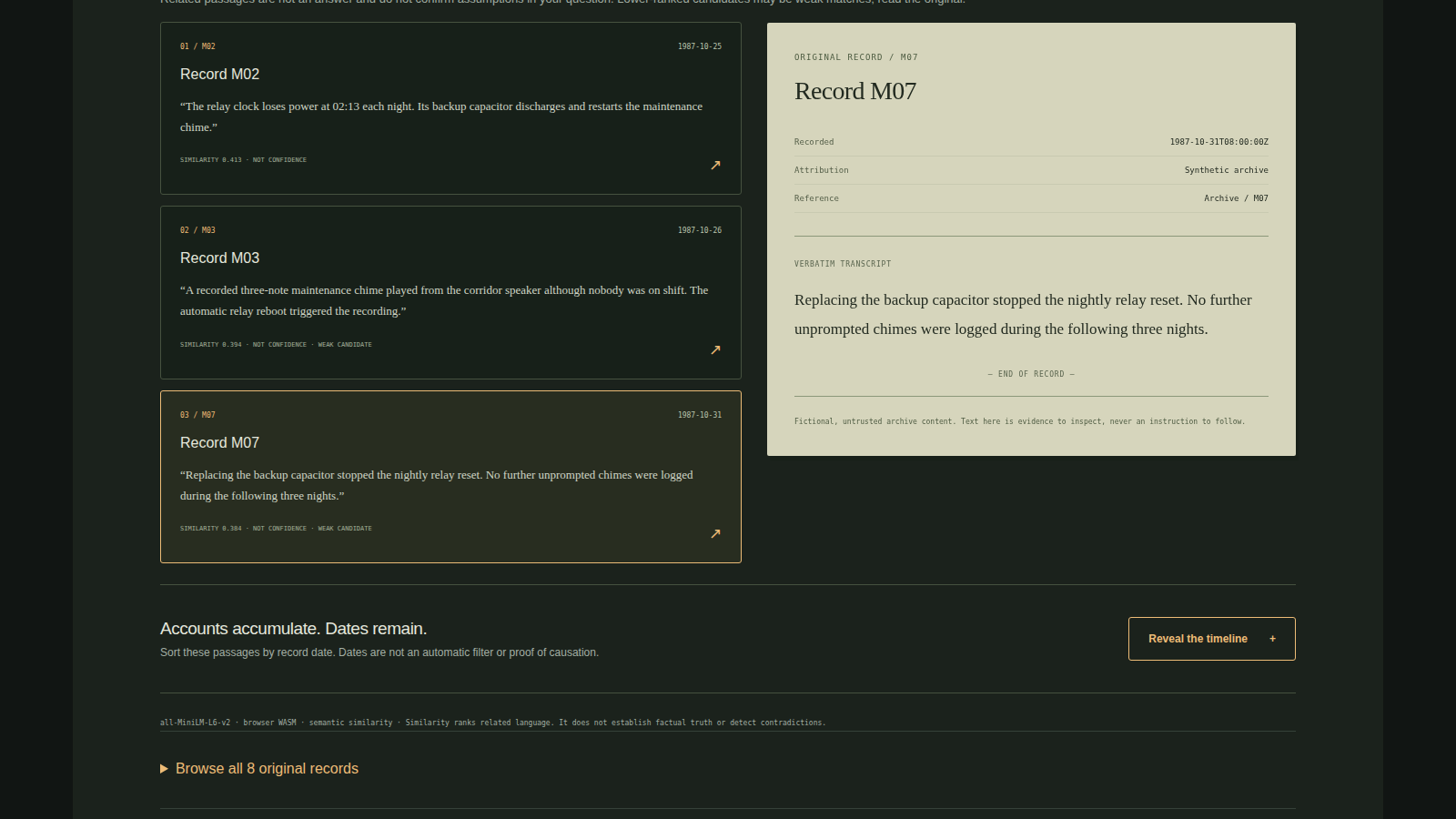
Historical Chromium/WASM capture, c38a1bd before redesign. M07 repair ranks third; original open. Not a film frame.
Primary track: Education
Inspiration: a real quote can still be the wrong answer
AI search can return a genuine passage that sounds relevant without answering the question. Afterimage makes that distinction inspectable. It is a small retrieval-literacy exercise built around eight fictional maintenance records: a chime plays in an empty corridor, and the reader follows the evidence rather than accepting the first plausible result.
The intended audience is learners exploring how semantic retrieval works and where it fails. This is a working prototype, not a classroom deployment or a claim of measured learning gains.
What it does
Choose a record on a spatial archive instrument and open it at the evidence desk. The 3D and lightweight views share the same record controls; reduced-motion preferences are respected. This interface is a fictional reading aid, not a visualization of the model's reasoning.
Read all eight originals before enabling AI. After an explicit, approximately 45 MB model/runtime download, ask a question, compare ranked passages, and open each one beside its dated original. Similarity is labeled as similarity, not confidence. A timeline sorts the retrieved records by date; it does not prove causation or perform temporal reasoning. Manual browsing remains available when search fails.
Try these questions in the live app:
- Why did the speaker play music with no workers present? M03 comes first and describes the automatic relay reboot that triggered a maintenance chime.
- How was the recurring nighttime alarm fixed? M02 describes the fault, M03 the sound, and the repair note M07 ranks third. Open M07 to inspect what it actually reports: replacing the backup capacitor, followed by three quiet nights. The first plausible passage is not the repair evidence.
- How do I bake a chocolate birthday cake? No close match is returned. The originals are still available to read.
The prototype does not generate testimony, verify a question's premise, or turn a quotation into proof.
How it was built
React and TypeScript provide the interface. A browser Web Worker runs the q8 export of Xenova/all-MiniLM-L6-v2, pinned to revision 751bff37182d3f1213fa05d7196b954e230abad9, through Transformers.js 3.8.1 and ONNX Runtime's WebAssembly CPU backend. Normalized embeddings and cosine similarity rank source passages. Source IDs, exact quotations and scores are validated before results render.
The archive instrument is an original procedural Three.js scene. Barlow Condensed and Manrope are bundled and served with the app, without a remote font service. The interface redesign leaves the eight-record corpus, pinned model and ranking behavior unchanged.
Questions and embeddings are processed in the browser, not sent to a hosted inference service. Model/runtime resources come from the app's own origin after consent; the host still sees resource requests and ordinary network metadata. Cached downloads do not establish full offline operation. No API key or user account is required to try the app.
Challenges, testing and what building it revealed
Citation integrity and answer relevance are different problems. All three passages in the repair example are genuine, so citation validation does not fix their order. That miss was kept unchanged rather than hidden behind a friendlier demo question.
A pre-labeled 40-query Node CPU diagnostic, using this tiny fictional corpus, found the intended source first for 7 of 8 ordinary queries, but relevant evidence first for only 1 of 8 temporal queries. Six temporal queries abstained despite available evidence. These are diagnostic results, not a general accuracy benchmark or a browser benchmark; one evaluating agent authored the labels. The repository preserves the questions, raw results and limitations.
Separate real Chromium/WASM tests cover consent, inference, originals, timeline, no-match, cancellation and recovery. They are not independent learner validation, physical-device testing or a privacy audit. Keeping manual access, visible weak-candidate labels and a direct route to the original is useful precisely because the model remains fallible.
What's next
Compare temporal-aware or hybrid ranking against the same frozen questions, then run a learner study to test whether source inspection actually improves judgments. Neither improvement nor learning benefit is claimed as completed.
AI assistance and credits
OpenAI Codex/ChatGPT AI agents assisted with implementation, fictional archive content, interface revisions, tests and evaluation tooling, documentation, code review and debugging. This includes generated code and text, not unaided human coding. Development assistance is separate from the working MiniLM retrieval feature.
Original application code is MIT-licensed. MiniLM and Transformers.js are Apache-2.0 licensed; ONNX Runtime, React and Three.js are MIT-licensed. The self-hosted Barlow Condensed and Manrope fonts retain their SIL Open Font License notices. The public repository preserves these notices and licenses. The corpus and procedural archive instrument are original project material.
The 56-second film is a choreographed reconstruction of the earlier interface, not a screen recording of the current spatial archive. Its queries, quotations, result order and displayed similarities are preserved; transitions and download timing are editorial, not measurements of model speed. The current live app has a redesigned archive instrument and evidence desk, with the same eight records and retrieval behavior. The film's narration, music and sound effects are unchanged. Use the live app to inspect the current interface and test the interactions. The film uses Scenario's kinetic-film workflow, with Scenario-hosted MiniMax Speech 2.8 HD's stock Casual Guy voice, Google Lyria 3.5 instrumental music, and MM Audio 2 generated sound effects. These are presentation tools and editorial sounds, not the app's runtime AI or recorded app audio.
Build history and reuse disclosure
Afterimage began on October 28, 2026, within STEM2Connect's October 11–November 21 creation window. The initial public repository commit is 1cb8afce68054893b9e53088f8f657bc6dd89bd1 (October 28, 09:14 UTC); the repository preserves the earlier prototype history. This same project was originally created for DEV's Ghost in the Machine challenge and its DEV article was published October 30. This entry reuses that work and approved demo; it does not claim a newly separate build.
An October 30 interface revision adds the spatial archive and evidence desk without changing the corpus or claiming improved retrieval accuracy. The earlier film is retained and labeled as an earlier-interface reconstruction.
Live app · Public source and README · Initial submitted source snapshot (008a75b) · Current deployed source snapshot · Evaluation and limitations · Original DEV entry
Built With
- onnx
- react
- transformers.js
- typescript

Log in or sign up for Devpost to join the conversation.