-
-
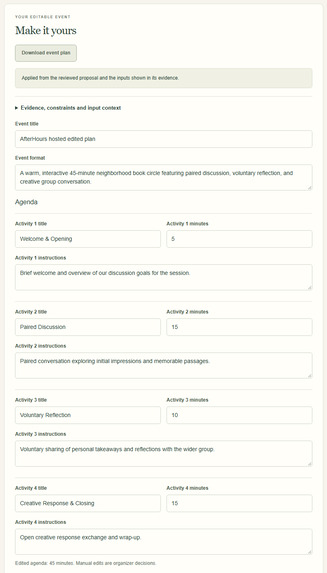
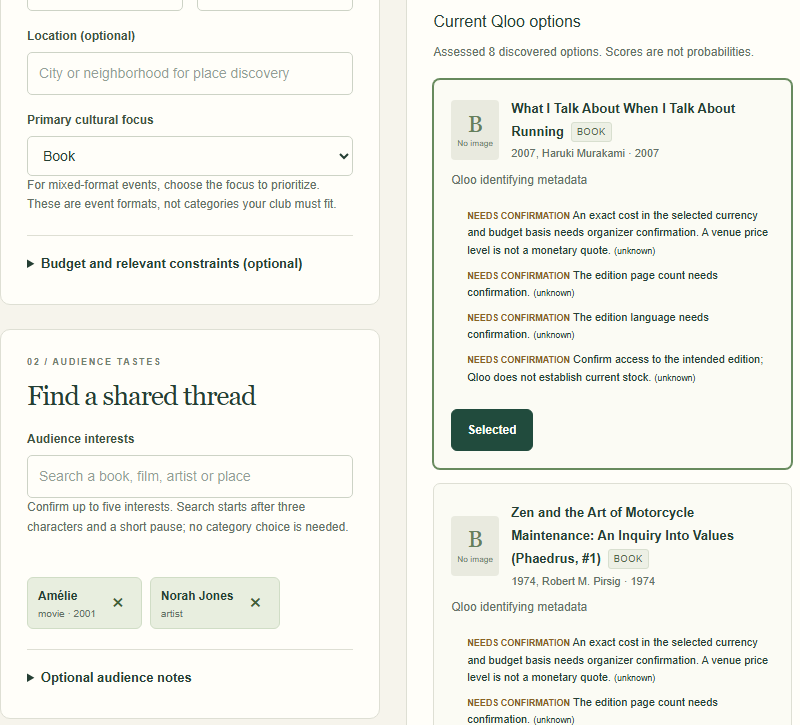
Confirmed Amélie and Norah Jones interests lead to eight Qloo-assessed book options. Real public-run crop.
-
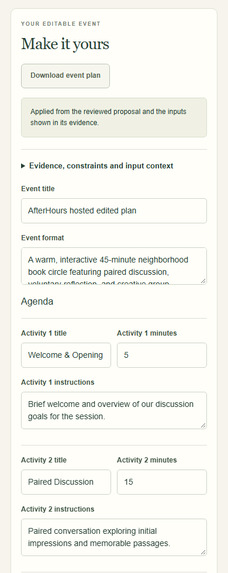
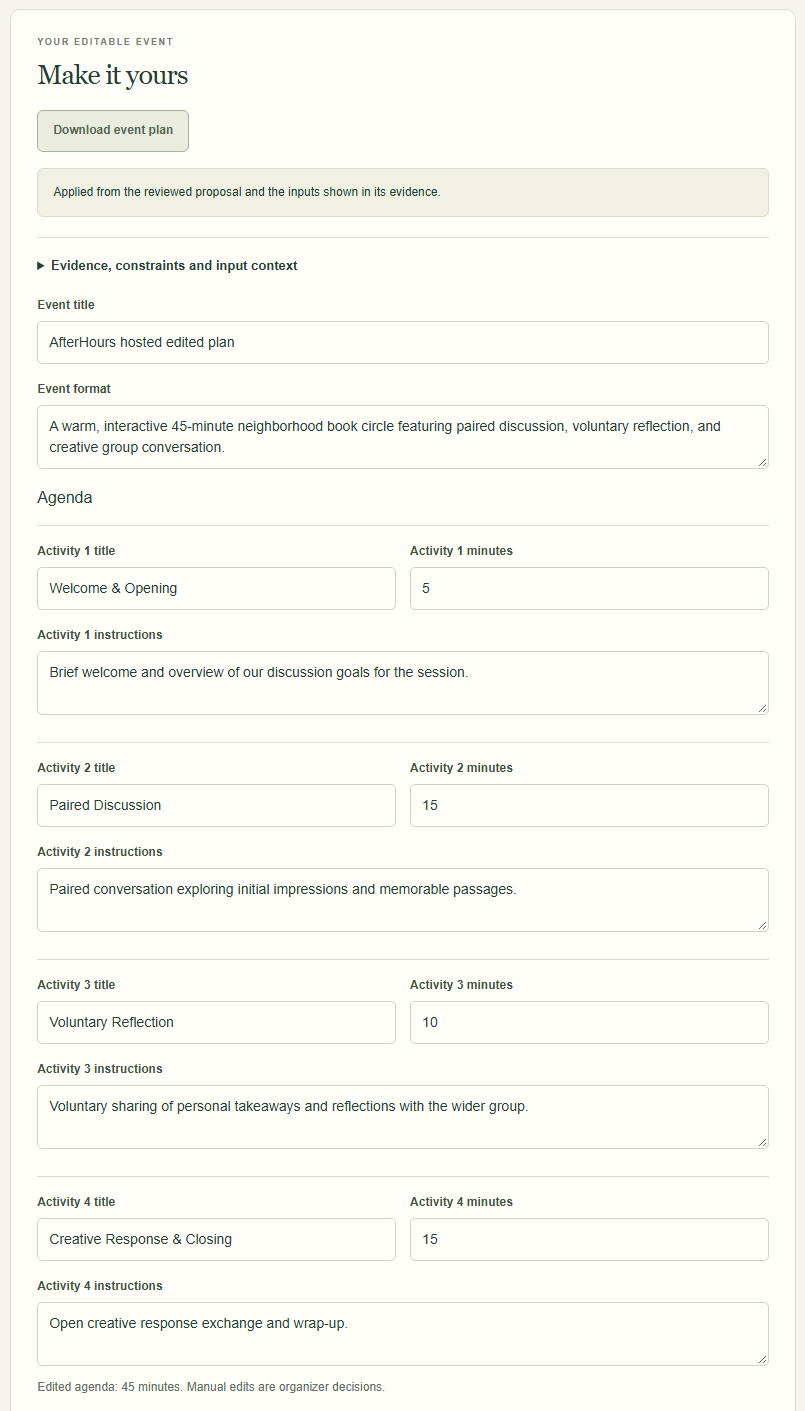
Applied 45-minute book plan with editable activities and Markdown download. Crop from the same real public run.
-
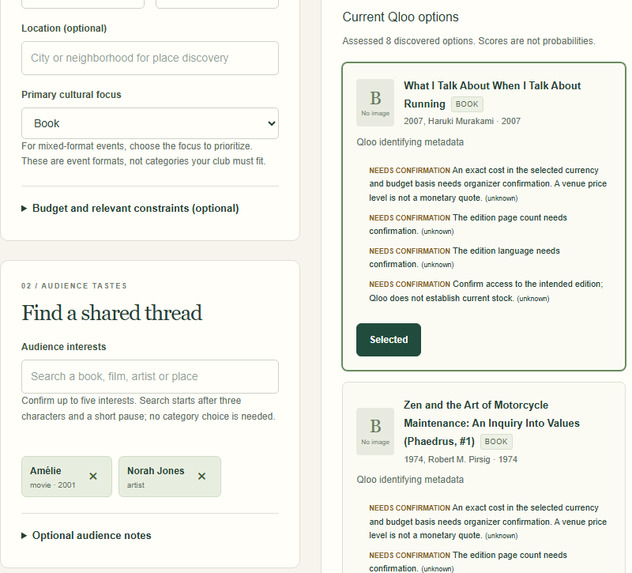
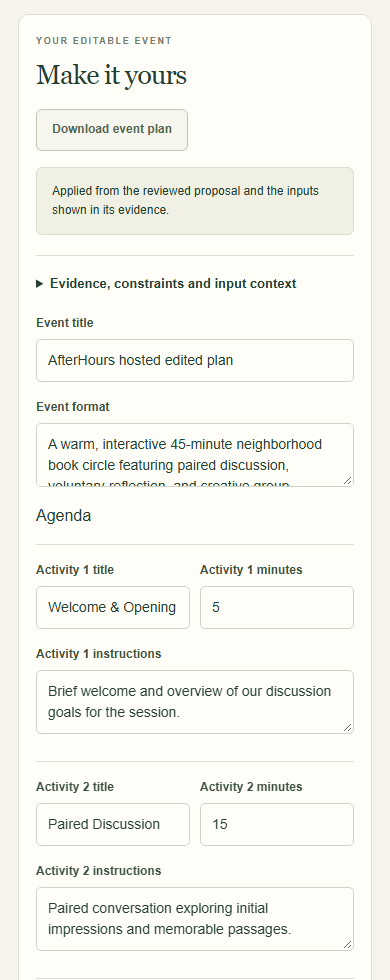
Mobile editor at 390px: edited title, download action and first two activities. Same real public run.
-
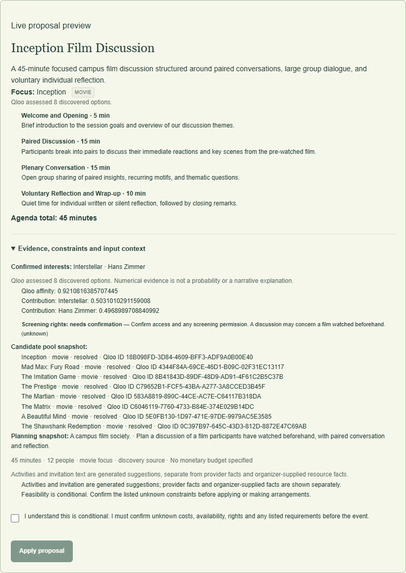
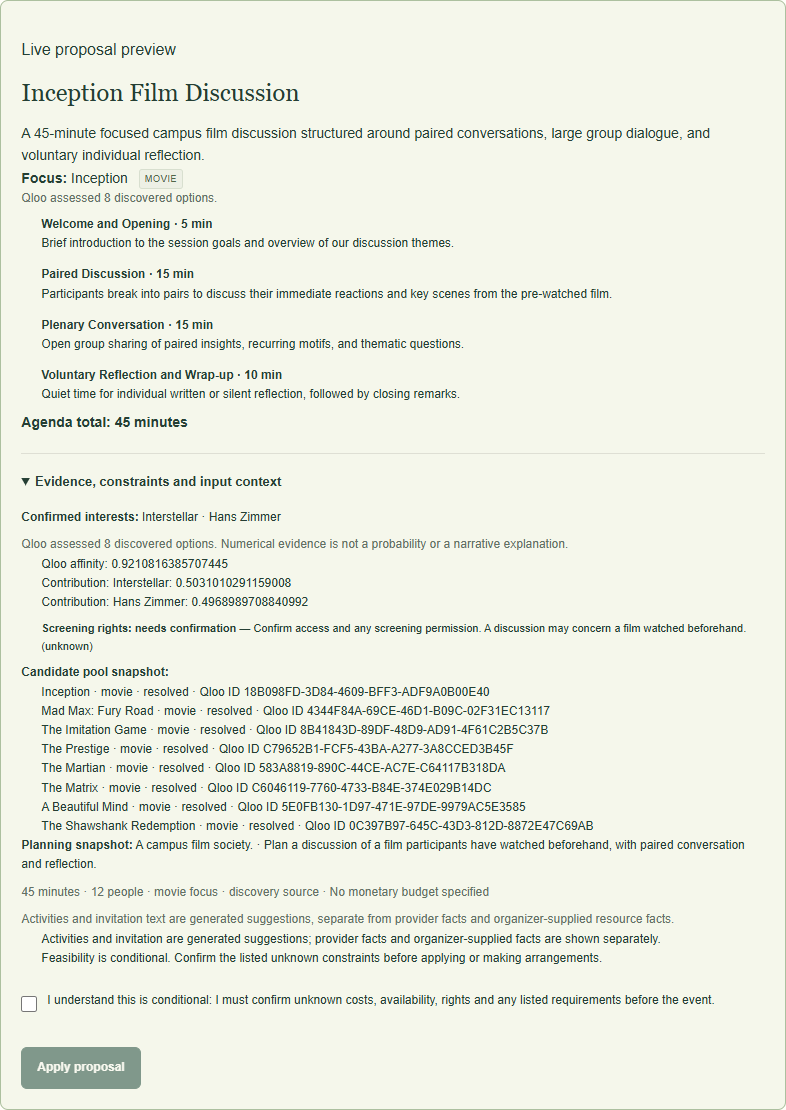
Live film example: Inception (2010), a 45-minute discussion of a film watched beforehand. Screening permissions unconfirmed.
-
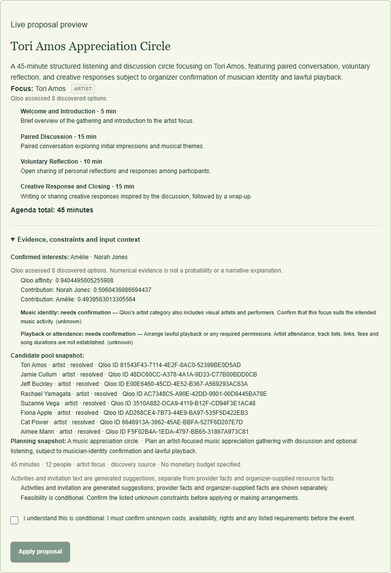
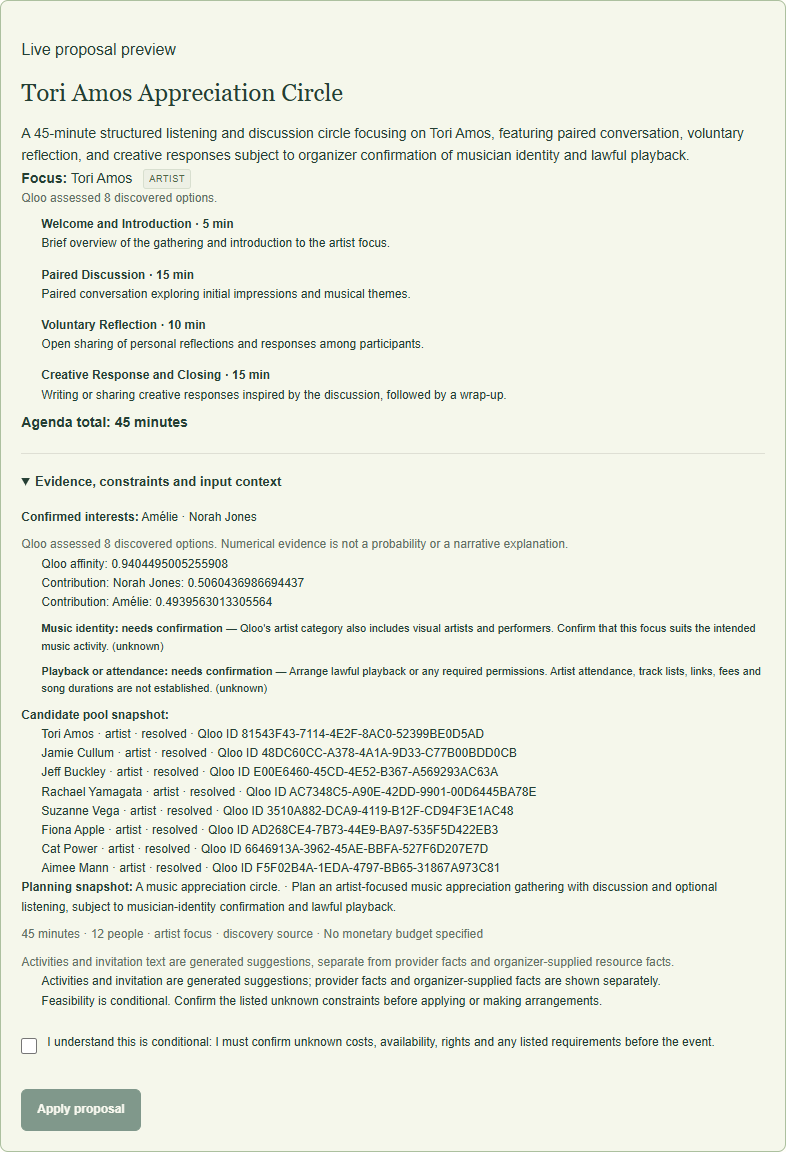
Live artist example: Tori Amos, a 45-minute plan. Musician identity and lawful playback still require confirmation.
Inspiration
A reading circle may know the films and musicians its members love before it knows which book to choose. The organizer then faces another task: turning that choice into a welcoming gathering.
I built AfterHours to connect those decisions. It uses confirmed cultural interests to discover a focus for an event, then helps the organizer shape the gathering while keeping the final decisions editable.
What it does
AfterHours supports reading circles, film societies and artist-focused gatherings through one organizer workspace:
- Describe your group: enter the gathering’s goal, duration, group size and relevant practical preferences.
- Confirm audience tastes: select the intended cultural identities rather than relying on ambiguous names.
- Discover with Qloo: obtain current cultural candidates and numerical taste evidence.
- Review a proposal: inspect the selected focus, timed agenda, materials, invitation and conditional requirements.
- Apply deliberately: existing edits remain intact until the organizer explicitly applies the proposal.
- Make it your own: edit the applied event and, for book plans, download the current version as Markdown.
An illustrative catalogue and browser-local CSV import offer additional ways to organize resources. Unknown prices, edition details and availability remain clearly marked for confirmation.
How we built it
I developed AfterHours as a solo project using Next.js, React, TypeScript and Tailwind CSS, deployed on Vercel.
Qloo supplies current candidate identities, affinity ordering and available numerical contributions from confirmed audience interests.
Gemini calls a native Qloo-backed tool, receives its fresh result and proposes gathering activities using that evidence. Server validation checks the selected candidate, cited evidence, practical assessments and an agenda that totals the requested duration.
Credentials remain server-side. Upstash Redis provides shared admission limits, pacing and expiring generation leases. Papa Parse handles local CSV parsing, while Node tests and Playwright verify application behavior.
Challenges we ran into
Cultural identity and practical feasibility required careful handling. Similar titles do not necessarily identify the same book, and an unknown price cannot be treated as an affordable copy.
Provider latency was another challenge. An earlier public attempt timed out after successful Qloo discovery. I revised the continuation budget while preserving the overall deadline, cancellation and request controls. Later acceptance passed, although the original latency cause remains unknown.
Throughout these cases, errors and late responses needed to preserve the organizer’s draft rather than replace it with incomplete or substitute content.
Accomplishments that we're proud of
Genuine public runs demonstrated three scenarios:
- Reading circle: Amélie and Norah Jones interests produced eight current Qloo book candidates. The agent selected What I Talk About When I Talk About Running and produced a validated 45-minute proposal. Explicit Apply and a Markdown download containing a subsequent edit both passed.
- Film society: an Inception (2010) discussion plan used current evidence and an explicitly applied 45-minute agenda for participants who watched beforehand.
- Music appreciation circle: a conditional Tori Amos artist-focused plan used current evidence and an explicitly applied 45-minute agenda.
Controlled browser checks also cover errors, cancellation, revisions, edit preservation, keyboard interaction and mobile layout.
What we learned
Provider evidence, generated suggestions and organizer edits must remain distinguishable. Qloo scores are not probabilities, and Gemini’s activities are creative suggestions rather than verified cultural explanations.
The examples also exposed practical boundaries: film access and screening permissions remain unconfirmed, and the artist example retains musician-identity and lawful-playback conditions.
Place and shortlist flows remain live unverified. Markdown export is book-only, and workspace data is session-only. These demonstrations establish working journeys, not recommendation quality, adoption or sustained reliability.
What's next for AfterHours
The next step is observing real organizers using AfterHours and evaluating whether its choices and activities help their groups.
Further work includes stronger identity and availability evidence, live verification of the remaining flows and persistent workspaces. These are future goals, not claims of completed research or integrations.
Built With
- add-individual-tags:-next.js
- git
- node.js
- playwright
- react
- tailwind-css
- typescript
