Inspiration
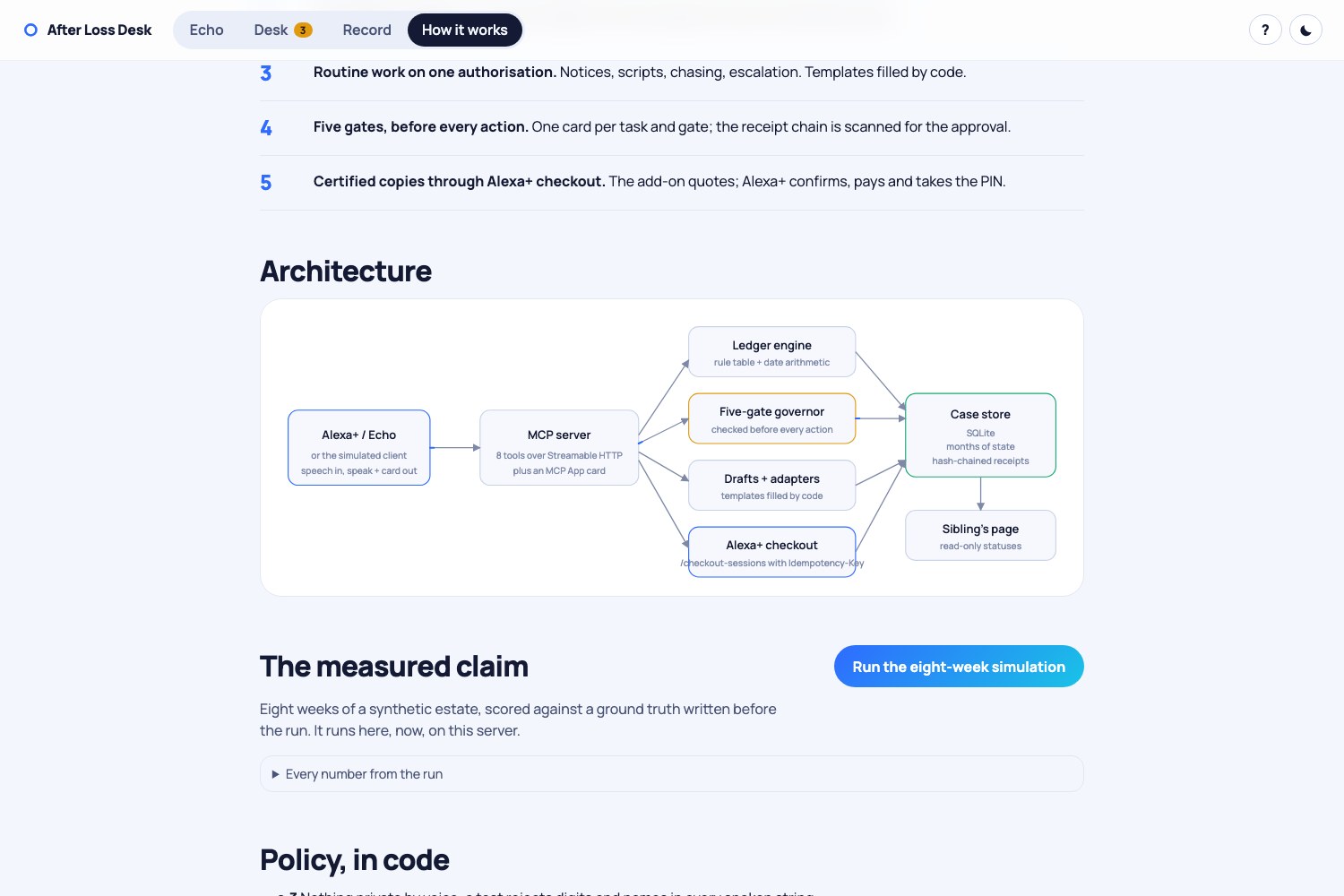
Every year, about 3.1 million Americans pass away, leaving a spouse or adult child to handle their affairs. This process is grueling: the surviving relative typically spends about 500 hours across 18 months notifying banks, utilities, insurers, credit bureaus, and Social Security, while constantly buying certified death certificates and chasing down responses.
Most of this work does not require complex legal judgment—it is just repetitive, tedious administrative follow-up. A person only needs to get involved for a few critical decisions, such as signing documents, moving funds, parting with original paperwork, or resolving disputes among heirs.
Because households with smart speakers like Amazon Echo skew older, the device is already sitting in the kitchen where this paperwork naturally piles up. That makes voice assistants the ideal automated "desk" to handle the busywork and guide families through settling an estate.
What it does
It is an automated estate assistant that uses six basic answers to handle months of notifications, paperwork, follow-ups, and certified mailings—only interrupting you when money, signatures, or major legal choices are involved, all while keeping private account details completely unvoiced.
How we built it
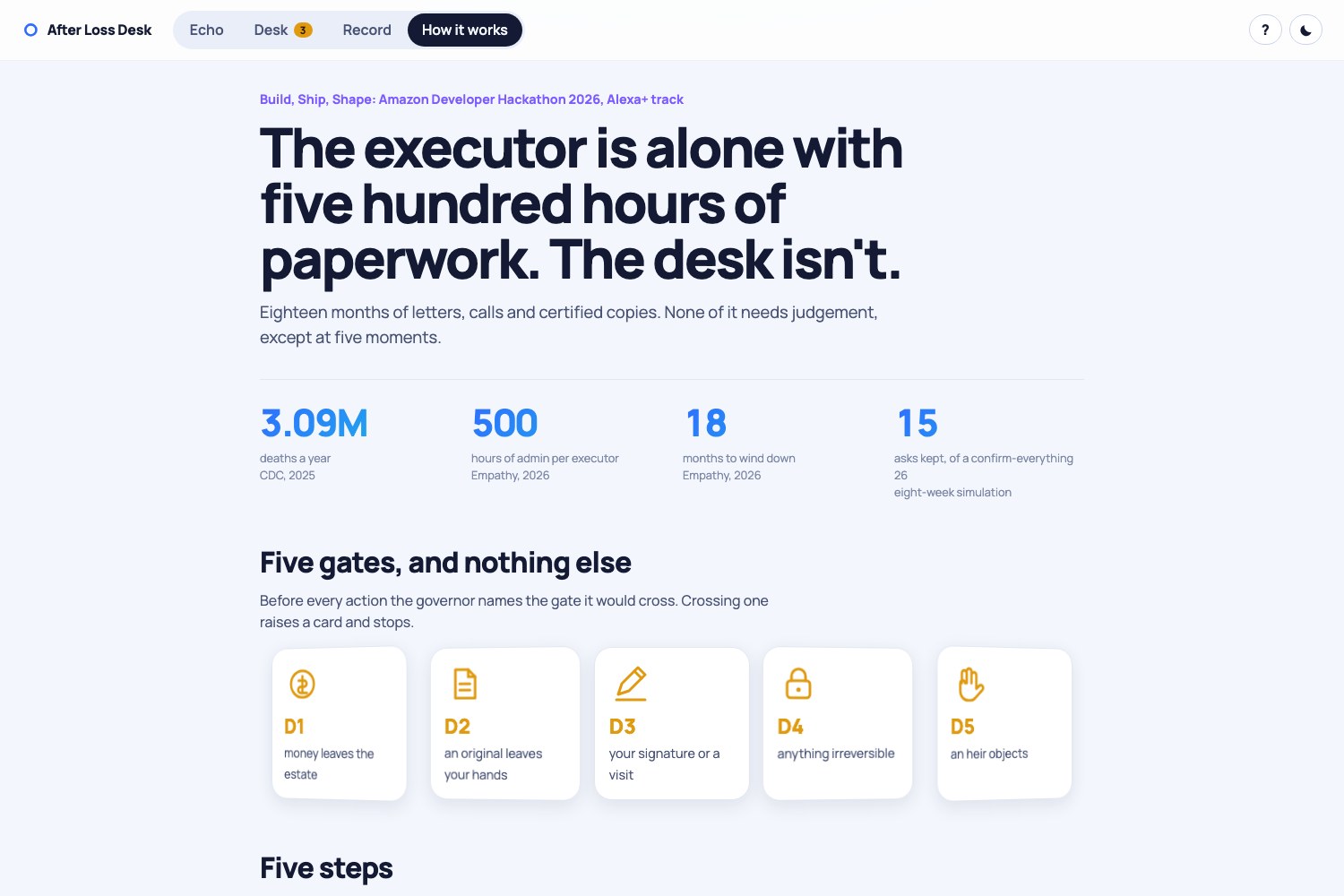
- The Tech Stack: Built with Python, FastAPI, and FastMCP using the Model Context Protocol (MCP) over Streamable HTTP, backed by an SQLite database.
- Smart UI Cards: Each tool call references a shared interactive UI component (
ui://afterloss/card.html) to render visual cards on the screen. - Safe Payments (Voice Checkout): Modeled directly on the Alexa+ checkout lifecycle (
create,update,complete). It enforces strict 24-hour idempotency keys: running the same payment request twice replays the original receipt instead of charging again, and throws an error if details are altered. - Fact-Locked Drafting: Letters and notices use strict, code-populated templates. If an LLM polishes or rephrases the text, the draft is kept only if every original fact and detail is preserved intact.
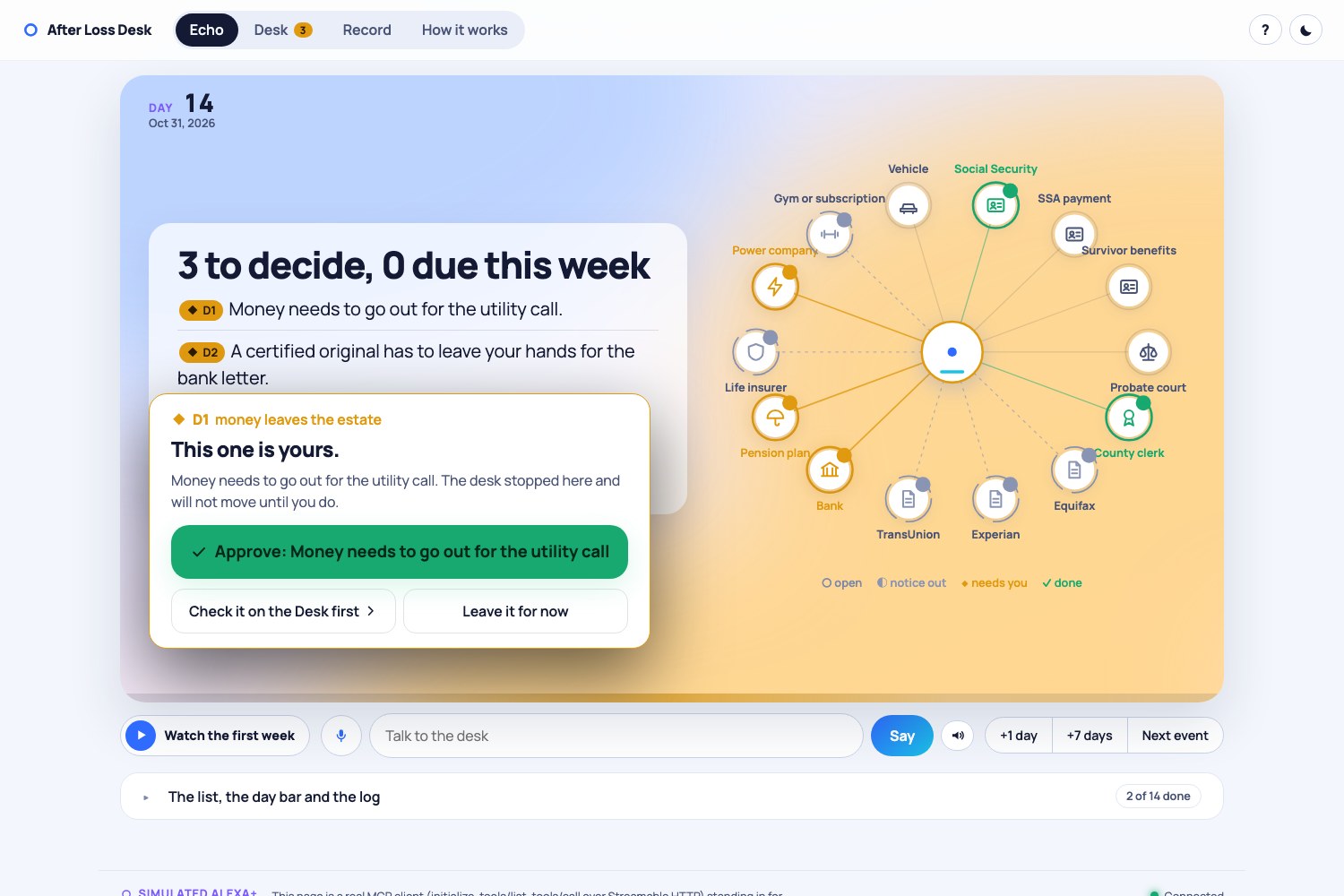
- Enforced Human Approvals: A built-in governor inspects the audit chain before any high-stakes task. If an action falls under any of the five human gates, it cannot execute without a verified user approval on record.
- Automated CI/CD Testing: Every build runs an automated eight-week simulation of estate settlement against known ground-truth scenarios. The build immediately fails if notice recall drops below 100% or if any gated action executes without authorization.
The Prototype & Simulated Echo Show Experience
Because official Alexa+ developer tools remain in preview, the frontend honestly simulates the hardware instead of faking the integration:
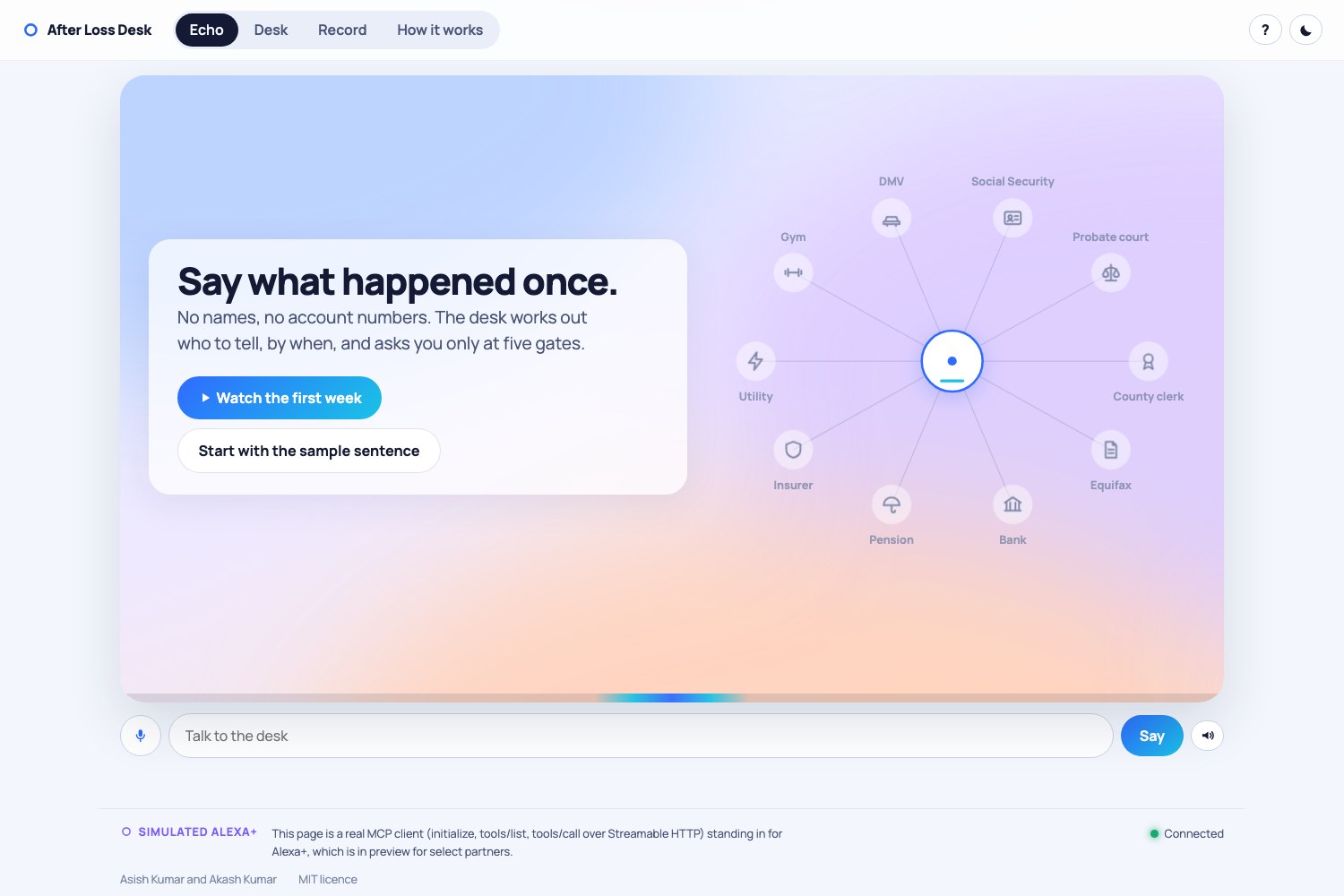
- Real MCP Client: The browser runs an authentic MCP client that talks directly to the backend tools using the standard protocol, framed to look like an Echo Show display.
Live Visual Feedback:
- The background changes color to reflect system status (violet when listening, amber when paused at a decision gate).
- Institutions are arranged in an outer ring. A visual pulse travels outward when a notice is sent and flows back inward when a response arrives.
Key App Views:
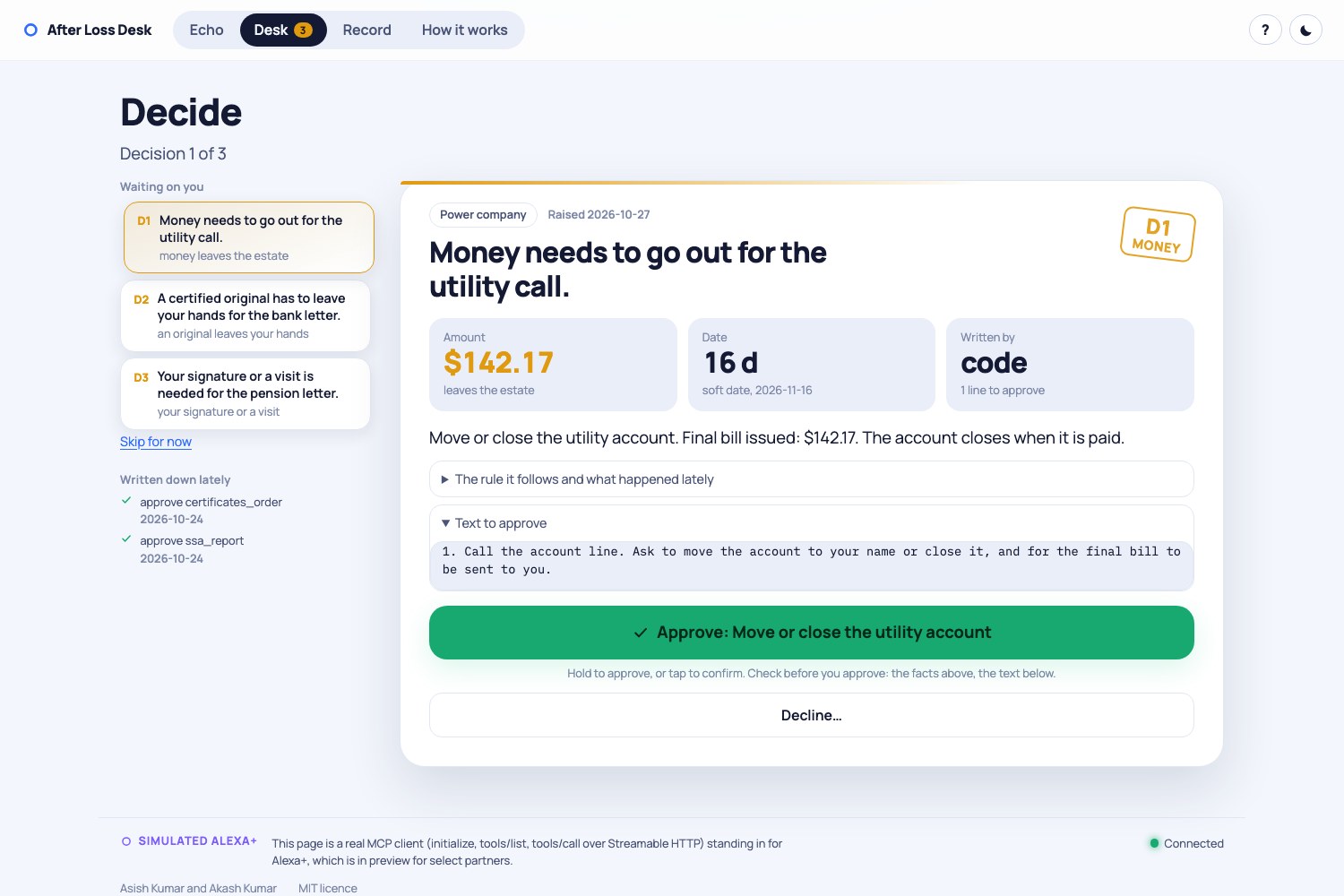
The Desk: Displays active tasks, summaries of pending gates, and a hold-to-approve button so users cannot trigger critical decisions by accident.
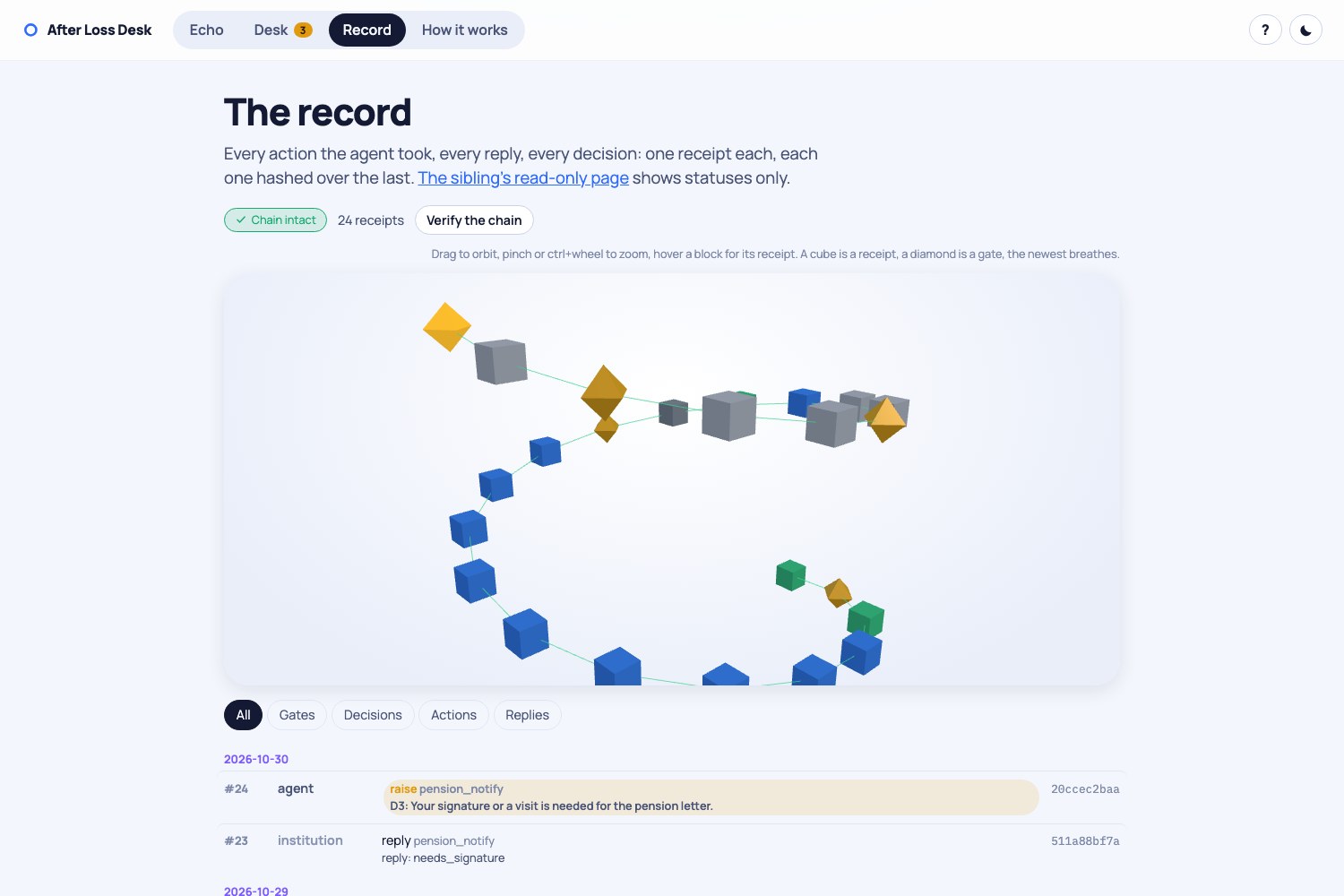
The Record: An interactive, 3D visual audit log where users can inspect and verify the tamper-proof cryptographic receipt chain.
The "How" Page: Runs and charts the full eight-week accelerated simulation in real time to demonstrate how the agent handles months of estate work.
Challenges we ran into
- Routing Conflicts: Mounting the Streamable HTTP app directly under FastAPI triggered
405 Method Not Allowederrors until we explicitly merged its routes into the primary router. - Unclear MCP App Standards: The Alexa+ documentation didn't specify which revision of the MCP Apps standard it supports, requiring us to navigate the integration without clear version guidelines.
- Undefined Voice Privacy Rules: Amazon's policy against speaking private personal information came with zero practical examples. We had to define the standard ourselves—restricting voice outputs to closed categories, showing sensitive labels on screen only, and writing automated tests to block private data from being read aloud.
- No Checkout Sandbox: Alexa+ lacked a test sandbox for payments, forcing us to build our own verification suite to prove double charges are prevented (idempotency).
- Preview-Only Constraints: Because the official developer tools are still in preview, we had to build our own web client from scratch to authentically simulate and demonstrate the Echo Show experience.
Accomplishments that we're proud of
- High-Precision Automation: Across an eight-week simulation, the agent completed all 17 tasks with perfect 100% precision and recall—cutting user interruptions down to just 15 (compared to 26 from a standard "confirm-everything" agent) without a single forbidden action.
- Flawless Safety & Compliance: Generated 77 tamper-proof cryptographic receipts with 100% chain verification, and delivered 72 voice outputs with zero privacy policy violations.
- Full Rubric Coverage: Implemented four major advanced criteria in a single add-on: multi-month persistent state, cross-service orchestration, voice checkout, and MCP Apps UI—plus a complete Agent Skill specification.
- Valuable Platform Feedback: Delivered an 8-item friction log with concrete feature requests to help improve the official Alexa+ developer platform.
What we learned
- Safety requires hard code, not prompt engineering: Critical guardrails—like deciding when to stop and ask for human approval—cannot rely on model instructions; they must be enforced deterministically in code.
- Privacy demands strict tests, not style guides: Keeping sensitive personal information off the speaker requires closed schemas and automated filter tests, not just vague guidelines.
- The rule table is the real product: A verified, cited legal rulebook for each jurisdiction is the core engine; the AI, voice interface, and UI are simply delivery mechanisms that serve it.
- Benchmarking must precede claims: An end-to-end simulation tested against an objective, pre-written ground truth is the only credible way to prove an agent interrupts less while missing nothing.
What's next for After-loss-desk
- Expanding State Coverage: Developing cited, JSON-based rule tables for additional states beyond California.
- Direct Institution Integrations: Building production adapters to send notices directly via live electronic forms and automated physical mail APIs.
- Full E-Commerce Compliance: Implementing Section 16 voice purchasing requirements, including explicit written confirmations and pre-purchase refund disclosures.
- Hardware Deployment: Joining the official Alexa+ private preview to transition from a simulated client to live execution on physical Echo devices.

Log in or sign up for Devpost to join the conversation.