Inspiration
What it does
Inspiration
Building a voice assistant in an African language is not blocked by models. It is blocked by data. While helping a telecom AI team record and validate audio for a Wolof voicebot, we spent hours on a task that every team in the region repeats alone: collecting, transcribing and checking speech, with unclear consent and unclear licences. The few datasets that exist are scattered, and the big players who collect African voices rarely share them back.
The hackathon theme, building the African exchange platform, for devs, by devs, was exactly that gap. What if the community of African developers could create, share and benchmark its own voice resources?
What it does
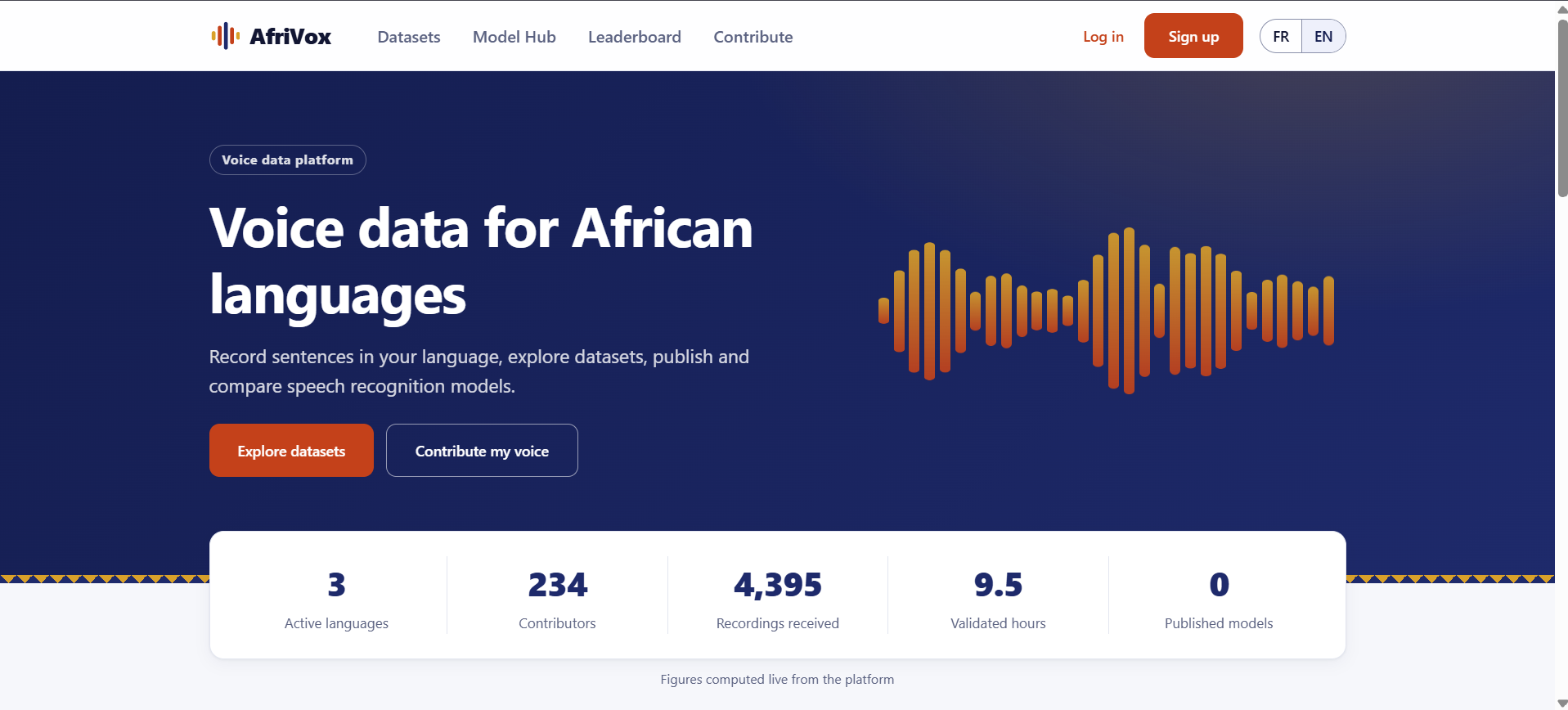
AfriVox is an exchange platform for African voice data.
- Contributors record sentences from their phone (installable web app, works offline) and validate each other's recordings. They earn credits, then a share of sales.
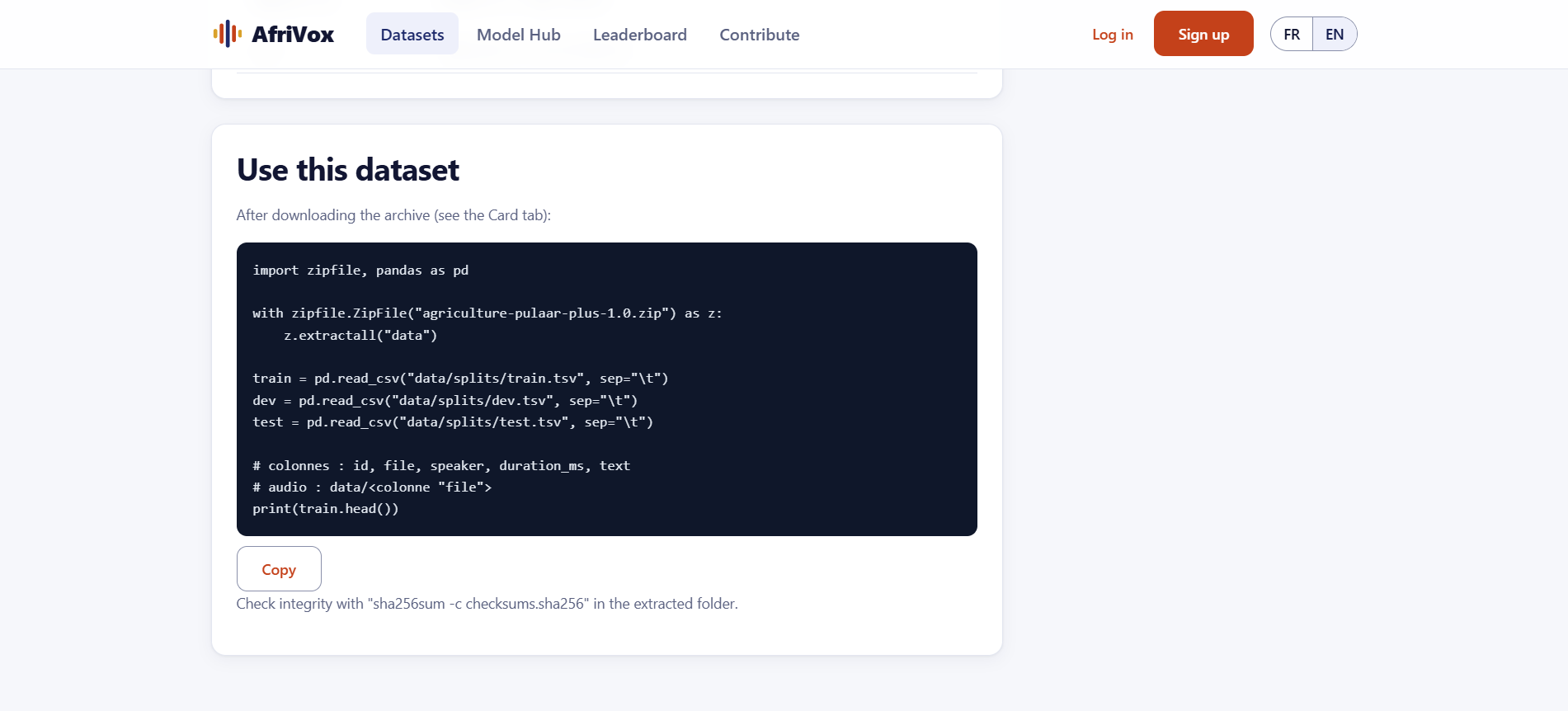
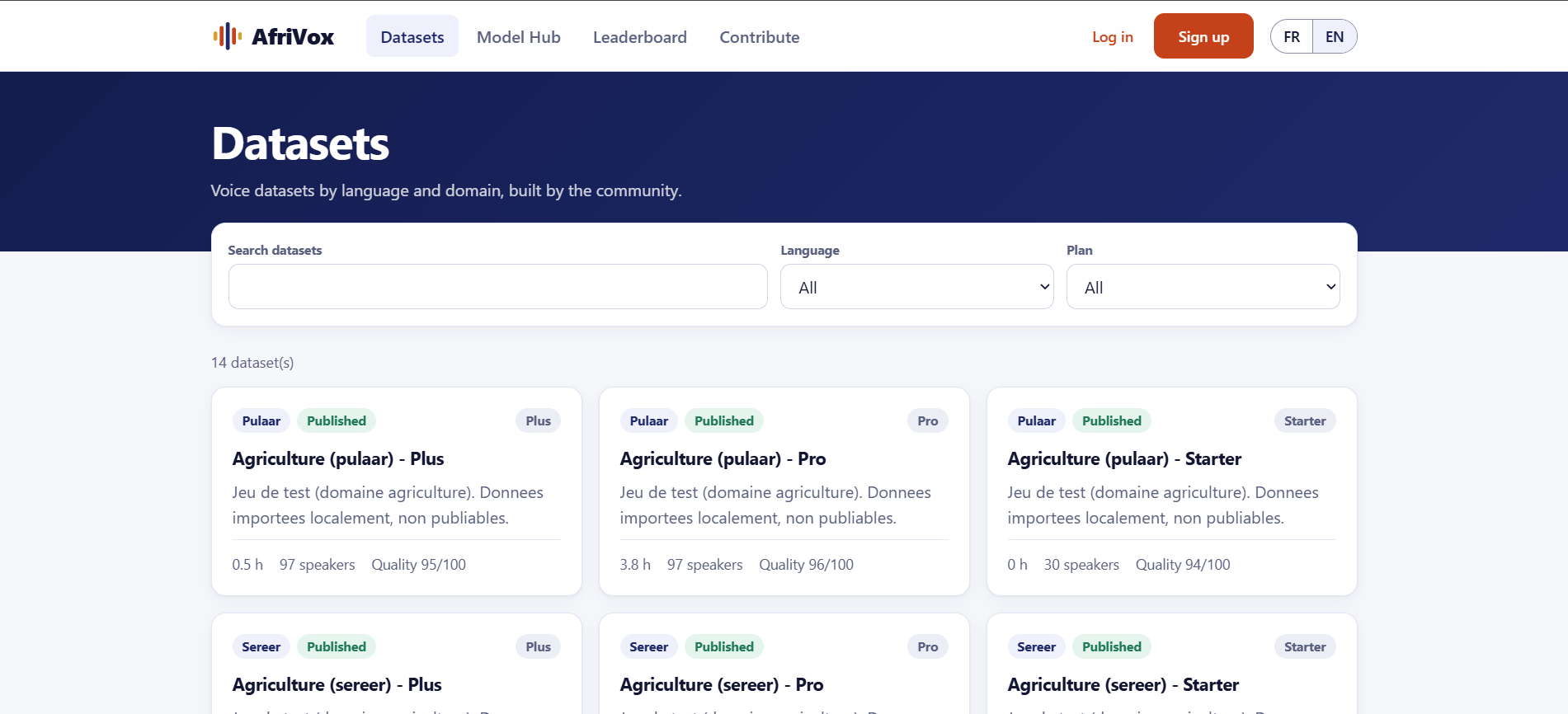
- Developers get a public profile, download datasets (a free Starter plan for prototyping, paid plans beyond), publish models in a Model Hub and use an API.
- Organisations (telecoms, banks, ministries, startups) submit a request for a custom dataset and receive a quote.
What makes it useful for developers:
- A measured leaderboard. Models are ranked per language on reference transcripts that are never published. Developers submit predictions and the platform computes the score itself.
- Licence inheritance. A published model inherits the restrictions of the dataset it was trained on.
- Real consent. When a contributor withdraws consent, their recordings are excluded from the next dataset versions.
How we built it
- Backend: Spring Boot generated with JHipster, JWT authentication, PostgreSQL, Liquibase migrations.
- Frontend: Angular, as a mobile-first PWA with offline recording.
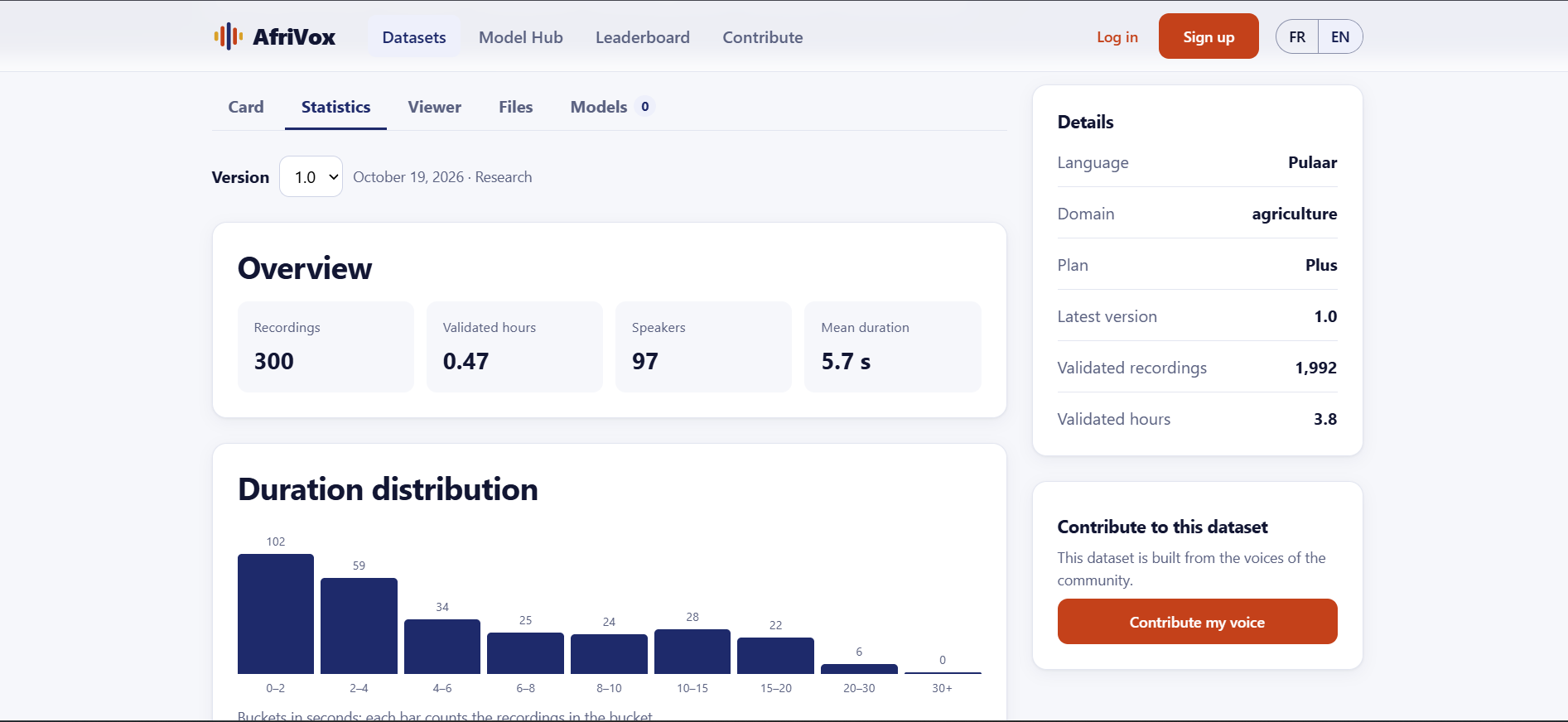
- Quality pipeline: automatic checks (duration, volume, silence, noise, duplicates), then peer validation with 2 to 3 qualified validators and gold tasks to measure their reliability.
- Datasets: versioned and immutable, delivered through signed, expiring download links.
- Hosting: a single Datacloud cloud server in Dakar, with Docker Compose and HTTPS.
- Licences: only permissive dependencies (MIT, Apache 2.0, BSD), tracked in an inventory.
The leaderboard uses the standard word error rate:
$$\mathrm{WER} = \frac{S + D + I}{N}$$
where $S$, $D$ and $I$ are substitutions, deletions and insertions against the $N$ words of the reference transcript. We compute it ourselves after normalising both texts.
We used AI tools during development and can explain every part of the code.
Challenges we ran into
- The cold start. A language is only useful once enough qualified validators exist. We open a language only after it reaches a minimum number of validators, and we recruited the first Wolof and Pulaar contributors by hand.
- Consent that actually works. Making a withdrawal propagate to future dataset versions forced us to treat datasets as immutable versions rather than editable folders.
- Licence compliance. Many Java libraries are under LGPL or dual licences, so we audited our dependencies and replaced the ones that did not fit.
- A tight budget. The platform runs on 1 vCPU and 2 GB of RAM, so quality checks and scoring run asynchronously and builds happen outside the server.
- Time. About three weeks to go from idea to a hosted, usable product meant cutting hard: real Mobile Money payments, lent voices and subscriptions are left for later.
What we learned
- Data quality and consent are product features, not paperwork.
- Measuring beats declaring: a leaderboard on private references is more trustworthy than self-reported scores.
- Strict scoping matters more than extra features when the clock is running.
- Licence compliance has to be handled from day one, not at the end.
What's next
More languages, paid datasets uploaded by the community, real Mobile Money payments, and partnerships with existing African language initiatives.
How we built it
Challenges we ran into
Accomplishments that we're proud of
What we learned
What's next for Afrivox
Test login : | Role | Login | Password | |---------------|--------------|----------------| | Contributor | jury_contrib | ZXJqHVYr4ugpaj | | Developer | jury_dev | dKD1FpNJZt220i | | Administrator | jury_admin | P2kx2N9HZTSK51 |
Built With
- angular.js
- docker
- springboot


Log in or sign up for Devpost to join the conversation.