-
-
-
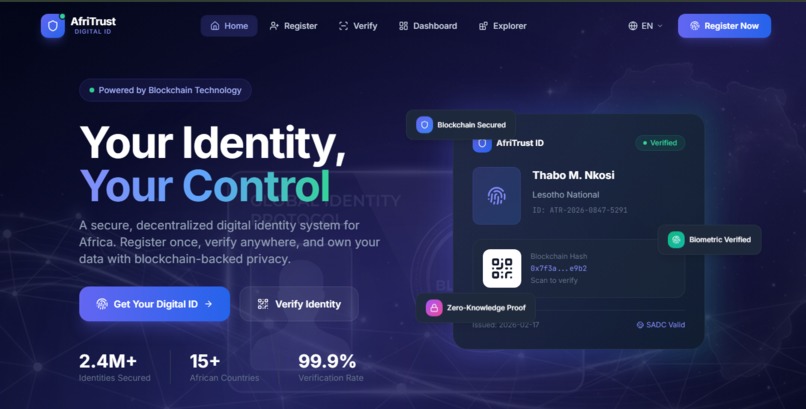
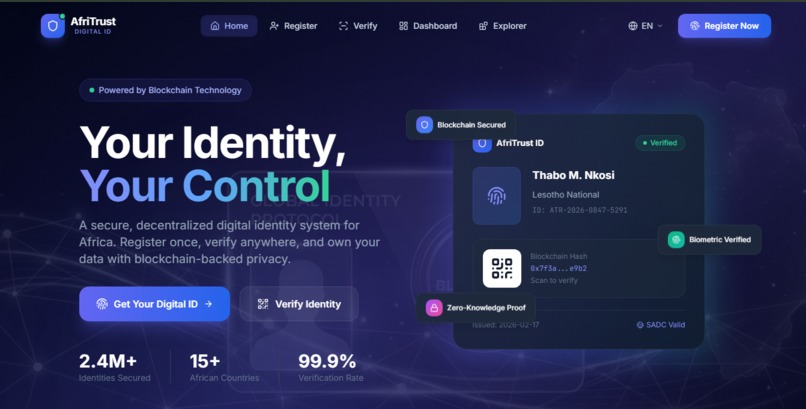
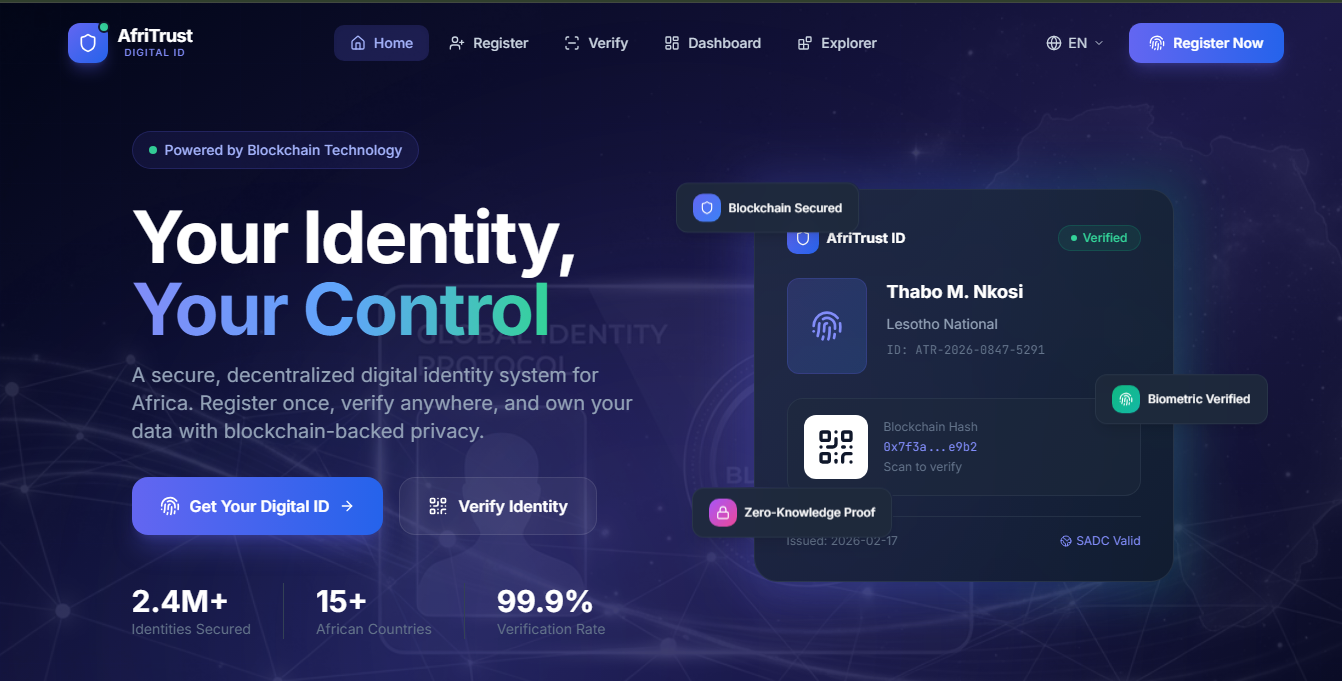
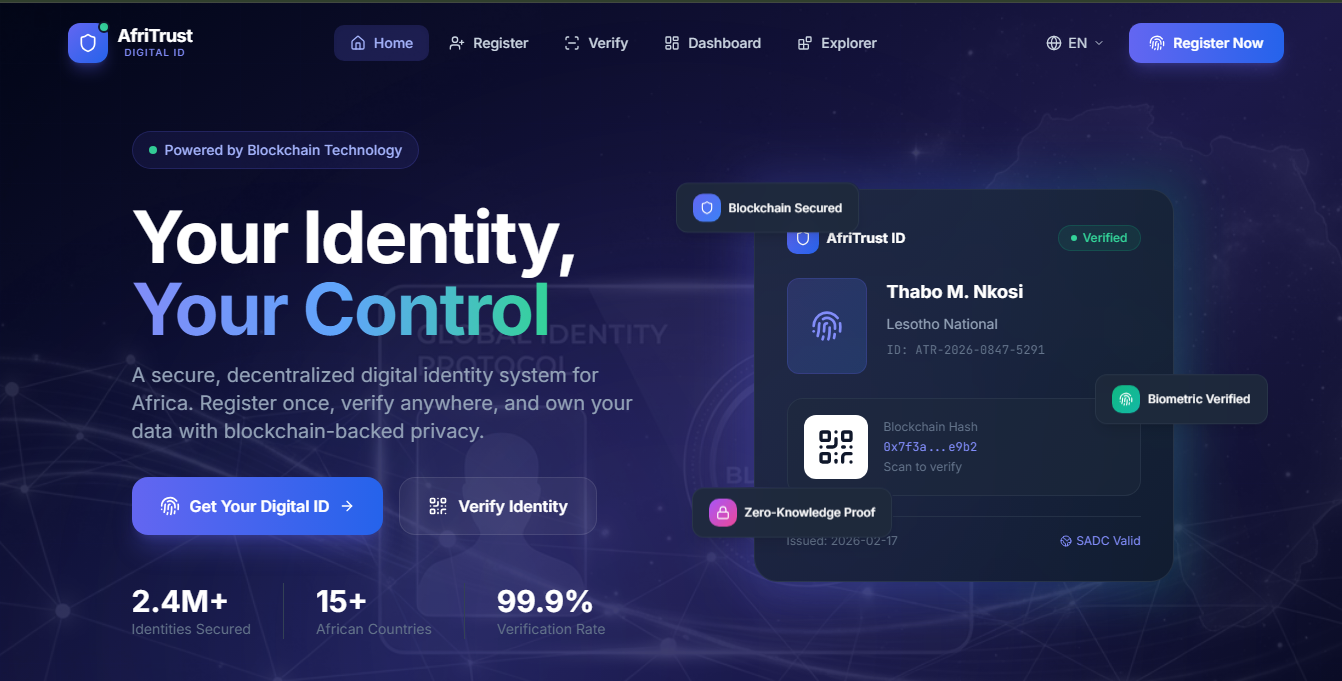
This is our first landing page of AfriTrust Digital ID
Inspiration
Across Southern Africa, many citizens struggle to access healthcare and public services due to fragmented, paper-based, or insecure identity systems. In rural areas of Lesotho, identity verification delays service delivery and increases fraud risks. We were inspired to use our background in blockchain, cybersecurity, and secure system design to build a privacy-first digital identity system aligned with Africa’s Digital Public Infrastructure (DPI) goals.
We wanted to design a solution that protects citizens' data while improving trust, efficiency, and inclusion.
What it does
AfriTrust ID is a blockchain-backed digital identity system that enables secure and privacy-preserving identity verification. It:
- Registers citizens securely
- Encrypts personal data off-chain
- Stores a cryptographic hash on blockchain
- Generates a QR-based Digital ID
- Enables fast verification without exposing full personal data
Identity integrity is ensured using cryptographic hashing: H = SHA256(\text{CitizenData})
Verification confirms that: Verify(H_{stored}, H_{provided}) \rightarrow True / False
This ensures data has not been altered while maintaining privacy.
How we built it
We developed a Minimum Viable Prototype (MVP) using:
Blockchain Layer
- Ethereum (local test network)
- Solidity smart contracts
- Hardhat & Web3.js
Backend
- Node.js & Express.js
- REST APIs for registration and verification
- AES encryption for secure data storage
Frontend
- React.js interface
- QR code generation and scanning
Security
- SHA-256 hashing
- Role-Based Access Control (RBAC)
- Secure authentication mechanisms
The system separates identity storage (encrypted database) from verification logic (blockchain hash validation), ensuring both privacy and integrity.
Challenges we ran into
- Balancing decentralization with data privacy
- Integrating blockchain with encrypted off-chain storage
- Designing QR verification for low-connectivity environments
- Managing development time within hackathon constraints
We addressed these challenges by simplifying the architecture and focusing on core verification logic for our prototype.
Accomplishments that we're proud of
- Successfully implemented blockchain-based identity hash storage
- Built a working QR verification system
- Designed a privacy-preserving identity model
- Created a functional end-to-end MVP
- Applied real cryptographic principles to a public service use case
Most importantly, we transformed a complex national-level concept into a practical prototype.
What we learned
- The importance of privacy-by-design in Digital ID systems
- How blockchain enhances data integrity but must be carefully integrated
- The complexity of building systems aligned with public infrastructure standards
- The value of teamwork, planning, and rapid prototyping
This project strengthened our technical and strategic understanding of secure digital systems.
What's next for AfriTrust Innovators
Next steps include:
- Integrating biometric authentication
- Improving offline verification capabilities
- Conducting pilot testing with healthcare service scenarios
- Exploring interoperability with government systems
- Refining our smart contracts for scalability
Our long-term vision is to expand AfriTrust ID into a scalable Digital Public Infrastructure solution for Southern and Eastern Africa.
Built With
- aes-encryption
- css3
- ethereum
- express.js
- git-&-github
- hardhat
- html5
- javascript
- mysql
- node.js
- oracle-19c
- postman-api-testing
- react
- role-based-access-control
- sha-256
- solidity
- sql
- vs-code
- web3

Log in or sign up for Devpost to join the conversation.