-
-
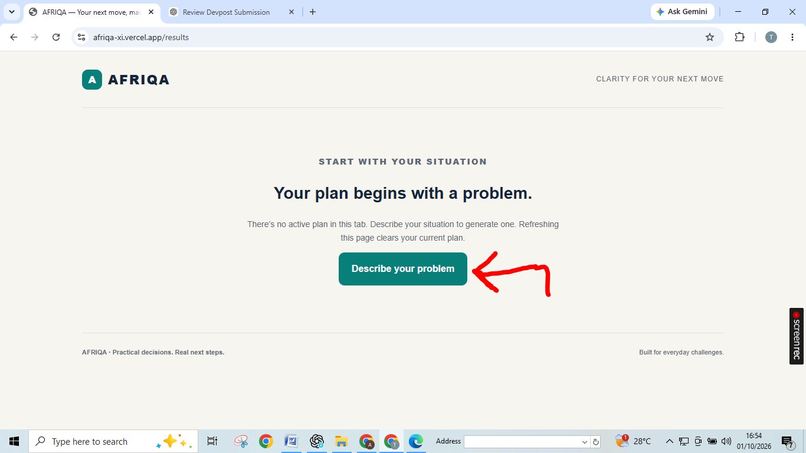
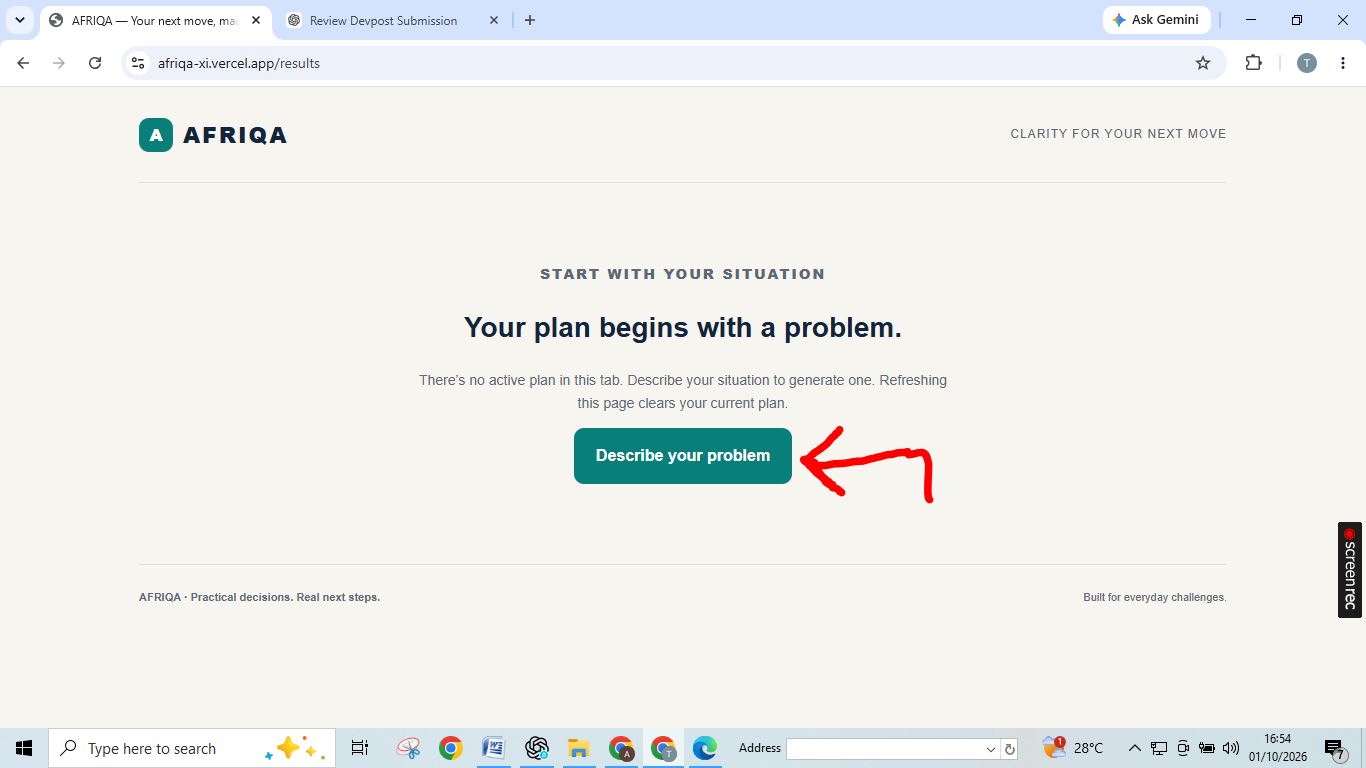
Demo Landing page
-
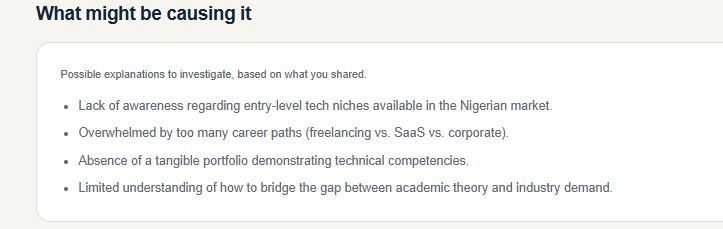
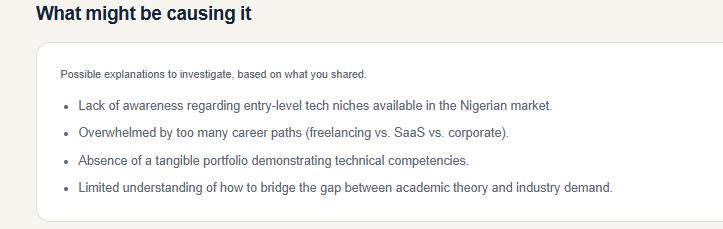
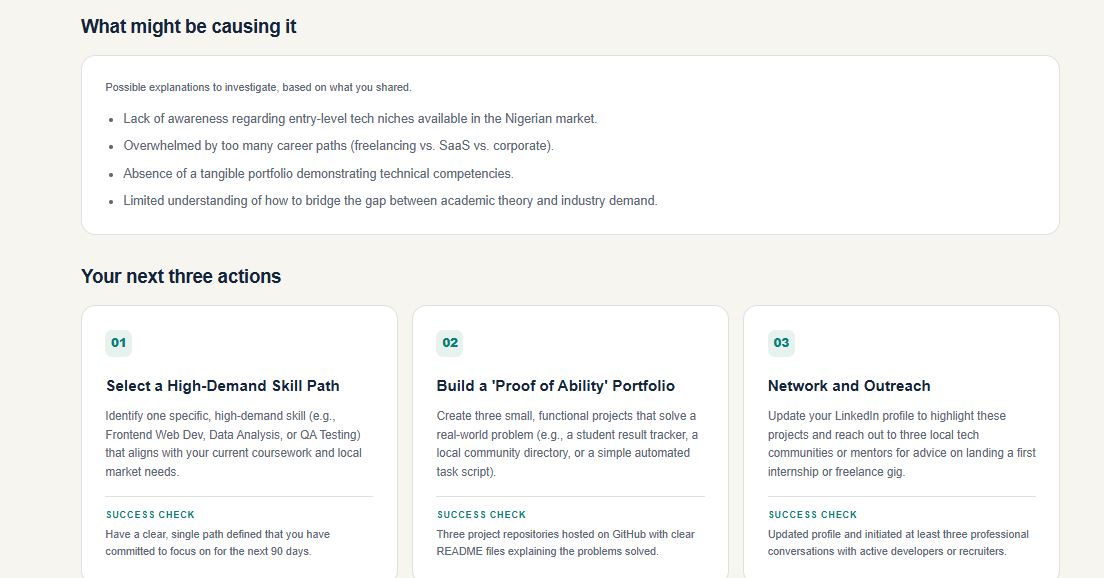
What might be causing the problem
-
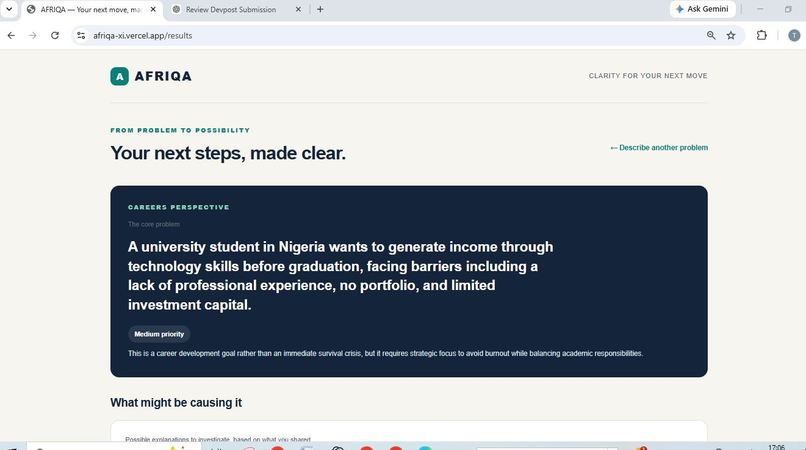
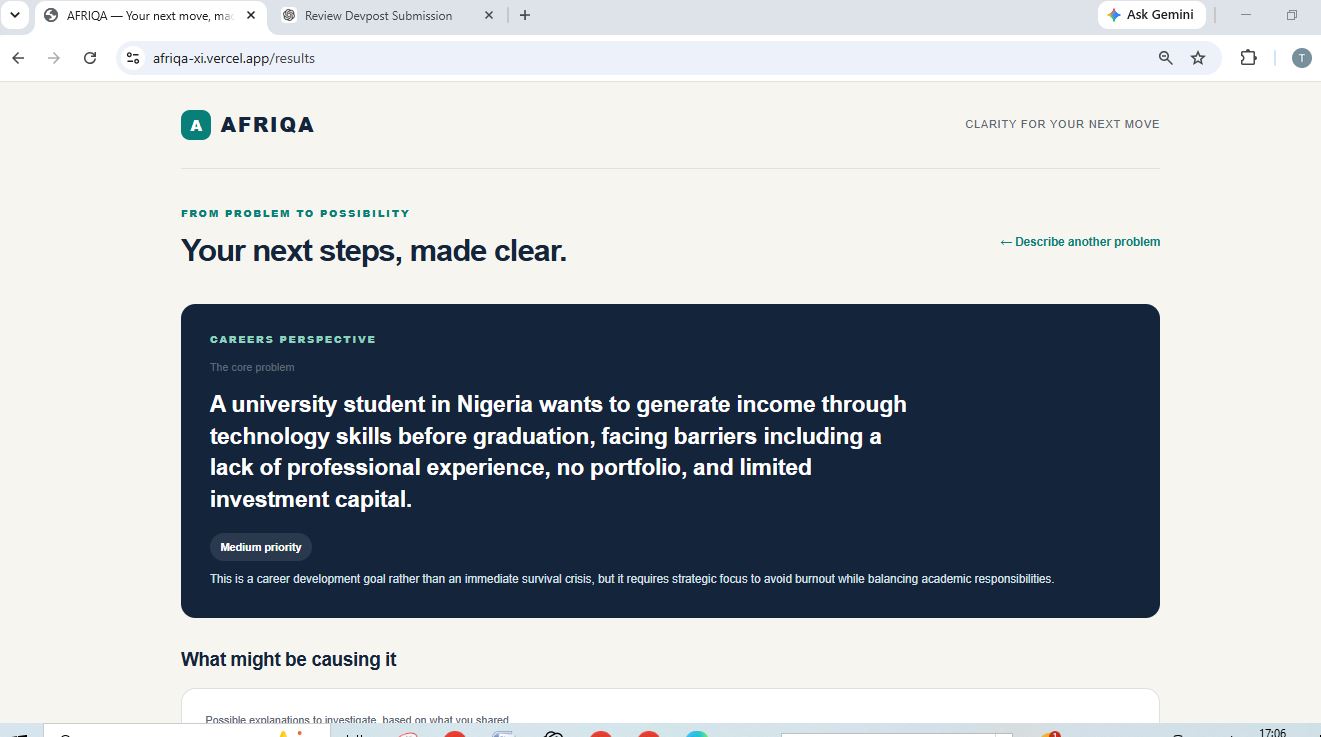
Assistant first feed back
-
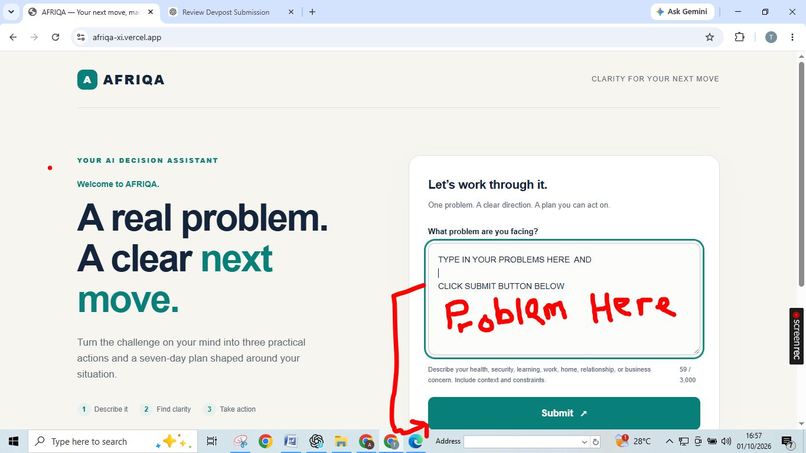
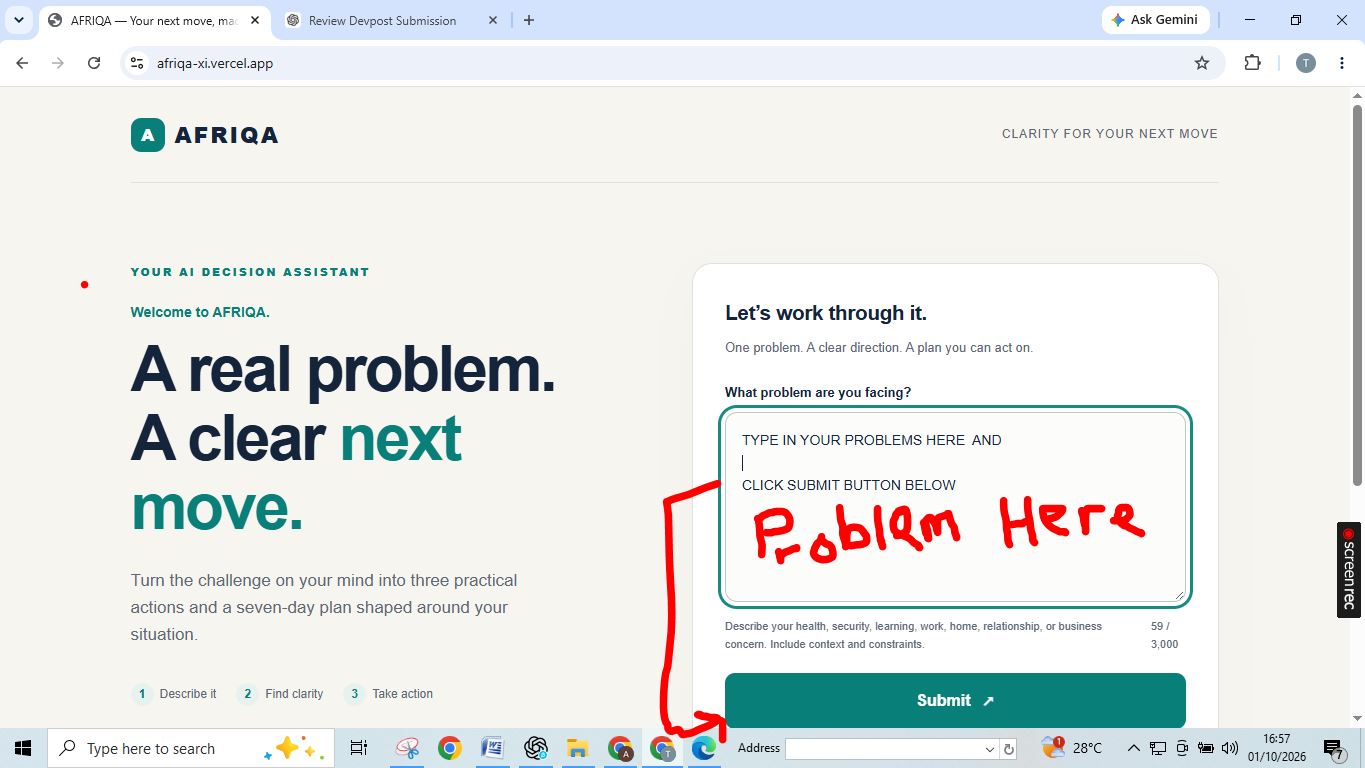
Where to type in your problem(s)
-
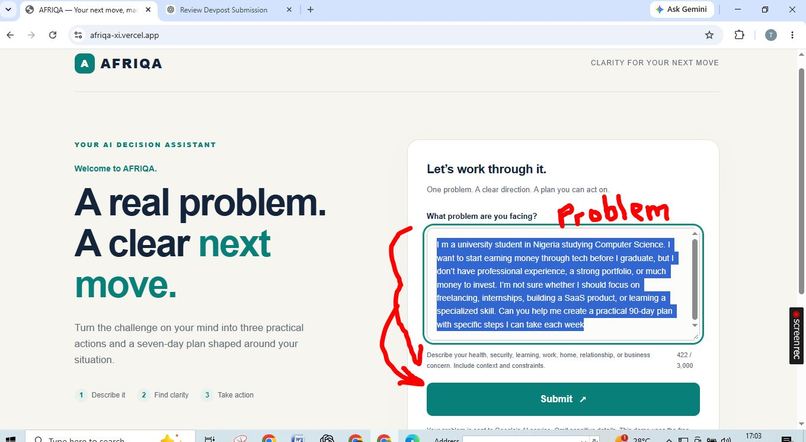
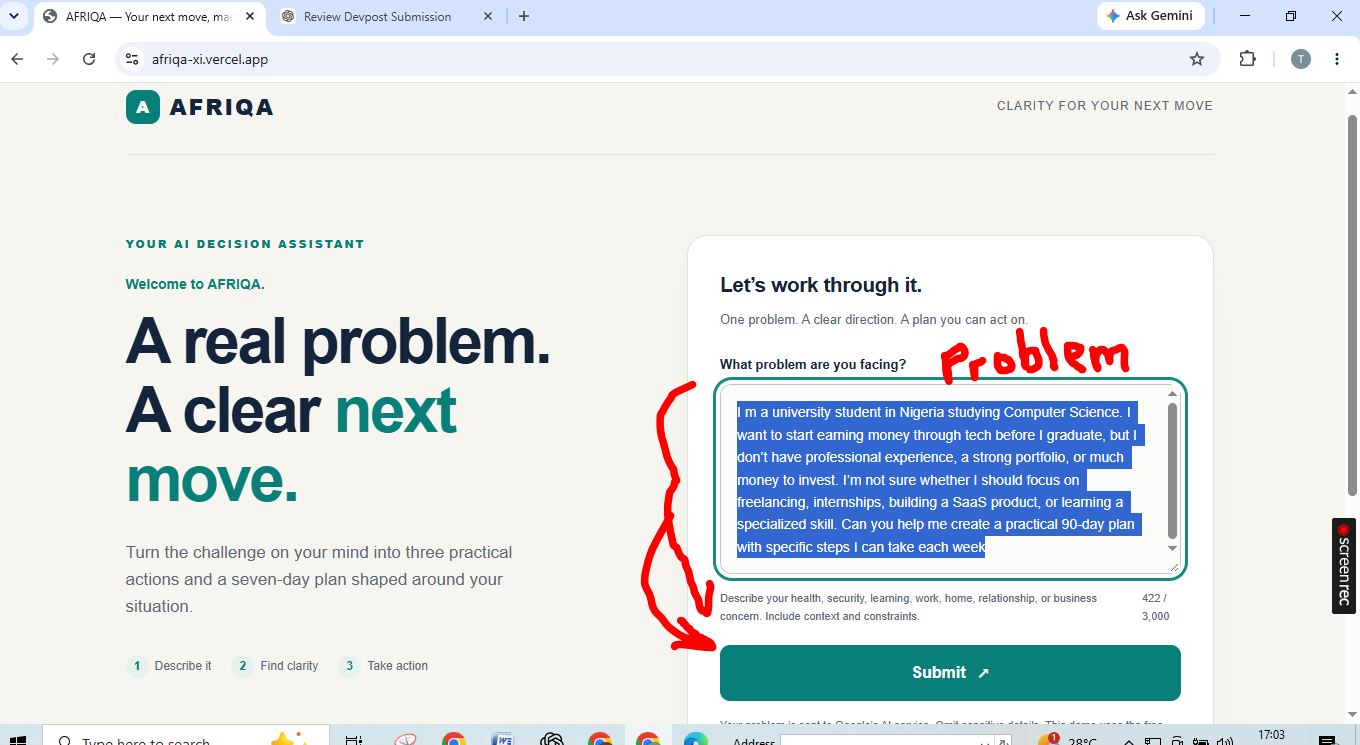
Describe your problem(s)
-
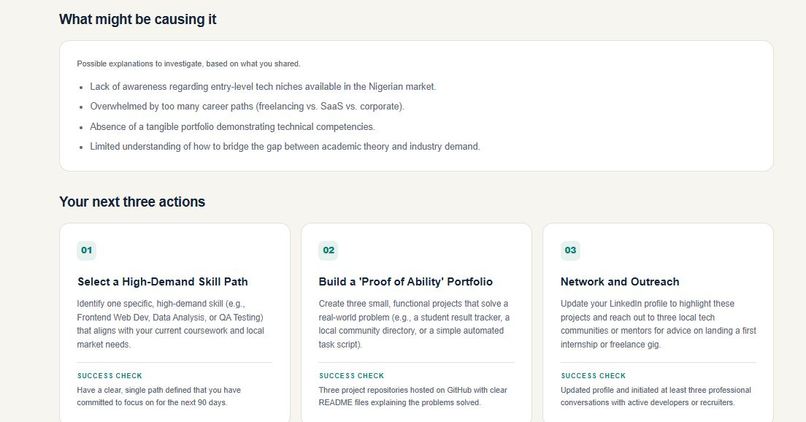
Your next three actions
-
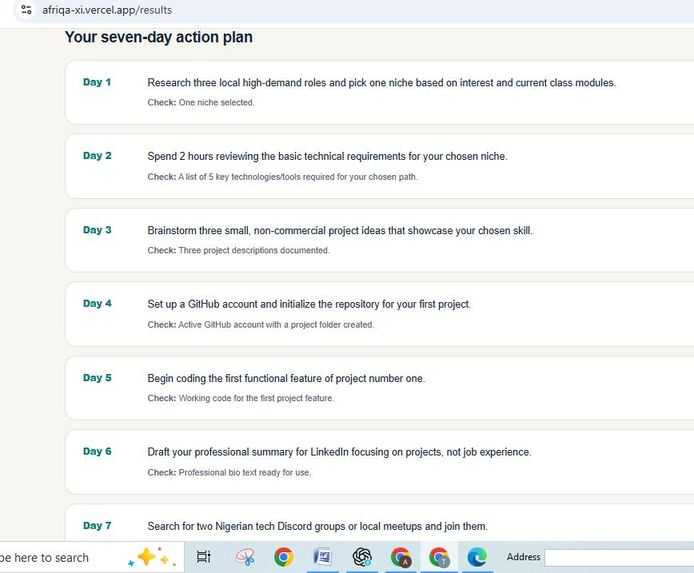
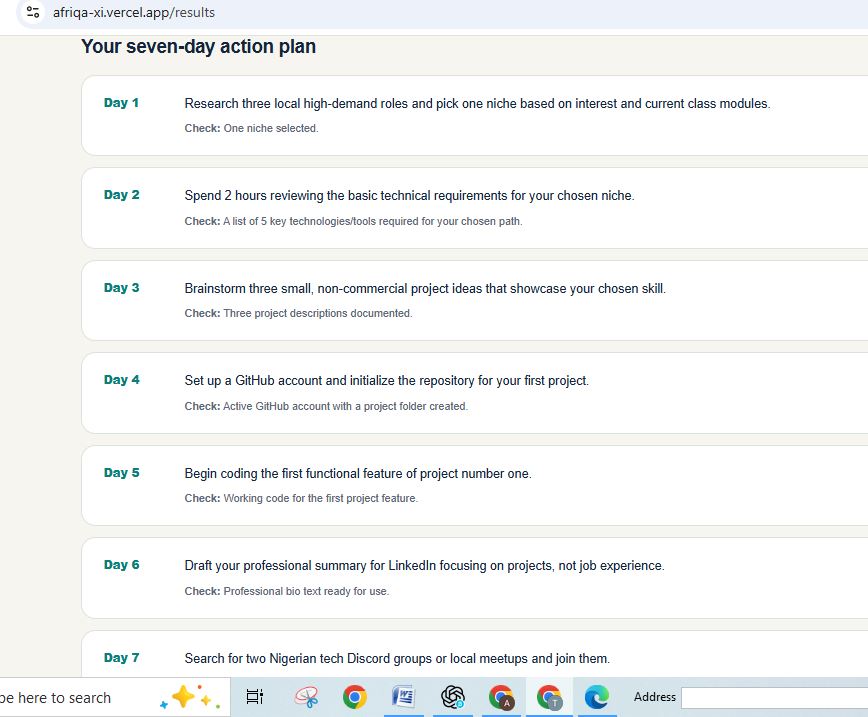
Your seven-day action plan
Inspiration
AFRIQA was inspired by the everyday challenges people face when making difficult decisions and not knowing what to do next. I wanted to create a simple, accessible tool that turns uncertainty and complex problems into clear, practical next steps that people can actually act on.
What it does
AFRIQA helps people turn a problem or situation into a clear, actionable plan. Users start by describing the challenge they are facing. AFRIQA then helps organize that problem into practical next steps, giving users a clearer path forward instead of leaving them overwhelmed by uncertainty or information. The experience is built around a simple idea: Describe your problem → Get clarity → Follow a practical plan → Take your next step. Whether the challenge involves an opportunity, career, education, business, or another real-life situation, AFRIQA is designed to help users move from “I don't know what to do” to “I know my next move.” At its core, AFRIQA is a decision-support experience focused on making problems easier to understand and action easier to take.
How I built it
I started by defining the core problem: people often know what problem they are facing but struggle to identify a practical next step. From there, I designed AFRIQA around "a simple flow problem → understanding → plan → next move and" kept the product focused on turning user input into actionable guidance.
I designed the interface to make the experience feel simple and approachable. Rather than overwhelming users with multiple options, the interface guides them toward describing their problem and then presents the resulting plan in a clear, structured way. The results experience is designed around clarity and action, so users can quickly understand what they can do next.
The AI workflow is centered on the user's problem. User input is passed through the application's AI layer, where the situation is interpreted and transformed into structured guidance and actionable steps. The goal is not simply to generate a long response, but to turn an unstructured problem into something the user can understand and act on.
I validated the concept by repeatedly checking whether the generated results actually addressed the user's original problem and whether the recommended steps were understandable and practical. I also refined the experience based on where the output or user flow could create confusion.
I tested the complete user journey from submitting a problem to receiving the final result to identify issues in the interface, response quality, and overall flow. We focused particularly on whether users could understand their results quickly and whether the suggested next steps felt relevant to the problem they entered.
I brought the final experience together as a web application and deployed AFRIQA so users can access it directly through the web. The final product prioritizes a short, intuitive journey from problem to plan, making the core value of AFRIQA immediately understandable. My final stack is: Next.js · TypeScript · Gemini Flash Lite · Zod · GitHub · Vercel
Challenges I ran into
One of my biggest product challenges was preventing the AI from giving advice that was technically reasonable but too generic. A user asking about a business problem, career decision, education, or another domain needs guidance that reflects their specific situation. I therefore focused on structuring the user's input and guiding the AI toward recommendations that are relevant to the context provided. The installation hit two problems: dependency download failed with network errors, then insufficient disk space prevented completion, after providing enough disk space, I successfully complete the installations.
Accomplishments that I am proud of
- A working app that turns a problem into three actions and a seven days plan.
- Domain-specific guidance for business, education, health, security, relationships, and more.
- A live vercel demo, public GitHub repository, and completed demo video
What I learned
Many things were learnt, below are among what I have learnt:
- Planning a focused workflow before coding the app.
- Using a coding agent to implement, test and debug it.
- Deploying an AI app while keeping its API private.
- Testing real example to improve domain relevance.
What's next for AFRIQA
- Awaiting users' feedback , comments on the app for further implementation.
- Improve domain-specific advice through more real-world testing.
- Explore offline or low connectivity access.
- Test AFRIQA with small-business owners, students and other intended users.
Built With
- codex
- css
- github
- google-gemini-api
- next.js
- node.js
- react
- typescript
- vercel
- zod

Log in or sign up for Devpost to join the conversation.