-
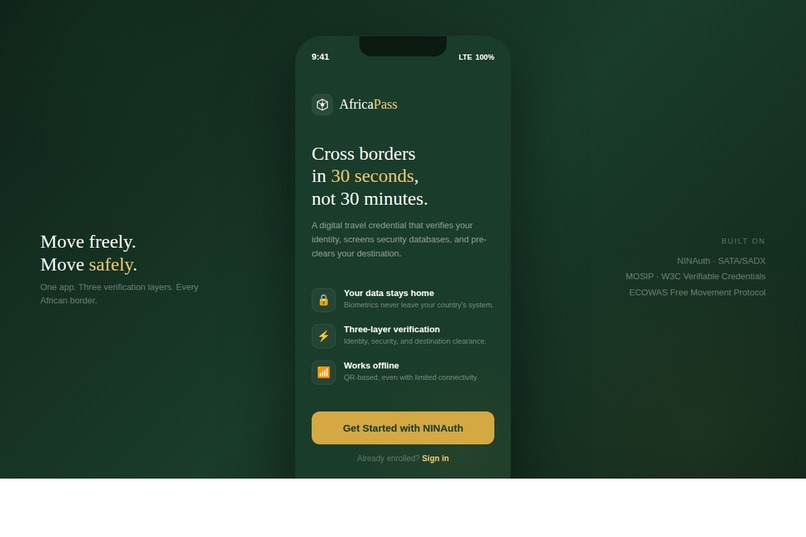
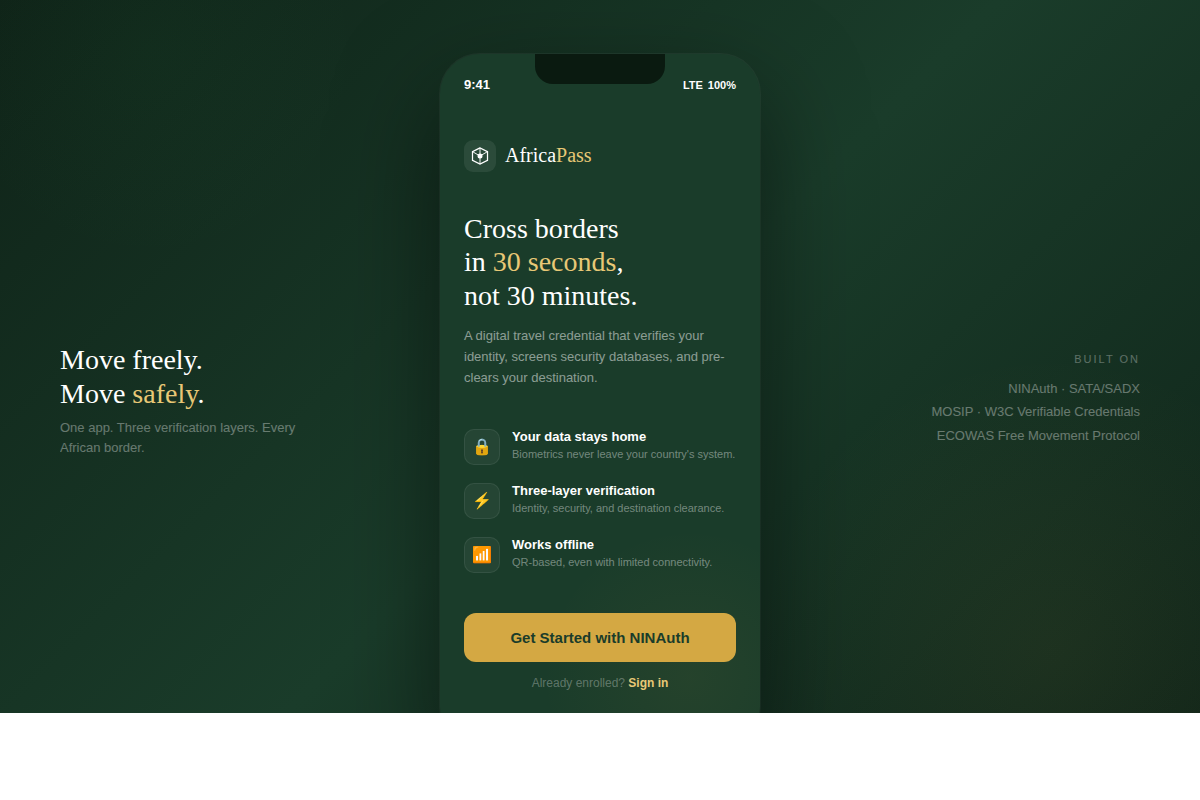
Onboarding
-
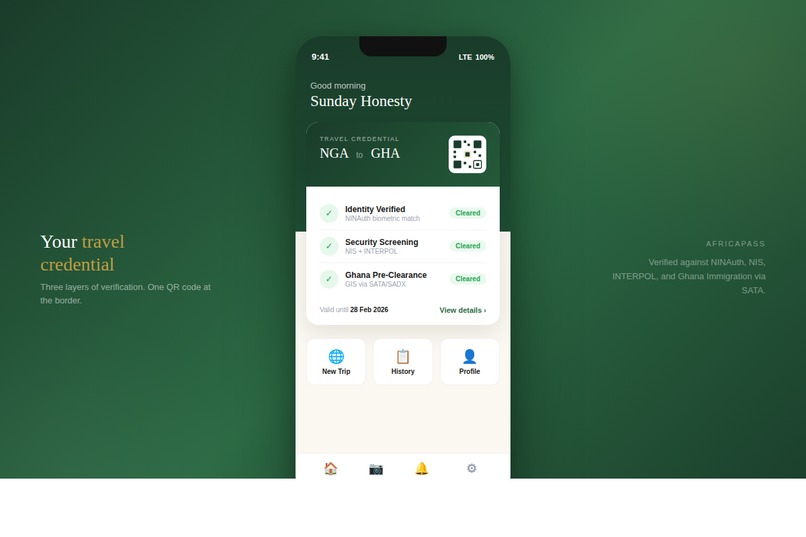
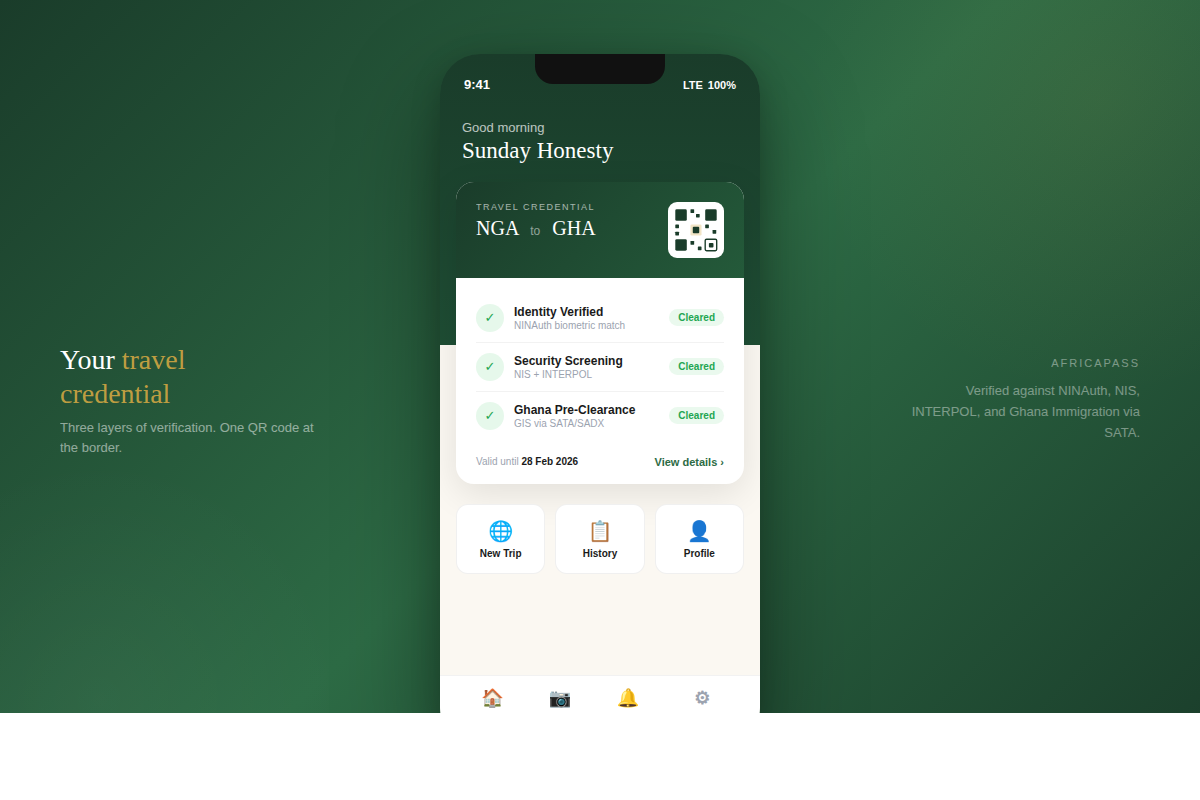
Home Screen
-
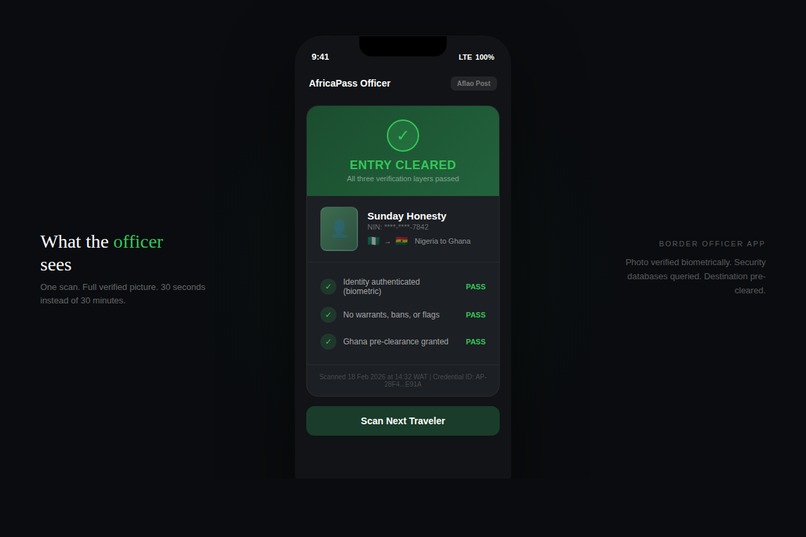
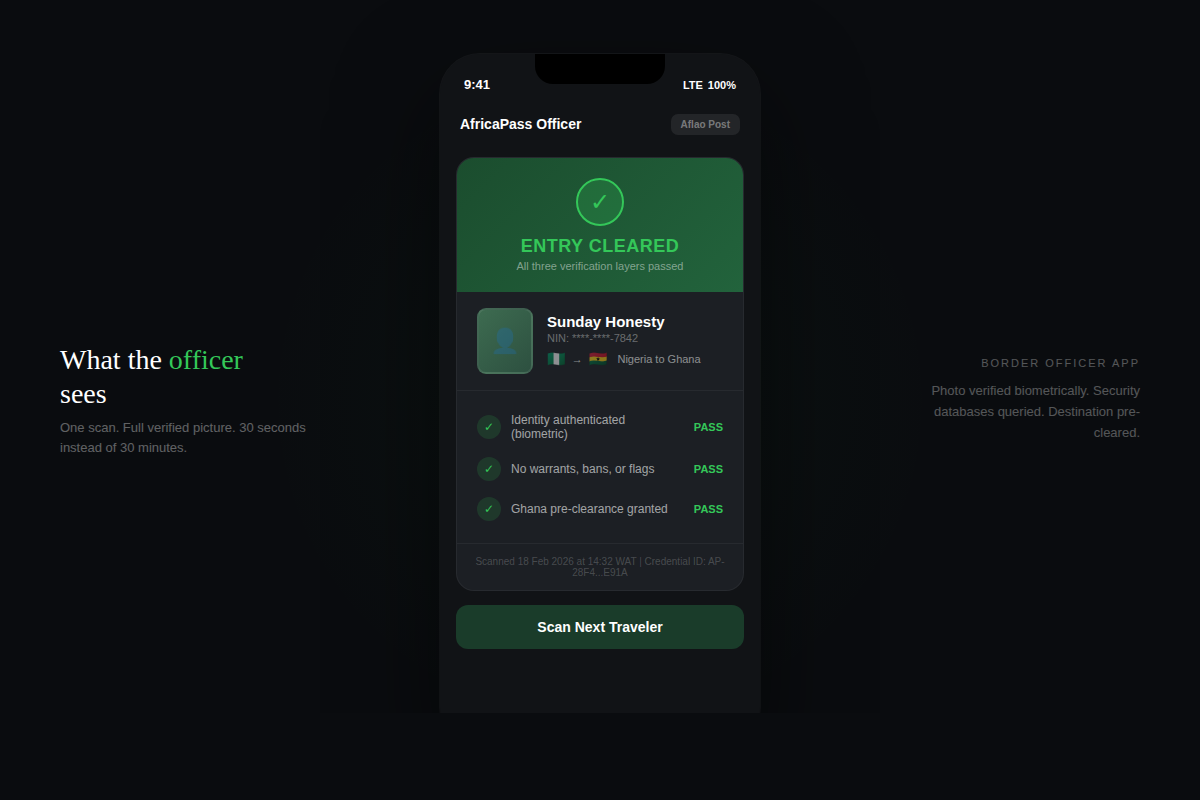
Immigration Officer Scan
-
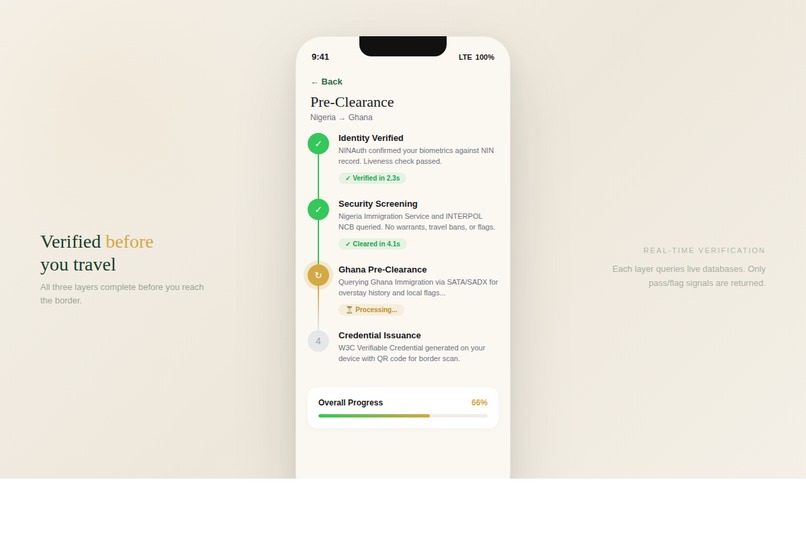
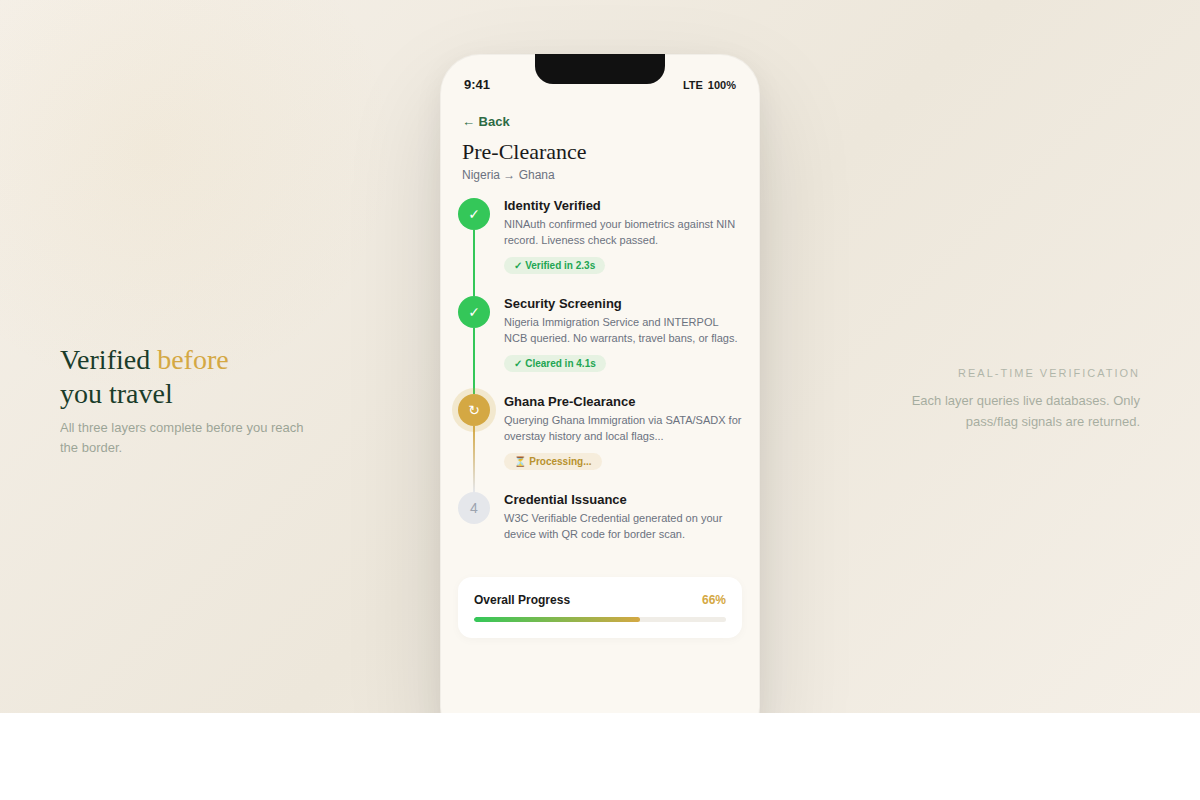
Pre-clearance
Inspiration
I was angry, very angry, that I couldn't sleep all night. That's the truth. And when I shared my frustration and idea with my team member, she immediately felt the same way.
I was reading the 2025 Africa Visa Openness Index and the numbers hit me hard: as of 2026, Africans still need a visa before travel for roughly 47% of trips to other African countries. Meanwhile, in Europe, 29 countries share the Schengen Agreement, a French citizen can drive to Germany or fly to Greece as easily as going between two cities in the same country. 400 million Europeans move freely across a continent. 1.4 billion Africans mostly cannot.
The part that really stung? Travel within Africa is often more restricted for Africans than it is for Europeans or Americans visiting the same countries. A tourist from London can get visa-on-arrival to countries that would make me, a Nigerian, queue at an embassy for weeks. We are strangers on our own continent. I'm a Nigerian student at CMU Africa in Kigali. I've lived this. I've dealt with the visa paperwork, the uncertainty, the wait times. And around me I see classmates from across the continent dealing with the same thing: brilliant people who can't easily visit each other's countries. Some leaders have called these borders "colonial relics that hinder growth." I agree. But being angry isn't enough. I wanted to find a technical solution, something that doesn't just complain about the problem but gives governments a reason to actually open up.
That's when the question hit: why do governments keep these restrictions in the first place? The answer isn't spite. It's trust. They don't trust other countries' identity systems. They can't verify who's crossing their border in real time. They don't have access to each other's security databases. So they default to the blunt instrument of "require a visa for everyone", even though visas are terrible security tools. People overstay, documents get forged, and at most land borders, the officer is just looking at your passport with their eyes anyway. So I asked myself: what if you could give governments better security than visas provide, so they'd be willing to relax requirements in the first place? What if a Nigerian traveler could be verified against Nigeria's NIN database, screened against security databases, and pre-cleared by Ghana's immigration system, all before they even reach the border? That's how AfricaPass was born. From frustration. From the absurdity that I can more easily fly to London than to Accra. And from the realization that the infrastructure to fix this - NINAuth, SATA, MOSIP, all actually exists now. Nobody has just connected the pieces into something a real traveler can use at a real border.
What it does
AfricaPass is a mobile app that lets African travelers pre-verify their identity against both their home country's and destination country's systems before they travel, generating a digital credential for faster, more secure border clearance. The credential is built on three verification layers:
Identity Authentication (origin country): Biometrics verified against your National ID (e.g. NINAuth in Nigeria). Much stronger than a passport photo check. Security Screening (origin country): Immigration service, INTERPOL, and law enforcement databases queried. Only a pass/flag signal is returned, never raw data. Destination Pre-Clearance (destination country): A federated query through SATA's data exchange checks for prior overstays, deportation history, and watchlist entries. Returns green, yellow, or red.
At the border, the officer scans a QR code from the traveler's phone, sees the verified photo and three-layer clearance status, and the traveler is through in about 30 seconds. The credential works offline with periodic sync, which is critical for land borders with limited connectivity.
How we built it
We started by mapping what actually happens at real border checkpoints today. What does the officer check when you depart Lagos? What do they check when you arrive in Kigali? We documented every step and found that even at airports, each country only queries its own database. At land borders like Aflao or Seme, many officers have zero database access at all. We then mapped the competitive landscape: SATA/SADX for cross-border data exchange, Smile ID for identity verification, MOSIP for credentials infrastructure, and the Gatekeepers project from Morocco for airport biometric matching. None of them solve cross-border travel facilitation. The infrastructure pieces exist. The application layer connecting them doesn't. Our technical stack: React Native (mobile), FastAPI + PostgreSQL (backend), integrating NINAuth and Ghana NIA verification APIs, with SATA/SADX as the cross-border protocol. Credentials follow the W3C Verifiable Credentials standard. We'll use the MOSIP Sandbox for prototyping.
Challenges we ran into
The political design problem is harder than the technical one. Getting two governments to let their systems talk to each other is not a coding challenge, but it's a trust challenge. We spent a lot of time thinking about how to make governments feel safe. The answer: federated architecture where each country keeps full control of its data, and AfricaPass only ever receives clearance signals (green/yellow/red), never raw security data. No central database. No data leaves the country. That's not just a privacy feature, but it's the reason governments would actually say yes. Mapping what actually happens at borders. There's very little documentation on the actual step-by-step process at African border posts. We had to piece together the reality from traveler experiences, news reports, and the ECOWAS Commission's own assessments of border challenges. Designing for offline environments. Many land border posts have no reliable internet. The credential needs to be cryptographically verifiable even when the officer's device is offline. This pushed us toward signed credentials that can be validated locally with periodic sync - similar to how boarding passes work on planes.
Accomplishments that we're proud of
We uncovered a gap that the hackathon's own data validates. We analyzed all 8 winning teams from the Upanzi Network's inaugural Digital ID Hackathon across four African regions. Four teams tackled healthcare, two agriculture, one education, one single-country airport check-in. Zero tackled cross-border travel facilitation. We also built something we haven't seen elsewhere: a detailed before-and-after comparison of border crossing with real operational detail. Documenting exactly what Nigeria checks at departure, what Rwanda checks at arrival, what neither can see, and how AfricaPass fills each gap. That evidence base makes the case concrete rather than theoretical.
What we learned
The gap between African policy and African reality is where the real opportunities live. ECOWAS free movement has existed on paper since 1979. AfCFTA envisions free continental movement. Digital ID infrastructure is being built right now. But nobody has connected these into a product a real traveler can use at a real border. We also learned that the pitch to governments isn't "open your borders." It's "we'll give you better security than visas currently provide." Frame it as a security upgrade, not a border opening, and the political calculus changes completely.
What's next for AfricaPass
Our pilot corridor is Nigeria-Ghana, the busiest in West Africa, where both countries already have functioning digital ID APIs and are SATA-aligned. Phase 0 (current): Research and validation. Mapping exact API specs, interviewing frequent border crossers and officers, connecting with the SATA team through CMU Africa's Upanzi Network. Phase 1: Working prototype with NINAuth integration in the MOSIP Sandbox. Credential issuance and QR-based verification flow. Phase 2: Bilateral pilot with 500 to 1,000 frequent travelers on the Nigeria-Ghana corridor. Phase 3: Expansion to other ECOWAS corridors and then East Africa. The goal is simple: an African should be able to move across Africa as easily as a European moves across Europe. The infrastructure is finally being built. AfricaPass will be the app that puts it in people's hands.
Built With
- fastapi
- fastapi-+-postgresql-(backend)
- integrating-ninauth-and-ghana-nia-verification-apis
- postgresql
- react-native
- sata/sadx

Log in or sign up for Devpost to join the conversation.