Inspiration
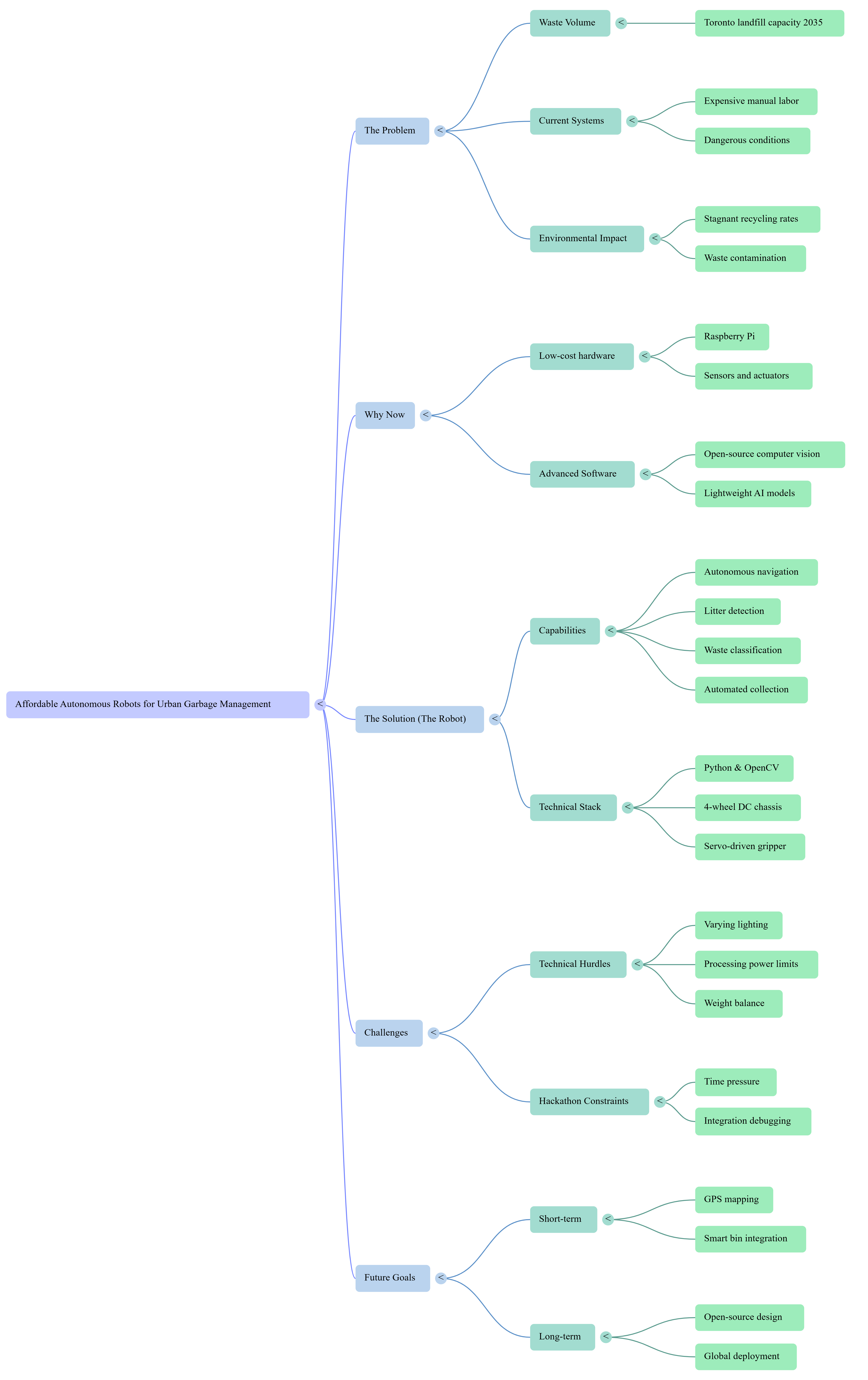
As a 10th standard student from India, I’ve seen firsthand how unmanaged garbage overwhelms cities — from overflowing streets in Coimbatore to massive landfills choking urban spaces. Toronto faces the same challenge, with its Green Lane Landfill nearing capacity by 2035 and recycling rates stuck around 50%.
I got inspired to build affordable robots that can make garbage management smarter and cleaner, because the same low-cost hardware (Raspberry Pi, simple motors, basic sensors) that works in Indian schools can solve real problems in Toronto too. The idea is simple: use teen-level robotics to attack waste at its source.
What it does
Our robot is an autonomous mobile unit that navigates public spaces, detects litter using computer vision, picks up small pieces of trash, and sorts basic recyclables from general waste.
It uses a camera to identify objects, a simple robotic arm or gripper to collect waste, and basic AI to classify items (plastic, paper, metal). It can also alert when bins are full, helping optimize collection routes. In short, it turns chaotic street litter into organized, manageable waste — all built affordably.
How we built it
We used a Raspberry Pi as the brain, paired with a Pi Camera for vision and ultrasonic sensors for obstacle avoidance. The base is a simple 4-wheel chassis with DC motors controlled via motor drivers.
For the arm/gripper, we used servo motors. Computer vision runs using OpenCV and a lightweight model (like MobileNet or custom-trained on small datasets) to detect and classify waste. Everything was coded in Python. We 3D-printed some parts and assembled the rest with off-the-shelf components available in most school labs or online. Total build cost stayed under CAD $150–200 to keep it realistic and scalable.
Challenges we ran into
- Accurate waste detection in varying lighting and cluttered environments — real streets are messy!
- Balancing the robot’s weight with the gripper mechanism so it doesn’t tip over.
- Limited processing power on the Raspberry Pi — we had to optimize the code heavily to run detection in real-time.
Accomplishments that we're proud of
- Successfully built a fully working prototype in under 48 hours that can autonomously detect, approach, and pick up small litter items.
- Achieved decent accuracy in waste classification (plastic vs paper) even with limited training data.
- Kept the entire robot extremely low-cost and simple enough that other teens in India or Toronto can replicate and improve it.
What we learned
- Real-world robotics is 80% problem-solving and 20% coding. Failure teaches faster than success.
- Computer vision sounds easy until you test it outdoors — lighting, angles, and background noise make a huge difference.
- Simplicity wins: fancy solutions often break; keeping the design minimal made our robot more reliable.
- Collaboration and clear documentation matter — even when working alone, thinking about how others could build on it changed how I approached the project.
What's next for Affordable Autonomous Robots for Urban Garbage Management
Next steps include improving detection accuracy with more diverse training data, adding GPS for mapping dirty hotspots, and integrating with smart bins for real-time alerts.
