-
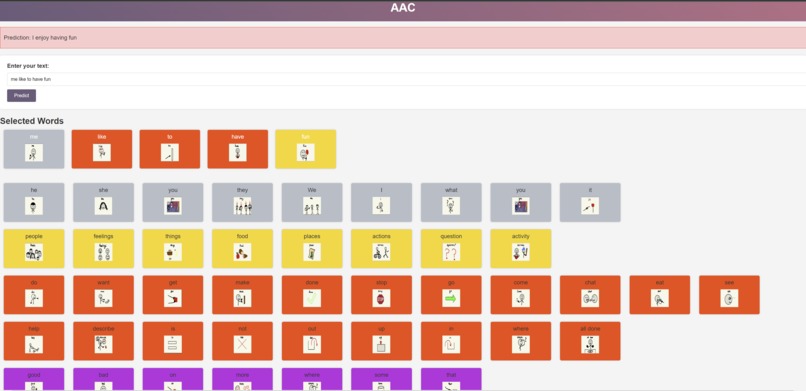
The pictures/phrase chosen and the outcome/translation

Inspiration
Our inspiration came from a member of our group who knows someone who could directly benefit from our project. Witnessing the daily struggles and communication barriers faced by this individual made the need for such a solution palpably evident to our team. It was not just about creating a piece of technology; it was about making a tangible difference in someone's life. By diving deeper into the challenges this person faced, we recognized that they were not alone in their plight. There are countless individuals worldwide who grapple with similar challenges every day, many of whom lack the resources to acquire the overpriced tools available in the market.
What it does
We utilized spaCy and Grammarly/coedit-large models to transform concise phrases into clearer language. The purpose of our project is to provide a solution for individuals who have difficulty using their voice. These programs do exist but are extremely overpriced and expensive. By using free open-source resources, we created a program that is both cost-effective and accessible to a wider audience.
How we built it
Using Git, our team managed to work cohesively. Given that our target users might have diverse technological backgrounds, we emphasized creating a user-friendly interface. We opted for a minimalist design with intuitive controls, ensuring that even individuals without any tech-savvy could navigate and utilize our tool with ease. To achieve this, we used frameworks like JavaScript, HTML, and CSS for the front end and Flask for the back end, ensuring rapid development and seamless integration.
Challenges we ran into
a challenge we faced was that the gammarly AI we were using was struggling to reword/rephrase inputs with such little context. For this, we implemented spaCy, an nlp to help parse and provide context to the phrases. One of the inherent complexities of language is its dependence on context. A word or a phrase can have multiple meanings, and without a broader understanding, it can be challenging to offer an accurate rewording.
Accomplishments that we're proud of
Our team is proud of the implementation of our predictive program. We were able to extract as much implicit context as possible by analyzing the structure, syntax, and semantics of the user-provided text. By identifying the roles of different words in a sentence (like subject, object, verb, etc.), and sometimes even understanding potential topics or themes, we could give the Grammarly model a better foundation upon which to base its corrections and suggestions.
What we learned
Our team learned more about MongoDB as it was a couple of group members' first time using a NoSQL Database. We also learned more about JavaScript as this was the first time implementing JavaScript in a personal project for many of us. We dove into the documentation of different apis and libraries such as Hugging Face and many others. Most importantly we learned more about AAC and how much of an impact technology could have on those who are in need.
What's next for Affordable AAC ( Augmentative and Alternative Communication)
Our team worked diligently on this project, yet we still had many more ideas to implement to improve user-friendliness and accuracy of outputs. We plan on implementing another generative AI to help lead users to what they are trying to say. For example, this can be seen in Apple's messaging system, where the keyboard would give suggestions for the next word they may type.

Log in or sign up for Devpost to join the conversation.