-
-
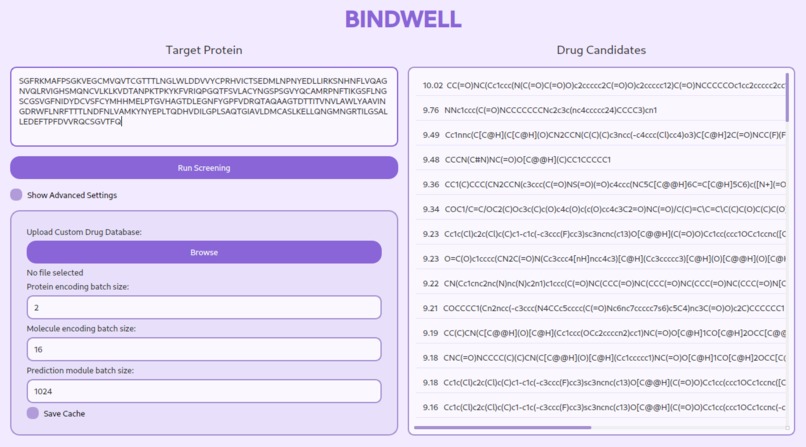
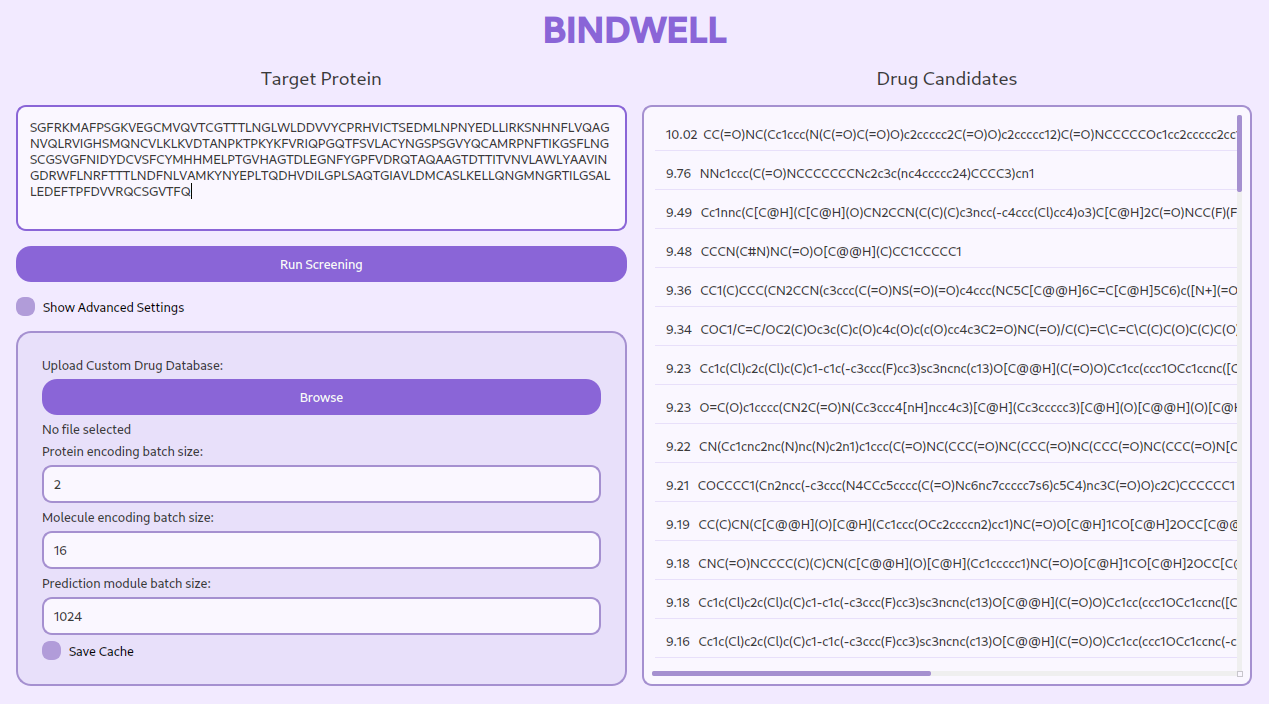
User friendly interface
-
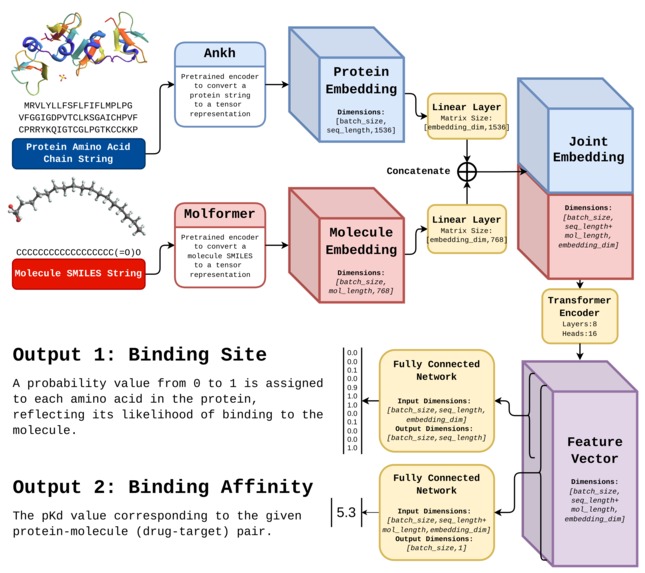
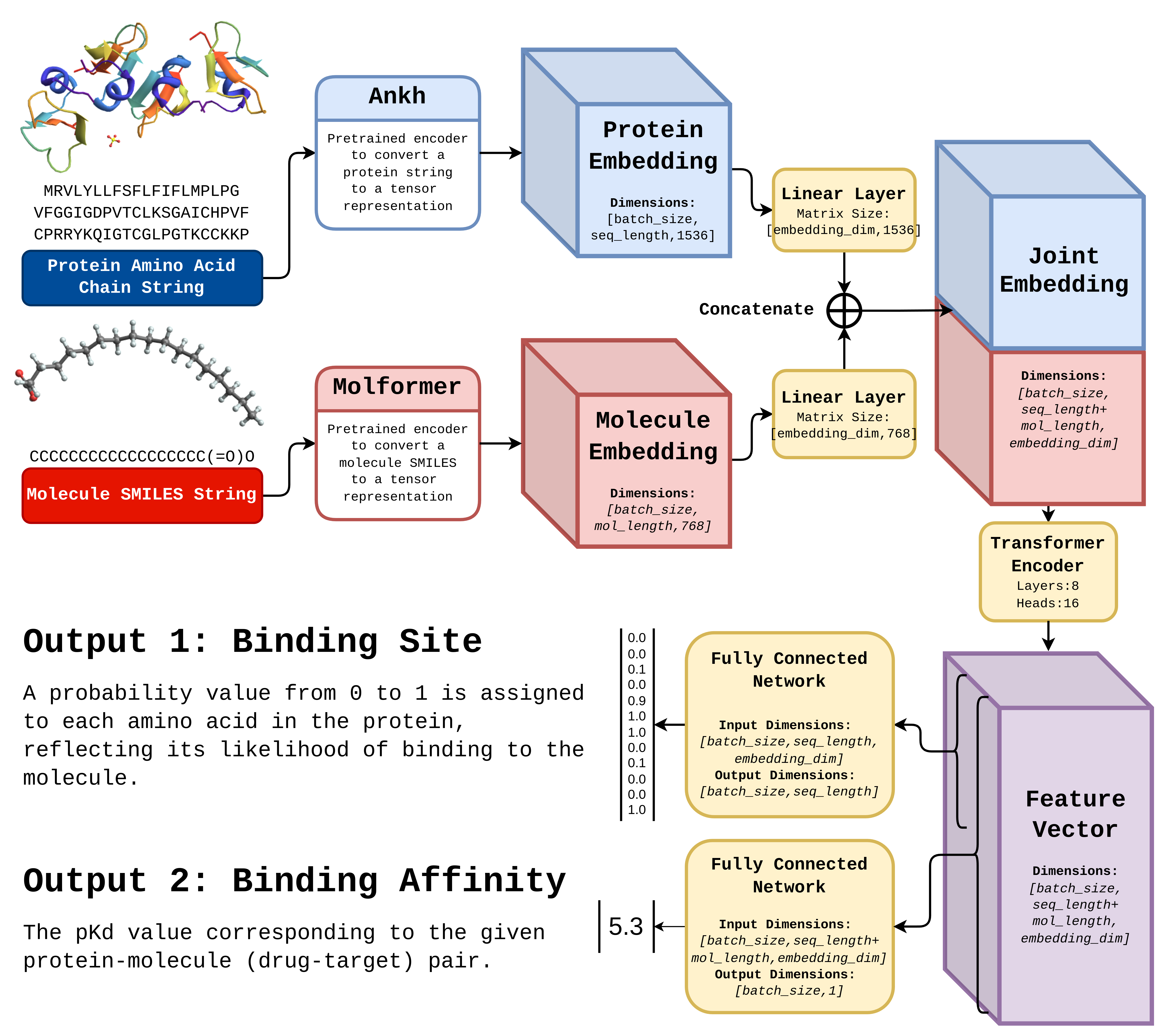
Our novel model architecture
BINDWELL: The intelligent approach to therapeutic development, powered by AI
Inspiration
In 2020, the average American spent over $1,200 on prescription medications [1], with a staggering 1 in 5 Americans unable to afford their medications [2]. The consequences are dire: patients are forced to choose between life-saving treatments and basic necessities. The root of this crisis lies in the staggering cost of bringing a drug to market in the US - a whopping $2 billion and 15 years on average [3].
A significant portion of this expenditure is squandered on the inefficient process of high-throughput screening in drug discovery. The drug discovery process starts with researchers screening millions of compounds to identify those that bind effectively to a particular protein, winnowing down millions of possible drugs to a few hundred promising leads. Current methods used are time-consuming, costly, and have limitations [4]. Consequently, there is significant room for improvement in this critical step of the preclinical phase.
What is Bindwell?
Bindwell revolutionizes pharmaceutical R&D through AI-powered virtual screening, making drug discovery faster, cheaper, and more efficient. Our custom-built AI model AffinityLM predicts drug-protein interactions with unprecedented speed and accuracy.
How it works:
- Input: Target protein sequence
- Process: AI-based screening against a standard library of 500,000 drug-likely compounds with AffinityLM
- Output: Top 100 drug candidates with binding predictions
Key features:
- Speed: Screens up to 700,000 compounds per second (vs. weeks for traditional methods).
- Sequence-based: Works with any protein, no 3D structure needed.
- Comprehensive: Predicts binding affinity rather than binary hits.
- Data-rich: Trained on 20 million drug-protein pairs, the largest dataset ever used in the field.
Bindwell's Accomplishments
- Incredible Inference Time: Screens up to 700,000 molecules per second on consumer hardware, meaning it can screen the entire corpus of known organic chemicals (177 million) in just 4.5 minutes, a 242-year long process with traditional methods [5].
- Successful Prediction of SARS-CoV-2 Inhibitors: Predicted drug inhibitors for SARS-CoV-2 with 85% concordance with existing research [6].
- State-of-the-art Accuracy: Our AffinityLM model matches or surpasses the accuracy of industry models on multiple independent benchmarks. (see Bindwell's github)
Impact
Bindwell's approach to drug discovery offers incredible implications for healthcare and scientific research:
- Rapid Response to Outbreaks: Bindwell's sequence-only model enables immediate screening for new drugs, eliminating the need for time-consuming 3D data or physical compounds, allowing for rapid response to global pandemics and disease outbreaks.
- Advancing Scientific Research: AffinityLM's novel model architecture addresses data scarcity issues, providing a viable path to overcome the longstanding data availability challenge in the field.
- Cost and Time Savings: Bindwell's approach offers a nearly 100% cost reduction compared to traditional methods (such as), while screening thousands of times more compounds, ultimately bringing life-saving drugs to market faster and more affordably.
Building Bindwell
We trained Bindwell's AffinityLM model on a dataset of 20 million drug-target pairs from BindingDB and Uniprot, the largest dataset ever used for this task. AffinityLM uses two language models to encode protein and ligand sequences, followed by linear transformations, concatenation, self-attention, and two prediction heads for binding affinity and site (See Diagram). We then implemented AffinityLM in PyTorch, trained it in 39 hours on consumer hardware, and created a user-friendly frontend with PyQT5. Bindwell and AffinityLM represent a significant milestone in AI-driven drug discovery.
Challenges Bindwell Faced
- Data Scarcity and Overfitting: With only 2 million publically available binding affinities, to prevent overfitting, we developed the AffinityLM architecture to leverage the 18 million protein-ligand binding sites available, enabling a small model without sacrificing accuracy.
- Model Optimization: Balancing model size and hyperparameters was a significant challenge. We iterated through three models, starting small and scaling up, to avoid sacrificing accuracy for efficiency or vice versa.
- Effective Caching: With large molecular embeddings and multiple devices (CPU and CUDA GPU) for inference, to maximize inference times, we had to develop an memory efficient caching method. We made a simple flexible caching strategy that selectively moves data between DRAM and VRAM as needed, though there's still room for improvement.
Looking Forward
We're all deeply committed to contributing to the field of AI-driven drug discovery, and to further accelerate its progress, we plan to publish a research paper detailing our approach to developing AffinityLM. By sharing our work with the scientific community, we also hope to foster more collaboration and innovation in the pursuit of life-changing therapies, especially amidst an AI revolution.
References:
[1] IQVIA Institute for Human Data Science. (2020). The Use of Medicines in the United States: Review of 2020.
[2] National Opinion Research Center (NORC) at the University of Chicago. (2020). Medication Adherence in America: A National Report Card.
[3] DiMasi, J. A., Grabowski, H. G., & Hansen, R. W. (2014). Cost of developing a new drug. Journal of Health Economics, 47, 20-33.
[4] Kolb, P., & Caflisch, A. (2006). Automatic docking and pharmacophore discovery. Journal of Medicinal Chemistry, 49(24), 7384-7392.
[5] Kolukisaoglu, H. U. (2010). High-throughput screening. In Encyclopedia of Industrial Biotechnology: Bioprocess, Bioseparation, and Cell Technology (pp. 1-13). John Wiley & Sons, Inc.
[6] Beck, B. R., Shin, B., Choi, Y., Park, S., & Kang, K. (2020). Predicting commercially available antiviral drugs that may be effective against the COVID-19 virus. Journal of Medical Virology, 92(6), 911-920.


Log in or sign up for Devpost to join the conversation.