-
-
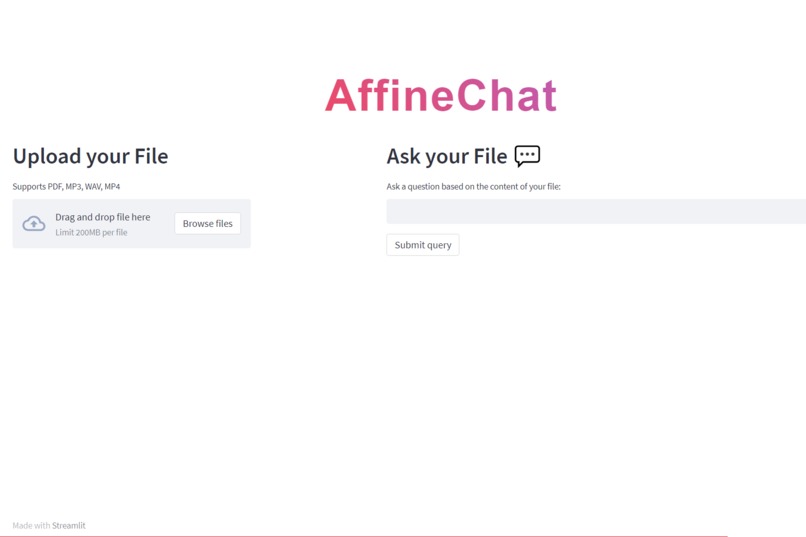
AfineChat UI
-


Inspiration
Frequently, we encounter a common challenge that involves the need to reference specific sections of files such as research papers, manuals, or recorded meetings. However, the traditional manual search process can be time-consuming, exhausting, and often fails to provide quick and accurate results.
This issue arises when we have to retrieve relevant information or extract specific details from extensive documents. In the case of research papers, for example, locating a particular concept or citation within a lengthy article can be a daunting task, requiring significant time and effort to scan through the document manually.
Similarly, when referring to manuals or recorded meetings, finding a particular procedure or discussion becomes arduous due to the vast amount of content that needs to be sifted through. This manual search process often involves skimming through pages, scrolling through long transcripts, or even listening to entire recordings, leading to frustration and wasted time.
Moreover, relying solely on manual search methods can result in inaccuracies or incomplete retrieval of information. Human errors may occur during the search process, leading to missed details or overlooked sections. Additionally, the lack of quick and accurate results can hinder productivity and impede efficient decision-making.
the motivation to address the challenges posed by the time-consuming and exhausting manual search process, which often lacks quick and accurate results, has prompted the exploration and development of AI-powered solutions like AffineChat, which holds the promise of revolutionizing information retrieval, enabling efficient and accurate referencing within various types of files, ultimately saving time, improving productivity, and enhancing decision-making processes.
What it does
The primary purpose of the system is to provide assistance to users in various aspects related to information retrieval and knowledge exploration. It serves as a tool that aids users in finding specific information, addressing complex queries, and navigating through extensive amounts of data to locate relevant information tailored to their specific requirements.
By leveraging advanced language processing capabilities, the system can effectively understand user inputs and interpret their needs. It can handle a wide range of inquiries, ranging from simple fact-based questions to more intricate and nuanced queries that involve multiple contextual factors.
When users are in search of specific information, the system actively guides them through the process, offering suggestions and refining search parameters to optimize results. It comprehends the nuances of user queries, allowing for more accurate and contextually relevant responses.
How we built it
The development process began by utilizing the Dolly 3 billion model as our foundation. Initially, we focused on training the model for general question and answer tasks, fine-tuning its capabilities to comprehend a wide range of queries and provide accurate responses.
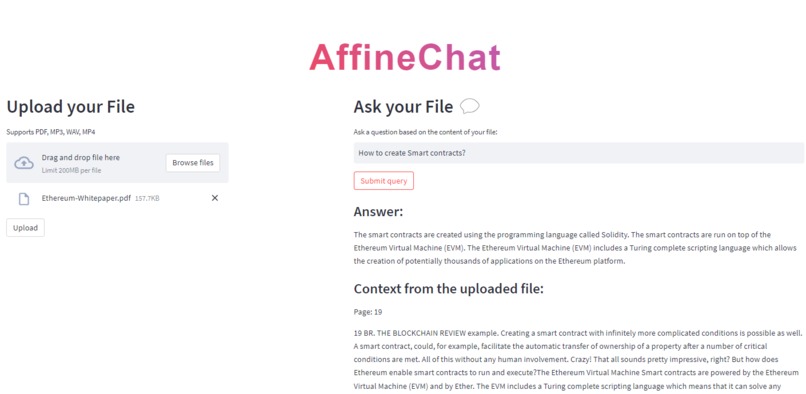
Once we achieved satisfactory results in the general Q&A domain, we proceeded to enhance the system's capabilities by enabling it to query specific documents. This involved incorporating techniques to extract information from structured and unstructured data sources such as research papers, manuals, or recorded meetings. By training the model on relevant document collections, we enabled it to effectively retrieve specific information based on user queries.
Building upon these achievements, our next objective was to expand the system's functionality beyond textual data and extend it to work with multimedia. This required integrating additional tools and techniques to process and analyze multimedia content such as images, audio, and video. By incorporating these capabilities, we aimed to enable users to obtain information not only from text-based sources but also from visual or auditory content.
Challenges we ran into
Throughout the development process, extensive experimentation and iterative improvements were undertaken. We fine-tuned the model by utilizing large-scale datasets, refining its understanding of various language patterns, document structures, and multimedia processing techniques. This iterative approach allowed us to continuously improve the system's accuracy, performance, and responsiveness.
Moreover, the development process involved a collaborative effort, with a multidisciplinary team comprising researchers, data scientists, and engineers. Regular knowledge sharing, feedback loops, and rigorous testing were integral to the process, ensuring the system's reliability, robustness, and adherence to quality standards.
Accomplishments that we're proud of
What we learned
Potential of Open source technologies, Reliability of Databricks as a platform and time stamp citation is also required when Querying against multimedia files
What's next for AffineChat: Ask Your Files, They'll Answer
We are currently working on expanding the citation capability to incorporate time stamp of the multimedia file. We are also planning to give users the option to choose another alarm from pool of multiple LLMs.
Currently for textual data, the application accepts PDF file, we plan to expand AffineChat to take textual data of various format
Built With
- amazon-web-services
- chroma
- databricks
- langchain
- python
- starlette
- streamlit


Log in or sign up for Devpost to join the conversation.