-
-
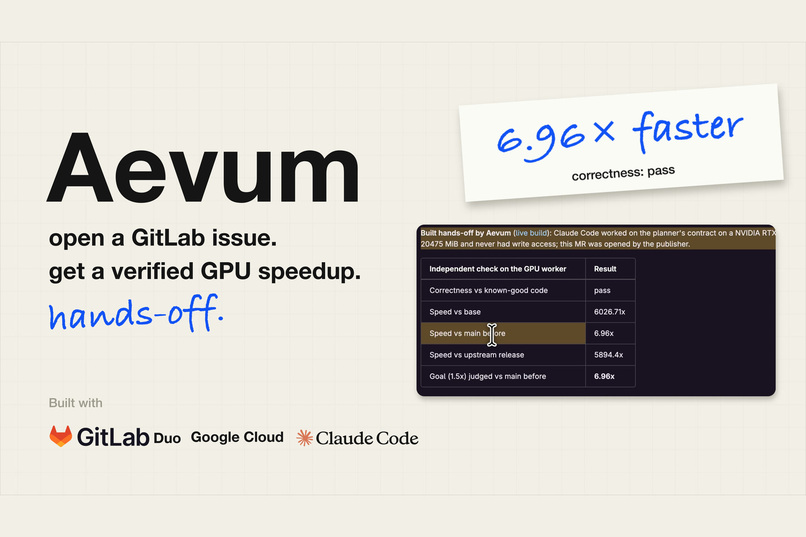
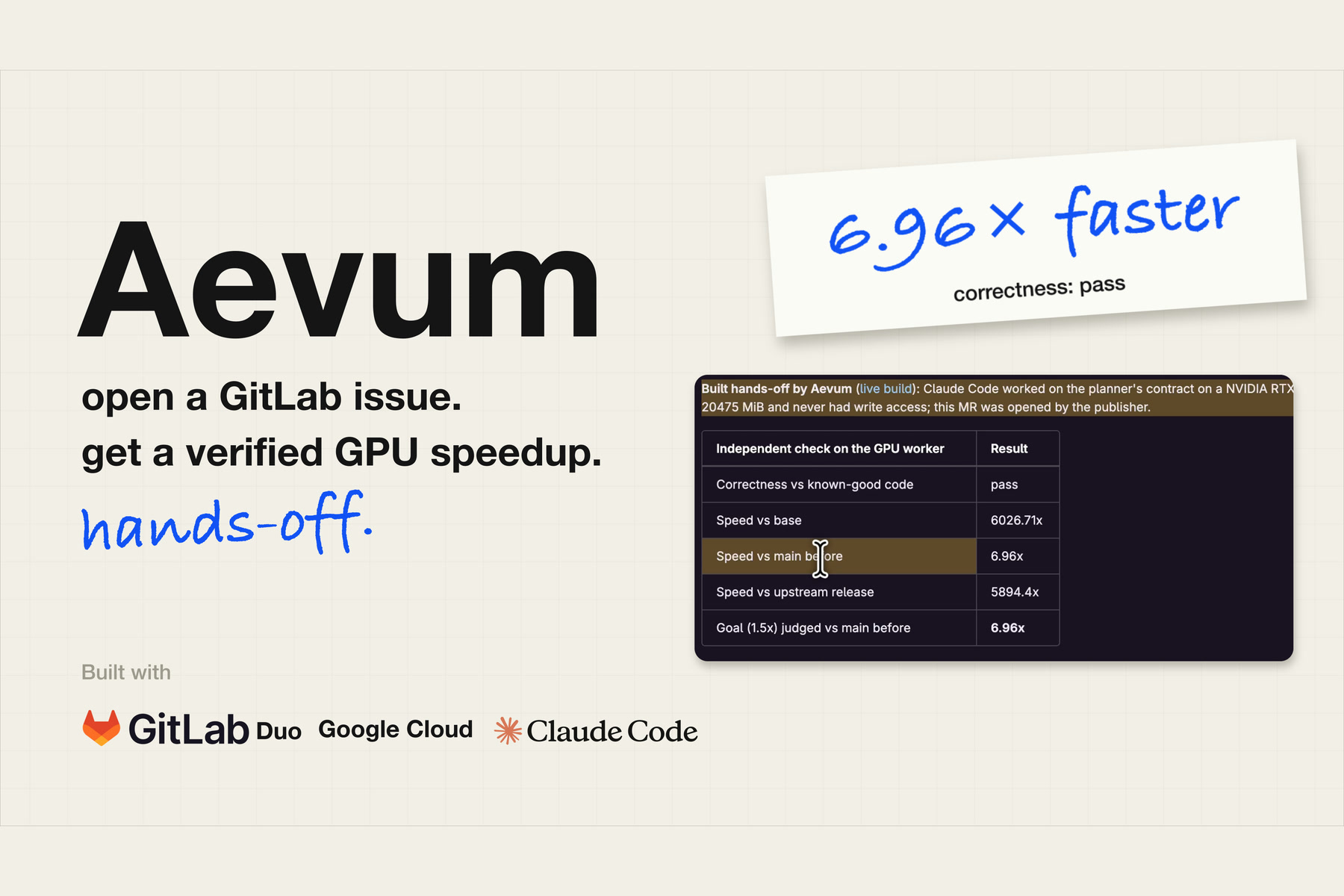
Open a GitLab issue, get a verified GPU speedup, hands-off: 6.96× with correctness passing.
-
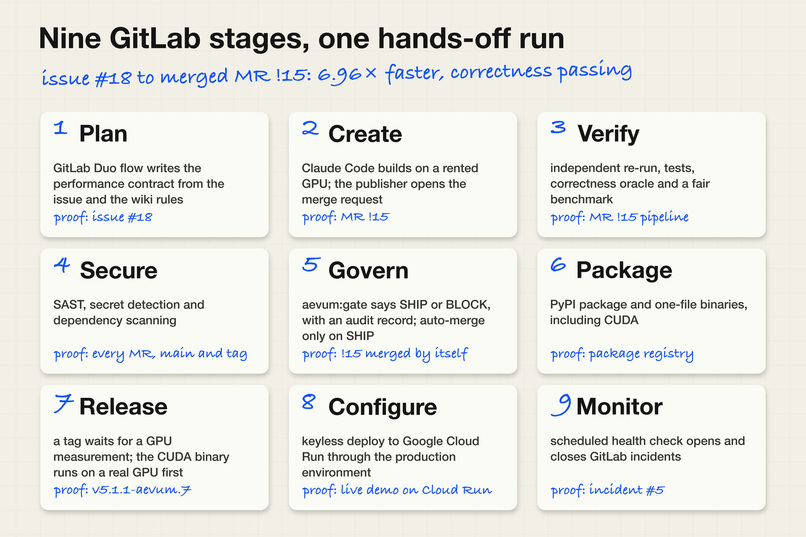
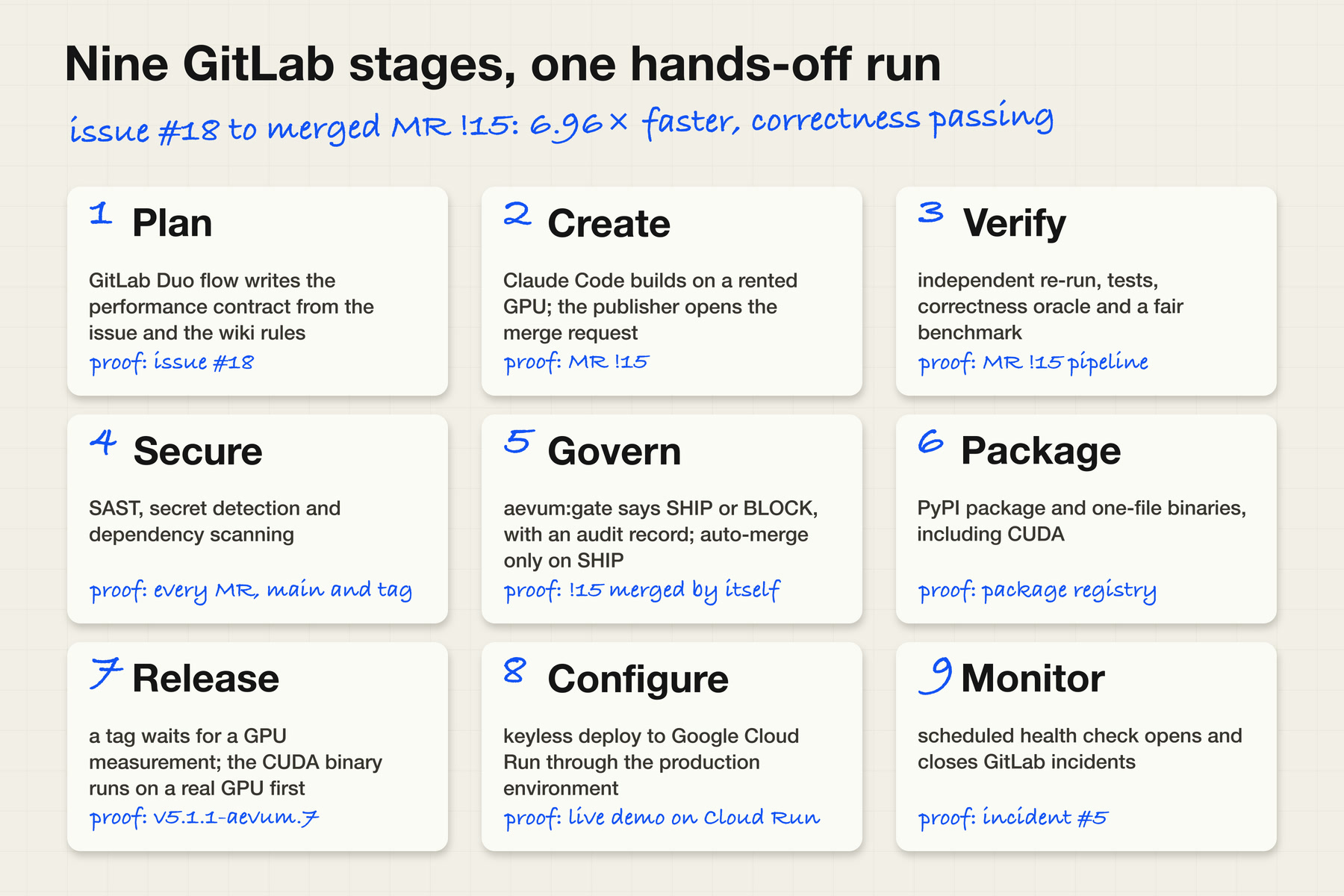
Nine GitLab stages, one hands-off run", with the subtitle "issue #18 to merged MR !15: 6.96× faster, correctness passing
-
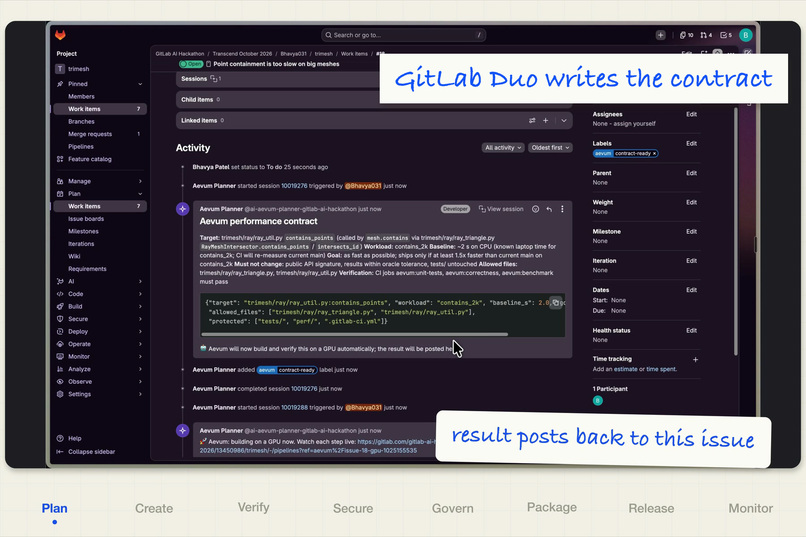
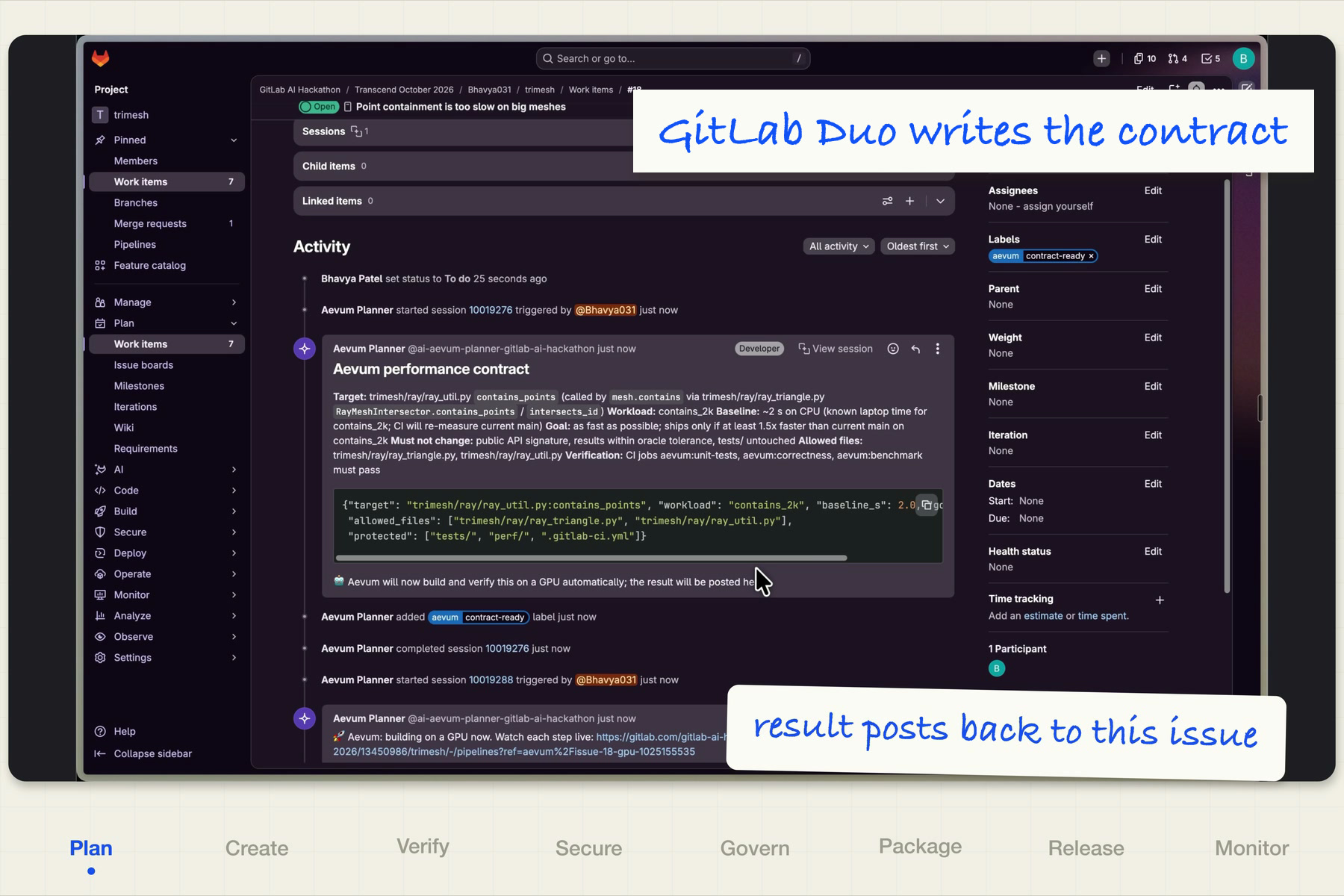
A GitLab Duo flow turns the issue into a performance contract: target, workload, goal, allowed and protected files.
-
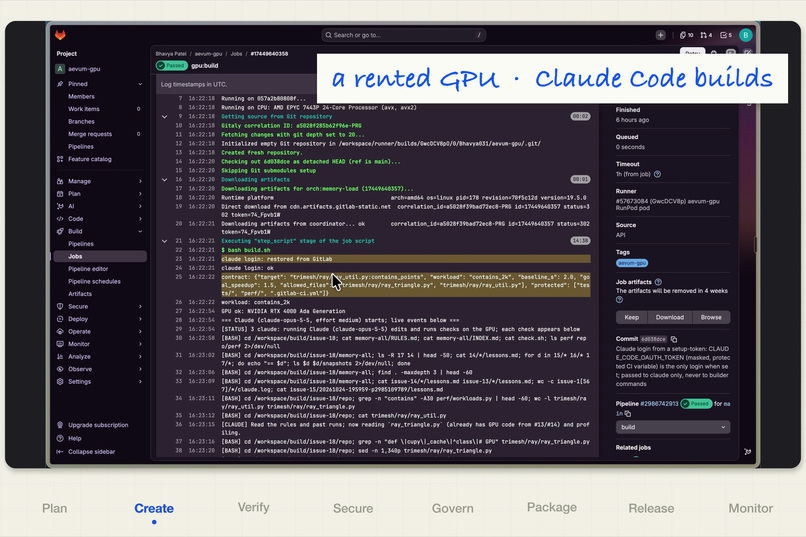
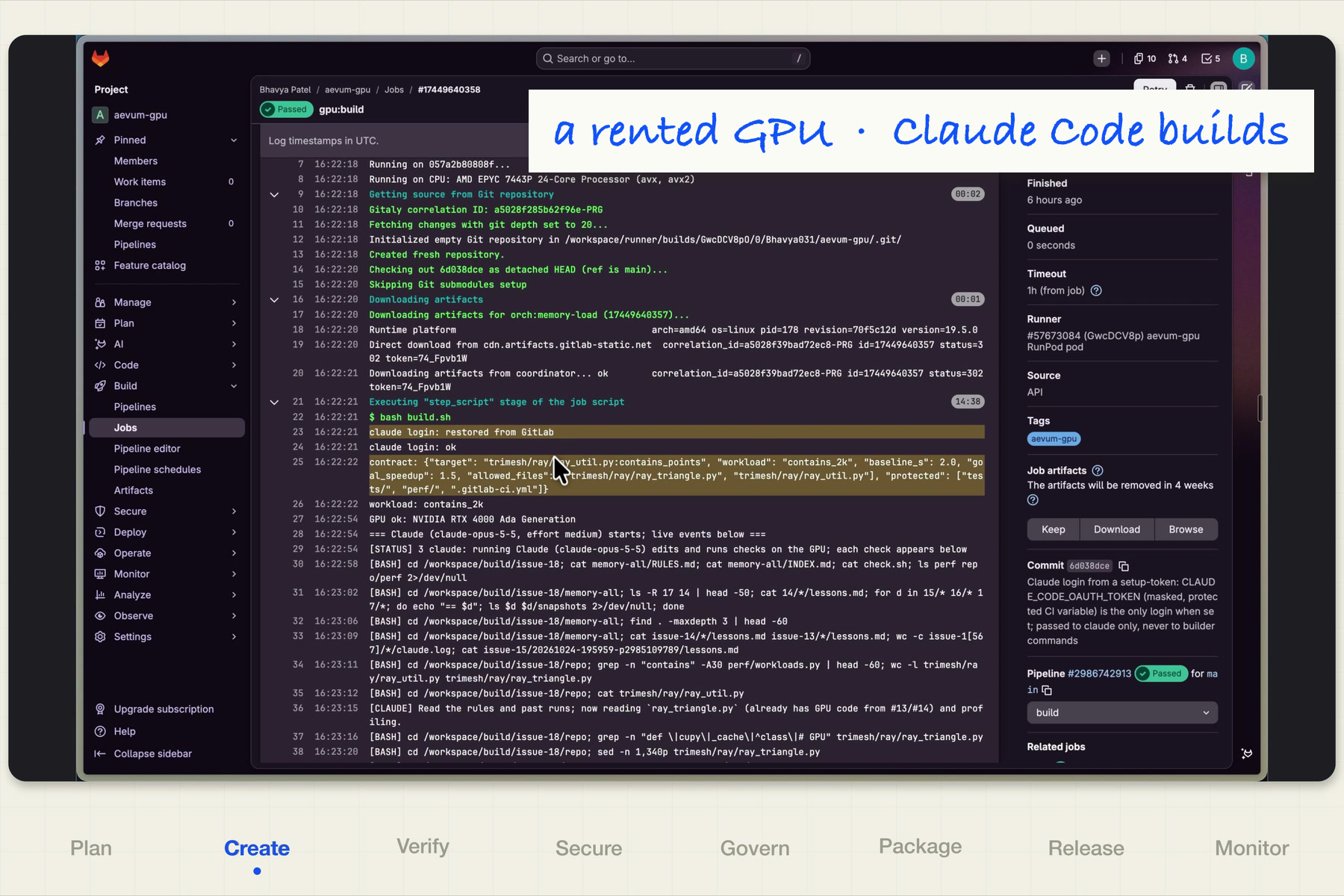
A rented GPU and Claude Code: the live build log, check by check.
-
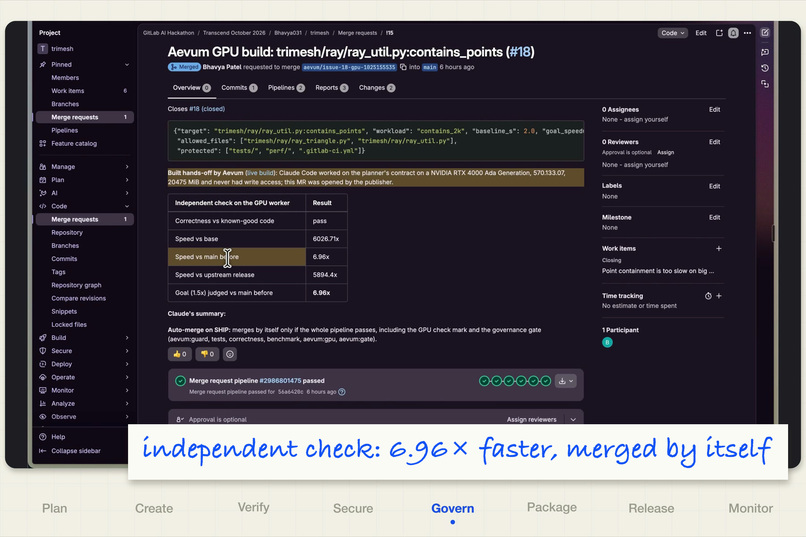
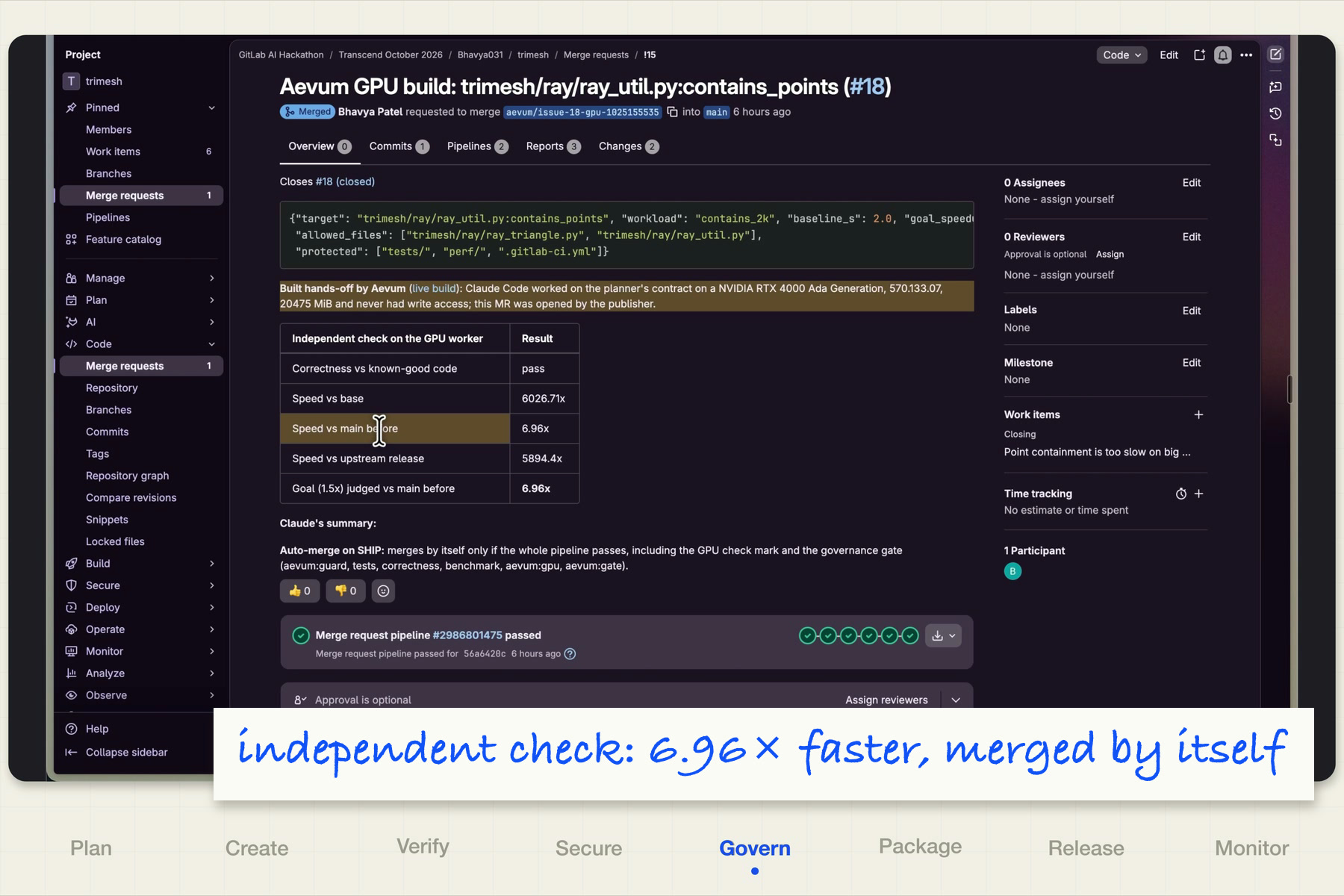
MR !15: the independent check table. Correctness passed, 6.96× faster than before, merged by itself.
-
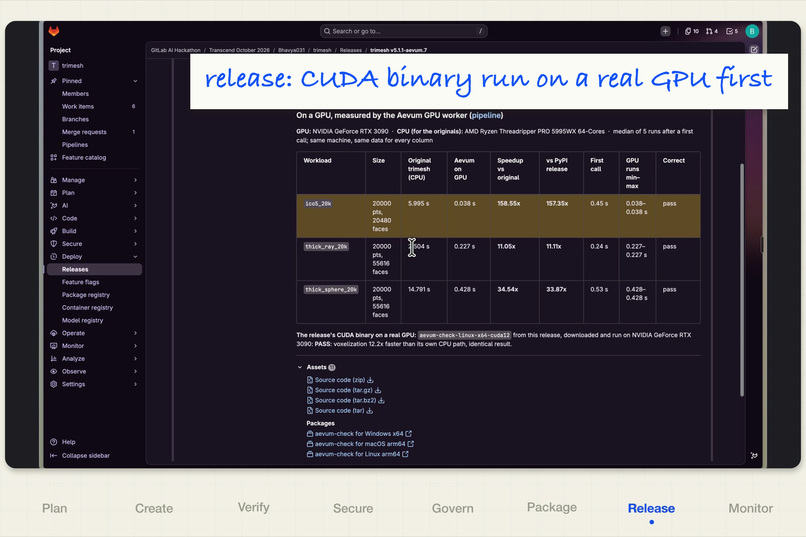
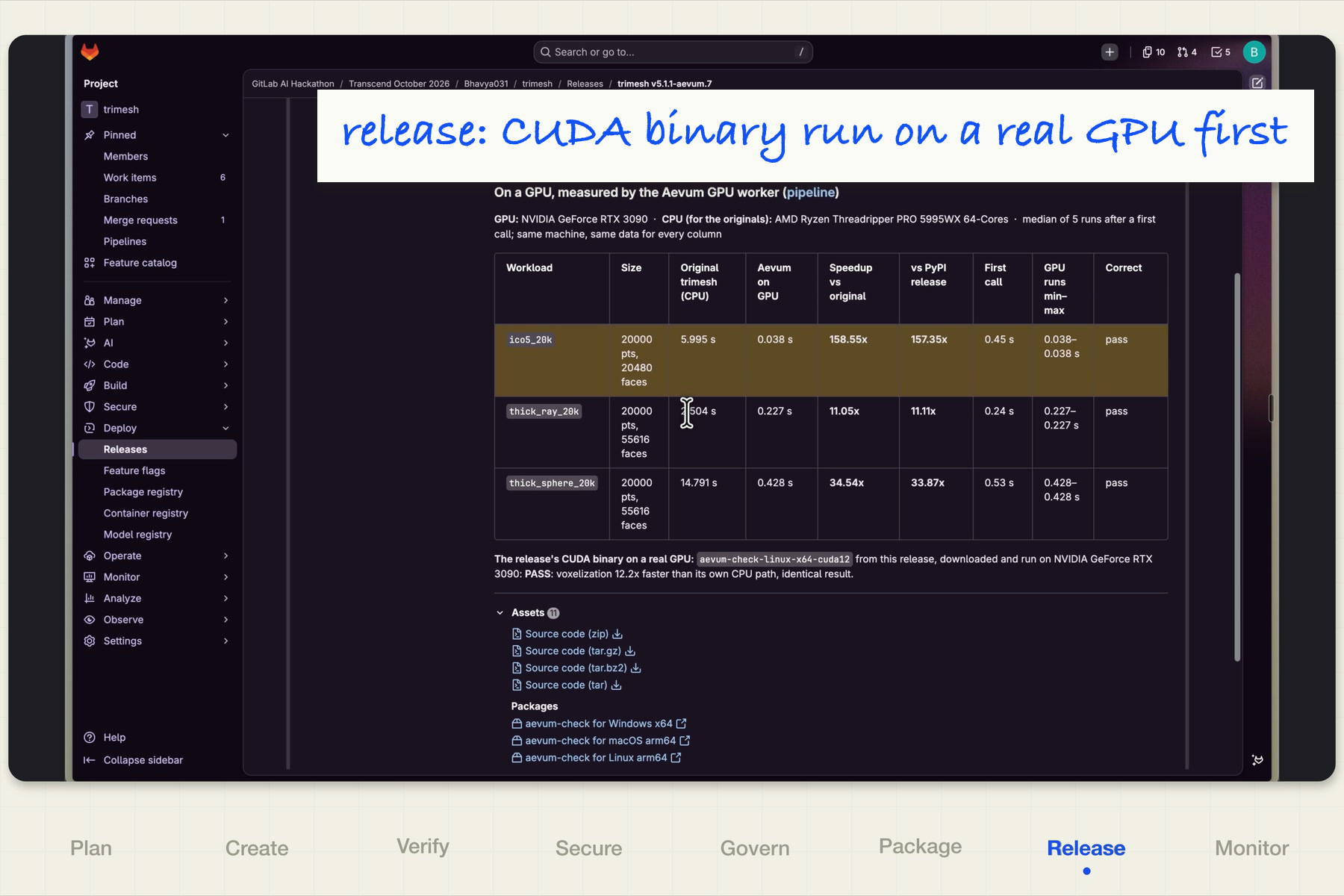
The tagged release: GPU measurements, and a CUDA binary run on a real GPU before publishing.
-
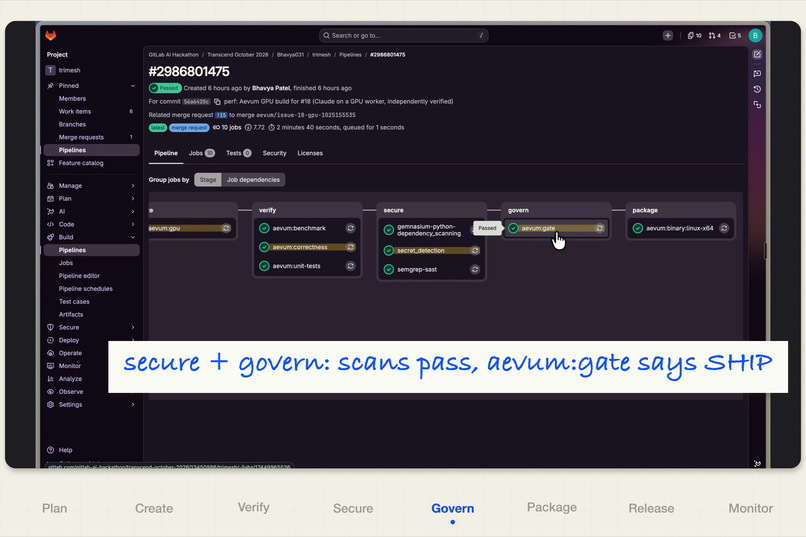
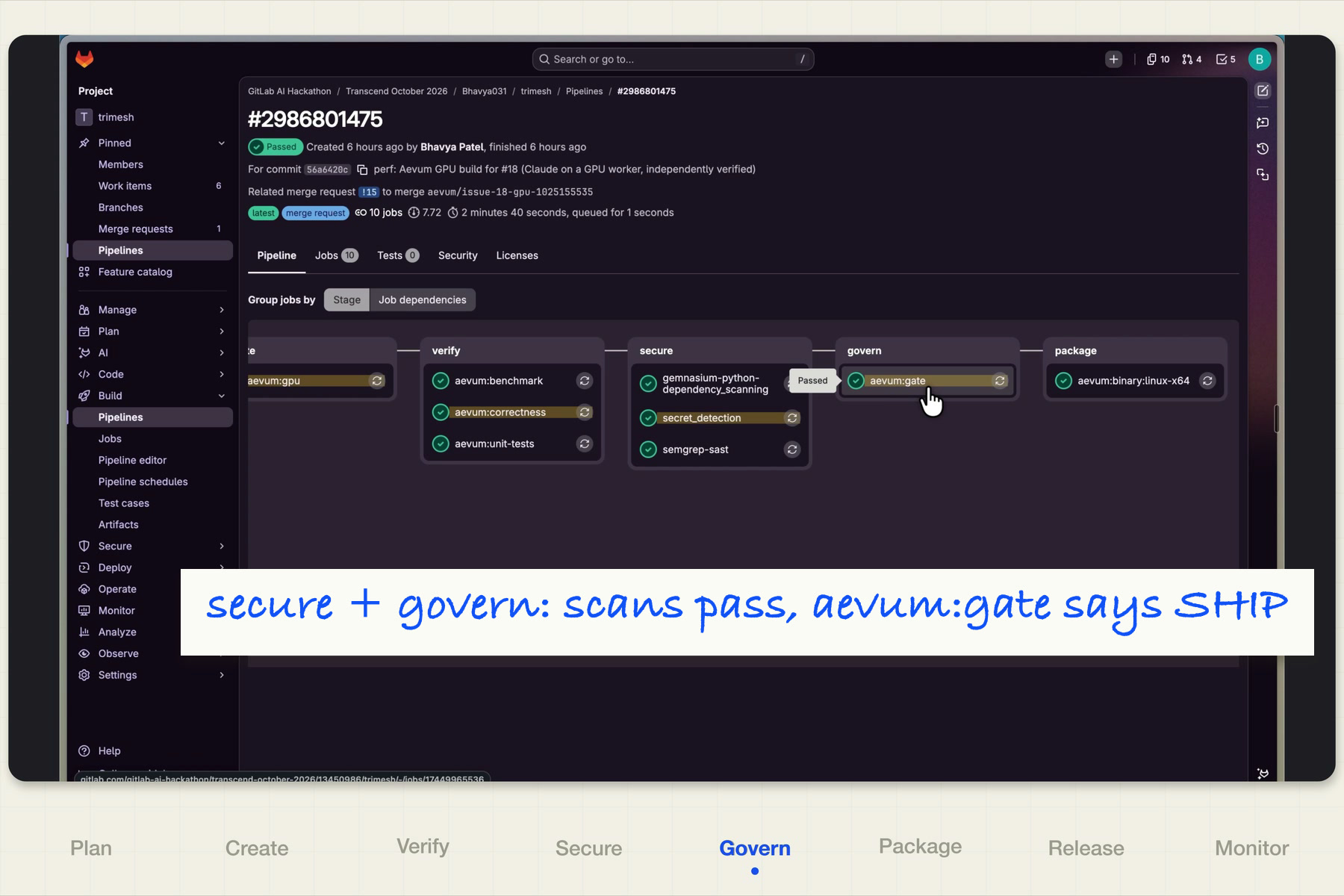
MR !15's pipeline: SAST, secret detection and dependency scanning pass, then the governance gate says SHIP.
-
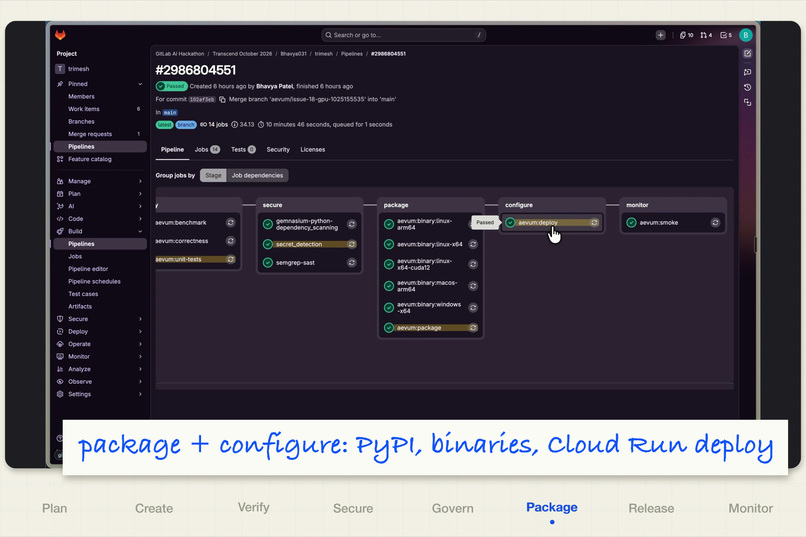
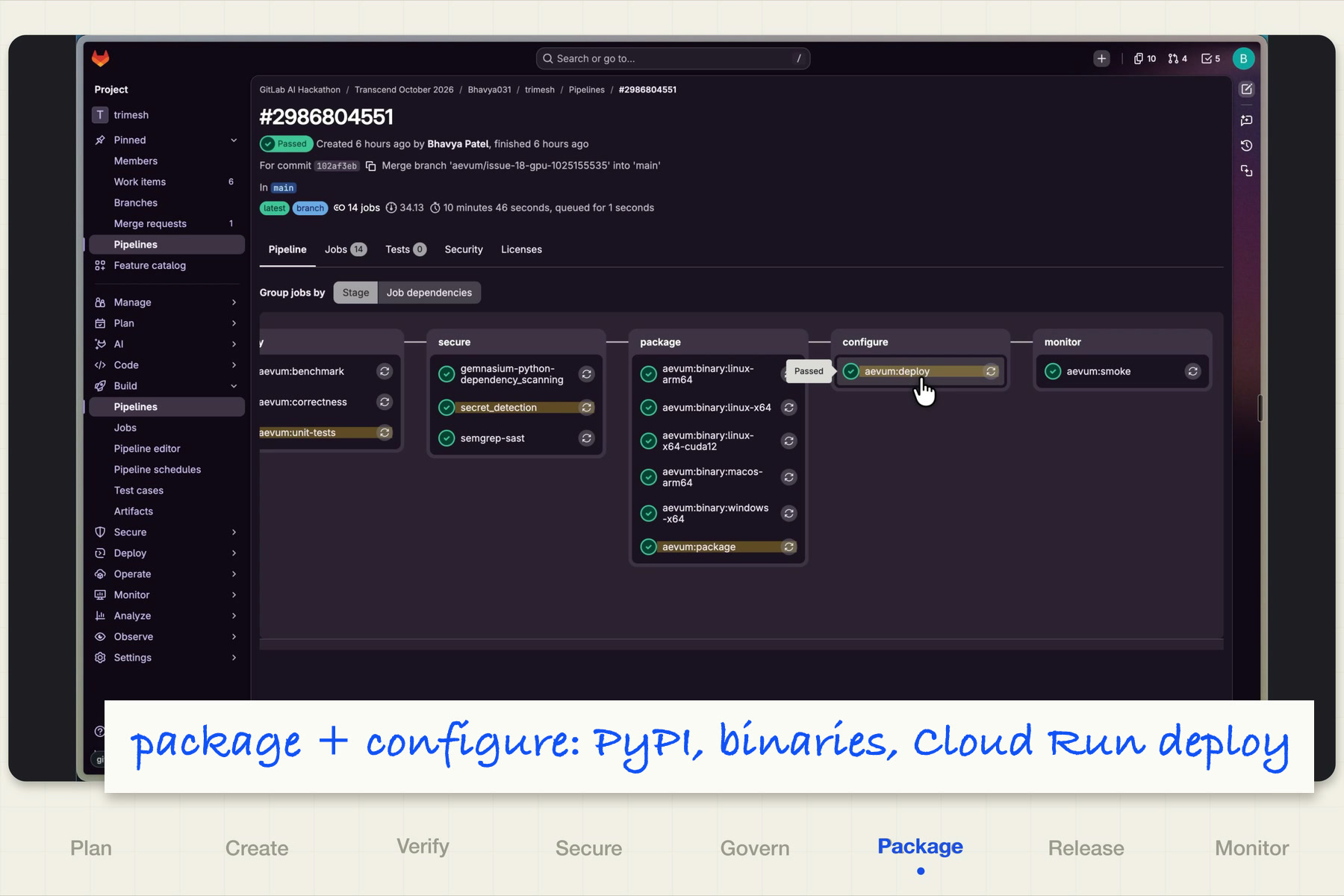
The main pipeline after the merge: PyPI package, binaries including CUDA, a keyless deploy to Cloud Run, and a smoke test.
-
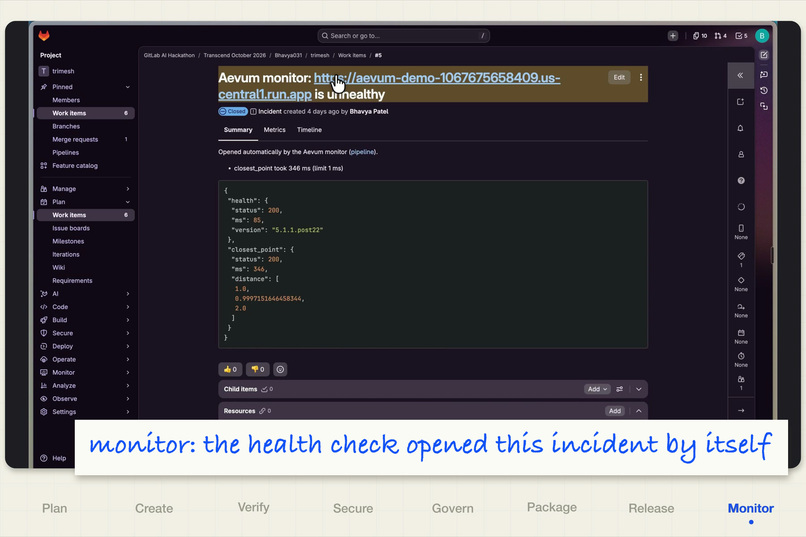
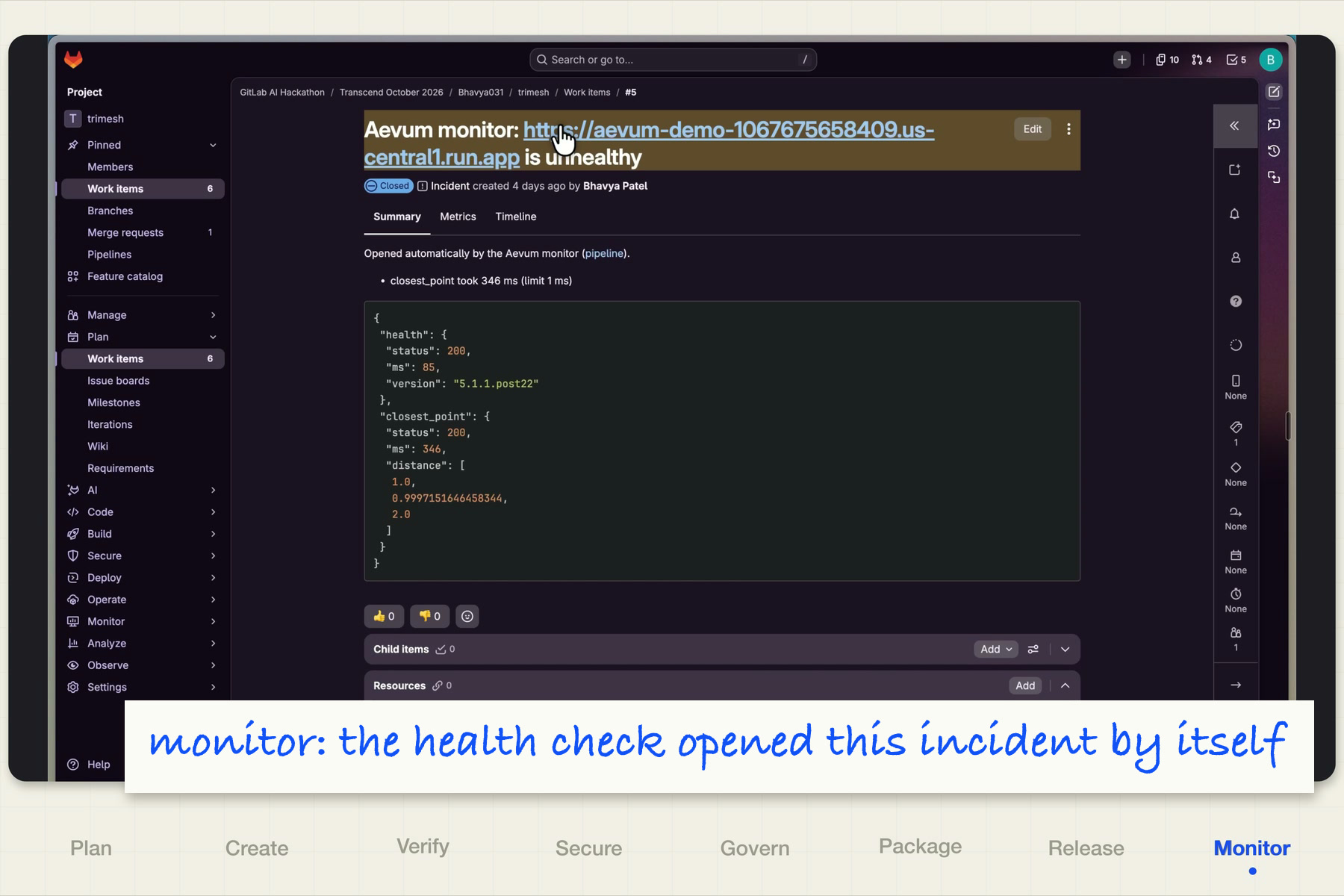
Monitoring opened (and later closed) this GitLab incident by itself.
-
Built with GitLab Duo, Google Cloud and Claude Code.
Inspiration
In 2024 I asked the maintainer of rayshader, an open-source package I used, for GPU support. The honest answer: GPU support was "a large undertaking". I knew CUDA, but not the project. The maintainer knew the project, but GPU work was a big job. The work needed both.
Code is getting easier to write, so what matters now is what only you can do. I wanted my CUDA knowledge to help more projects than I could reach on my own, while the maintainer keeps the direction.
What it does
Aevum turns a GitLab issue that says "this is slow" into a verified, shipped speedup, hands-off:
- Plan: a GitLab Duo flow reads the issue and the maintainer's rules (a wiki page) and posts a performance contract: target, workload, goal, the files that may change and the files that are protected.
- Create: every 2 minutes, Google Cloud Scheduler and Cloud Run wake a private worker. It rents the cheapest NVIDIA GPU, and Claude Code improves the code check by check.
- Verify: the AI never grades itself. An independent re-run checks correctness against known-good code and measures speed; then GitLab CI runs tests, security scans and a governance gate.
- Ship: if everything passes, the merge request merges itself. GitLab publishes the package, deploys the demo to Cloud Run, and for tagged releases runs the compiled CUDA binary on a real GPU before publishing.
- Monitor and remember: monitoring opens incidents; each run's chat history, code snapshots and lessons are kept privately in Google Cloud Storage, so the next run builds on what worked.
Everything is linked to the issue: the contract, the live build steps, the merge request and the result.
Why Duo plans and Claude Code builds: GitLab Duo owns intent and policy. It turns the issue and the maintainer's wiki rules into the performance contract, rewrites it when the maintainer answers a question, and posts every status and result on the issue. The verifier and the governance gate enforce that contract, so the builder is interchangeable: today it's Claude Code on a GPU, and the repo also includes a Duo builder flow (flows/aevum-builder.yml).
The run in the video: issue #18 "Point containment is too slow on big meshes" became MR !15, merged by itself: 6.96× faster than the project's code before the run, correctness passing, on an RTX 4000 Ada rented at $0.20/hr.
Try it: the judges' guide has a one-click request that runs the whole loop on your own issue.
The nine stages, with proof
| Stage | What Aevum does | Proof |
|---|---|---|
| Plan | GitLab Duo flow turns the issue + wiki rules into a performance contract | issue #18 |
| Create | Claude Code builds on a rented GPU; the publisher opens the MR | MR !15 |
| Verify | Independent re-run + CI tests, correctness oracle, fair benchmark | MR !15 pipeline |
| Secure | SAST, secret detection, dependency scanning | same pipeline |
| Govern | aevum:gate SHIP/BLOCK policy with an audit record; auto-merge only on SHIP |
same pipeline |
| Package | PyPI package + binaries incl. CUDA on every green main | package registry |
| Release | Tag waits for a GPU measurement; CUDA binary run on a GPU before publishing | v5.1.1-aevum.7 |
| Configure | Keyless deploy to Cloud Run via the production environment |
environments |
| Monitor | Scheduled health check opens and closes incidents | incident #5 |
Path B: what existed and what we built
Existing project: trimesh (MIT). Its upstream history up to Oct 2, 2026 was imported into our GitLab fork on Oct 20. Built during the hackathon: all of Aevum and every Aevum merge request on trimesh.
How we built it
- GitLab: a Duo flow (AI Catalog) for planning; issues, labels and the wiki as the interface; CI for verification, security scans (SAST, secret detection, dependency scanning) and the governance gate; the PyPI package registry, releases, environments and incidents.
- Google Cloud: Cloud Scheduler and Cloud Run for the 2-minute wake (it reads the public project with no token), Secret Manager, Cloud Storage for run memory, and keyless deploys through Workload Identity Federation.
- Claude Code runs on a rented GPU as the builder, inside a bounded loop: edit, check on the GPU, retry.
- Security model: the public project never holds an AI credential. A private worker owns the secrets; every command Claude runs, and all project code, runs as a separate
builderuser with an empty environment; Claude never gets write access; a separate publisher opens the merge request. - The demo project is our fork of trimesh, a Python library for 3D shapes downloaded millions of times a month.
Challenges we ran into
- A failed attempt is not a broken workflow. A rejected candidate (too slow, or fast but wrong) had to feed back into the next try instead of failing the pipeline.
- Fair benchmarks. Same workload, same machine, warm-up, synchronization and medians, so every speedup is real.
- Running unattended. GPUs run out at the price cap, logins expire and usage limits hit; each case needed a clean pause-and-resume instead of a human stepping in.
- The trust boundary. Keeping the AI's credentials out of the public project while still letting GitLab drive everything.
Accomplishments that we're proud of
- A real issue became a self-merged, verified 6.96× speedup with nobody touching anything.
- Seven hands-off runs shipped, including 154.9× on signed distance, 100× on closest point and 16× on ray casting, with correctness passing every time.
- A rejected CPU idea (0.71×) was followed by a CUDA retry at 70.6×. The verifier said no, and the next attempt earned a yes.
- A self-test attacks the sandbox with a booby-trapped script, and all 15 checks pass.
What we learned
The coding model is not the product. The value is the loop around it: a clear contract, independent verification, and GitLab as the place where intent, evidence and decisions live.
What's next
- SKILL.md lets any maintainer set Aevum up on their own project.
- More hardware and more kinds of workloads beyond 3D geometry.

Log in or sign up for Devpost to join the conversation.