-
-
-
-
-
-
-
-
-
-
-
-
Diagram
-
Archicteture
-
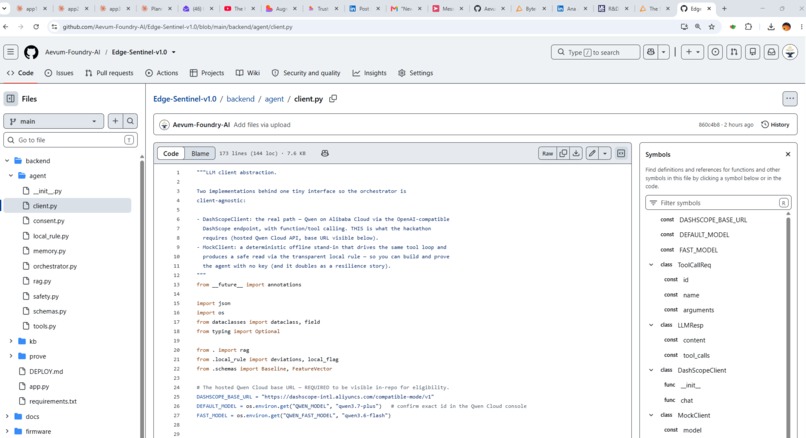
Evidence
-
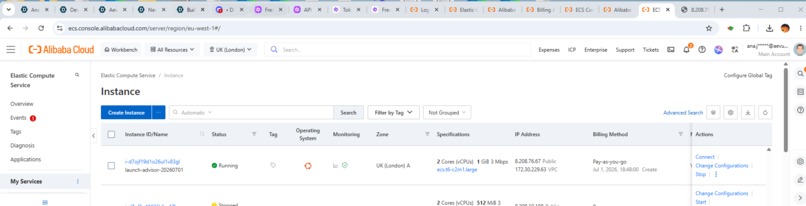
Evidence
Inspiration
Most wearables make the same three trades. They lock you into one company's ecosystem, they send your most intimate signals off your wrist to a cloud you do not control, and the moment the network drops they stop being useful. The newest, most celebrated bands are no exception.
We are developing Aevum Terra, a rural cooperative wellness community planned for the Alentejo and Algarve and meant to take shape over the coming years. In a place like that, none of those trades is acceptable. Privacy is not a setting, it is the point. Connectivity cannot be assumed. And the people who would benefit most are often the least served by a subscription-locked, cloud-dependent device.
So we built the opposite: a wellbeing wearable that senses at the edge, reasons with a cloud agent only over the few derived numbers you consent to share, keeps working when the network does not, and never makes a diagnosis.
Underneath the engineering there is a simpler idea. A good wellbeing device gives you a way to understand how you are doing when you cannot quite put it into words. That matters for anyone on a hard day. It matters most for the people who struggle to be heard at all, which is why we care so much about children and teens with SEND (the UK term for Special Educational Needs and Disabilities). For a child whose hardest sentence is "I'm not okay today," a calm, consented signal read together with a trusted adult is a way to be understood without having to find the words. Same device, same restraint, giving a voice to the people a cloud wearable would serve last.
What it does
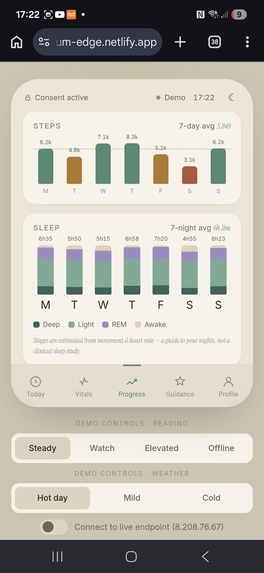
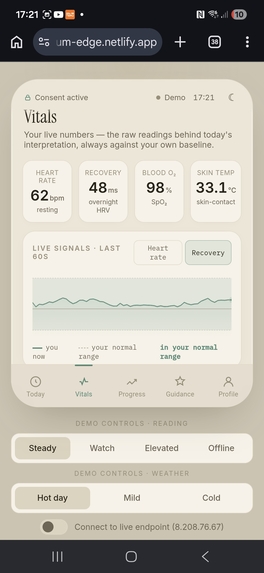
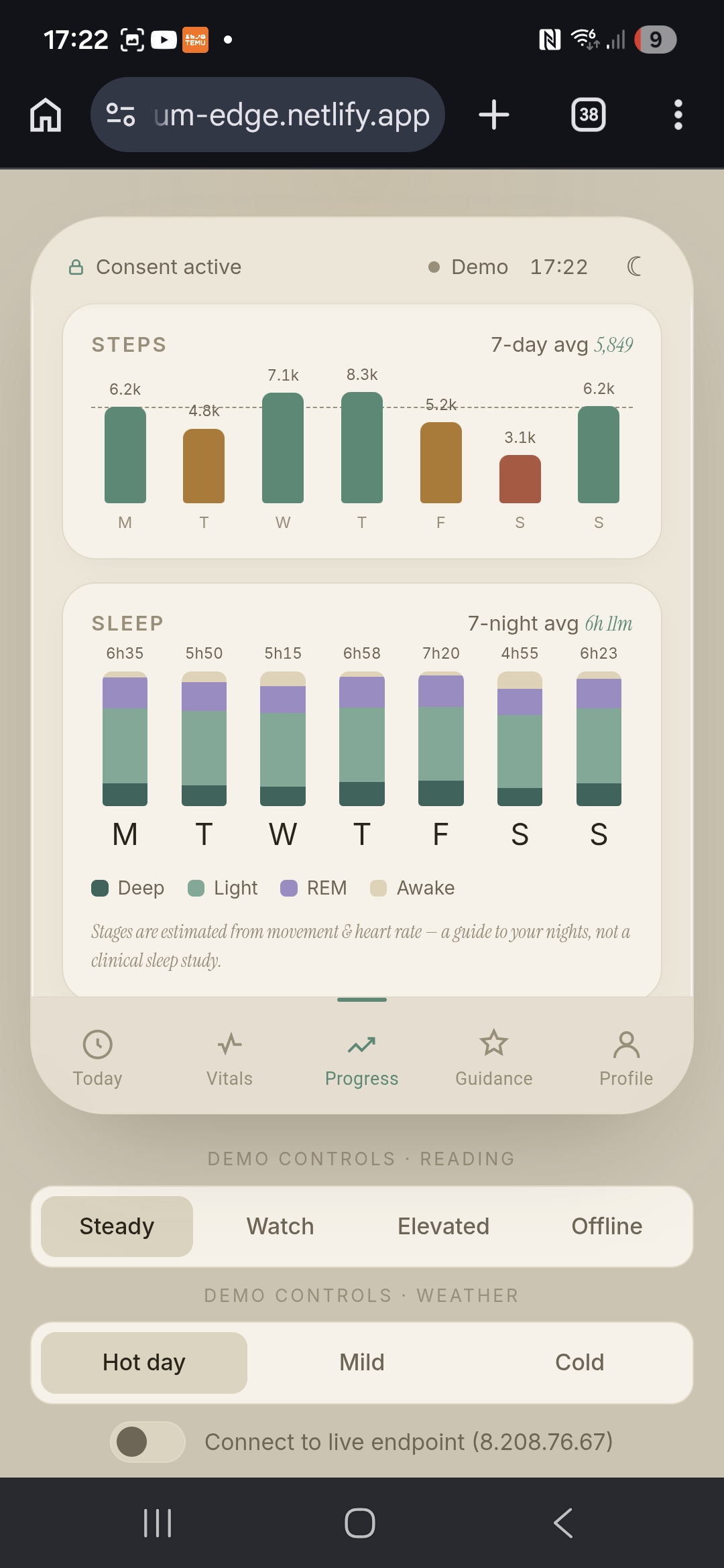
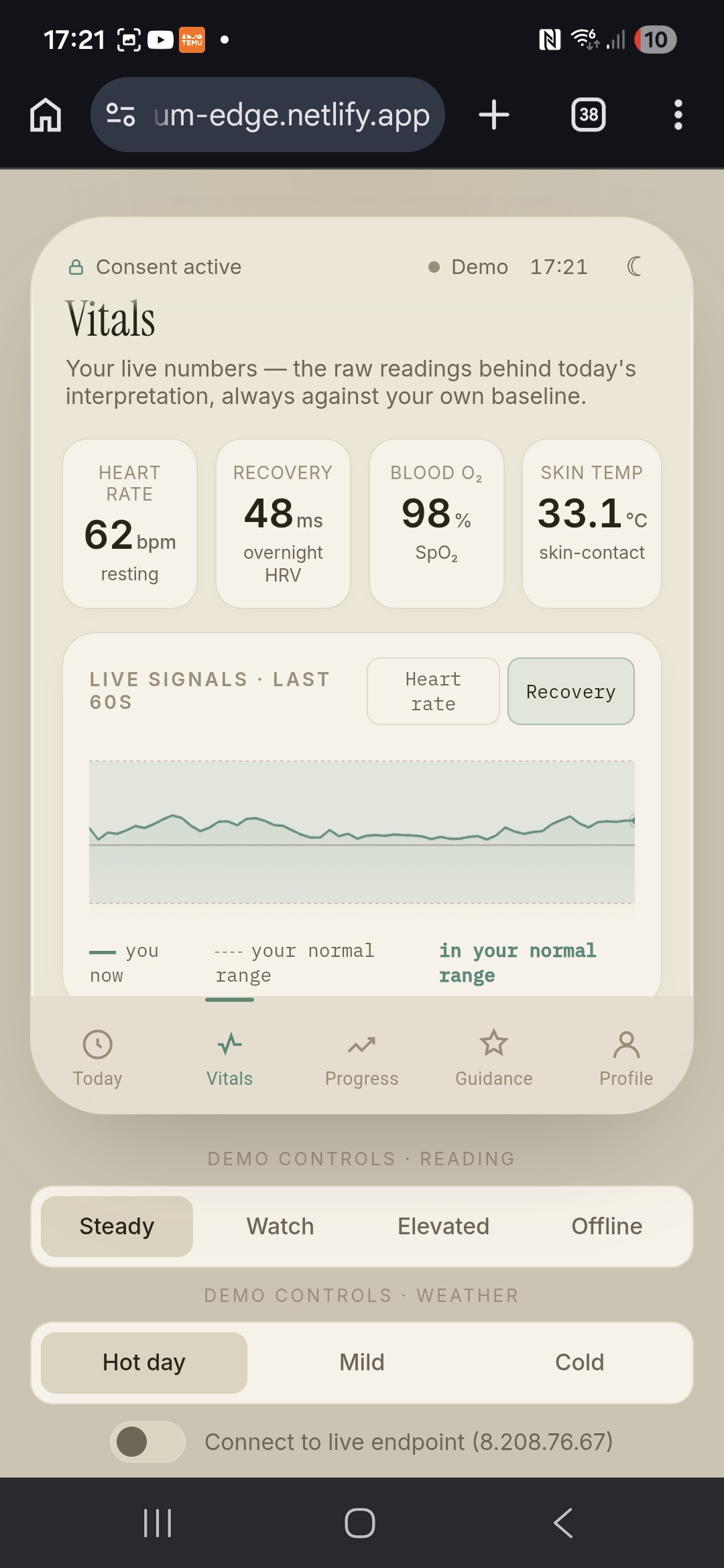
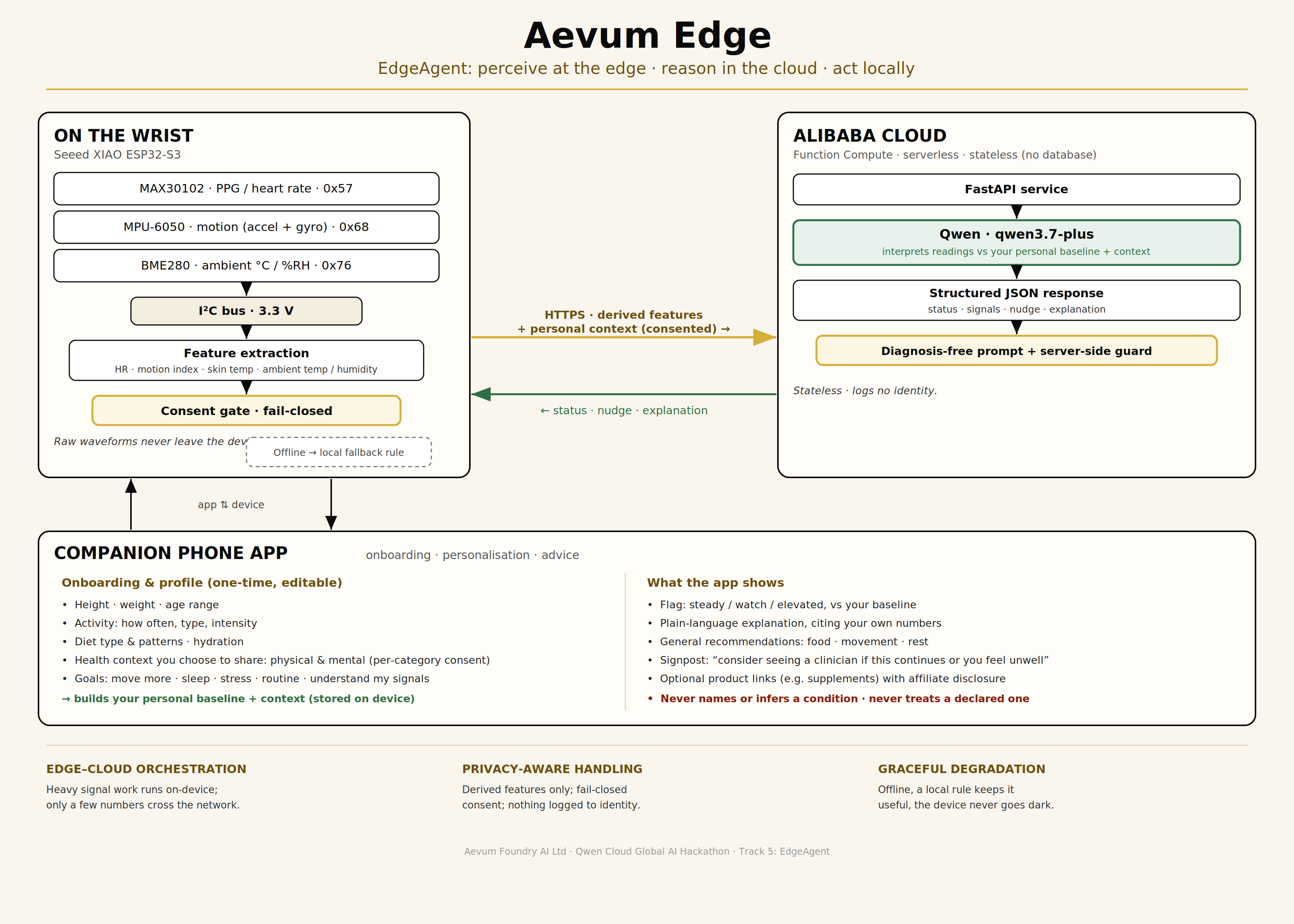
Aevum Edge is a screenless, wrist-worn wellbeing node for anyone. It reads heart rate (PPG), motion, and skin and ambient temperature, and does the first heavy work on the device itself, turning raw waveforms into a handful of plain numbers.
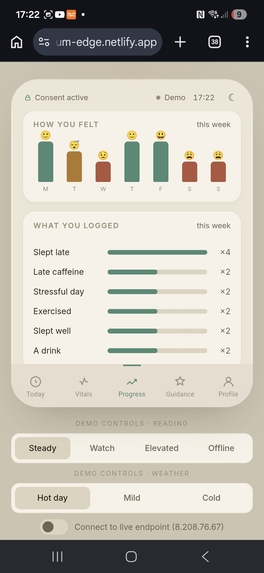
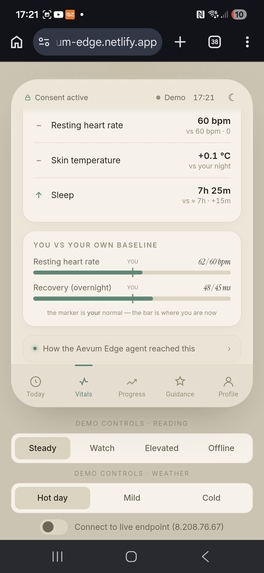
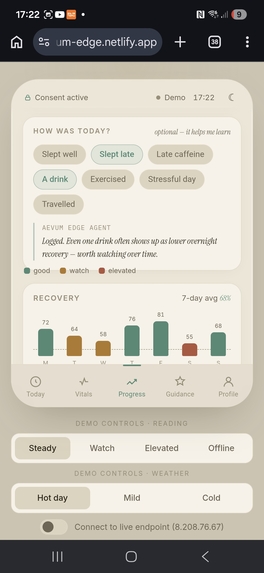
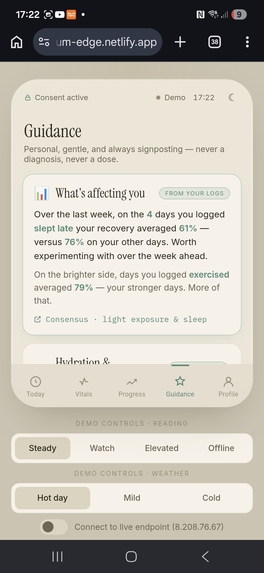
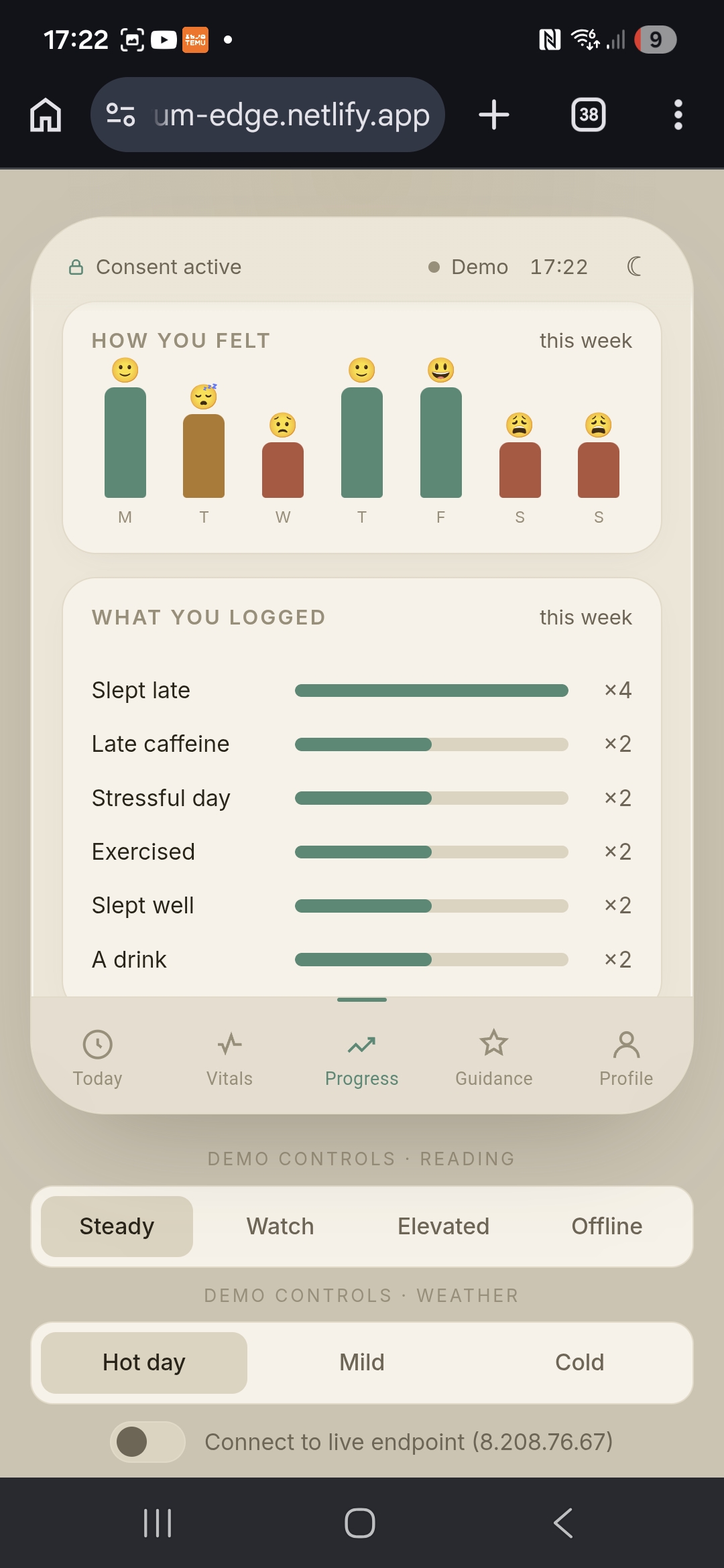
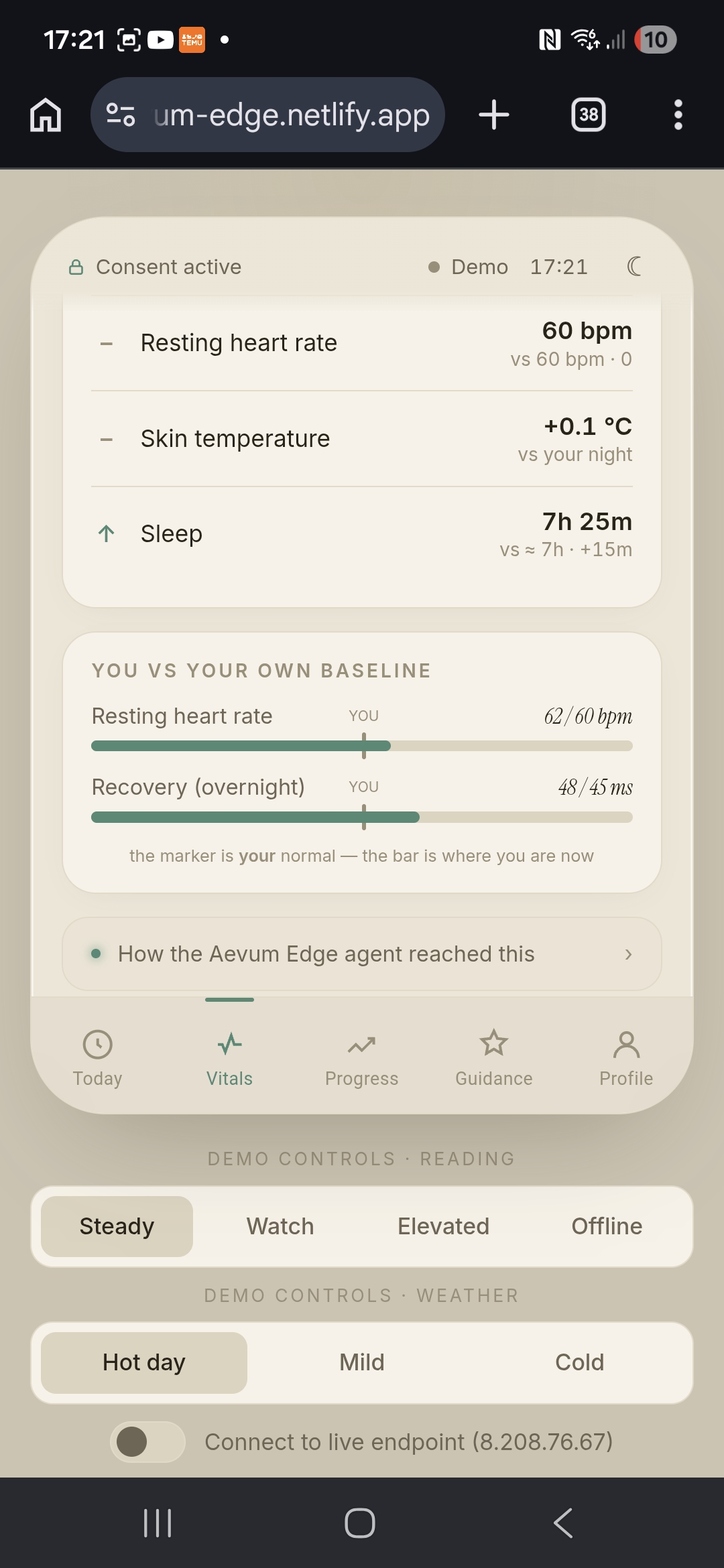
It holds those numbers to three calm states, read against your own baseline: Steady, Watch, Elevated. Wellbeing words, not clinical ones. It detects no condition. It describes a state, it does not screen for one.
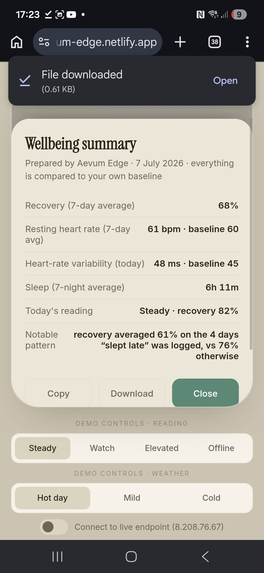
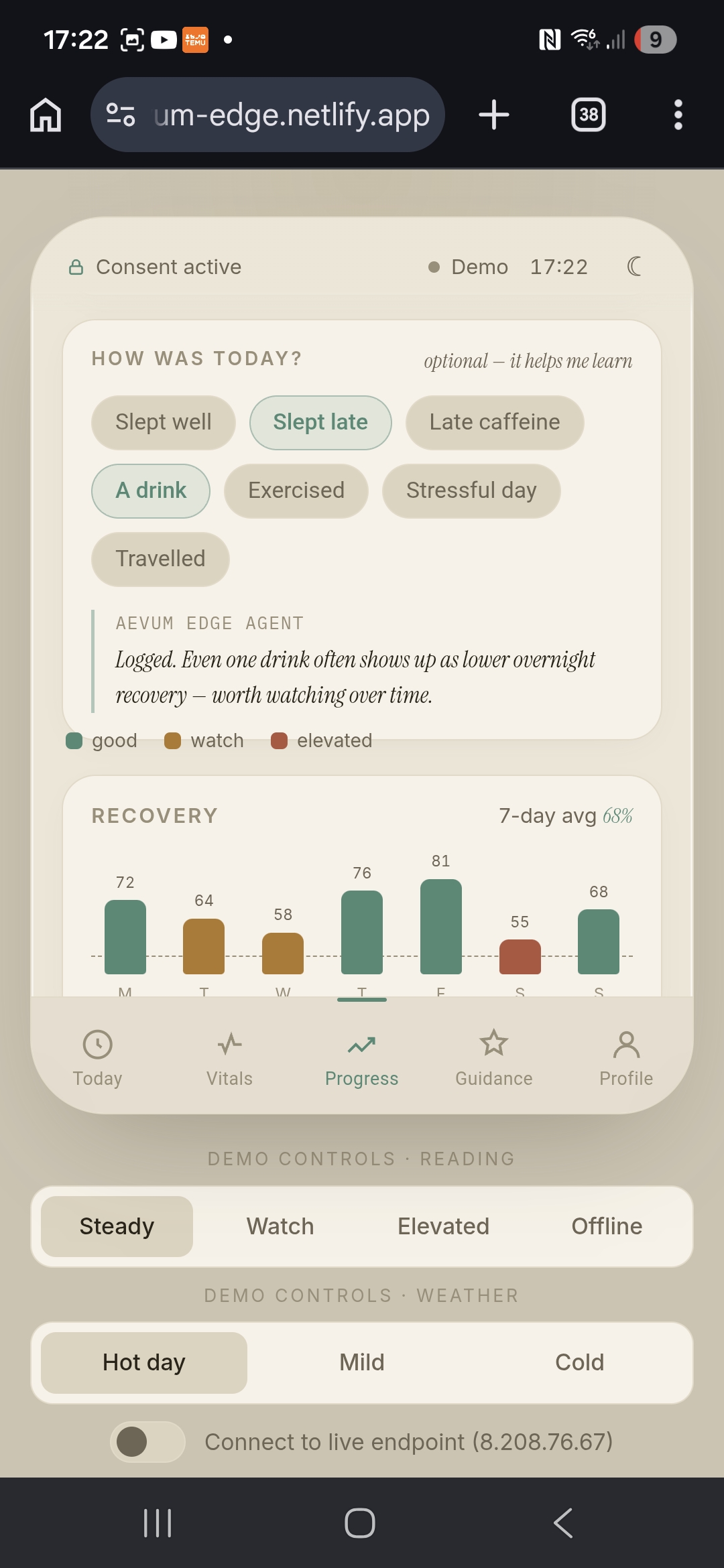
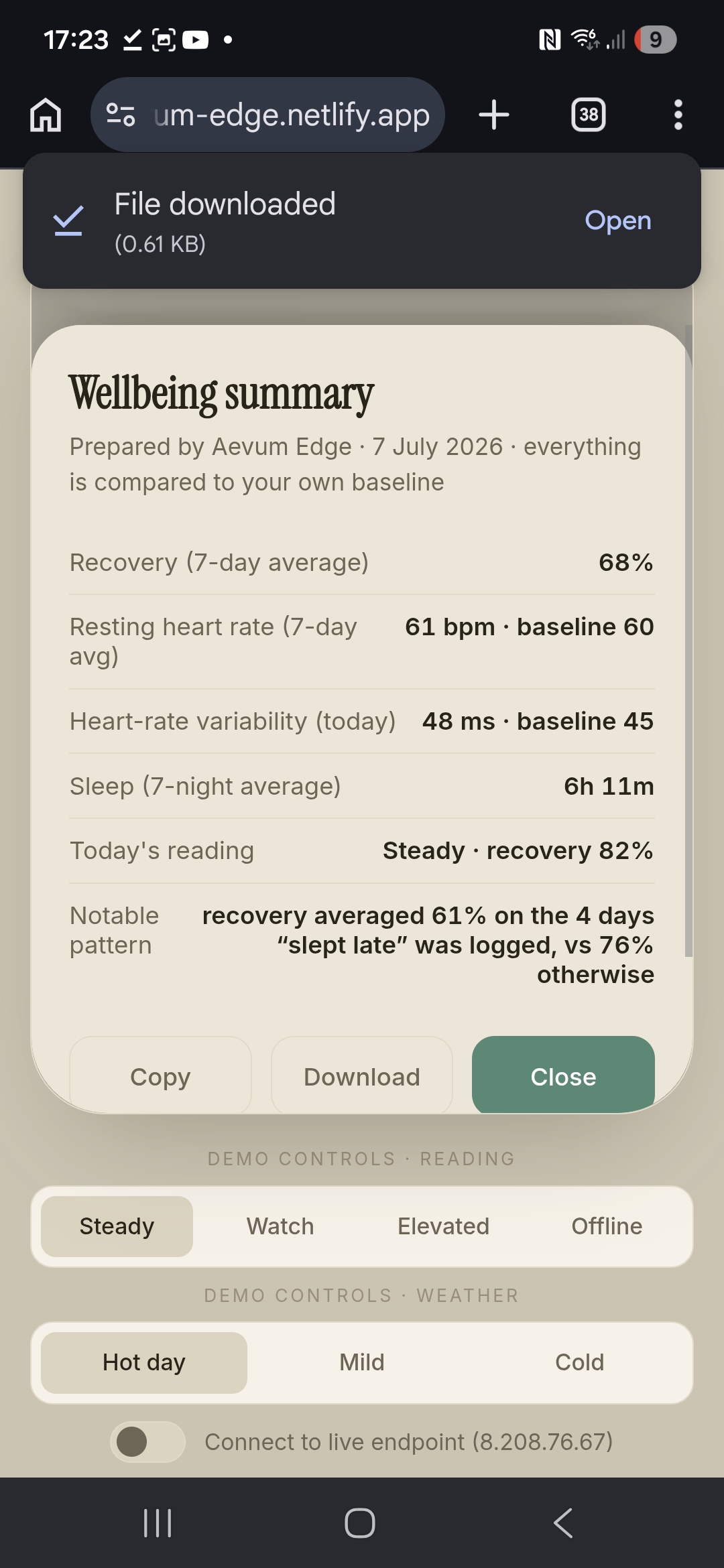
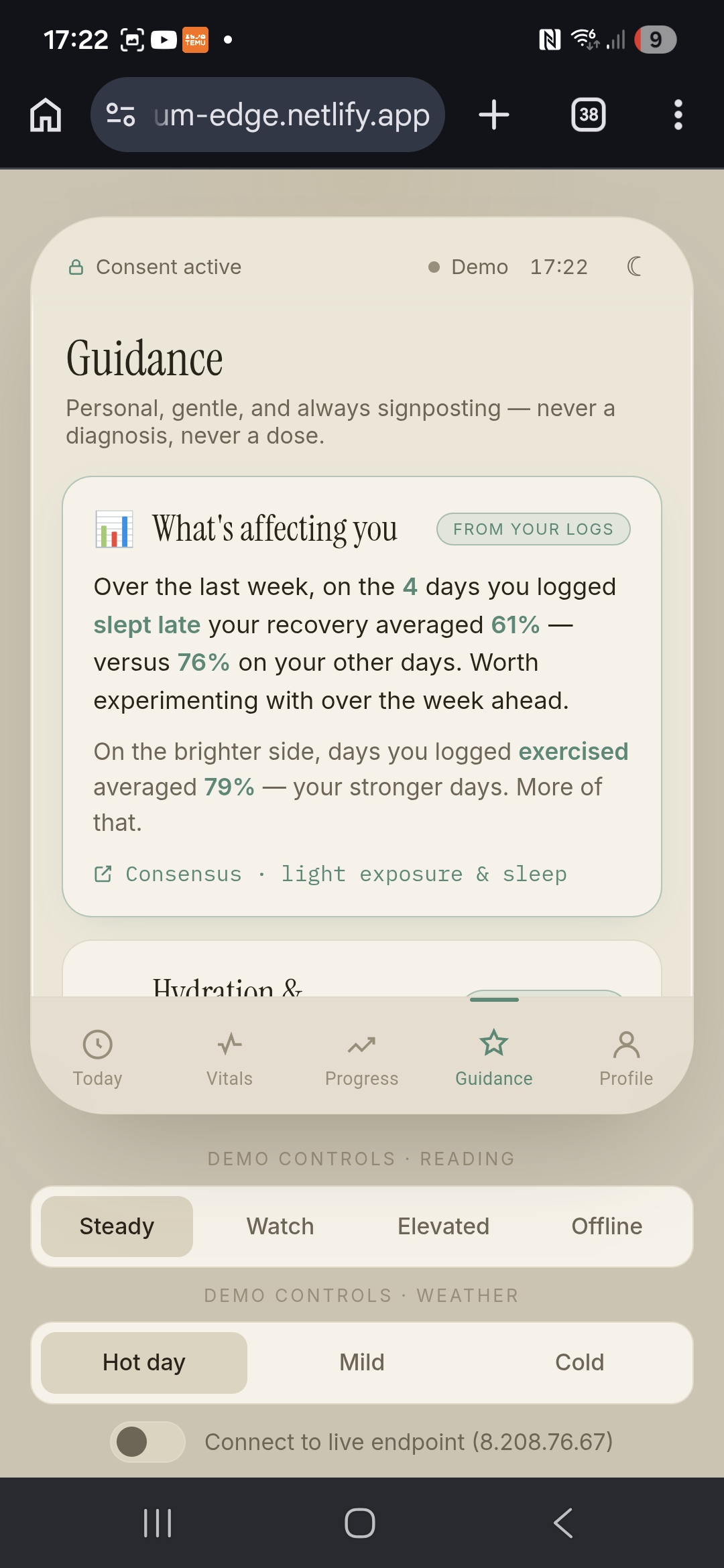
The state is only half of it. The same reading means different things for different people, so a Qwen-powered edge agent translates that one signal per person, against your own baseline, into a plain-language read of whether you are steady, worth a watch, or elevated, and why, in your own numbers.
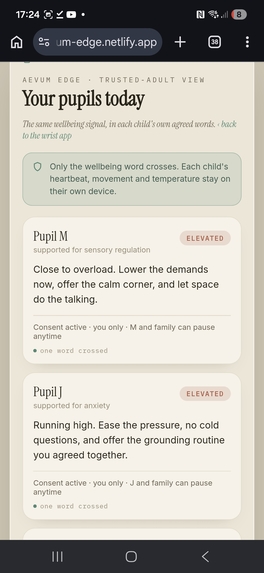
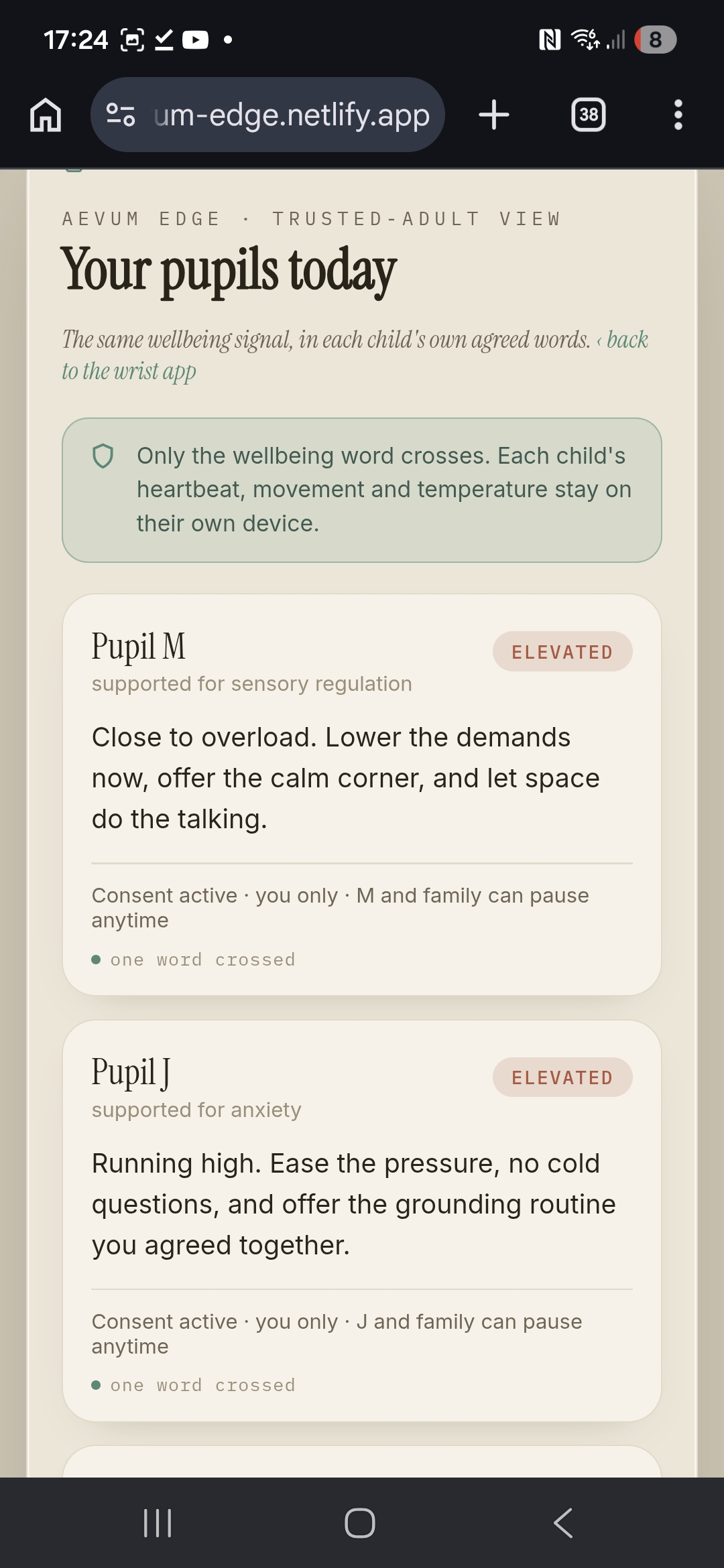
That per-person translation is what lets the device give someone a voice. Put it in a school, with consent, and it becomes a wellbeing signpost for a child with additional needs, and above all the child's own signpost, not a monitor pointed at them. The same three states carry each child's own agreed responses, set with them and their family:
- Steady: a settled, regulated day. Meet them as usual.
- Watch: something is shifting. A gentle check-in and a familiar routine can steady the day before it tips.
- Elevated: running high, or close to overload. Lower the demands, offer a quiet space, let space do the talking. An autistic learner near sensory overload and a learner living with anxiety are each met in the way that works for them. It is the same wellbeing engine everyone else uses, translated per person, and that translation is the reason an on-device agent earns its place.
The privacy boundary holds either way, and it is architecture, not a setting. The physiological signals never leave the wrist. In the school case, only the single translated word reaches the teacher, and only with consent. No cloud wearable can tell that story, because their model is the reverse: your heartbeat, in their cloud, by default.
How we built it
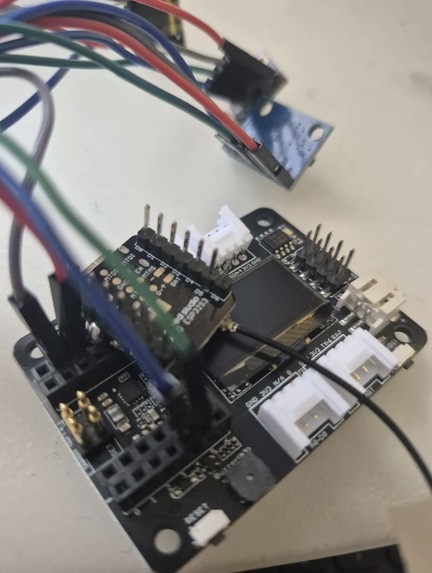
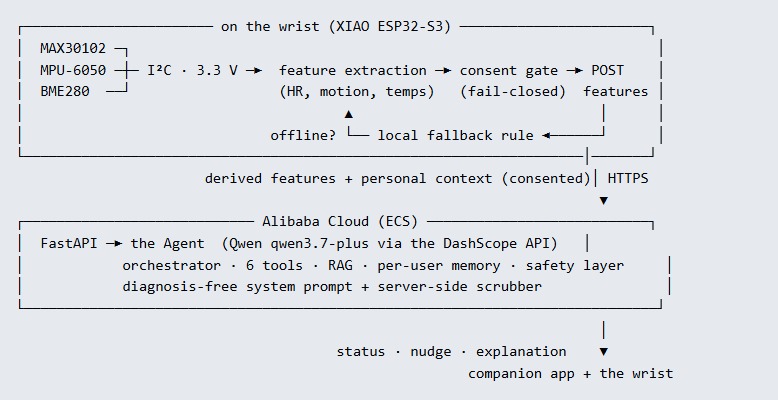
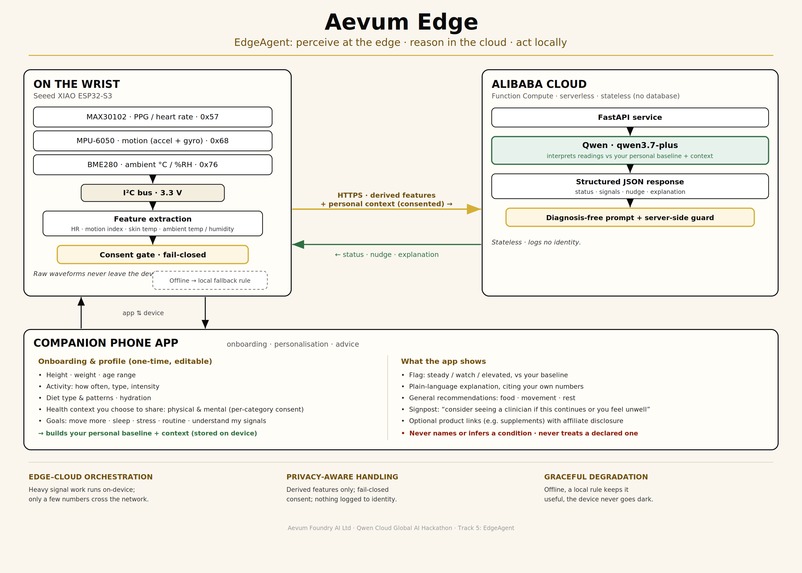
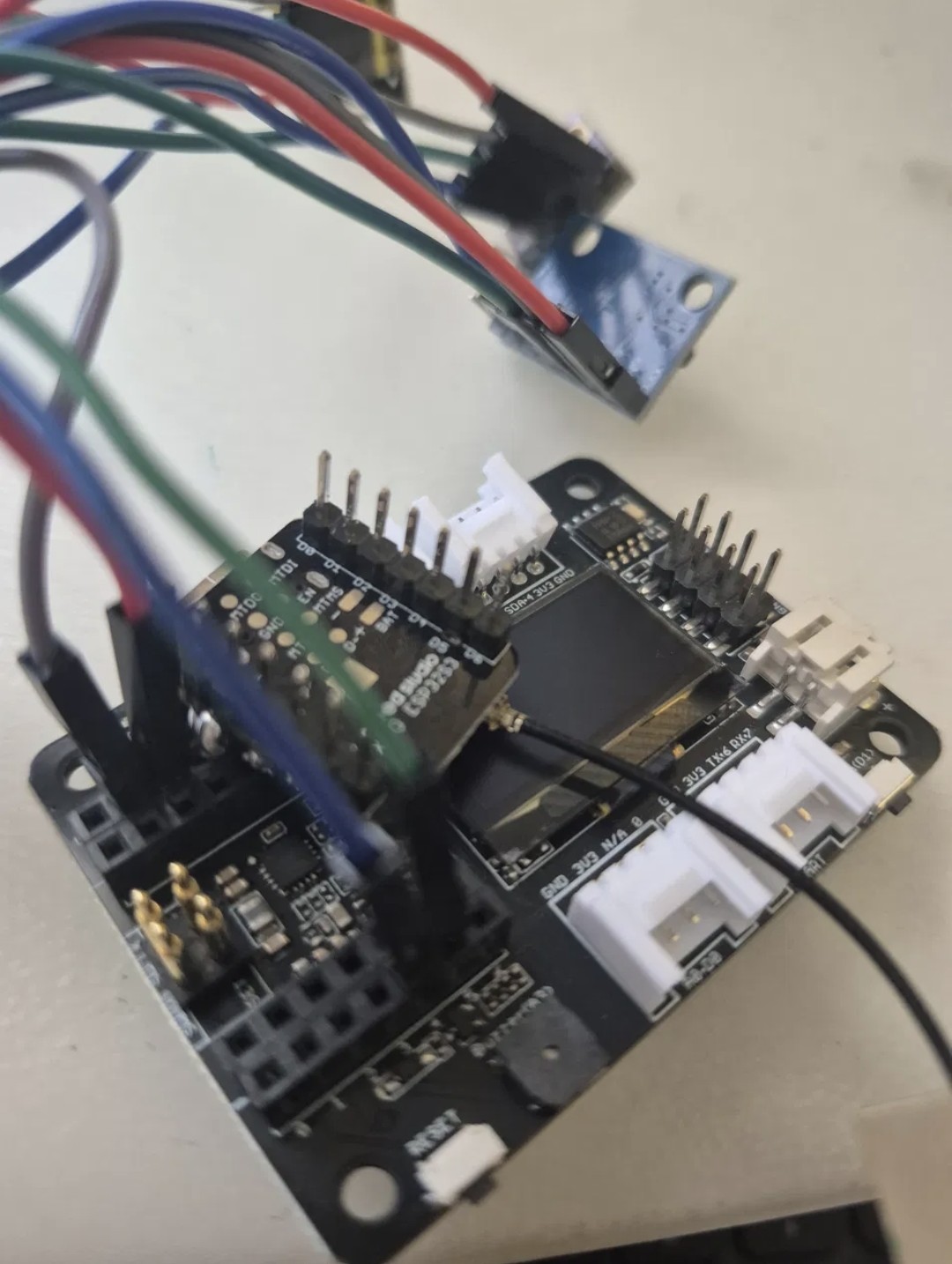
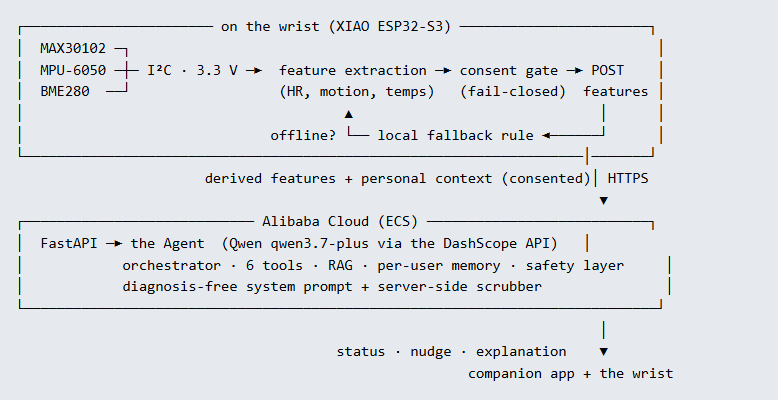
The device is a XIAO ESP32-S3 with a MAX30102 (PPG), an MPU-6050 (motion) and a BME280 (temperature and ambient) on one I²C bus. The firmware samples a short window, extracts features on-device (heart rate, pulse-rate variability gated on stillness, movement quality, thermal context), runs a fail-closed consent check, and sends only the derived features, never a waveform.
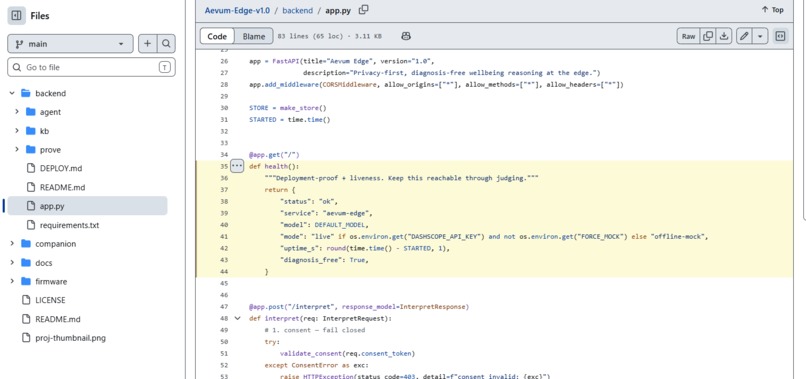
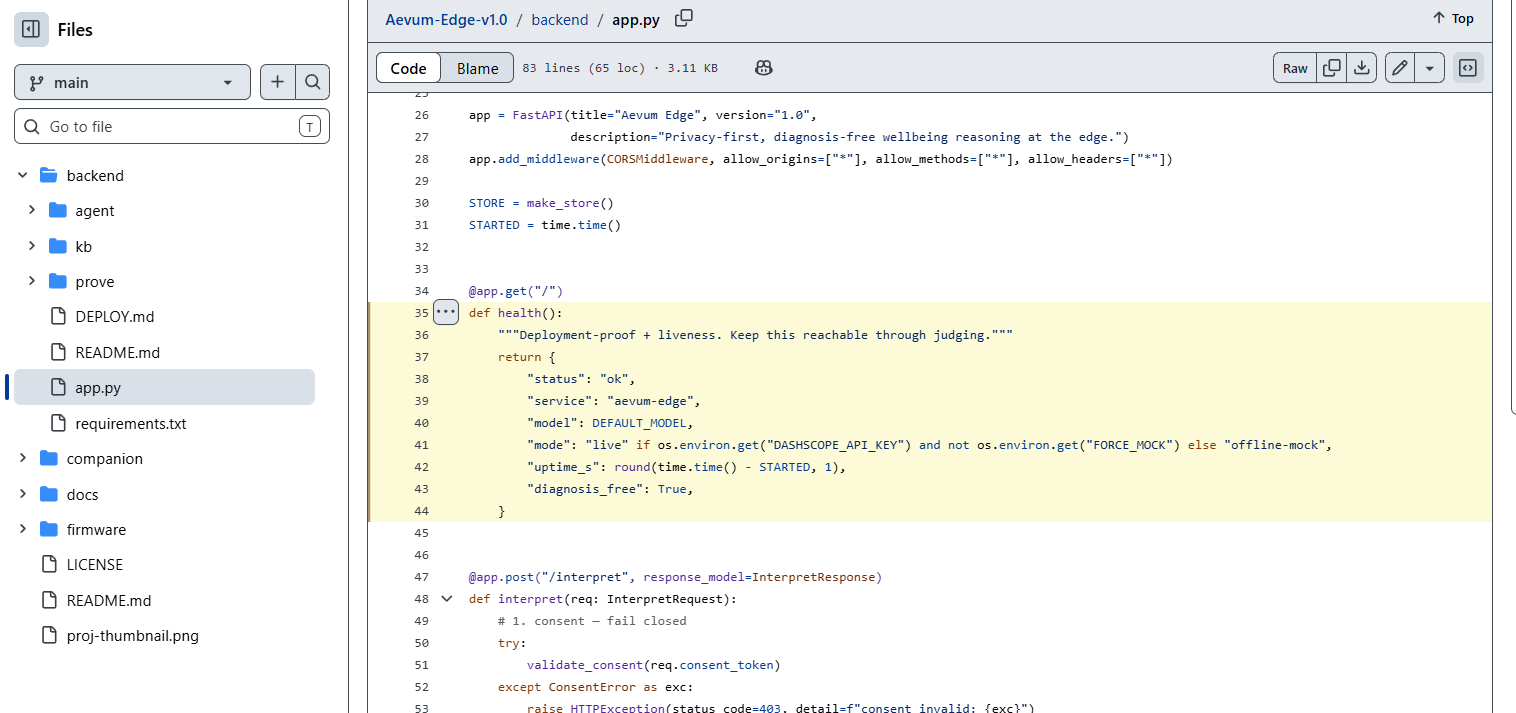
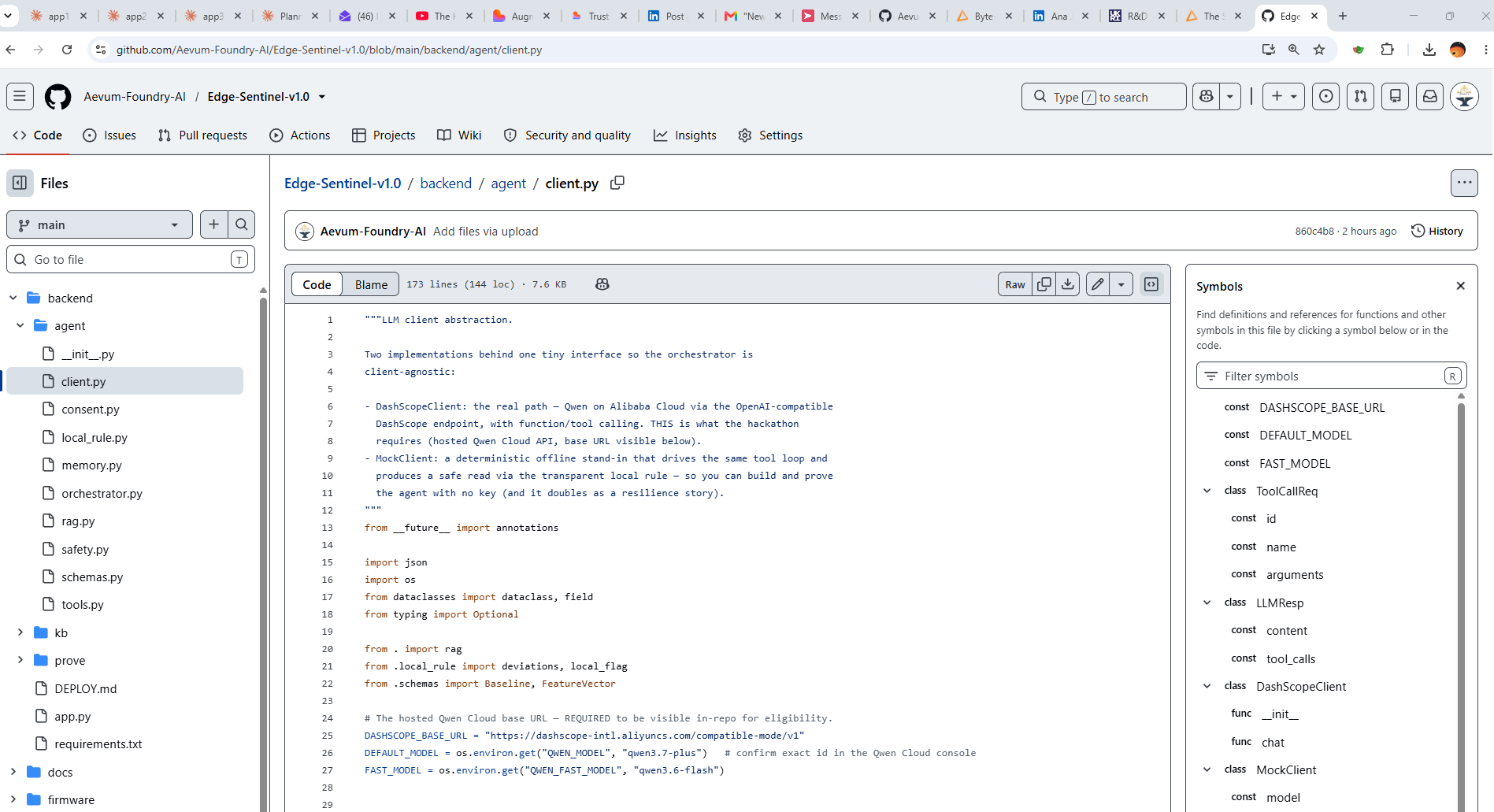
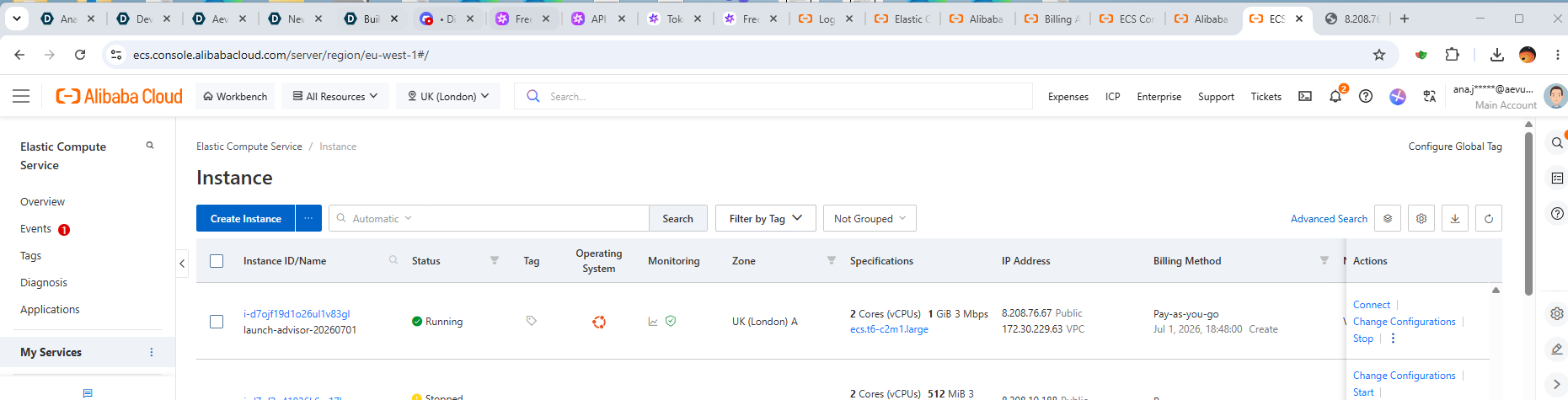
The cloud core is the Aevum Edge agent, and it is not a single model call. It is a Qwen qwen3.7-plus agent running a plan, act, synthesise loop. It chooses among six specialised tools (cardiac features, movement, thermal context, baseline comparison, wellbeing retrieval, and safety signposting), chains them, grounds every answer in a licence-clean retrieval knowledge base, remembers the personal baseline, and is wrapped by two guards: a fail-closed consent gate and a diagnosis-free scrubber. Every tool call is logged, so the reasoning is inspectable, not a black box. It runs on Alibaba Cloud ECS against the hosted Qwen Cloud API, whose OpenAI-compatible endpoint made wiring the model in the cleanest part of the build.
In a school setting that same agent does the per-child translation: it takes the one wellbeing state and the child's own agreed responses, held on-device, and returns the plain-language support for the adult, one child at a time. One word crosses the boundary. The guidance is assembled around it.
When the network drops the device does not go dark. It falls back to a transparent on-device rule, and to the cached agreed responses, so the person, or the adult supporting a child, still gets the right steer. When the connection returns, the agent's richer reasoning comes back with it. That is what edge should mean: graceful, not brittle.
Challenges we ran into
Trustworthy physiology from a cheap optical sensor. Pulse-rate variability from a wrist PPG only means something when the wearer is still, because movement swamps it. So we gate it on stillness rather than report a confident, wrong number. Honesty over bravado is the whole ethos.
Keeping the medical-device line bright. It is tempting to add blood pressure and "biological age," because the market rewards them, but those signals drag a wellbeing device across the MHRA line into regulated territory. We drew the line on purpose and kept every output a wellbeing state against the person's own baseline, never a clinical claim.
Making personalisation real, and dignified. The same reading has to mean different things for different people, and in a SEND setting it has to mean the right thing for one specific child. We built a rolling per-user baseline and a per-person response layer, so an identical heart rate reads Steady for one person and Watch for another, and the guidance that follows is theirs, not generic.
Accomplishments that we're proud of
- A real agent, not a wrapper: tools, retrieval, memory and a safety layer, with an inspectable tool-trace.
- A privacy boundary you can defend: raw physiology never leaves the wrist; in the school case a single consented word reaches the adult.
- Roughly 33 times data minimisation: a raw sensor window is about 8 KB; only about 240 bytes of derived features cross the link.
- Graceful offline fallback: the device stays useful, and cached responses still surface, with no network and no model.
- Diagnosis-free by construction: a constrained vocabulary plus a server-side scrubber, not just a disclaimer.
- Inclusive by design: solder-light hardware and open-core software that works fully even unpaid, and a wellbeing read that gives a voice to people who struggle to find the words, children and teens with SEND above all. ## What we learned
That restraint is a feature. In a category racing to claim more vitals, more medical-grade language, more of your data in someone's cloud, the harder and more valuable engineering was deciding what not to do. What not to send, what not to claim, what not to diagnose. Design a wellbeing device that gives a voice to the child who cannot say "I'm not okay today," hold the privacy boundary at the wrist, and it gets better for everyone, not only the person it was hardest to build for.
What's next
A co-designed schools pilot with disabled children and their families, on the principle that runs through the whole build: never done to a child, only with them. Parental consent and the child's own assent, and the child able to turn it off at any time. As Aevum Terra takes shape over the coming years, a wellbeing pilot with that community will follow. A research-grade temperature sensor is going on, and cuffless blood-pressure estimation stays on the research roadmap, held there deliberately until it can be validated against a reference cuff, because we will not surface a vital sign we cannot stand behind.
Aevum Edge is open-source (MIT), built by Aevum Foundry AI Ltd.
Try it. Companion app, the wrist: https://aevum-edge-sentinel.netlify.app · Trusted-adult view, the SEND signpost: <ADD NETLIFY URL> · Agent API: http://8.208.76.67/ · Code: github.com/Aevum-Foundry-AI/Edge-Sentinel-v1.0


Log in or sign up for Devpost to join the conversation.