What's next for AetherLocal: Offline AI Tutor for The Smart
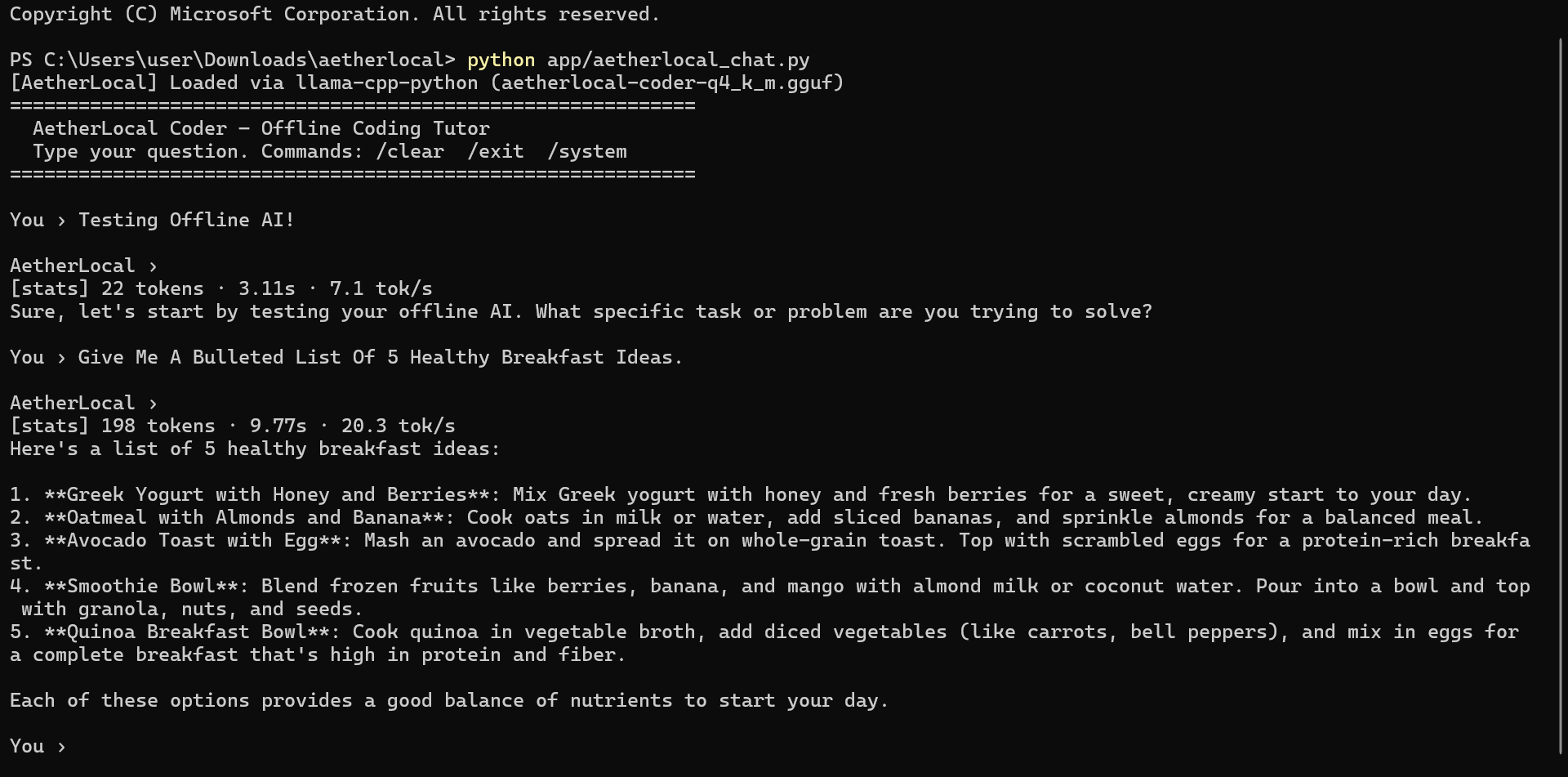
InspirationIn many learning environments across Africa, software development students face a hidden barrier: the cost and instability of internet connectivity. While developers in well-connected hubs can seamlessly use cloud-powered AI assistants, many students are cut off from these tools when data is scarce or networks drop.We were inspired to build AetherLocal to bridge this digital divide. We wanted to create an omnipresent knowledge medium—resembling the concept of "Aether" itself—that acts as an invisible, persistent tutor right on a student's machine. By pairing local AI with university curricula, we set out to prove that high-quality tech education does not require a constant fiber-optic connection.How We Built ItAetherLocal is built to prioritize raw efficiency and zero-network independence:The Core Engine: We utilized llama.cpp to run execution cycles locally on standard, budget-friendly laptops.The Model: We selected a 1.5 Billion parameter model architecture, highly optimized for code generation and instruction following.Quantization: To fit the model inside restricted hardware memory footprints, we used GGUF Q4_K_M 4-bit quantization, maintaining sharp accuracy while dropping memory requirements drastically.Local Knowledge Injection: We implemented a local retrieval mechanism over educational textbooks, debugging patterns, and African university computer science curricula snippets.Challenges We FacedOur biggest technical hurdle was balancing speed, resource consumption, and accuracy. When optimizing code-tutors locally, execution speed must remain usable, but heavy precision models crash low-end machines.For instance, optimizing an algorithm to compute the longest contiguous subarray whose sum is divisible by 3 requires keeping the time complexity at O(N) and auxiliary space at O(1). If the model hallucinates a brute-force O(N²) solution, a student's machine might lock up. We spent hours tuning our local retrieval system to inject highly structural contextual prompts, keeping model logic tight and robust without expanding parameter size.What We LearnedWe learned that the future of AI is not solely in massive, centralized data centers. Smaller, fine-tuned, and quantized models are incredibly capable when contextualized with clean, localized data. More importantly, we learned that designing software with an "offline-first" mindset forces you to write cleaner, more efficient, and highly accessible code that respects the user's local hardware constraints.


Log in or sign up for Devpost to join the conversation.