Inspiration
An observer needs more than a red warning: they need to understand what changed and what to review next. Inspired by the Roque de los Muchachos observatory in the Canary Islands, Aetheris AI explores a conversational workflow that connects a signal, an explanation, and a reviewable follow-up.
What it does
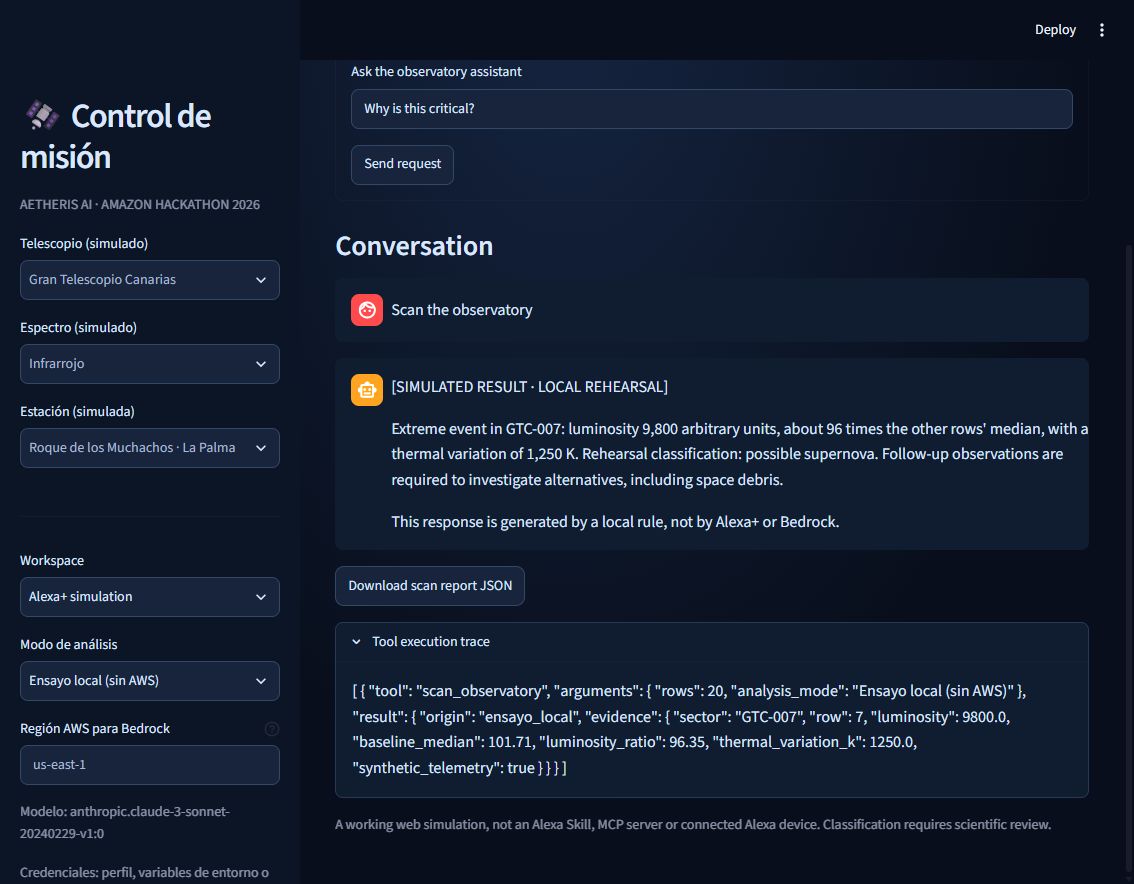
Aetheris AI has two connected workspaces. Observatory displays 20 synthetic measurements, with an intentionally extreme event in row seven, sector GTC-007. Alexa+ simulation lets an observer scan the batch, explain the anomaly, and prepare follow-up.
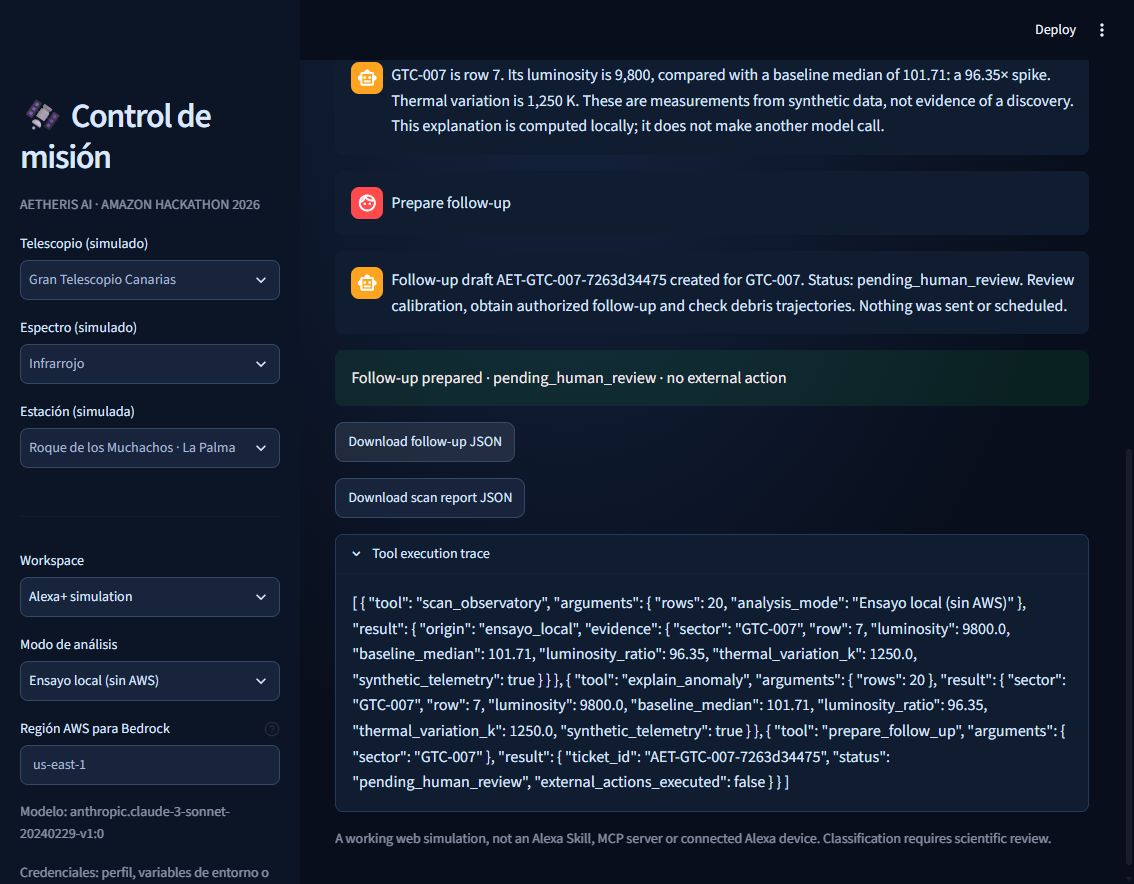
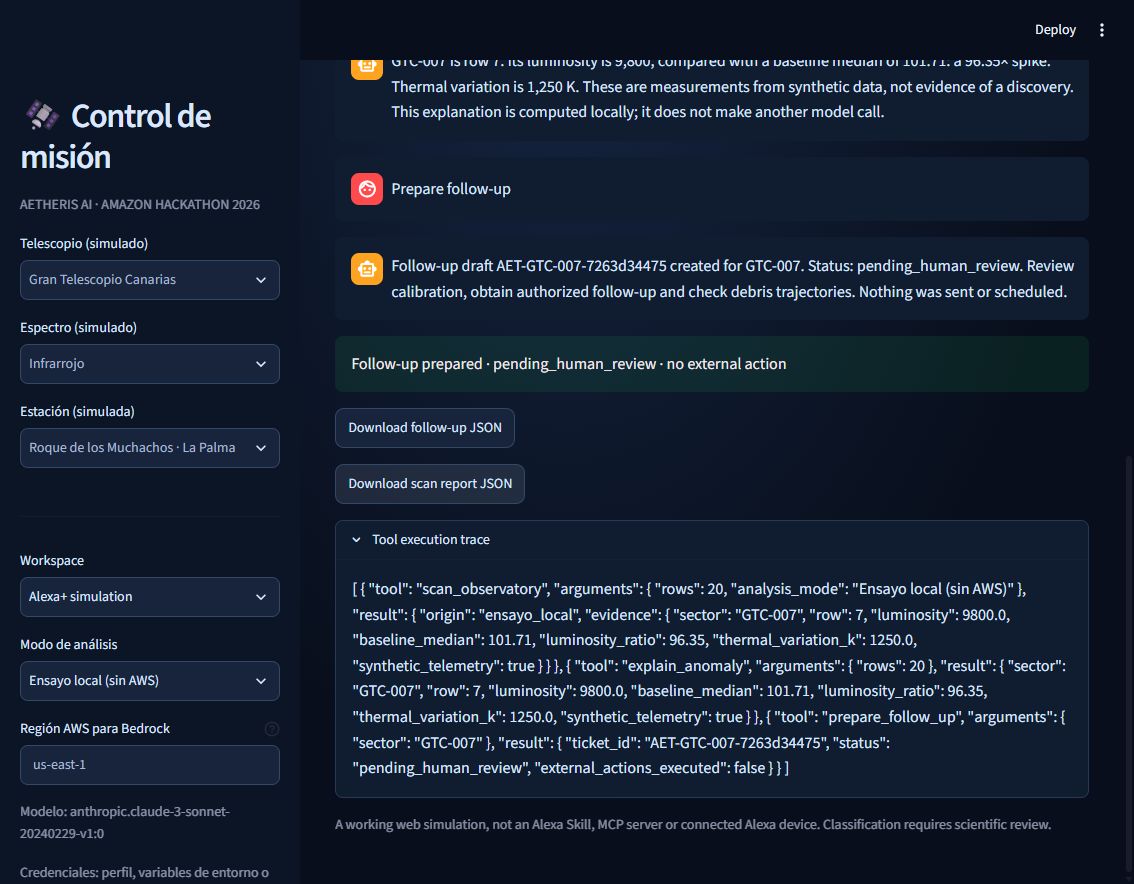
The browser assistant uses a deterministic local router and visible tool traces. It is an explicitly simulated Alexa+ experience, without a live Alexa connection, Agent Skill, MCP server, or device integration. Follow-up produces a JSON draft marked pending_human_review; nothing is sent or scheduled.
Local rehearsal is clearly labeled and works without AWS. A real Bedrock invocation path is implemented, but a successful live AWS call has not been validated in this delivery.
How we built it
All application logic is in app.py, using Python, Streamlit, and Pandas. One shared DataFrame supplies the table, chart, conversational tools, and analysis payload so the evidence stays consistent.
The implemented AWS path creates a boto3 bedrock-runtime client, calls invoke_model with anthropic.claude-3-sonnet-20240229-v1:0, and parses Claude Messages text blocks. Credentials remain outside the code. Setup instructions and a scoped bedrock:InvokeModel policy document the integration.
The repository includes pinned dependencies, local run instructions, a Windows launcher, downloadable reports, and 26 passing local tests. AWS responses in those tests are mocked.
Challenges
We kept the application in one file while managing conversation state, tool results, and stale outputs. We also separated synthetic data, local rehearsal, simulated Alexa interaction, and the AWS path. Authentication or access errors do not silently produce simulated answers. The requested older model still requires account, region, and lifecycle validation.
Accomplishments
The prototype demonstrates a complete local path from visible telemetry to explanation and a human-reviewed draft. Users can inspect tool operations and export evidence. The cloud request handling exists as runnable source and tested application behavior, rather than only a proposed architecture.
What we learned
Provenance makes an assistant easier to trust. A prepared action needs a clear review state, and a working SDK implementation must be distinguished from a verified live service call.
What's next
Complete an authorized Bedrock invocation and preserve its evidence. Evaluate a supported model migration, then test with astronomers and representative observations. Add richer time-series data and uncertainty handling, and measure quality and latency. The current classification remains a demo hypothesis, not a validated discovery.
Demo evidence
Screens captured from the functioning local Alexa+ web simulation, using synthetic telemetry and local rehearsal.

Log in or sign up for Devpost to join the conversation.