-
-
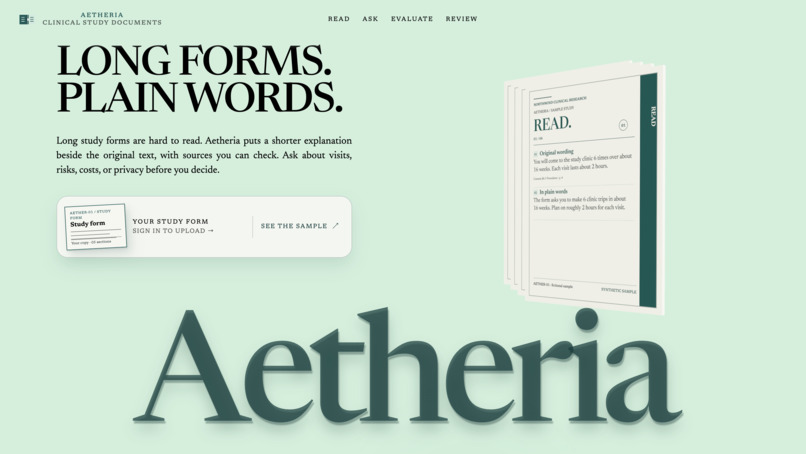
Landing Page
-
-
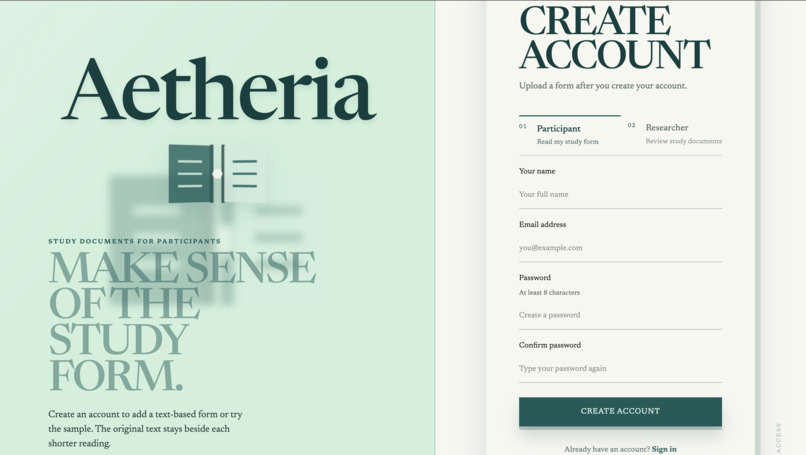
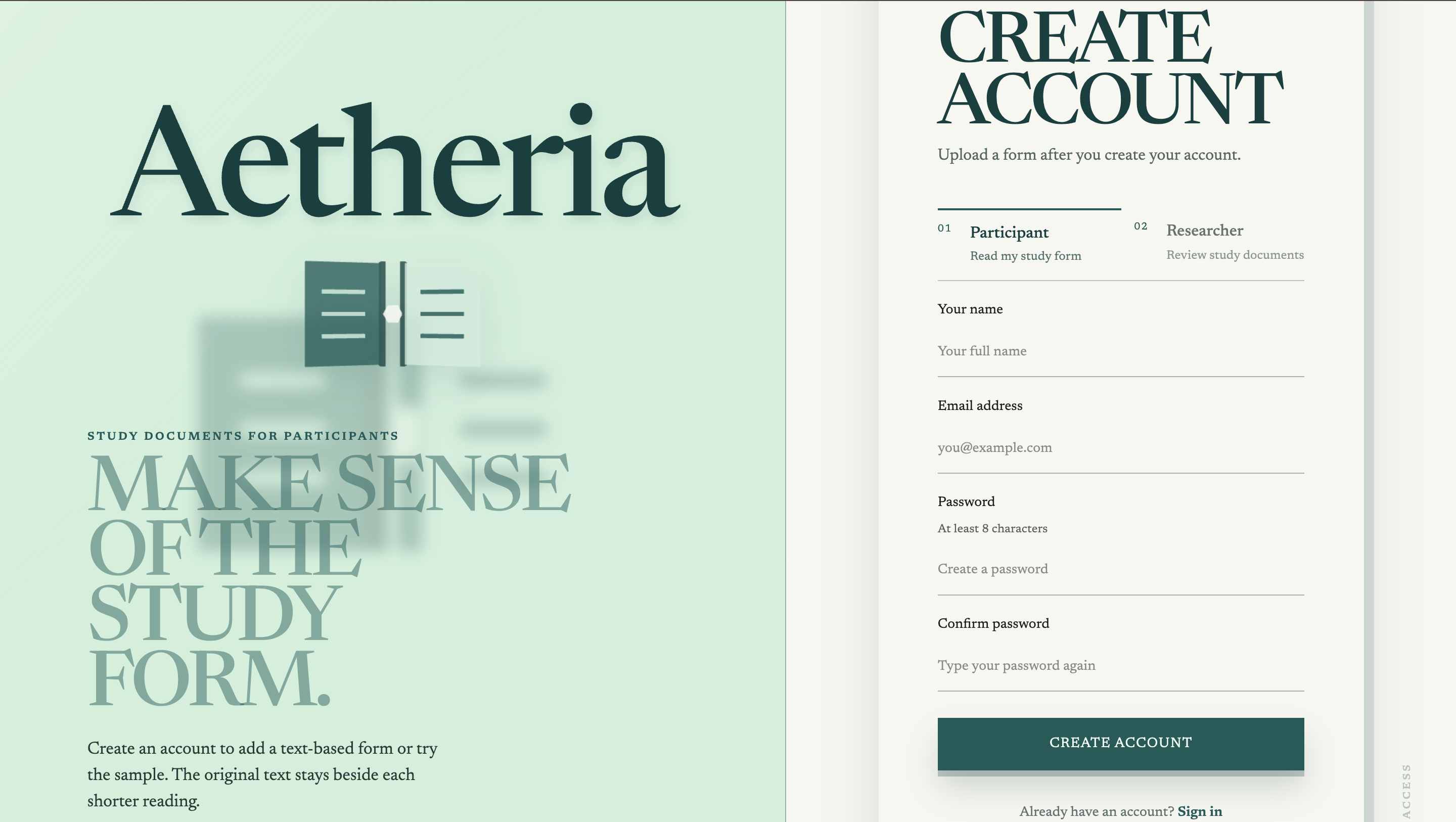
Sign Up Page
Aetheria
Inspiration
Imagine being asked to participate in a clinical trial that could affect your health and future, only to be handed a lengthy consent document filled with medical jargon, complicated procedures, and unfamiliar terminology.
You're expected to understand the risks, benefits, and responsibilities before signing. But what happens when the document itself becomes a barrier to understanding?
That question inspired us to build Aetheria.
We realized that informed consent shouldn't simply mean reading a document and signing your name. It should mean genuinely understanding what you're agreeing to, having the opportunity to ask questions, and knowing when to seek clarification from a real person.
Our goal was to make clinical research more accessible, transparent, and human-centered through responsible artificial intelligence.
Aetheria was built around one simple belief: understanding should always come before consent.
What It Does
Aetheria is an AI-powered clinical research document assistant that helps participants understand complex consent forms while giving researchers tools to improve document clarity and consistency.
The platform provides two dedicated experiences.
For Participants
Participants can upload a text-based PDF, TXT, or Markdown consent document or explore our included fictional AETHER-01 sample study.
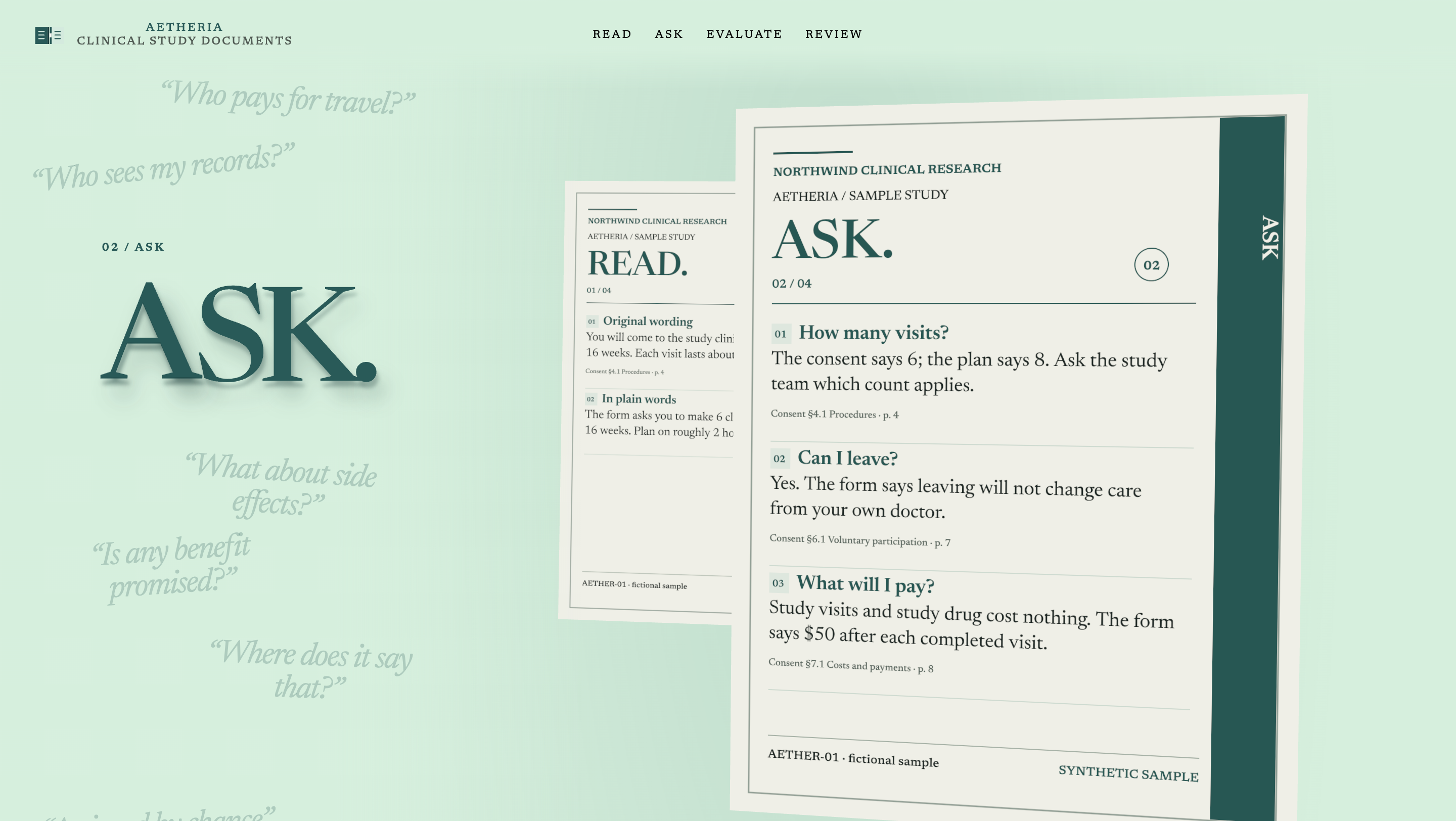
Aetheria displays the original document alongside a simplified explanation, allowing participants to understand complex information without losing access to the original wording.
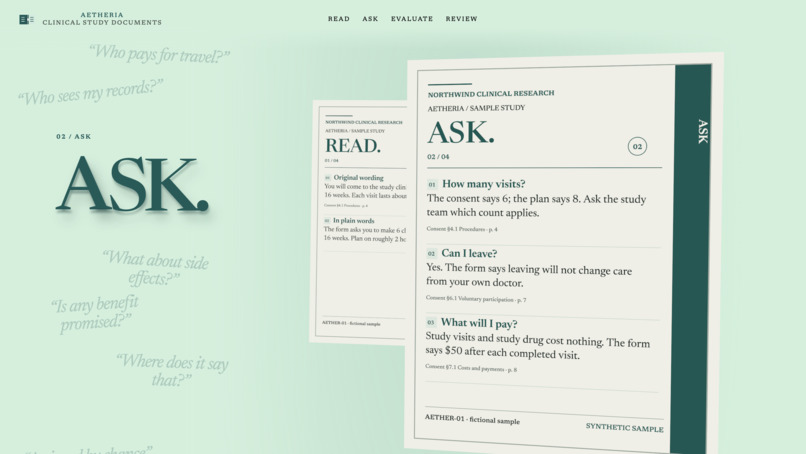
Participants can also ask questions about their document through an evidence-grounded assistant. Instead of providing unsupported answers, Aetheria retrieves relevant passages and displays the source text supporting each response.
Additional features include:
- Plain-language explanations: Complex medical terminology becomes easier to understand.
- Multilingual accessibility: Interface support for English, Spanish, French, and Simplified Chinese.
- Evidence-grounded Q&A: Answers are linked to supporting passages from the consent form.
- Teach-back checks: Participants explain concepts in their own words to identify potential areas of confusion.
- Human handoff: Unresolved questions can be sent to the research team.
- Progress tracking: Participants can review saved questions and their document-reading progress.
Aetheria does not provide medical advice, collect consent signatures, or determine whether someone understands a study. Those responsibilities remain with qualified humans.
For Researchers
Researchers have access to a dedicated workspace for reviewing and improving clinical research materials.
The workspace supports participant handoffs, follow-up messaging, document comparison, wording reviews, numerical consistency checks, and version history.
Researchers can also examine stored public trial materials from NCT03238781, which are kept separate from the fictional practice consent.
A built-in test lab supports validation of important application behaviors.
Together, these tools help researchers identify potential communication problems before they become larger misunderstandings.
How We Built It
We built Aetheria as a full-stack application using React, TypeScript, Vite, Three.js, Python FastAPI, and SQLite.
Our frontend provides an immersive, interactive experience while handling consent document reading, comparison, and local processing.
We used PDF.js to extract text from supported PDF documents directly in the browser.
The backend, powered by FastAPI, handles authentication, signed session tokens, teach-back handoffs, and researcher messaging. SQLite provides local persistence, while the deployed architecture supports Neon PostgreSQL.
Building the AI System
One of our most important technical decisions was designing Aetheria around Retrieval-Augmented Generation, or RAG.
Instead of allowing an AI model to freely answer clinical questions, we built a document-grounded retrieval workflow.
When a participant asks a question, Aetheria searches the uploaded consent document for relevant passages. Those passages provide the evidence used to construct the response.
When configured, Google's Gemini models can generate a clearer explanation. A local Ollama provider is also supported, and built-in deterministic rules allow essential functionality to continue without a cloud AI service.
We added citation and numerical validation checks to reduce unsupported claims and help ensure that responses remain connected to their source material.
The system is designed to acknowledge when the consent form doesn't provide enough information rather than invent an answer.
Building for Accessibility
We also wanted the platform to feel less intimidating than traditional clinical software.
Using Three.js and modern React components, we created an immersive interface while keeping the reading workflow focused on clarity.
Language options, simplified explanations, and interactive comprehension checks help make the experience more approachable for different users.
Challenges We Faced
1. Making AI Responses More Trustworthy
Our biggest challenge was preventing AI-generated explanations from introducing information that wasn't supported by the original document.
In clinical research, an incorrect number, exaggerated claim, or invented procedure can create serious confusion.
We addressed this by combining passage retrieval, citation checks, numerical validation, and rule-based fallback behavior.
2. Balancing Simplicity With Accuracy
Medical documents are complex for a reason. Simplifying them without changing their meaning is difficult.
We designed the reading experience to preserve the original text alongside its simplified explanation, allowing participants to compare both versions instead of relying entirely on the AI.
3. Supporting Multiple AI Environments
Cloud AI services can experience rate limits, configuration problems, or temporary outages.
We wanted Aetheria to remain useful even without Gemini.
Building optional provider support alongside deterministic local functionality helped us create a more resilient prototype.
4. Connecting Participants With Researchers
We didn't want Aetheria to become another chatbot that leaves users alone with unanswered questions.
Building authenticated handoffs and follow-up messaging required us to connect the participant experience with a separate researcher workflow.
This became one of the platform's most meaningful features.
5. Creating an Immersive Interface Without Sacrificing Usability
Three-dimensional visuals can make a website memorable, but they can also distract from important information.
We had to balance visual design with the practical needs of reading, navigating, and understanding clinical documents.
What We Learned
Building Aetheria taught us that responsible AI is not simply about choosing a powerful language model. It's about designing the entire system around its limitations.
We learned how to combine retrieval techniques, generative AI, deterministic validation, and human escalation into one coherent workflow.
We also gained experience building full-stack applications with role-based authentication, document processing, database persistence, API integrations, and automated testing.
Most importantly, we learned that improving healthcare technology isn't always about automating more decisions.
Sometimes, the most valuable innovation is helping people ask better questions, understand complicated information, and communicate more effectively.
What's Next for Aetheria
Our next steps include improving document accessibility, expanding supported file formats, evaluating the accuracy of explanations and retrieval, and strengthening researcher review workflows.
We also want to explore better support for scanned documents, more comprehensive multilingual explanations, and usability testing with potential participants and clinical research professionals.
Before any real-world clinical deployment, Aetheria would require additional privacy, security, accessibility, and clinical validation.
Our long-term vision is to create a platform that supports clearer communication throughout the clinical research journey, from understanding consent documents to discussing questions with research teams.
Built With
- css3
- fastapi
- gemini
- html5
- javascript
- node.js
- ollama
- postgresql
- python
- rag
- react
- sqlite
- three.js
- typescript
- vercel
- vite

Log in or sign up for Devpost to join the conversation.