💡 Inspiration
🌌 We’ve always been fascinated by space exploration, astronomy, and sci-fi films like Interstellar. We wanted to build a web experience that lets anyone explore and reshape alien worlds in real time.
⚡ Instead of building a typical website that requires large 3D file downloads, our goal was to create a lightweight, instant-loading 3D universe that generates everything procedurally in the browser using math and code.
🪐 What it does
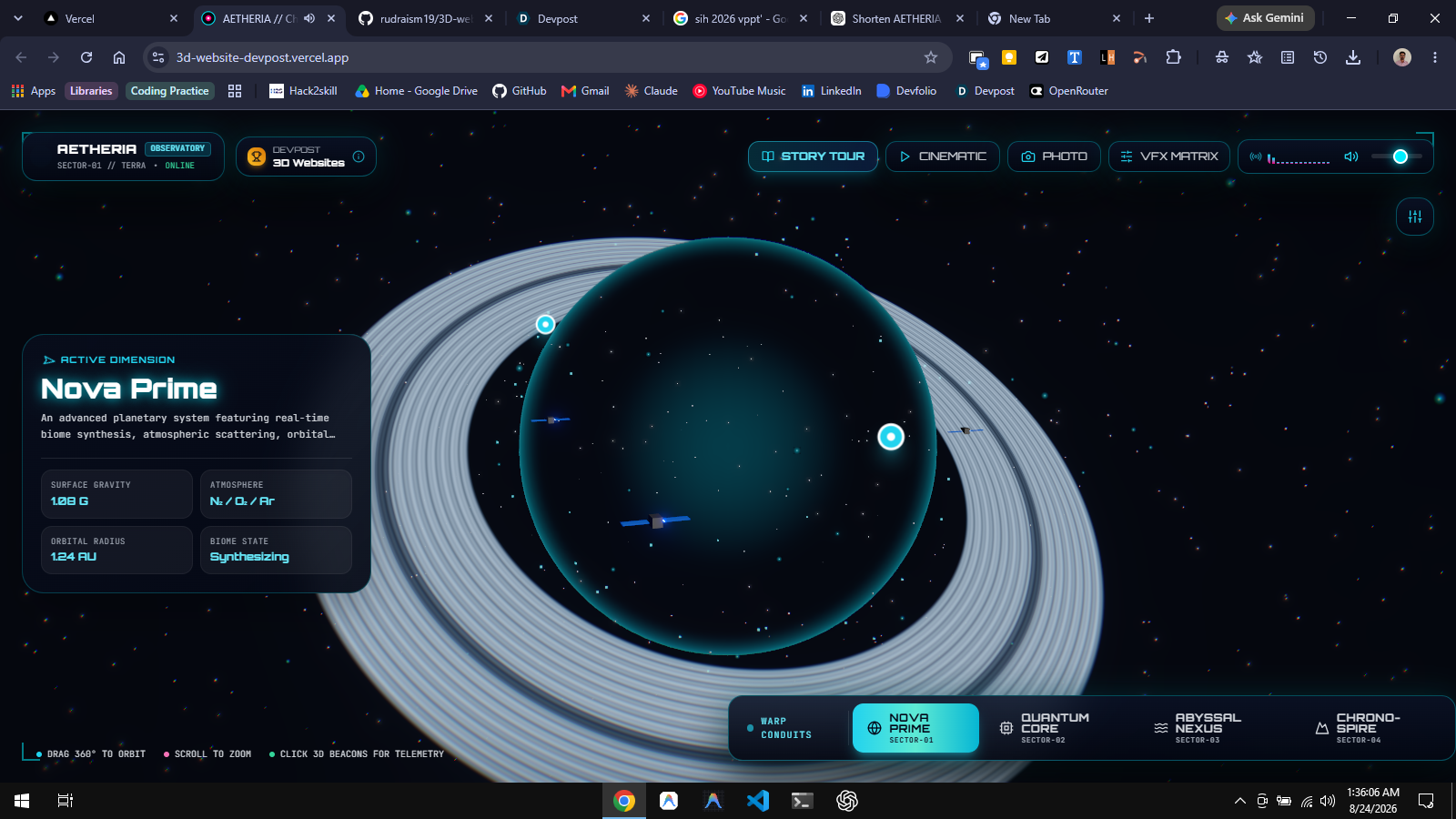
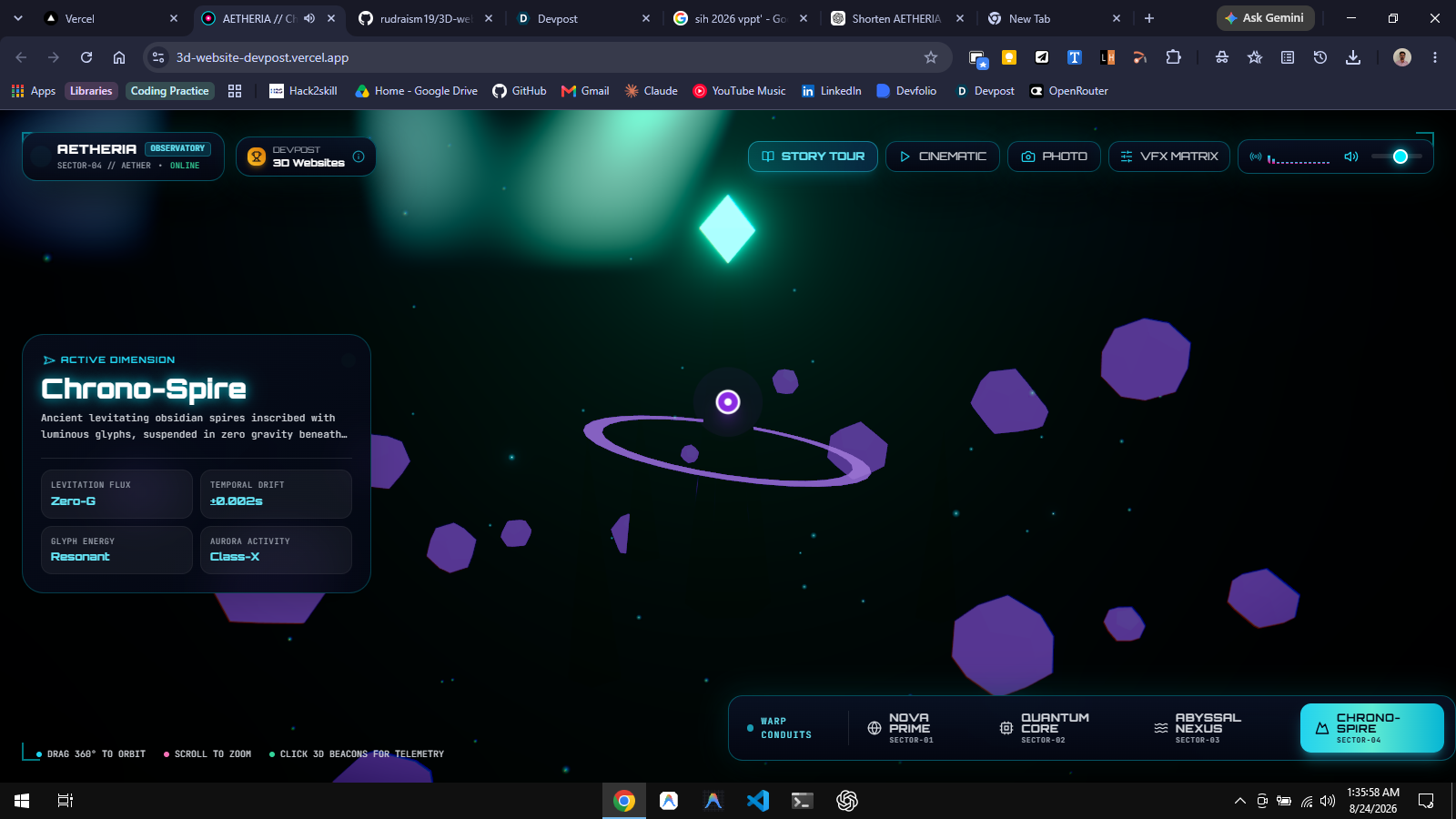
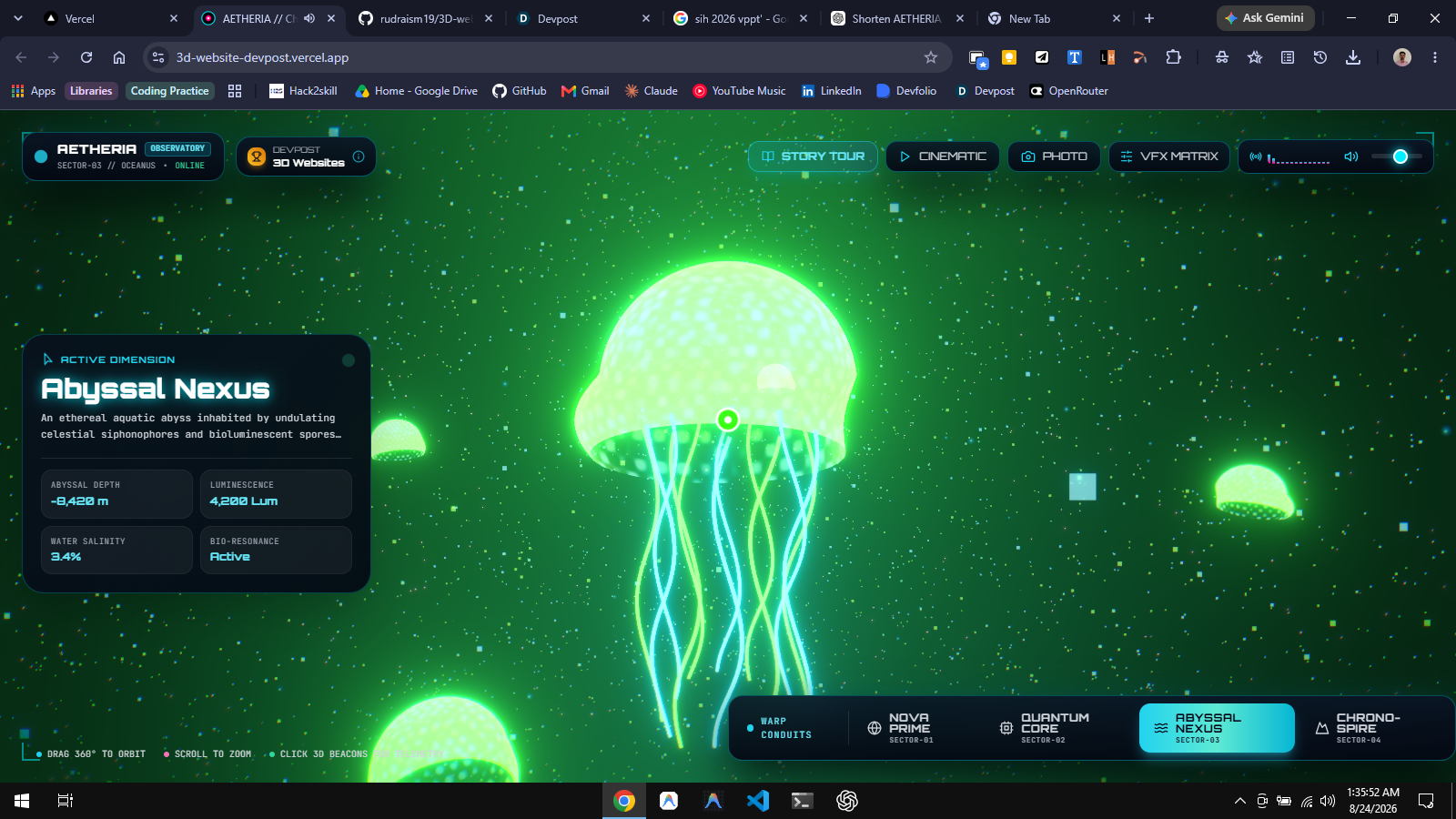
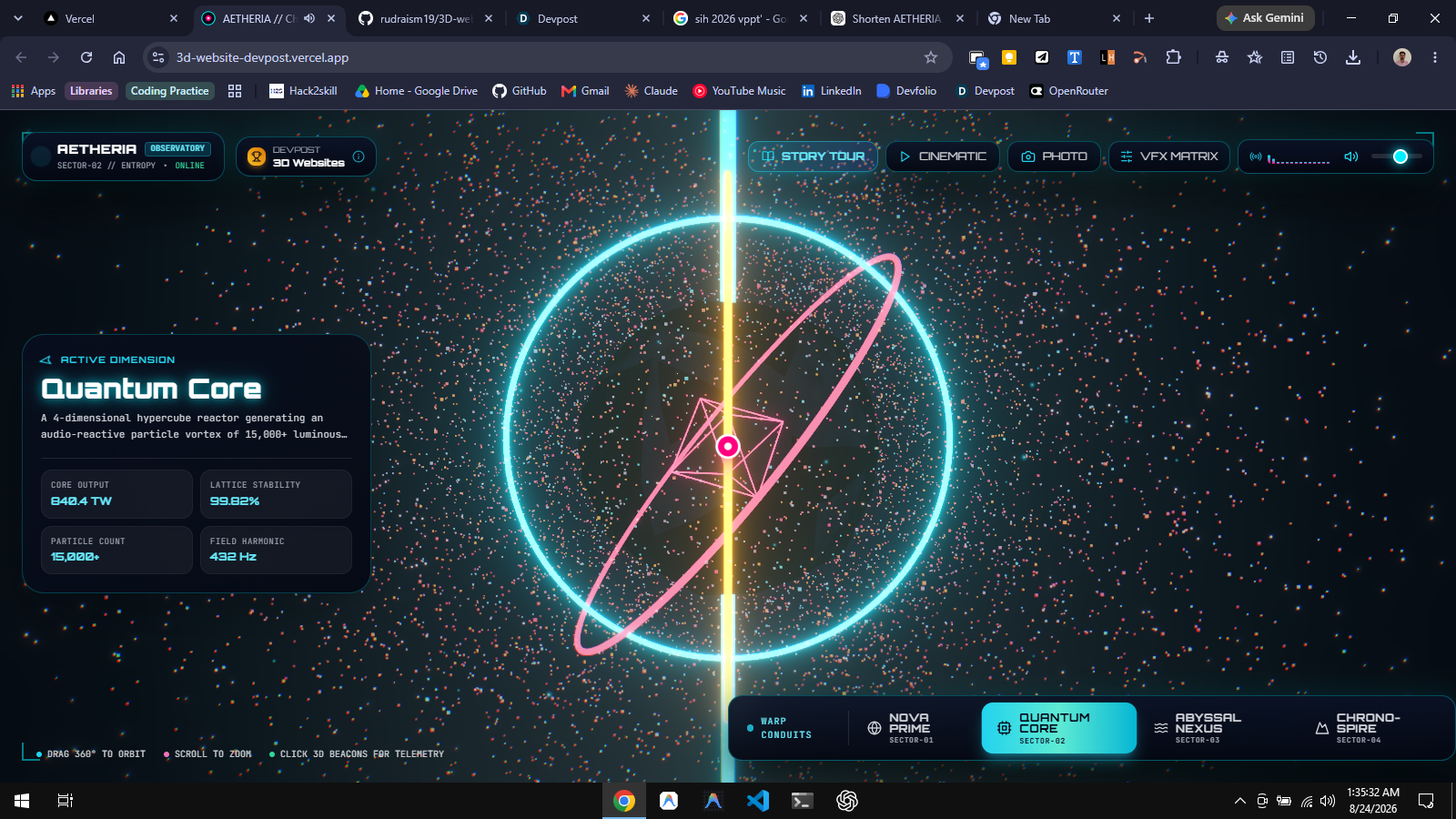
✨ AETHERIA // Chronos Nova is an interactive 3D space observatory with four unique worlds to explore:
- 🌍 Nova Prime: A living alien planet where you can terraform oceans, greenery, atmospheres, city lights, and magma in real time.
- 🔷 Quantum Core: A 4D rotating hypercube singularity surrounded by 15,000+ swirling quantum particles.
- 🪼 Abyssal Nexus: A glowing bioluminescent alien organism drifting through deep-space ocean depths.
- 🏛️ Chrono-Spire: Ancient floating monoliths beneath dynamic procedural aurora borealis skies.
🌟 Key Features:
- 🎛️ Interactive Sci-Fi HUD: Click on 3D holographic beacons to view planetary diagnostics and lore.
- 🎥 Cinematic Autopilot: Sit back and enjoy automated camera tours around each celestial realm.
- 📸 Photo Mode & Filters: Capture 4K screenshots with custom bloom and visual effects.
- 🎵 Built-in Audio Synth: Generates ambient space music and sound effects on the fly without any audio files.
🛠️ How we built it
💻 We built the project using modern web technologies:
- ⚛️ Frontend & UI: React, TypeScript, Vite, Tailwind CSS, and Framer Motion for smooth animations.
- 🎨 3D Graphics: Three.js and React Three Fiber (
@react-three/fiber,@react-three/drei). - 🔮 Procedural Shaders: Custom GLSL shaders for terrain generation, ocean waves, glowing atmospheres, and auroras:
- Multi-octave noise formulas for dynamic planetary elevation: $$h(\mathbf{p}) = \sum_{i=0}^{N-1} A_i \cdot \text{noise}(f_i \mathbf{p})$$
- Fresnel rim lighting for realistic glowing atmospheres: $$I_{\text{Fresnel}} = (1.0 - \mathbf{n} \cdot \mathbf{v})^\gamma$$
- 🎶 Sound Engine: Native Web Audio API to synthesize ambient space drones and UI clicks directly in code.
⚡ Challenges we ran into
- 🚀 Performance Optimization: Keeping smooth 60 FPS while rendering 20,000+ particles, post-processing bloom, and complex shaders simultaneously. We solved this using GPU instancing and vertex shader calculations.
- 🎯 3D UI Tracking: Accurately projecting 3D marker coordinates onto the 2D screen so HUD overlays follow moving planets smoothly.
- 🎼 Procedural Audio: Designing pleasing, relaxing space synth music purely through code and mathematical oscillators without using pre-recorded MP3 files.
🏆 Accomplishments that we're proud of
- ⚡ Instant Load Time: Loads in under a second because there are no heavy 3D models or audio tracks to download.
- 🎮 Smooth 60 FPS: High visual quality and fluid performance on both laptops and mobile devices.
- 🎛️ Real-Time Interactivity: Every slider and button immediately updates the 3D world in real time.
📚 What we learned
- 🧠 How to write custom GLSL vertex and fragment shaders for procedural world generation.
- 🔊 How to connect Web Audio API nodes with Three.js graphics to create audio-reactive visuals.
- 💎 Techniques for building responsive glassmorphic UI designs that work seamlessly with interactive 3D canvases.
🚀 What's next for AETHERIA // Chronos Nova
- 🥽 VR / AR Support: Adding WebXR support for Meta Quest and Apple Vision Pro.
- 🌐 Multiplayer Mode: Allowing multiple people to explore and terraform planets together in real time.
- 🧪 Custom Shader Sandbox: A built-in editor where users can write their own shader worlds and share them.
Built With
- 3d-graphics
- audio-synthesis
- canvas-confetti
- creative-coding
- css3
- framer-motion
- glsl
- html5
- javascript
- lucide-react
- math
- postprocessing
- procedural-generation
- react
- react-three-drei
- react-three-fiber
- shaders
- tailwindcss
- three.js
- typescript
- ui-ux
- vite
- web-audio-api
- webgl

Log in or sign up for Devpost to join the conversation.