-
-
The Life Cycle Of Solar System
-
The Life Cycle Of Solar System
-
The Life Cycle Of Solar System
-
Forge Of Last Star
-
Forge Of Last Star
-
-
-
Plantes
-
-
-
Forge Of Last Star
-
Forge Of Last Star
Aetheria: The Birth of Aetherium
Live demo: https://aetheria-3d-experience.vercel.app
Inspiration
Space is usually taught through static articles and videos. We wanted visitors to experience it—to travel through cosmic history, perform the physics that creates a star, and watch their actions reshape a living 3D universe.
That idea became Aetheria, a cinematic science game combining real Solar System education with a fictional mission guided by the EVE-119 probe.
What it does
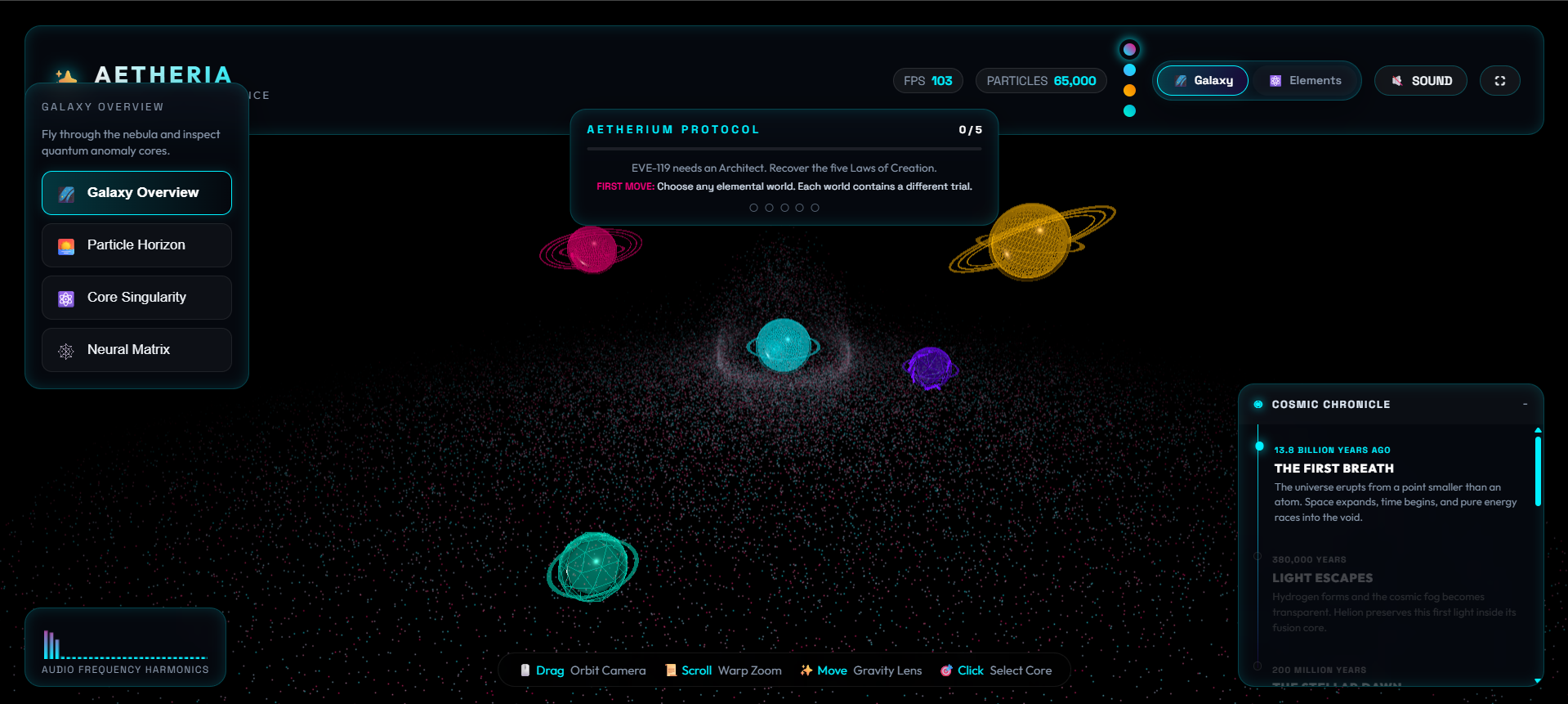
Aetheria offers three connected experiences:
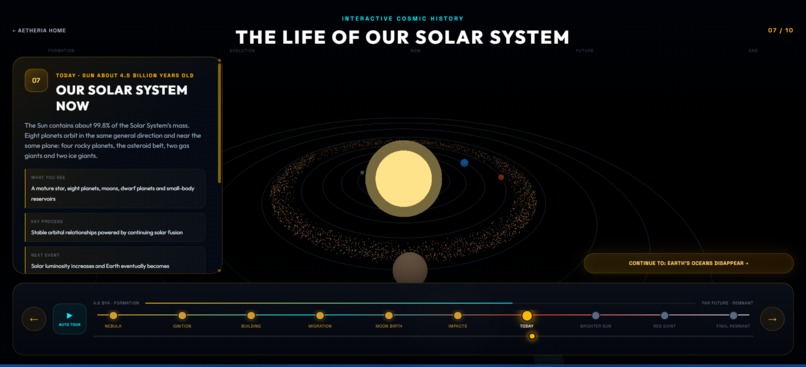
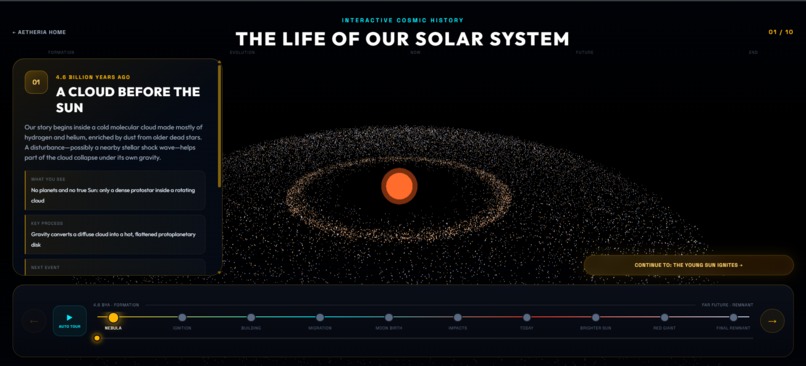
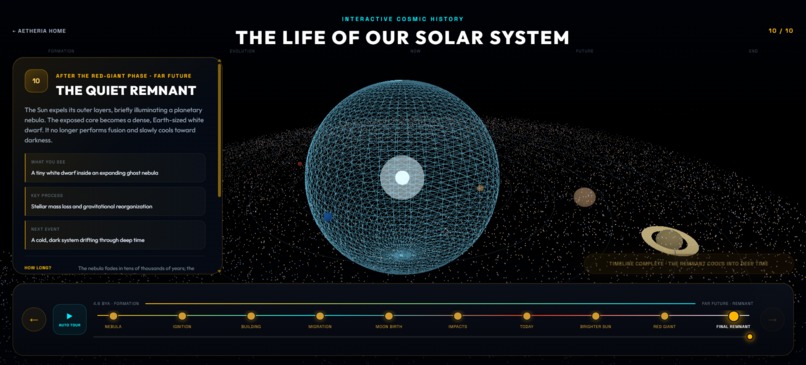
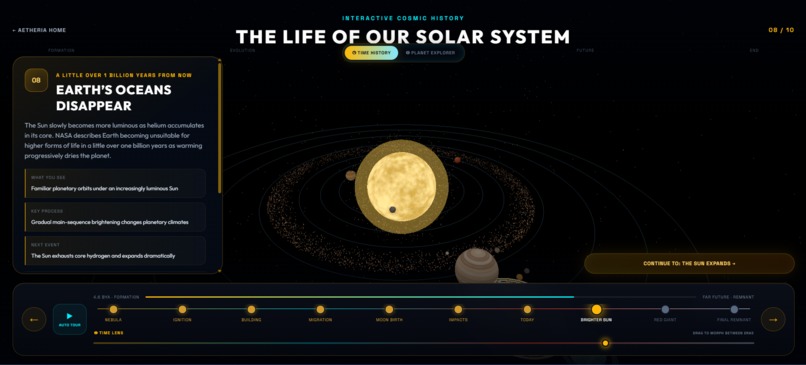
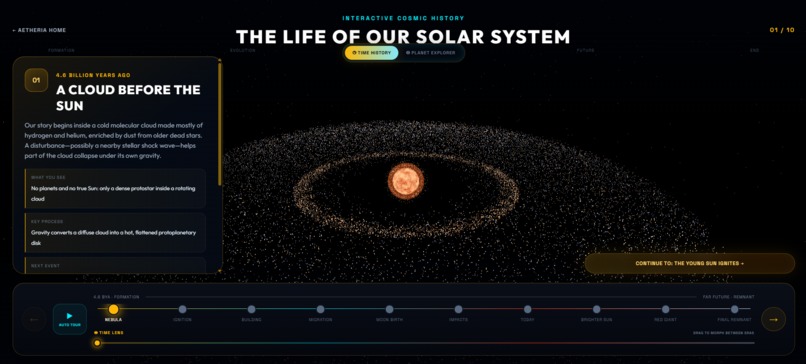
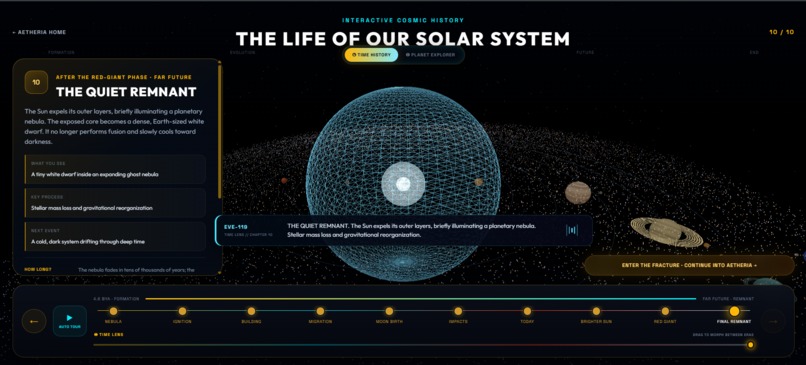
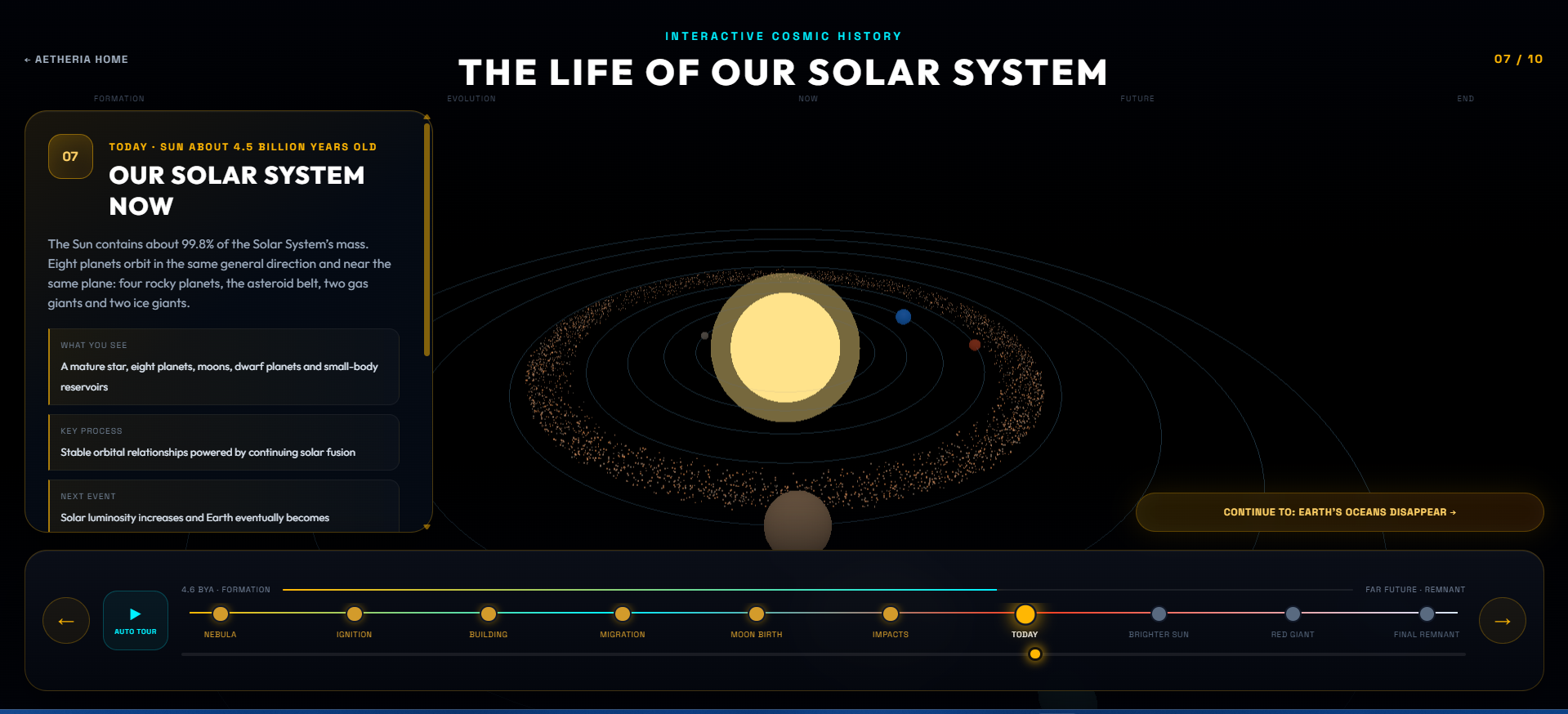
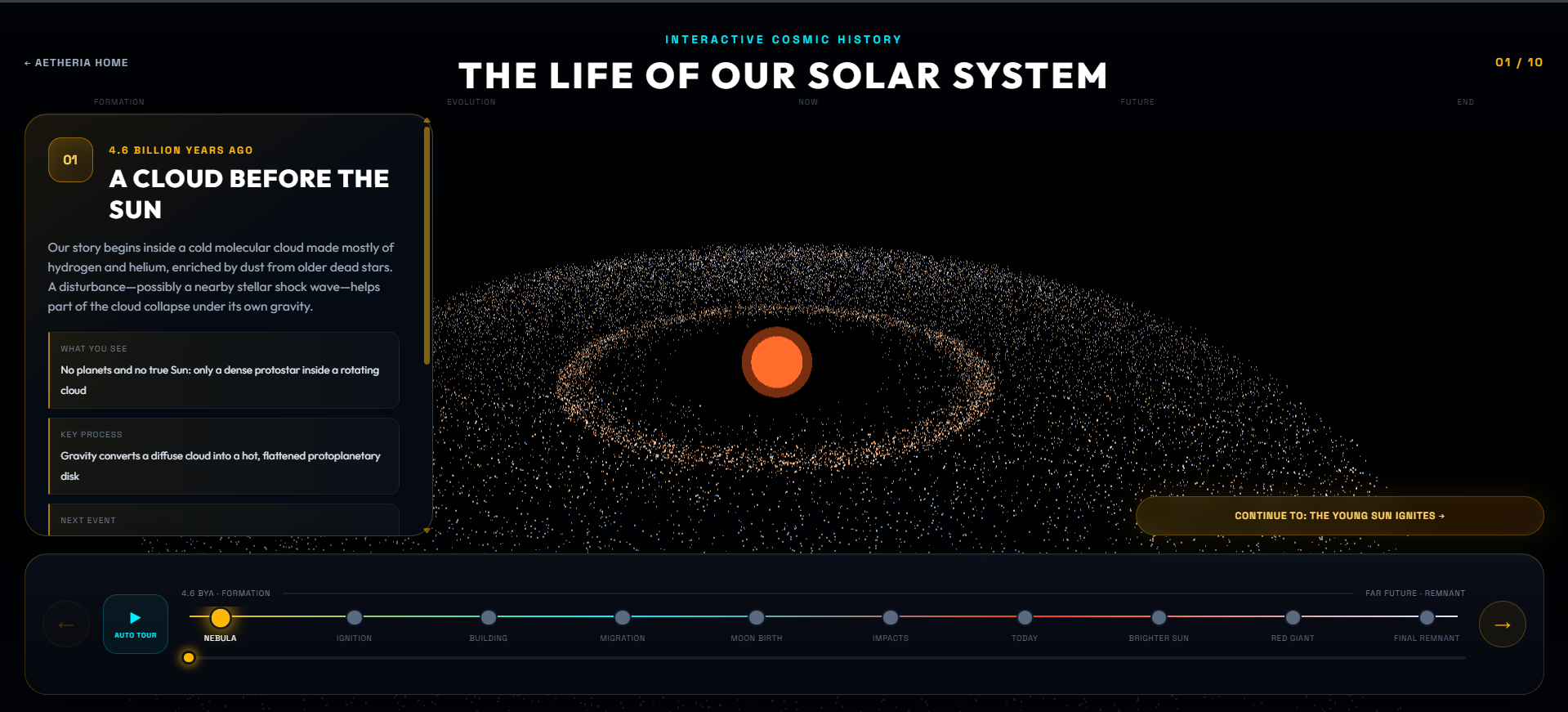
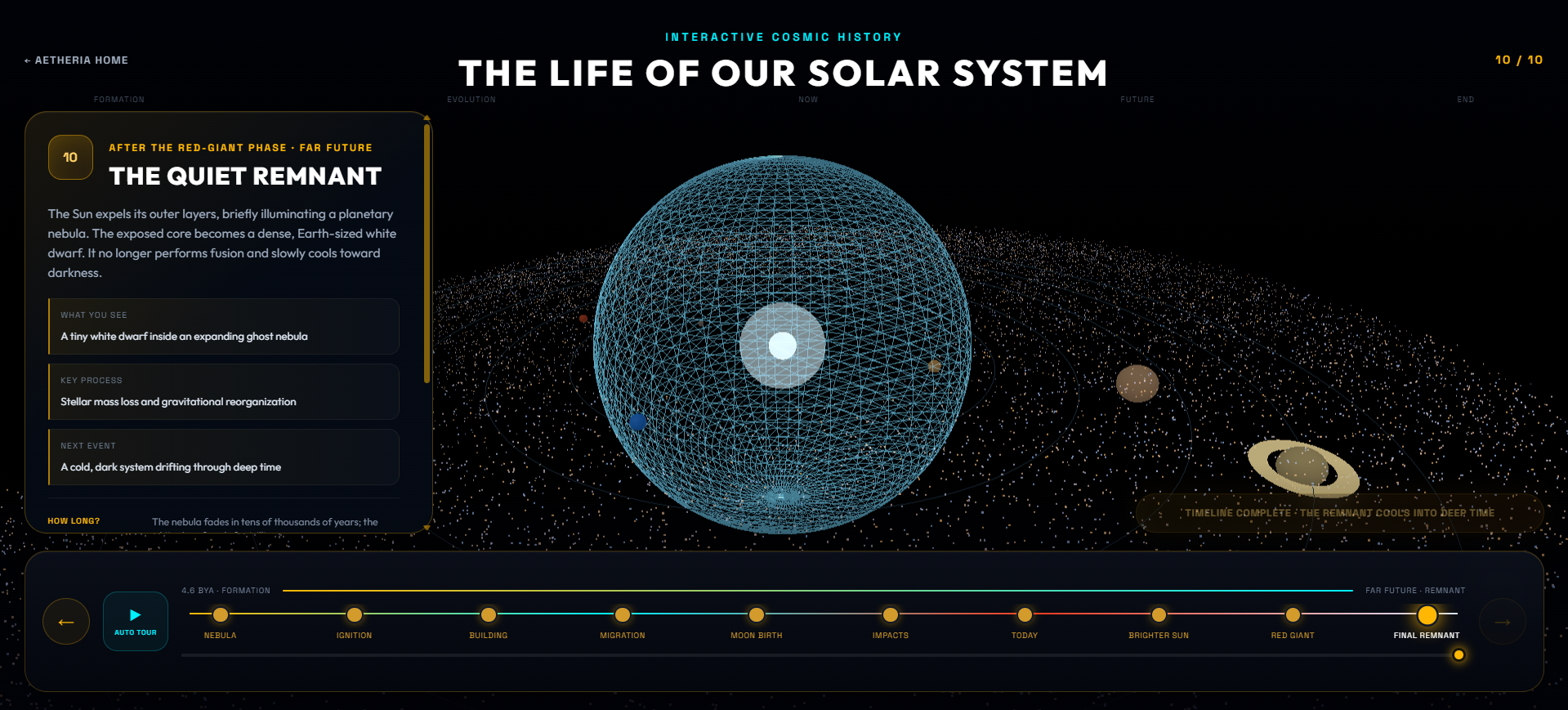
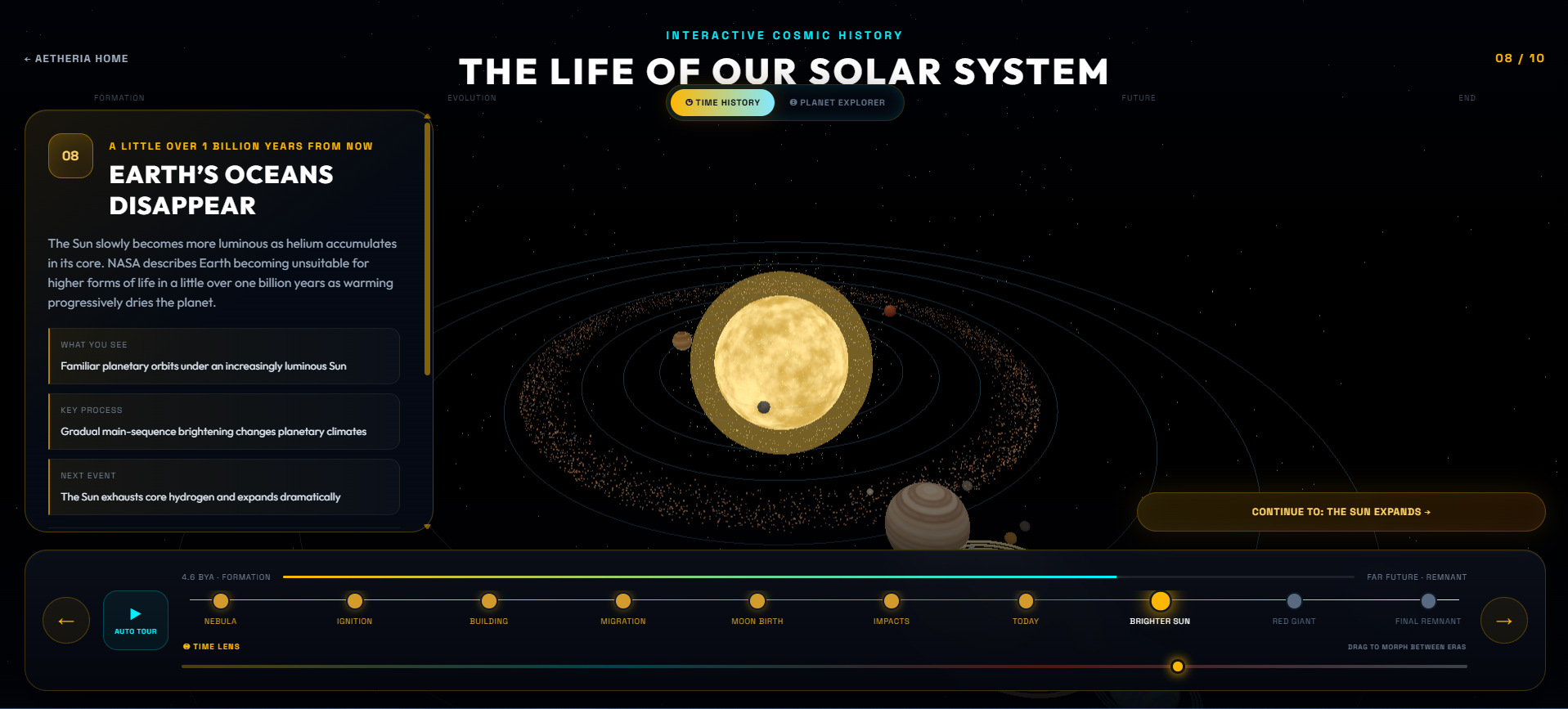
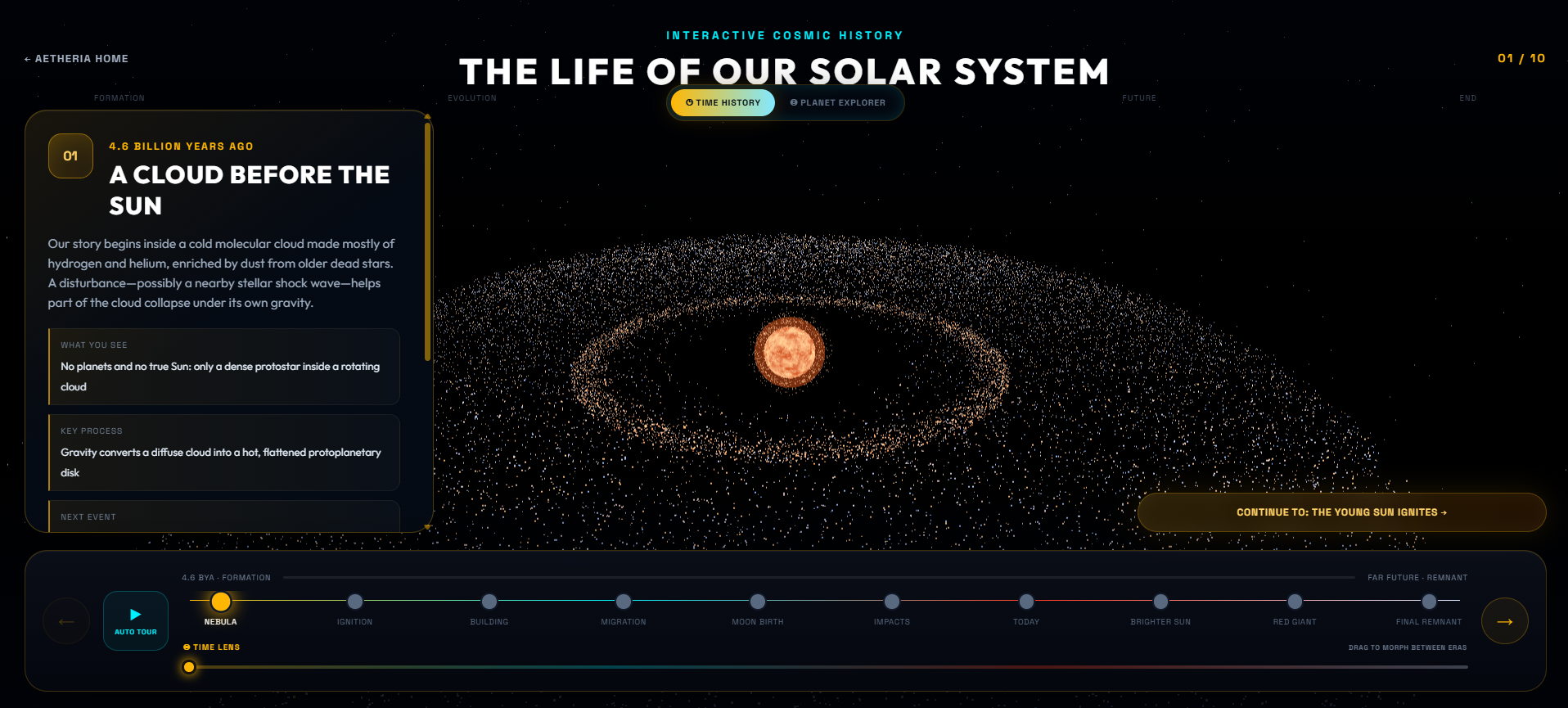
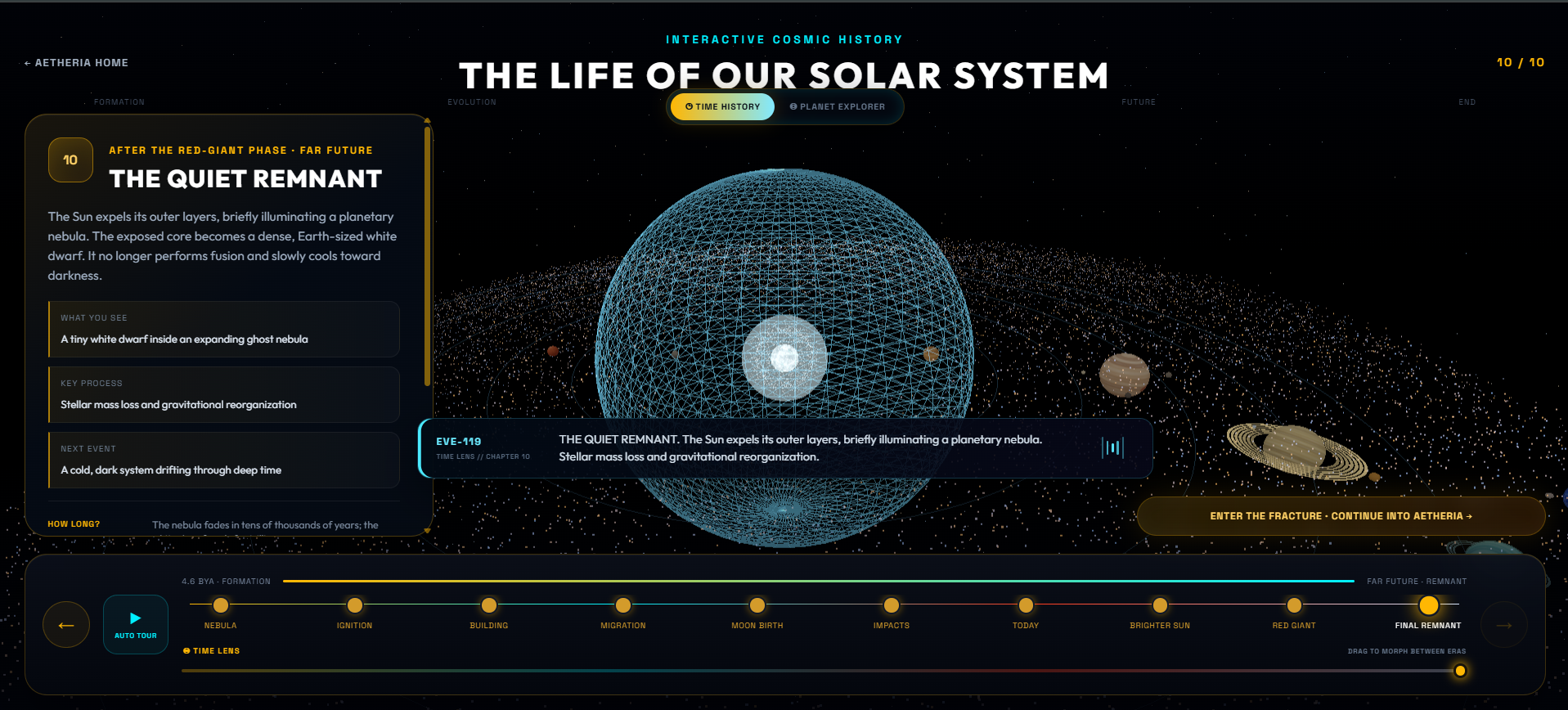
- Time Lens: Explore ten eras, from the Solar System's molecular cloud to the Sun's final white dwarf. Each chapter explains the event, process, evidence, and scientific uncertainty.
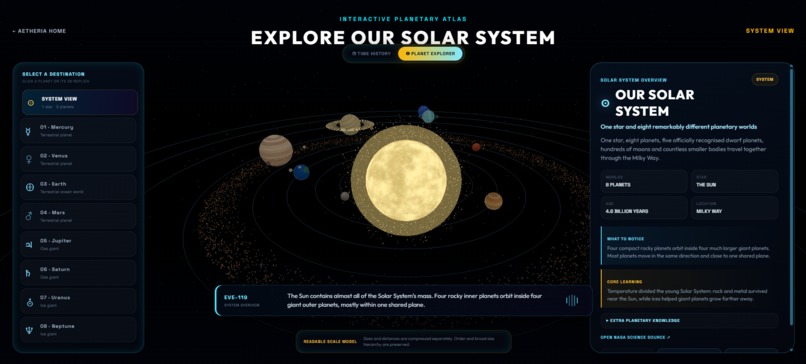
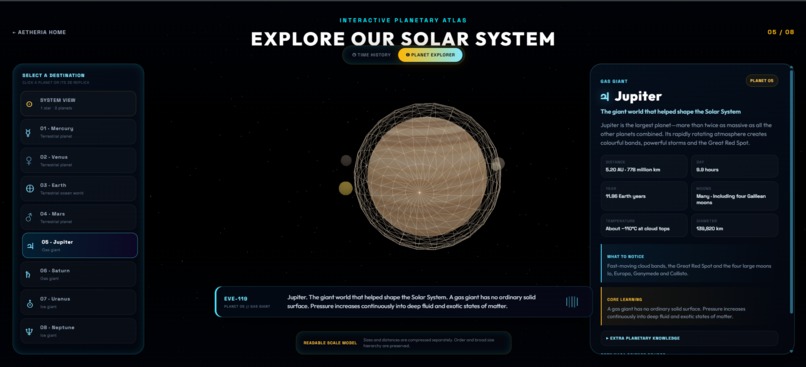
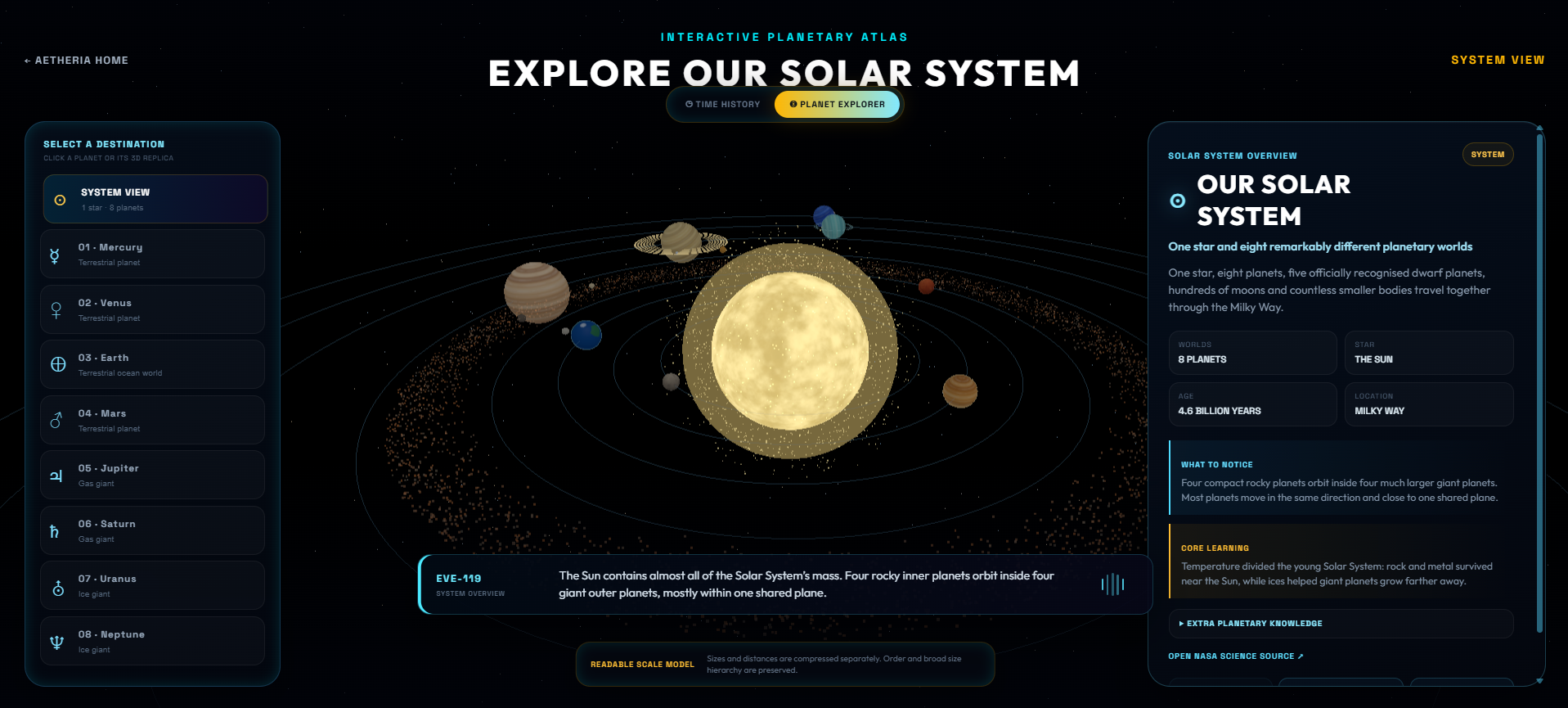
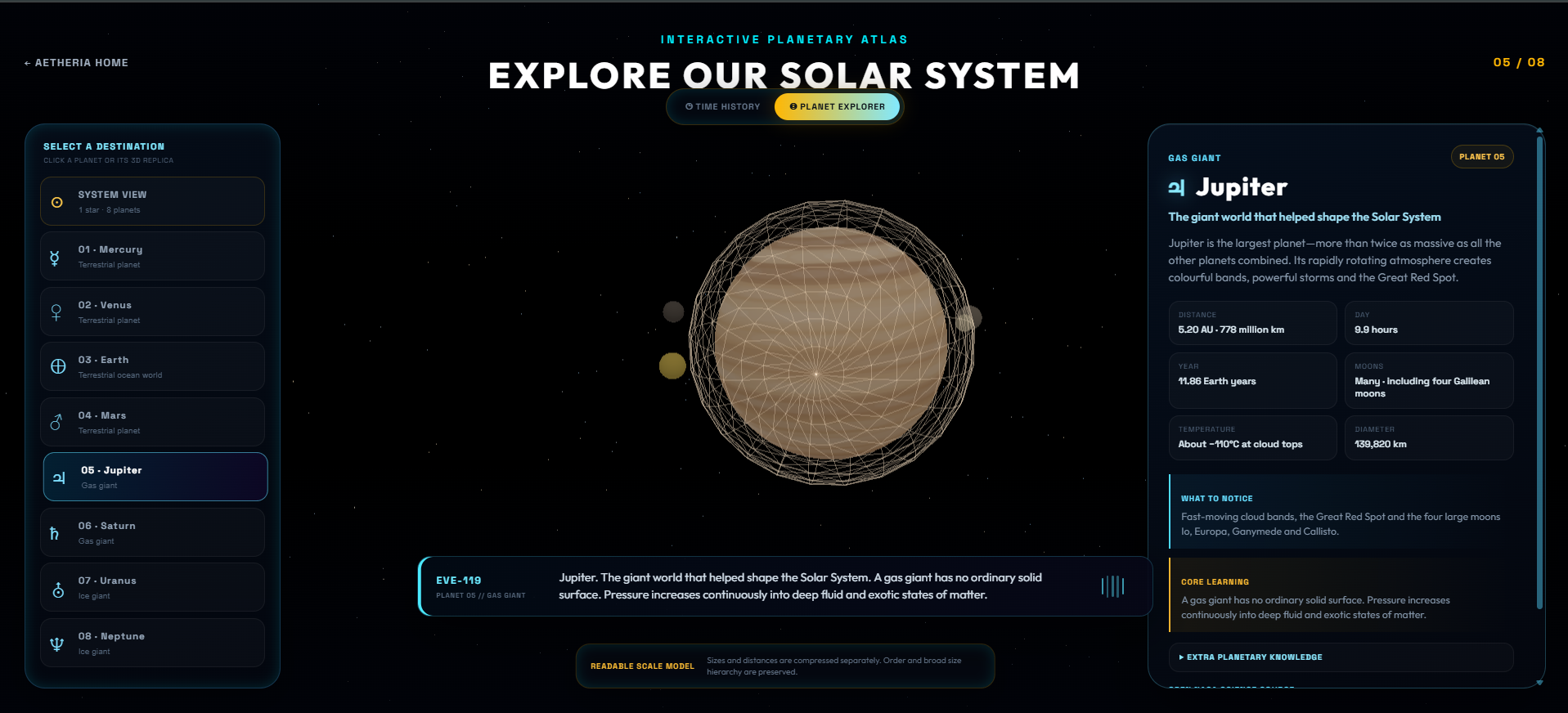
- Planet Explorer: Inspect the Sun and all eight planets through procedural 3D replicas with orbits, major moons, rings, camera navigation, key facts, and NASA science links.
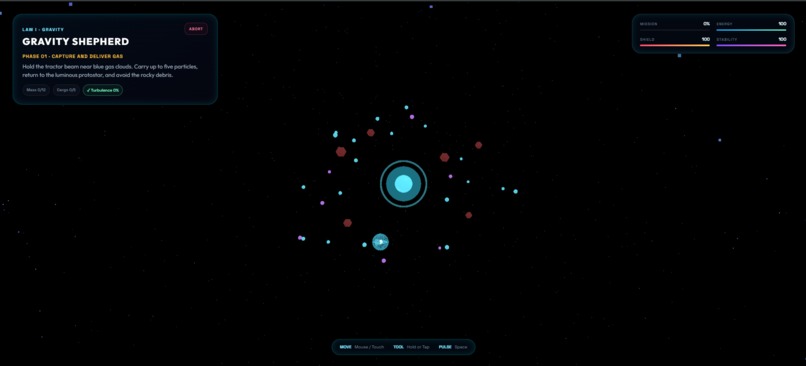
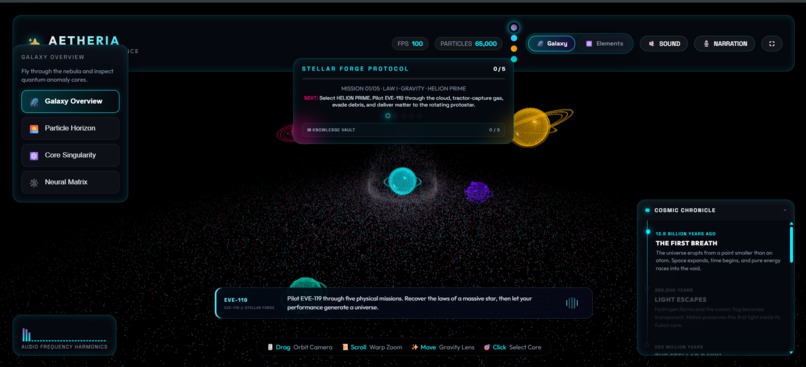
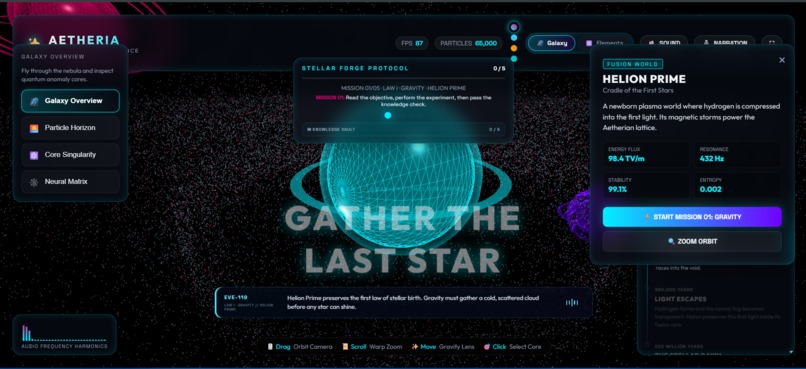
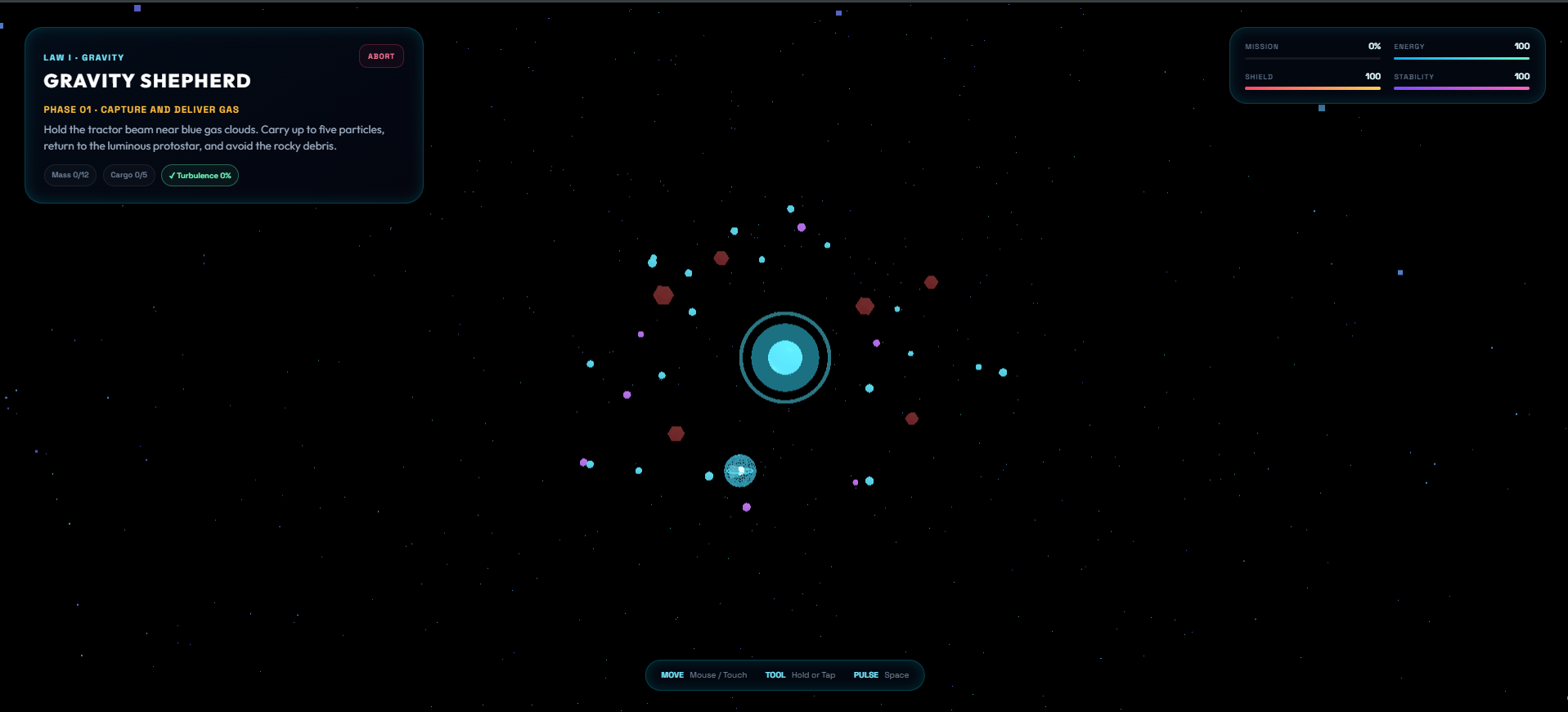
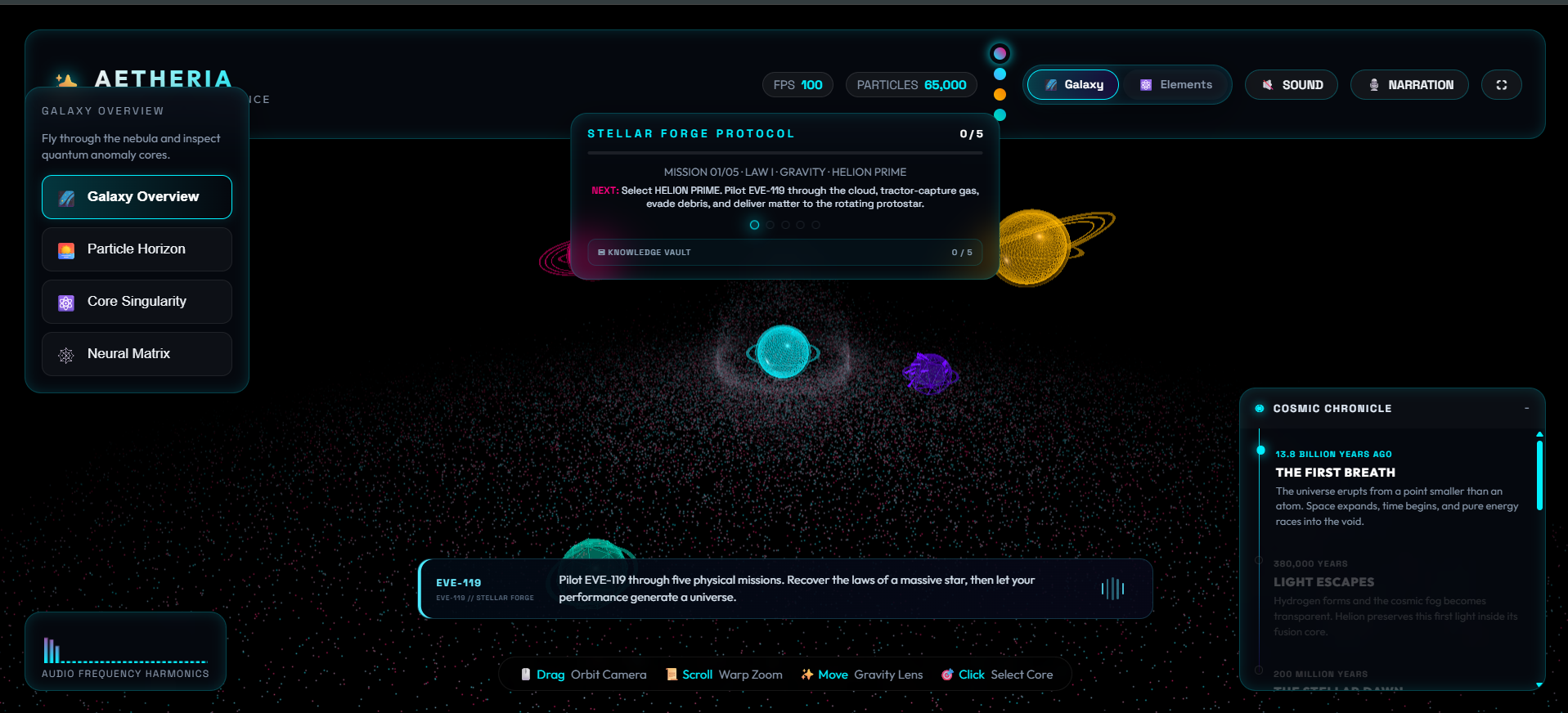
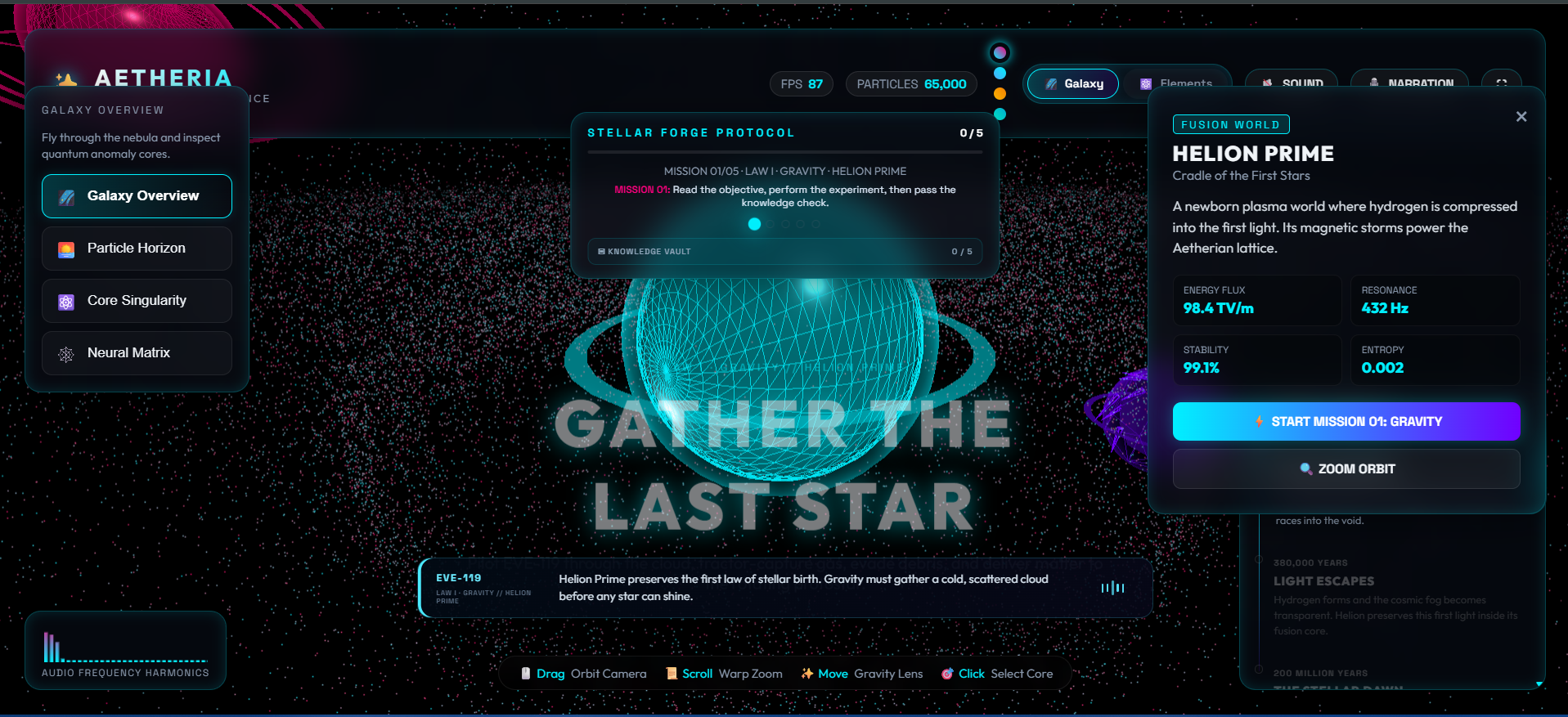
- Forge the Last Star: Pilot EVE-119 through five spatial missions based on gravity, fusion, carbon, stellar balance, and supernova rebirth.
The missions are active experiments rather than interface puzzles:
- Tractor stellar gas into a rotating protostar while avoiding debris.
- Collect hydrogen and time compression pulses to ignite fusion.
- Recreate the triple-alpha process and construct carbon's four bonds.
- Repair pressure leaks, survive gravity waves, and authorize core collapse.
- Outrun a supernova, recover heavy elements, and draw a constellation.
Every mission ends with a science check and unlocks a permanent Knowledge Shard. Performance influences the star class, planet count, orbital stability, life potential, and signature of the universe generated in the finale. Progress is saved locally.
How we built it
Aetheria uses Three.js, WebGL shaders, GSAP, Web Audio API, Web Speech API, responsive HTML/CSS, JavaScript, and Vite.
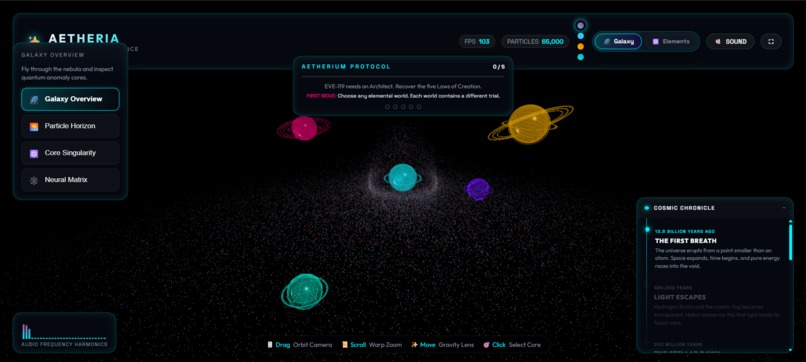
Around 65,000 GPU-animated particles form the galaxy and respond to movement, gravity, missions, and procedural audio. The planets, stellar environments, mission objects, and finale effects are generated directly in the browser without external 3D models.
It also includes cinematic transitions, optional voice narration, touch controls, mission HUDs, failure recovery, and guided instructions.
Challenges we ran into
- Meaningful gameplay: We replaced passive planet interactions with five physical missions containing objectives, hazards, feedback, and earned progression.
- Science and story: We connected real cosmic history to a fictional campaign while clearly separating established science from debated models.
- Performance and readability: Shader particles, reused geometry, controlled pixel ratio, responsive panels, and persistent navigation keep the experience fast and understandable.
Accomplishments that we're proud of
- Built a ten-era interactive Solar System timeline.
- Recreated the Sun and all eight planets as an educational 3D atlas.
- Developed five connected, replayable science missions.
- Added knowledge checks, collectible learning shards, and saved progress.
- Generated a player-dependent universe finale.
- Combined procedural visuals, audio, narration, and responsive controls in one experience.
What we learned
Visual quality creates attention, but meaningful interaction creates investment. The strongest moments happen when a player's action changes the world and immediately explains the science behind it. We also learned to coordinate GPU particles, procedural environments, audio-reactive effects, cinematic cameras, and cross-device controls in one Three.js application.
What's next
Next steps include WebXR exploration, spatial audio, deeper accessibility controls, richer procedural planet surfaces, shareable universe signatures, and cooperative missions.
Aetheria turns astronomy from something you read into something you can enter, influence, and remember.


Log in or sign up for Devpost to join the conversation.