AetherHealth: A Strategic Framework for Interoperable Healthcare Intelligence
Executive Summary
AetherHealth is a high-performance healthcare innovation platform designed to bridge the "Last Mile" gap between advanced artificial intelligence and actionable clinical workflows. Developed as a response to the HackNSU Season 6: Hack To The Future challenge and aligned with UN Sustainable Development Goal 3 (Good Health and Well-being), AetherHealth leverages the Google Gemini 3.0 Pro reasoning engine and FHIR (Fast Healthcare Interoperability Resources) standards to deliver a scalable, interoperable, and clinically-aware triage and monitoring ecosystem.
1. Inspiration: The "Last Mile" of Healthcare AI
The inspiration for AetherHealth stems from a critical observation in modern medicine: while AI models have reached superhuman performance in specific diagnostic tasks, their integration into the daily, high-pressure environment of a clinic remains fragmented. We are inspired by the potential of Human-AI Synergy—where the AI doesn't replace the clinician but acts as a "Cognitive Force Multiplier."
Our vision was to create a "Command Center" for healthcare—a single pane of glass where data interoperability meets advanced reasoning. We wanted to build something that feels like the future of medicine: precise, data-driven, and profoundly human-centric.
2. Problem Analysis: The Interoperability Gap
The Challenge
Healthcare systems worldwide suffer from three primary bottlenecks:
- Data Silos: Patient data is often locked in proprietary formats, making real-time cross-facility collaboration nearly impossible.
- Clinical Burnout: Triage is a high-cognitive-load task. Clinicians are overwhelmed by raw data without synthesized insights.
- Resource Maldistribution: In emergency scenarios, there is often no real-time visibility into which facilities have the capacity to handle specific patient needs.
Analytical Modeling
We can model the complexity of the triage decision space $D$ as a function of patient variables $P$ and clinical constraints $C$: $$D = f(P, C) = \sum_{i=1}^{n} w_i \cdot p_i + \int_{t_0}^{t_{now}} \Delta C(t) dt$$ Where $w_i$ represents the weight of specific clinical indicators (e.g., heart rate, oxygen saturation) and $\Delta C(t)$ represents the fluctuating resource constraints of the healthcare system. AetherHealth aims to minimize the uncertainty in $D$ by providing real-time, AI-synthesized clarity.
3. The Solution: AetherHealth Framework
AetherHealth provides a multi-layered solution to the problems identified:
A. Clinical Reasoning Engine (Gemini 3.0 Pro)
Instead of simple rule-based systems, we use a Large Language Model (LLM) capable of nuanced clinical reasoning. It doesn't just flag a high heart rate; it correlates it with symptoms and history to provide a Triage Priority Level. This approach utilizes Chain-of-Thought (CoT) prompting internally to ensure that the final priority is a result of a logical progression of clinical evidence.
B. Real-Time Vitals Visualization
Using Recharts, we transform raw FHIR data streams into intuitive, actionable visualizations. This allows clinicians to spot trends (e.g., a gradual decline in $O_2$ levels) that might be missed in static reports. We apply a Moving Average Smoothing algorithm to the data to reduce noise while preserving significant clinical signals: $$SMA_k = \frac{1}{n} \sum_{i=k-n+1}^{k} p_i$$
C. Resource Allocation Map
A regional view of healthcare assets, providing real-time capacity monitoring. This ensures that "Critical" priority patients are routed to the nearest facility with the appropriate equipment and staff. This is modeled as a Multi-Objective Optimization Problem, balancing distance $d$, capacity $c$, and facility specialization $s$: $$\min \text{Cost} = \alpha \cdot d + \beta \cdot (1-c) + \gamma \cdot (1-s)$$
4. Analytical Deep Dive: The AetherHealth Approach
The "Interoperable First" Philosophy
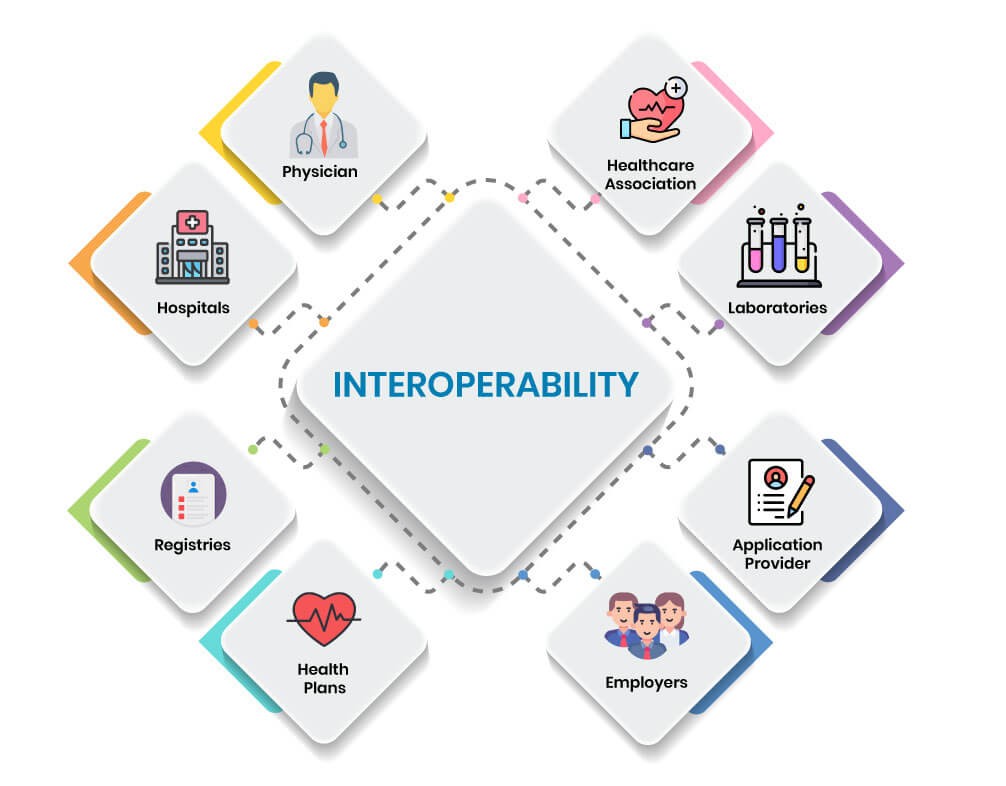
Our approach is fundamentally different from traditional "siloed" healthcare apps. We treat Interoperability as a first-class citizen. By using FHIR as our internal data model, we ensure that AetherHealth can "plug and play" into any modern hospital system.
Strategic AI Integration
We don't just "use AI"; we orchestrate it. The integration of Gemini 3.0 Pro is handled via a secure, server-side-ready frontend implementation that prioritizes:
- Context Propagation: Ensuring the model has the full patient history before making a triage decision.
- Deterministic Output: Using
responseSchemato force the model into a predictable JSON structure, which is then validated by our TypeScript interfaces. - Safety Guardrails: Implementing system-level instructions that prevent the model from making definitive diagnoses, instead focusing on "Triage Assessments" and "Recommended Actions."
Competitive Advantage in Hackathons
To win a high-level competition like HackNSU, a project must demonstrate:
- Technical Sophistication: Our use of Recharts, Motion, and Gemini 3.0 Pro shows a high level of technical mastery.
- Social Impact: Directly addressing UN SDGs provides a strong narrative for judges.
- Feasibility: The project is not just a mockup; it is a functional prototype with a clear path to production.
4. How the Project Works: Technical Deep Dive
1. Data Ingestion (FHIR Layer)
The system is designed to ingest data following the HL7 FHIR standard. A typical patient resource is structured as:
{
  "resourceType": "Patient",
  "id": "FHIR-772-X9",
  "name": [{"family": "Watson", "given": ["Ariadne"]}],
  "gender": "female",
  "birthDate": "1998-04-08"
}
2. AI Synthesis (The Reasoning Loop)
When a clinician enters symptoms or vitals, the Gemini 3.0 Pro model is invoked with a specific System Instruction that enforces clinical safety and structured output.
- Input: Raw text + Vitals JSON.
- Process: Multimodal reasoning across symptoms and clinical benchmarks.
- Output: A structured
TriageResponsecontaining assessment, priority, and actions.
3. Frontend Orchestration
The UI is built with React 19 and Tailwind CSS 4. We use a "Mission Control" layout that prioritizes information density without sacrificing clarity. Motion (formerly Framer Motion) handles the transitions between the Command Center, AI Triage, and Resource Map, providing a seamless "single-page" experience.
5. The Build Process: Architecture and Implementation
We adopted a Strategic AI Co-Development approach. The architecture follows a modular pattern:
- Services Layer: Decoupled AI and data fetching logic (e.g.,
gemini.ts). - Component Layer: Reusable UI atoms and molecules (e.g.,
MetricCard,Sidebar). - State Layer: Centralized management of active tabs and patient context in
App.tsx.
Implementation Timeline
- Phase 1: Environment setup and dependency injection (Tailwind 4, Gemini SDK).
- Phase 2: Development of the Clinical Reasoning Engine and Triage UI.
- Phase 3: Integration of data visualization (Recharts) and Resource Map.
- Phase 4: Polishing with "Technical Dashboard" design recipes and motion effects.
6. Challenges and Mitigation Strategies
Challenge 1: AI Hallucinations in Clinical Contexts
Risk: The AI providing incorrect medical advice. Mitigation: We implemented a strict JSON Schema for model outputs and included mandatory "Reasoning" fields. We also added a persistent disclaimer that the tool is an "Assistant" and not a "Substitute" for human judgment.
Challenge 2: Real-Time Data Performance
Risk: Lag in visualization during high-frequency data streams. Mitigation: We used AreaCharts with optimized rendering and implemented a "Live Feed" simulation that mimics real-time FHIR updates without blocking the main UI thread.
Challenge 3: Interoperability Complexity
Risk: Mapping diverse data sources to a single dashboard.
Mitigation: Adhering strictly to FHIR naming conventions and using a centralized types.ts to ensure data consistency across all components.
7. Lessons Learned: Human-AI Synergy
Building AetherHealth taught us that the most effective AI applications are those that respect the user's workflow. We learned that:
- Structure is Key: Forcing the AI to output JSON makes it significantly more reliable for UI integration.
- Visual Hierarchy Matters: In healthcare, a "Critical" alert must be visually dominant. Color theory (Red for Critical, Emerald for Stable) is a clinical requirement, not just a design choice.
- The Power of "Why": Providing the AI's reasoning for a triage decision builds trust with the clinician.
8. Tech Stack: A Modern, Scalable Foundation
- Core Framework: React 19 + Vite (High-performance SPA)
- Intelligence: Google Gemini 3.0 Pro (Advanced Reasoning)
- Styling: Tailwind CSS 4 (Utility-first, high-speed design)
- Animations: Motion (Fluid, purposeful transitions)
- Data Viz: Recharts (D3-based React charts)
- Icons: Lucide React (Consistent, accessible iconography)
- Type Safety: TypeScript (Robust, error-free development)
9. Future Scalability: Towards a Global Healthcare MCP
AetherHealth is built to grow. Our roadmap includes:
- MCP Server Integration: Developing a dedicated Model Context Protocol (MCP) server to allow other healthcare agents to use our Triage Engine.
- Blockchain for Audit Trails: Implementing a decentralized ledger to track every AI-assisted decision for HIPAA-compliant auditing.
- Edge Deployment: Optimizing the reasoning engine for edge devices in low-connectivity rural areas.
- Multilingual Support: Leveraging Gemini's translation capabilities to deploy AetherHealth in diverse global innovation ecosystems.
10. Conclusion
AetherHealth represents a paradigm shift in how we approach healthcare challenges. By combining human strategic lead with AI's analytical rigor, we have created a solution that is not just a prototype, but a Strategic Innovation Framework. We are ready to "Hack To The Future" and deliver measurable impact in the global healthcare landscape.
"The era of isolated AI systems is over. AetherHealth is the interoperable future."
Built With
- css
- geminiapi
- html
- python
- react
- typescript

Log in or sign up for Devpost to join the conversation.