Inspiration
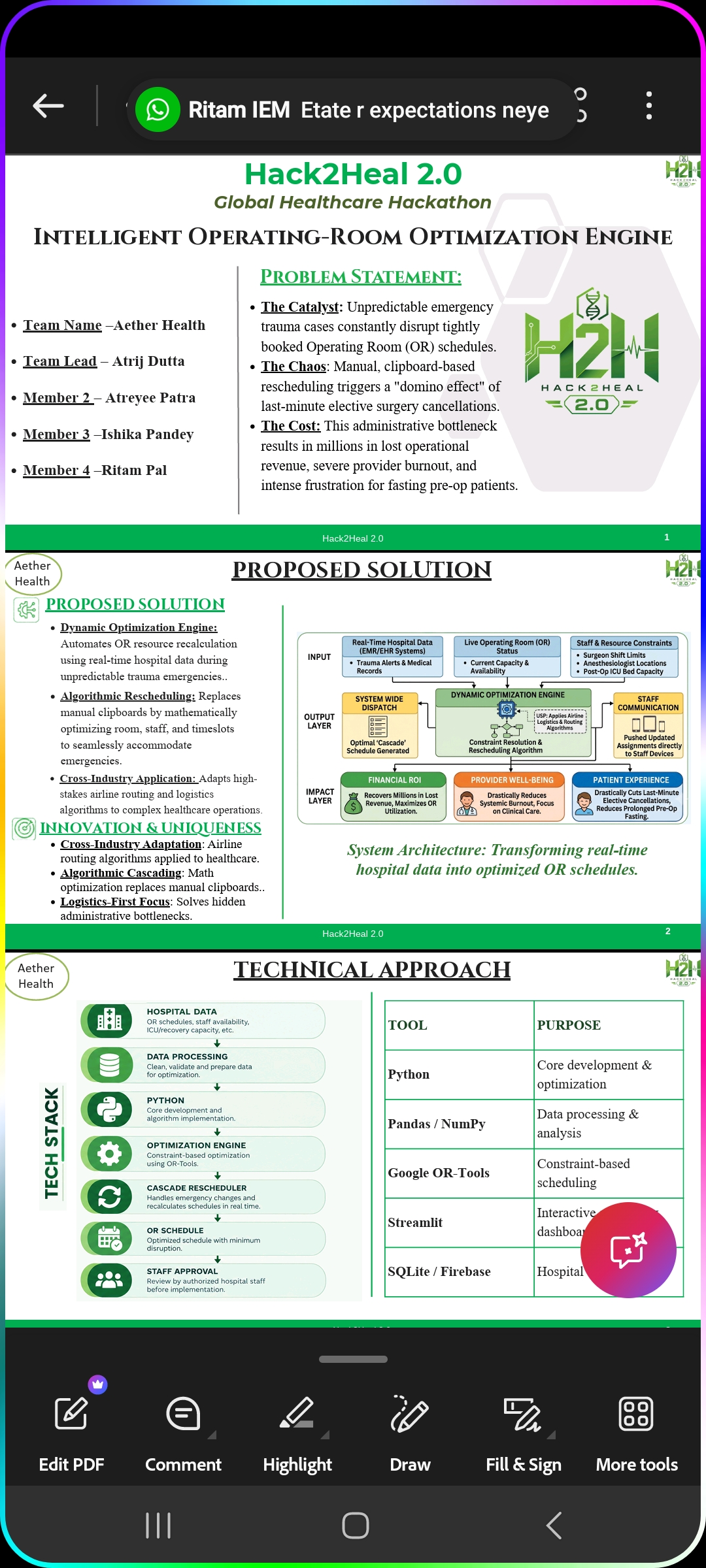
While researching global healthcare challenges, the AetherHealth team noticed a glaring gap: most innovation focuses strictly on clinical diagnosis, completely ignoring the massive administrative bottlenecks that cripple hospitals. We realized that a single unpredictable emergency trauma case creates a chaotic "domino effect," forcing hospitals to manually cancel elective surgeries using clipboards and phone calls. This wastes millions in operational revenue, burns out medical staff, and leaves fasting patients frustrated. We were inspired by cross-industry logistics—specifically how airlines instantly reroute flights during a storm—and decided to apply those exact constraint-resolution algorithms to high-stakes operating room management.
What it does
The Intelligent Operating-Room Optimization Engine is an automated software platform that functions as a real-time logistics brain for hospitals. When an emergency trauma alert is triggered, the system continuously monitors EMR/EHR data to ingest live hospital statuses. Instead of canceling a full day of elective surgeries, the engine instantly cross-references hundreds of live variables—including surgeon shift limits, anesthesiologist locations, and post-op ICU bed capacity. It then generates an optimal "cascade" schedule, mathematically reshuffling the remaining surgeries into available rooms and timeslots, and pushes these automated dispatch assignments directly to staff devices.
How we built it
We engineered the solution by dividing it into a data-ingestion layer, a processing engine, and a user interface. Backend & Algorithm: We utilized Python to build the core constraint-resolution engine, mapping out the multi-variable logistical algorithms required to calculate the optimal cascade schedule without conflicting resource demands. Middleware: We used Node.js to handle the simulated real-time data streams, acting as the bridge between mock EMR/EHR inputs and our optimization engine. Frontend Interface: To ensure the solution actually reduces administrative burden, we built a highly intuitive, clean dashboard using React and Tailwind CSS. This allows hospital administrators to view the algorithmic output in a simple, color-coded interface rather than staring at raw data.
Challenges we ran into
The biggest technical hurdle was defining the dependency constraints within the algorithm. Unlike standard scheduling, hospital operations are deeply intertwined; an elective surgery cannot be moved to a new timeslot unless a specific specialized surgeon, an available sterile room, and a post-op ICU bed are all available simultaneously. Translating these multi-layered biological and physical constraints into a pure mathematical routing problem required multiple iterations of our logic flow.
Accomplishments that we're proud of
We are incredibly proud of successfully adapting a cross-industry logistical model (airline routing) to a life-and-death healthcare environment. By shifting the focus from patient-facing apps to hidden operational infrastructure, we built a unique solution that tackles systemic provider burnout and financial bleed at the root cause. We also succeeded in packaging complex algorithmic math into a seamless, user-friendly administrative dispatch system.
What we learned
Building this engine deepened our understanding of constraint satisfaction algorithms and real-time data processing. More importantly, it taught us how deeply interconnected clinical success is with logistical efficiency. We learned that to truly improve the patient experience (like preventing prolonged pre-op fasting), you often have to solve the invisible administrative chaos happening behind the scenes.
What's next for AetherHealth
Moving forward, we want to expand the engine's data ingestion capabilities by integrating simulated IoT inputs—such as tracking the real-time physical location of crash carts or sterile equipment. We also plan to scale the algorithm to handle regional hospital network optimization, allowing multiple hospitals in a city to share resource availability data during mass casualty events. Our next immediate step is to test our algorithm against historical, open-source hospital log data to quantify the exact percentage of elective cancellations we can prevent.
Built With
- algorithm
- data
- healthcare
- it
- javascript
- learning
- machine
- node.js
- optimization
- python
- react.js
- science
- tailwind



Log in or sign up for Devpost to join the conversation.