Inspiration
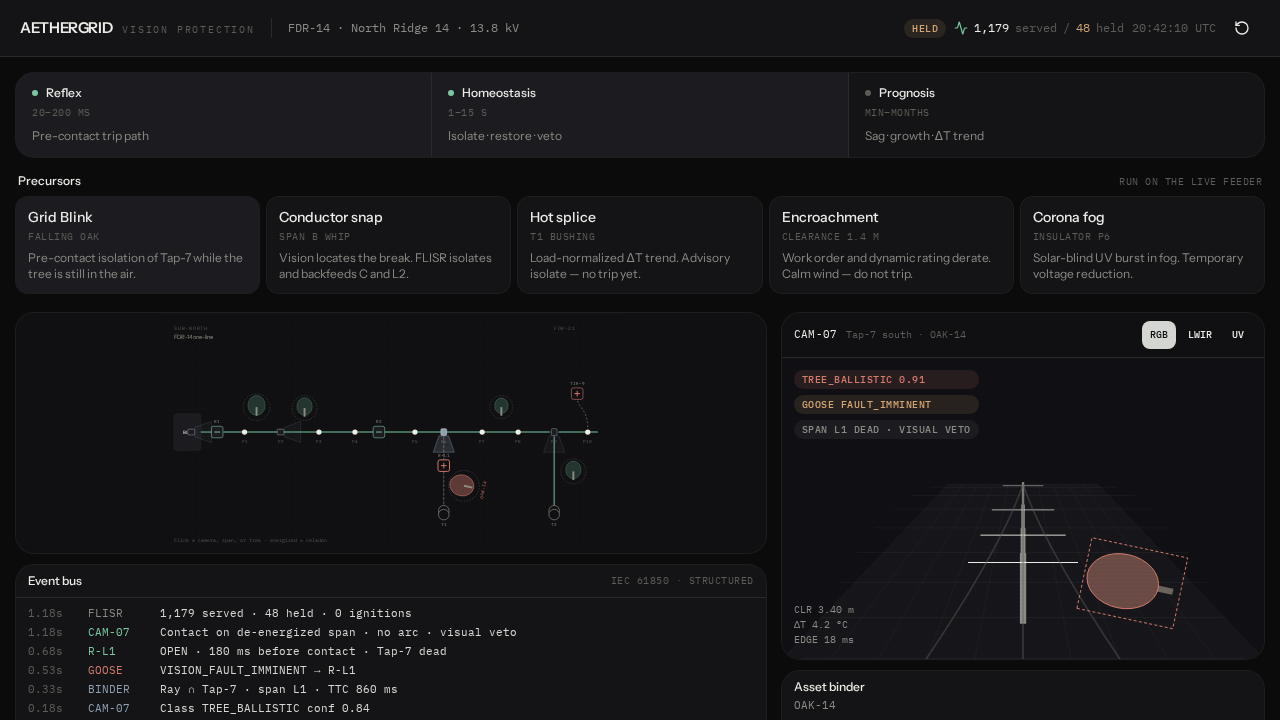
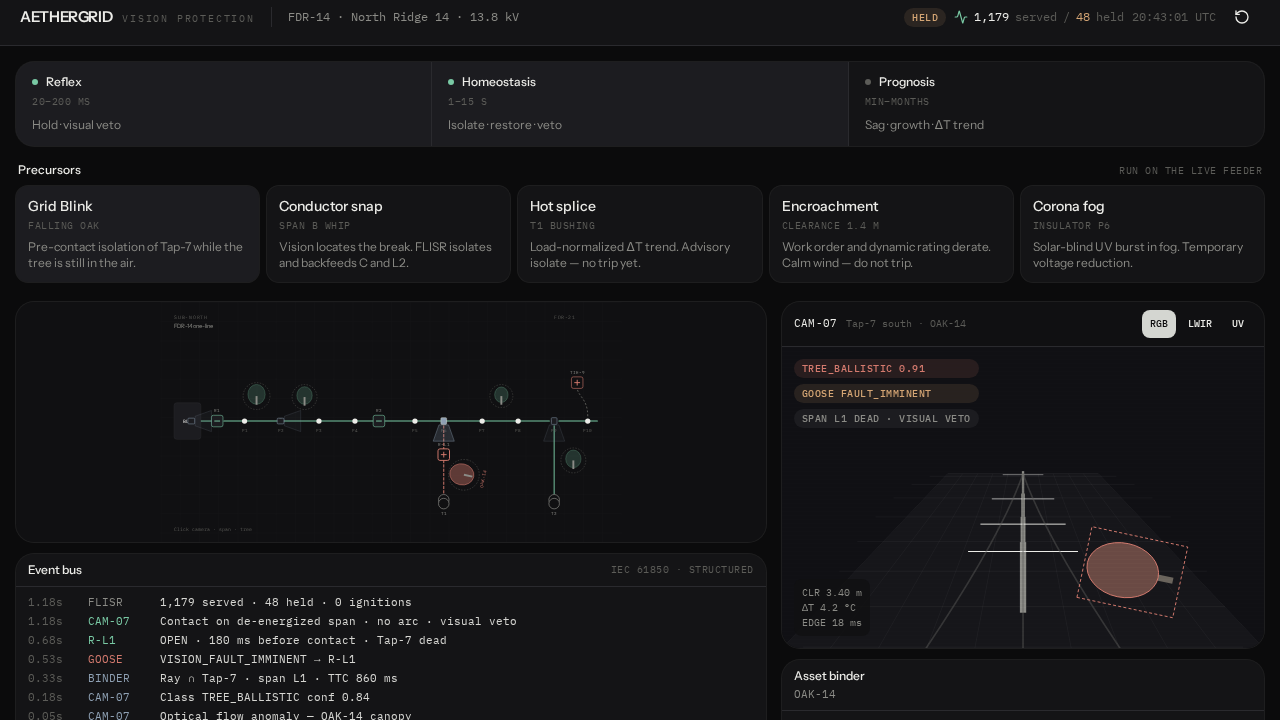
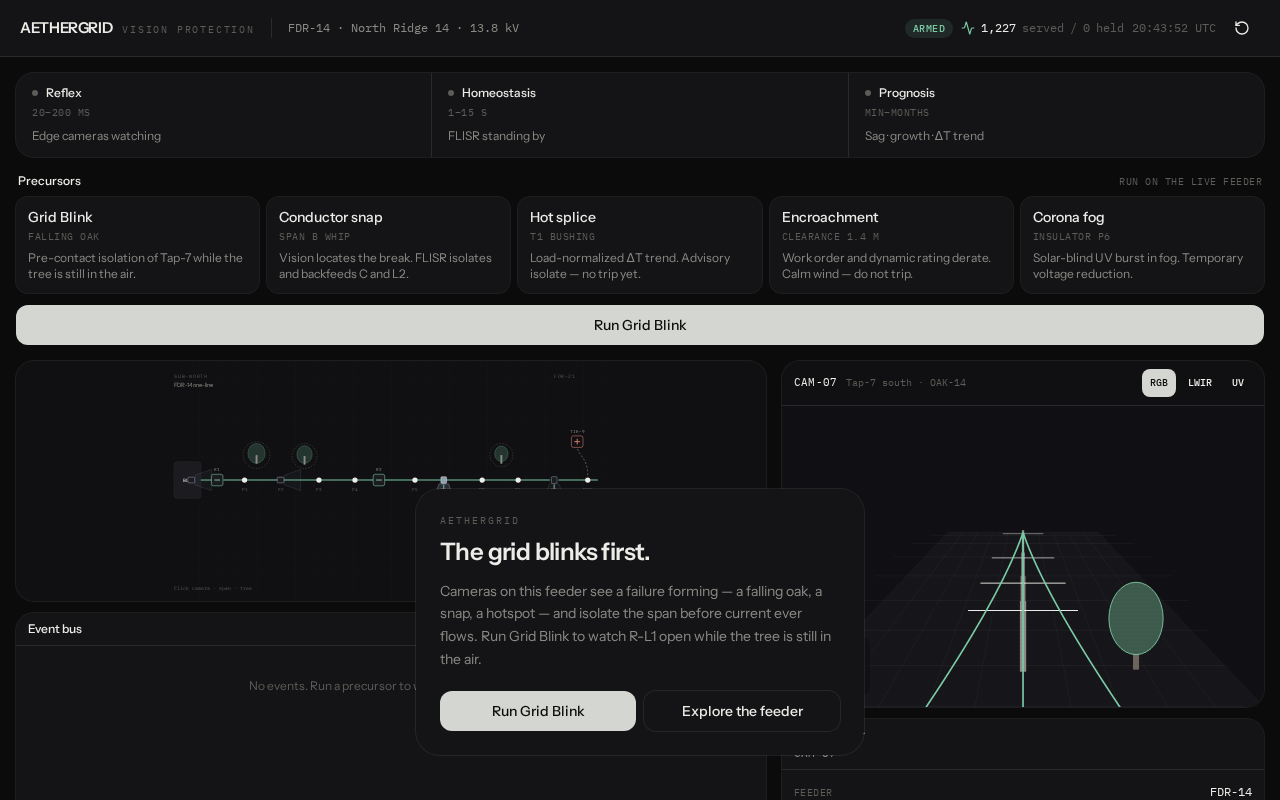
Modern power grids are massive, interconnected machines, yet they remain fundamentally reactive—they wait for a physical disaster, a catastrophic arc, or a fallen tree to actually happen before a protection relay trips. By the time a traditional overcurrent sensor detects a fault, the wildfire is already igniting, the equipment is melting, and customers are blacked out. We built AETHERGRID because we realized that the fastest protection sensor on a distribution feeder isn't an electrical meter—it's a camera that understands physics and gravity. We wanted to give the physical grid a true nervous system, allowing it to see a tree committing to fall or a conductor snapping in mid-air and trigger a pre-contact "Grid Blink" reflex milliseconds before impact.
What it does
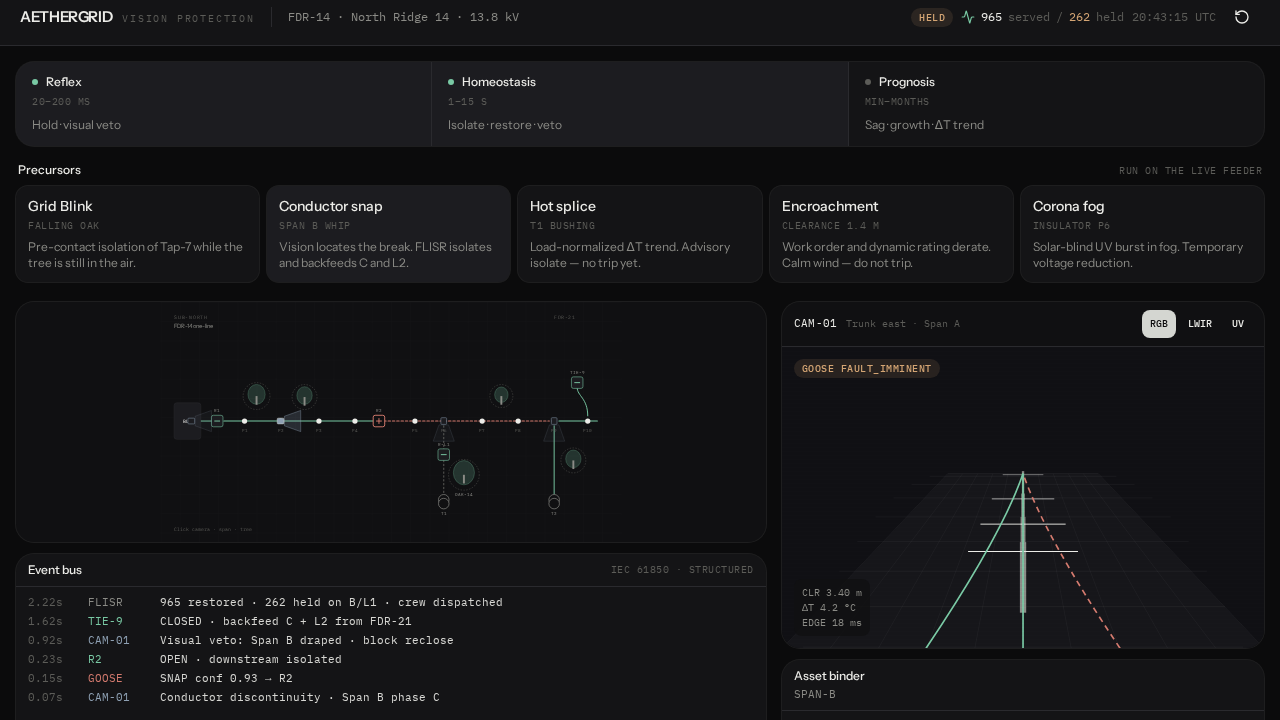
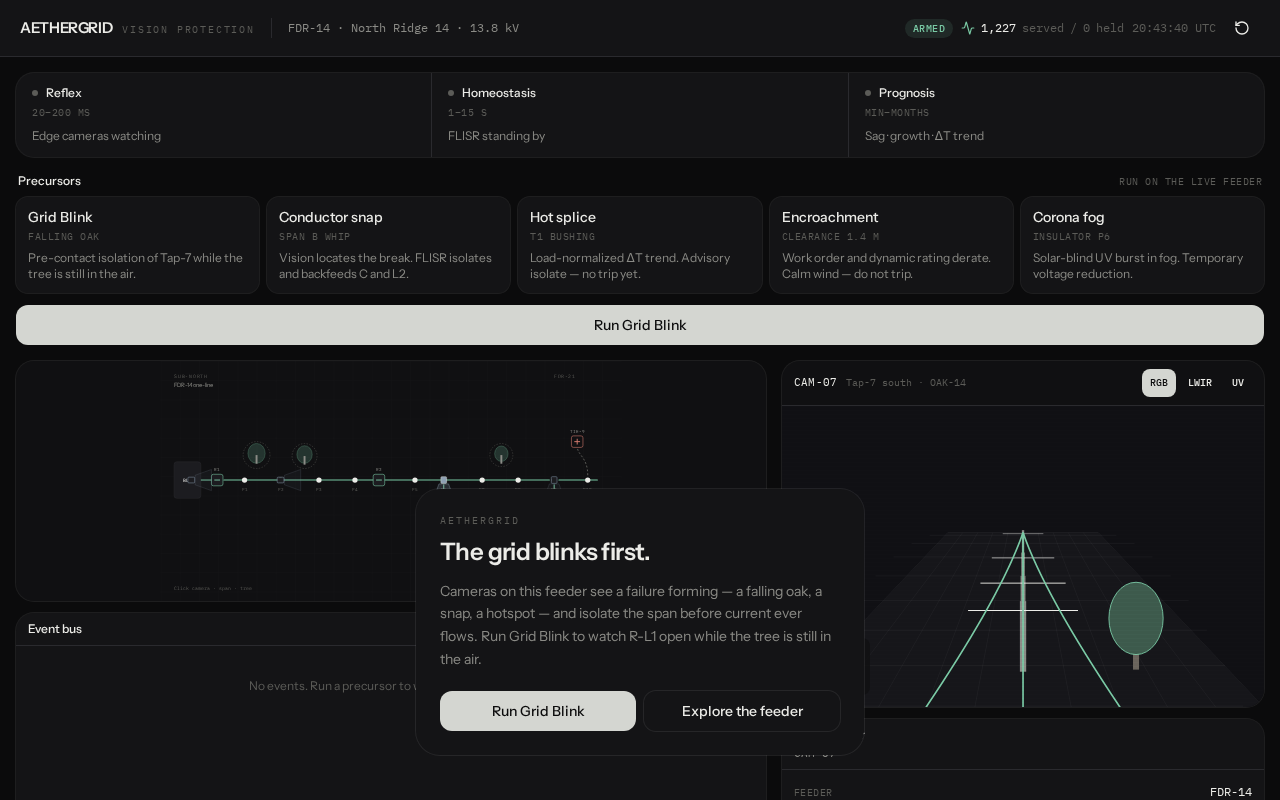
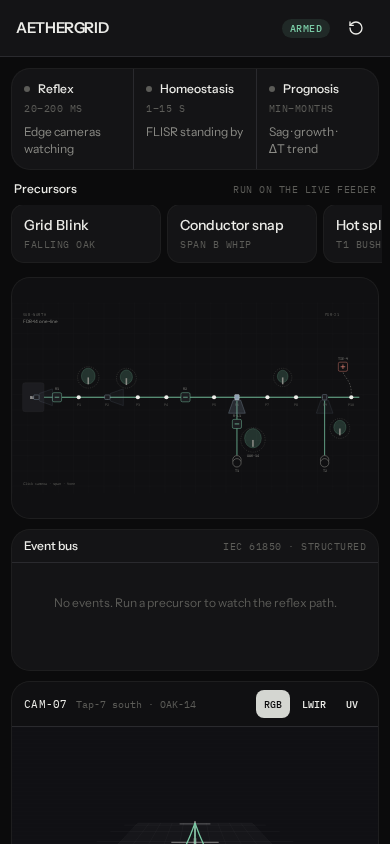
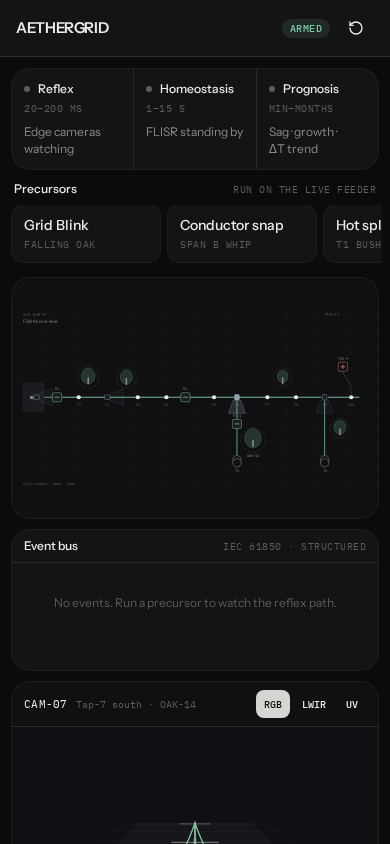
AETHERGRID is a distributed vision-native protection and resilience platform that operates across three distinct timescales: a sub-second edge reflex, a seconds-to-minutes homeostasis loop, and a long-range prognosis plane. Using a quad-modal pole-mounted sensor mesh (combining RGB, Radiometric LWIR thermal, Solar-Blind UV, and stereo/ToF optics), the system continuously tracks precursor physics like canopy encroachment, thermal hotspots, micro-sagging, and structural wear. When an immediate threat like a falling tree or a snapping line is detected, AETHERGRID computes the time-to-contact in 3D world coordinates and fires sub-millisecond IEC 61850 GOOSE commands to trip or isolate the exact span pre-contact, preventing arcs, wildfires, and cascading blackouts before they start.
How we built it
Multi-Modal Edge Pipeline: Deployed optimized TensorRT engines (YOLOv11-seg, custom U-Nets for conductor centerlines, and optical flow models) on NVIDIA Jetson hardware to process multi-stream video feeds locally at the pole.3D Spatial Geometry & Raycasting: Linked camera extrinsics and as-built span models to map 2D bounding boxes and pixel detections directly into real-world geographic coordinate vectors (X, Y, Z).Real-Time Reflex Fabric: Integrated low-latency communication pathways utilizing standard IEC 61850 GOOSE messaging over private LTE/5G fabric to achieve 20 to 200 millisecond trip loops directly with reclosers.Multi-Tiered Architecture: Engineered a three-layer hierarchy connecting edge reflex nodes to a control-center homeostasis layer (Vision-FLISR and restoration MIP) and a regional prognosis plane for long-term digital twin asset health tracking.
Challenges we ran into
Balancing Inference Speed with Precision: Running four concurrent optical bands (RGB, LWIR, UV, stereo) on edge hardware without exceeding power and thermal constraints demanded aggressive model quantization and careful pipeline scheduling. Eliminating False Positives in Reflex Trips: Protecting utility assets means zero room for error; designing confidence gates and conformal prediction bounds to differentiate between harmless tree sway in heavy wind versus true ballistic fall-in hazards was a major engineering hurdle. Simulating Rare Physical Failure Modes: Collecting real-world footage of rare catastrophic events like conductor whips and structural pole collapses is nearly impossible, requiring us to build robust synthetic data pipelines using simulation environments.
Accomplishments that we're proud of
Successfully architecting a true "pre-contact" reflex system that acts on physical movement before electrical faults occur, effectively converting a reliability tool into a proactive wildfire prevention engine. Building a multi-modal perception stack that unifies thermal anomaly detection, UV corona tracking, and metric sag-based Dynamic Line Rating into a single unified telemetry format. Demonstrating that sub-200ms edge vision processing can integrate directly with industrial grid communication standards like IEC 61850 without relying on fragile cloud backhauls.
What we learned
Infrastructure-grade AI cannot rely on cloud connectivity during major weather events; building a resilient system requires absolute local autonomy at the pole level with decentralized fallback routines. Merging computer vision with electric power engineering requires speaking the language of protection engineers—moving away from raw bounding box confidences toward deterministic, physics-informed safety margins.
What's next for AETHERGRID
Expanding shadow-mode deployments across high-risk wildfire distribution feeders to validate false-positive confusion matrices against historical outage logs. Integrating advanced drone and satellite telemetry feeds to automatically update the regional prognosis digital twin and fine-tune long-term vegetation growth models. Partnering with utility automation vendors to test auto-trip capabilities on dual-view reclosers for specific high-certainty hazards like ballistic tree falls and line snaps.

Log in or sign up for Devpost to join the conversation.