Inspiration
As middle and high school students, we often juggle multiple disconnected tools — one for coding, another for circuits, a separate chatbot for questions, and nothing that helps us catch security mistakes or understand real hardware from a photo.
We wanted a single place where a student could go from idea → code → circuit → security check → hardware analysis → cloud deploy, with an AI tutor that actually understands STEM. That’s how AetherForge was born.
What it does
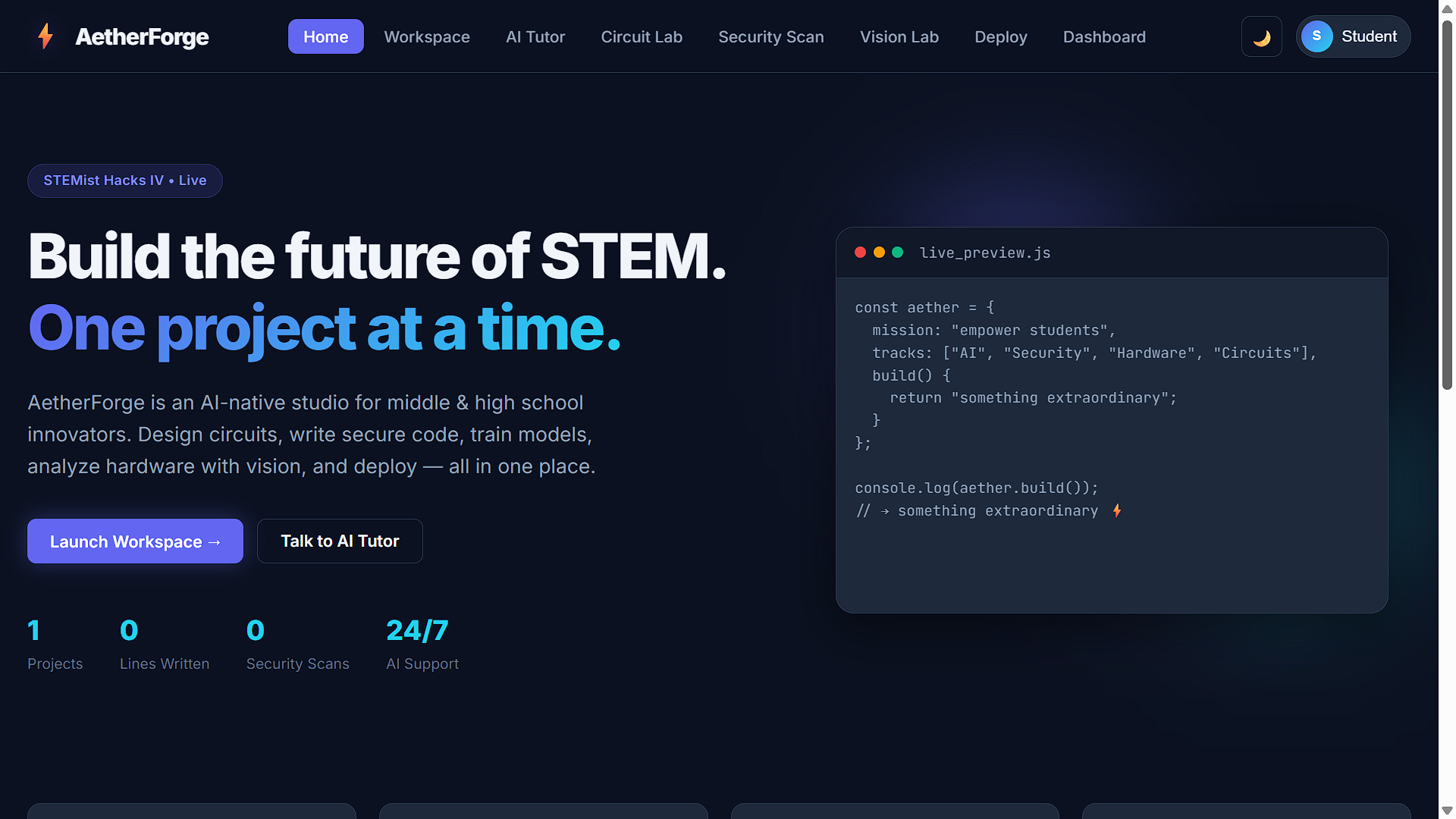
AetherForge is a complete AI-powered STEM project studio that runs entirely in the browser:
- Workspace – Multi-file code editor with live preview and console
- AI STEM Tutor – Context-aware mentoring for algorithms, electronics, physics, ML, and security
- Circuit Lab – Drag-and-drop components, wiring, real-time simulation, and oscilloscope
- Security Scanner – Detects hardcoded secrets, XSS risks, SQL injection patterns, weak crypto, and more
- Vision Lab – Upload a photo of a breadboard/PCB → AI detects components, suggests wiring, and generates a BOM
- One-Click Deploy – Full Render-style cloud deployment with build logs, env vars, and live URL
- Student Dashboard – Activity charts, skill radar, achievements, and learning path progress
Everything is persistent (localStorage) and works offline after the first load.
How we built it
We built AetherForge from scratch with vanilla HTML, CSS, and JavaScript — no frameworks, no build step.
Key technical pieces:
- Modular architecture (
utils,storage,ai-engine,circuit,security,vision,workspace,deploy,dashboard) - Canvas API for the circuit simulator, oscilloscope, charts, and vision bounding boxes
- Local knowledge engine that feels like a real LLM for the AI Tutor
- Static analysis rules engine for the security scanner
- Simulated but realistic Render-style deployment pipeline
- Full dark/light theme system and responsive design
Total codebase: 4,000+ lines.
Challenges we ran into
- Making the circuit simulator feel real without a full SPICE engine — we implemented a simplified nodal model that still gives useful voltage/current feedback.
- Keeping the AI Tutor educational and accurate without an external API (everything runs client-side).
- Designing a security scanner that is useful for students without creating false confidence.
- Fitting a complete multi-tool studio into a clean, fast UI that still works on school Chromebooks.
Accomplishments that we're proud of
- A fully working end-to-end student workflow in one tab
- Hitting every major prize track (Overall, AI, Security, Vision/Hardware, Circuit, Render)
- Zero external dependencies — judges can open
index.htmland everything just works - Achievement system and progress tracking that actually motivates continued learning
What we learned
- How to structure a large frontend application without a framework
- The real difficulty of good educational UX
- That “simple” simulations (circuits, vision, deploy logs) can still feel magical when polished
- Security concepts become much clearer when you have to teach them through a scanner
What's next for AetherForge
- Real collaborative editing
- Export to Arduino/MicroPython
- Deeper circuit models and more component libraries
- Optional cloud backend for saving projects across devices


Log in or sign up for Devpost to join the conversation.