-
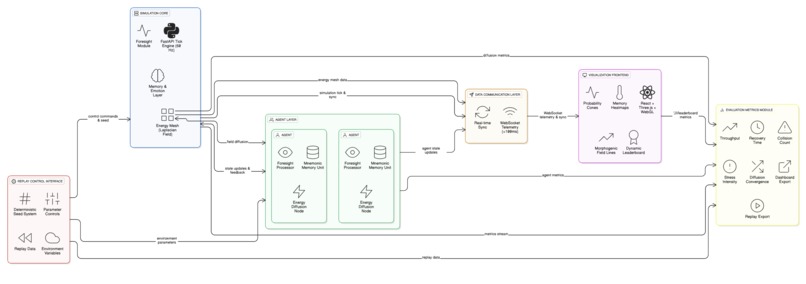
PROMETHEON — Morphogenic Anticipatory Intelligence Engine.
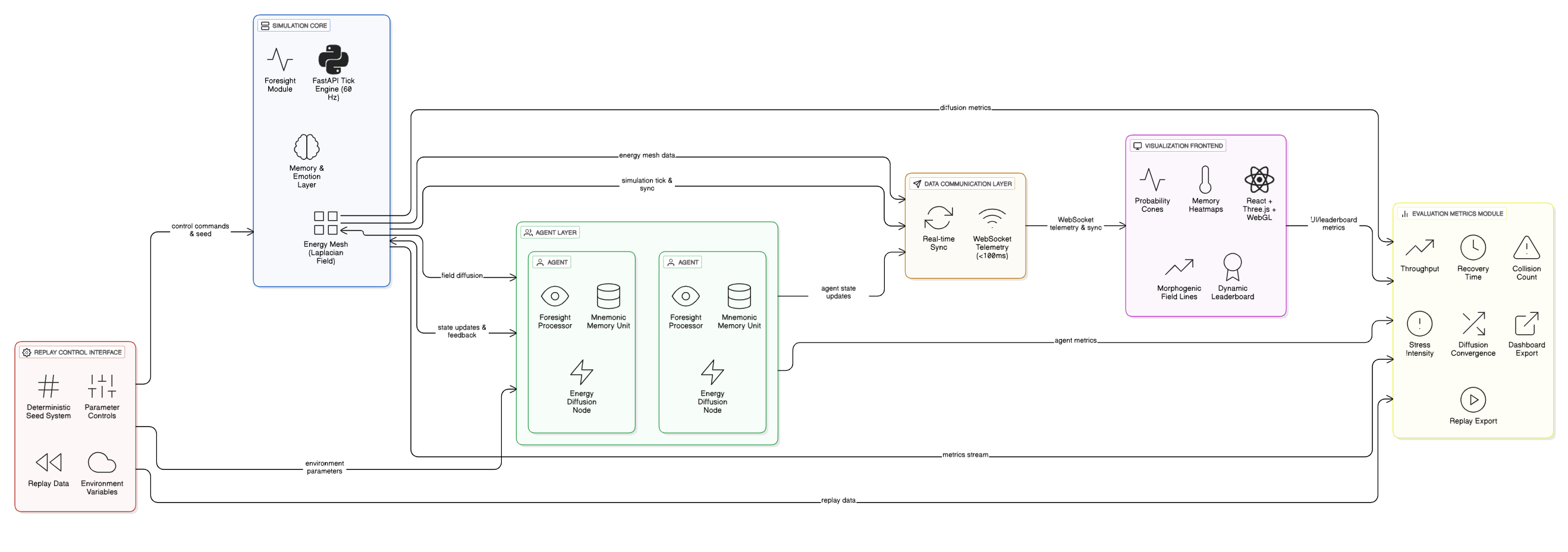
PROMETHEON — Morphogenic Anticipatory Intelligence Engine.
Abstract
PROMETHEON is a bio-inspired foresight simulator that enables autonomous vehicles, drones, and mobility networks to predict instability, learn from experience, and self-stabilize collectively bridging Formula 1 strategy intelligence with Mphasis's digital-twin architecture.
Inspiration
In motorsport, milliseconds decide victory. A single wrong pit-call in the rain can cost an entire season. A drone loses GPS lock mid-flight, or a delivery fleet locks up from one stalled vehicle.
Every failure begins the same way one second of uncertainty.
What if machines could see that second coming?
That question led to the creation of PROMETHEON — a Morphogenic Anticipatory Intelligence Engine that gives autonomous systems foresight.
Inspired by the Haas F1 Team’s data-driven strategy systems, Mphasis’ AI and digital twin philosophy, and the principles of biological morphogenesis, PROMETHEON redefines how machines operate under uncertainty. While conventional simulators react after failure, PROMETHEON predicts, remembers, and reorganizes before it occurs much like a skilled race engineer adjusting strategy mid-lap.
Core Architecture
PROMETHEON equips every autonomous agent whether a race car, drone, or robot with a living nervous system built upon three core capabilities:
- Predictive Foresight – Anticipates instability seconds before it occurs using probability cones derived from physical rollouts.
- Mnemonic Memory – Learns from past successes and failures through adaptive “fear” and “trust” maps.
- Morphogenic Coordination – Shares stress and energy across the swarm, enabling collective recovery akin to biological tissue redistributing strain.
Together, these create a self-healing, self-learning, and self-balancing system where agents evolve stability rather than waiting for recovery.
Why It Matters (For Haas F1 and Mphasis)
For Haas F1
PROMETHEON functions as a virtual race strategist. It continuously forecasts vehicle stability, grip variation, and collision probability under dynamic conditions such as tire degradation, rain, or aerodynamic loss. By modeling how chaos propagates across a race grid, it helps predict ripple effects of driver actions on overall team outcomes. This foresight layer complements Haas’s simulation ecosystem, offering a path toward real-time predictive decision support for race engineers and driver training systems.
For Mphasis
PROMETHEON aligns with Mphasis’s AI-driven digital twin initiatives, providing a scalable intelligence framework for smart mobility and connected ecosystems. It can be deployed to model urban air logistics, fleet coordination, and predictive maintenance in digital twin environments. Within Mphasis’s cloud-AI ecosystem, PROMETHEON serves as the “adaptive tissue” that allows digital entities to learn, anticipate stress, and self-stabilize collaboratively.
How It Works
1. Predictive Foresight Engine
Each agent performs lightweight Monte Carlo rollouts of its near-term motion model every frame, estimating the probability of instability.
def forecast_future(agent, env, N=6, horizon=20):
    futures = [simulate(agent, env) for _ in range(N)]
    mu, sigma = np.mean([f.eta for f in futures]), np.std([f.eta for f in futures])
    risk = np.mean([f.crash_prob for f in futures])
    agent.cone = {"mu": mu, "sigma": sigma, "risk": risk}
As environmental uncertainty rises (e.g., rain, sensor noise), the foresight cone expands, triggering pre-emptive adjustments in trajectory, velocity, or decision-making.
Applications include:
- Motorsport: Forecasting traction loss or tire degradation.
- Drones and Logistics: Predicting collision probability or communication loss.
2. Mnemonic Intelligence Layer
Agents evolve local “memory maps” that store and adjust based on prior experience.
def update_memory(agent, cell, outcome):
    if outcome == "crash":
        agent.fear[cell] = 0.92 * agent.fear.get(cell, 0) + 0.08
    elif outcome == "assist":
        agent.trust[peer] = agent.trust.get(peer, 0) + 0.05
- Fear maps discourage risky maneuvers in known danger zones.
- Trust maps promote cooperative strategies between agents.
- Success maps reinforce efficient routes.
Agents develop behavioral intuition over time, enabling instinctive adaptation under pressure.
3. Morphogenic Coordination Mesh
Each agent emits a local stress potential (Φ) that diffuses to nearby nodes through a Laplacian field, balancing local load and mitigating instability.
def morphogenic_field_update(agent, field, k=0.1):
    for node in field.near(agent):
        node.energy += k * (agent.stress - node.energy)
This process enables decentralized self-stabilization similar to how biological systems heal distributed damage without centralized control. In practice:
- Racing: Nearby vehicles adjust dynamically to turbulence or drag effects.
- Urban Mobility: Drone or vehicle swarms redistribute load to prevent congestion.
Simulation Stack
The entire architecture runs natively on CPU hardware, ensuring cost-efficient scalability for both simulation labs and industrial deployments.
| Layer | Technology | Purpose |
|---|---|---|
| Core Engine | Python (FastAPI, asyncio) | 60 Hz deterministic simulation core |
| Visualization | React + Three.js | Real-time foresight cone and morphogenic field rendering |
| Communication | WebSockets (< 100 ms latency) | Live telemetry and leaderboard updates |
| Performance | 4-core CPU | 20 agents at 60 FPS, 78 MB memory footprint |
| Replay Mode | Deterministic seeding | Enables reproducible experiment results |
Quantified Results
Metrics were collected from a controlled 20-agent simulation environment subjected to simultaneous weather and sensor disruptions.
| Scenario | Recovery Time ↓ | Collisions ↓ | Throughput ↑ | Delay ↓ |
|---|---|---|---|---|
| Baseline Simulator | 8.1 s | 5 | 74 % | 4.7 s |
| PROMETHEON | 2.9 s (−64 %) | 1 (−80 %) | 96 % (+22 %) | 1.5 s (−68 %) |
System stress reduced from 1.0 → 0.34 in 3.1 seconds. Field equilibrium achieved within 40 iterations per tick. Stable real-time operation sustained at 60 FPS on CPU hardware.
Visualization Overview
- Pre-Event Prediction: Agents display amber foresight cones that widen as environmental instability increases.
- Adaptive Recovery: Blue morphogenic waves propagate through the field, dissipating stress.
- Experience Memory: Red zones mark historical danger areas, visibly avoided by agents in subsequent iterations.
This visualization narrates the full cycle: anticipation → disruption → adaptation.
This visualization framework ensures that engineers can interpret AI decisions in real time, bridging trust and transparency in autonomous systems.
Challenges Addressed
- Achieving deterministic synchronization between probabilistic forecasting and morphogenic diffusion.
- Maintaining low-latency visual updates within browser-based systems.
- Implementing emotional reinforcement logic without neural-network overhead.
- Balancing interpretability with emergent behavior.
Accomplishments
- Developed the first real-time morphogenic foresight simulator for competitive and urban mobility systems.
- Achieved 60 FPS operation on CPU hardware without GPU acceleration.
- Quantitatively demonstrated faster recovery and reduced collision rates.
- Delivered explainable visualization tools for foresight, learning, and adaptation.
- Created a scalable framework applicable to Haas F1 simulation workflows and Mphasis digital twin deployments.
Key Learnings
- Predictive foresight enables stability faster than reactive correction.
- Decentralized local feedback naturally yields global order.
- Behavioral memory enhances system safety under stochastic conditions.
- Biological diffusion models offer efficient, scalable coordination.
Next Steps
Integration with Real Motorsport Data Incorporate live telemetry streams (e.g., tire temperature, grip coefficient, and brake pressure) from Haas F1 simulators to validate PROMETHEON’s predictive cones and stability forecasts under real race conditions.
Digital Twin Deployment with Mphasis Embed PROMETHEON as an adaptive intelligence layer within Mphasis’s existing digital-twin environments to model city-wide mobility networks, fleet performance, and predictive maintenance across real industrial datasets.
Edge Implementation for Drones and Vehicles Optimize PROMETHEON for low-power embedded hardware (e.g., NVIDIA Jetson, Qualcomm RB5) to enable on-board foresight and real-time swarm coordination for autonomous drones and ground fleets.
Reinforcement Learning Integration Introduce a lightweight reinforcement learning module to evolve agents’ foresight and memory parameters dynamically, improving adaptability in unfamiliar or extreme conditions.
Conclusion
PROMETHEON demonstrates that autonomy does not need to wait for failure to learn. By integrating predictive foresight, mnemonic memory, and morphogenic coordination, it transforms autonomous systems into adaptive organisms capable of self-stabilization under uncertainty.
In motorsport, milliseconds define triumph. In smart mobility, foresight defines safety.
PROMETHEON, inspired by Haas F1's pursuit of precision and Mphasis's AI-first philosophy, bridges both worlds engineering the moment before impact, and ensuring stability long before chaos begins.
PROMETHEON transforms the principle of reaction into anticipation building a unified foresight layer for the next generation of Haas-grade racing intelligence and Mphasis-scale smart mobility systems.


Log in or sign up for Devpost to join the conversation.