-
-
Aether Check-In
Aether — A Digital Deep Breath
A mood-tracking web app that listens, reflects, and gently guides you back to yourself.
Inspiration
It started with a pretty honest observation — when things get hard, the first thing we do is pick up our phones. And somehow we always put them back down feeling worse.
We're both students. We know what 2am before a midterm feels like. We know what it's like to sit down to study and just... stare at nothing. To be so drained you can't even explain why. To tell someone "I'm fine" when you're really somewhere between fine and falling apart.
There are a lot of wellness apps out there, and many of them do great things. But we felt like something was missing — a starting point. Something that doesn't ask you to commit to a routine or hit a streak before you've even figured out how you feel. Just a moment to pause, check in honestly, and take one small step.
We wanted to build that. A few seconds of breathing. A question. A quote that actually means something. Something small you can do right now. That's Aether.
What It Does
Aether guides the user through four stages:
1. The Centering Every session starts with a 4.5-second breathing exercise — a forced pause before anything else. It's a small thing that completely changes how you arrive at the rest of the experience.
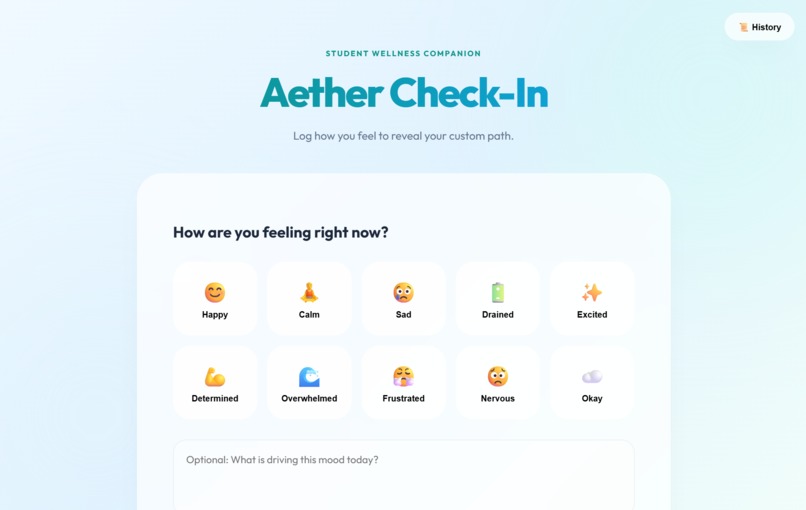
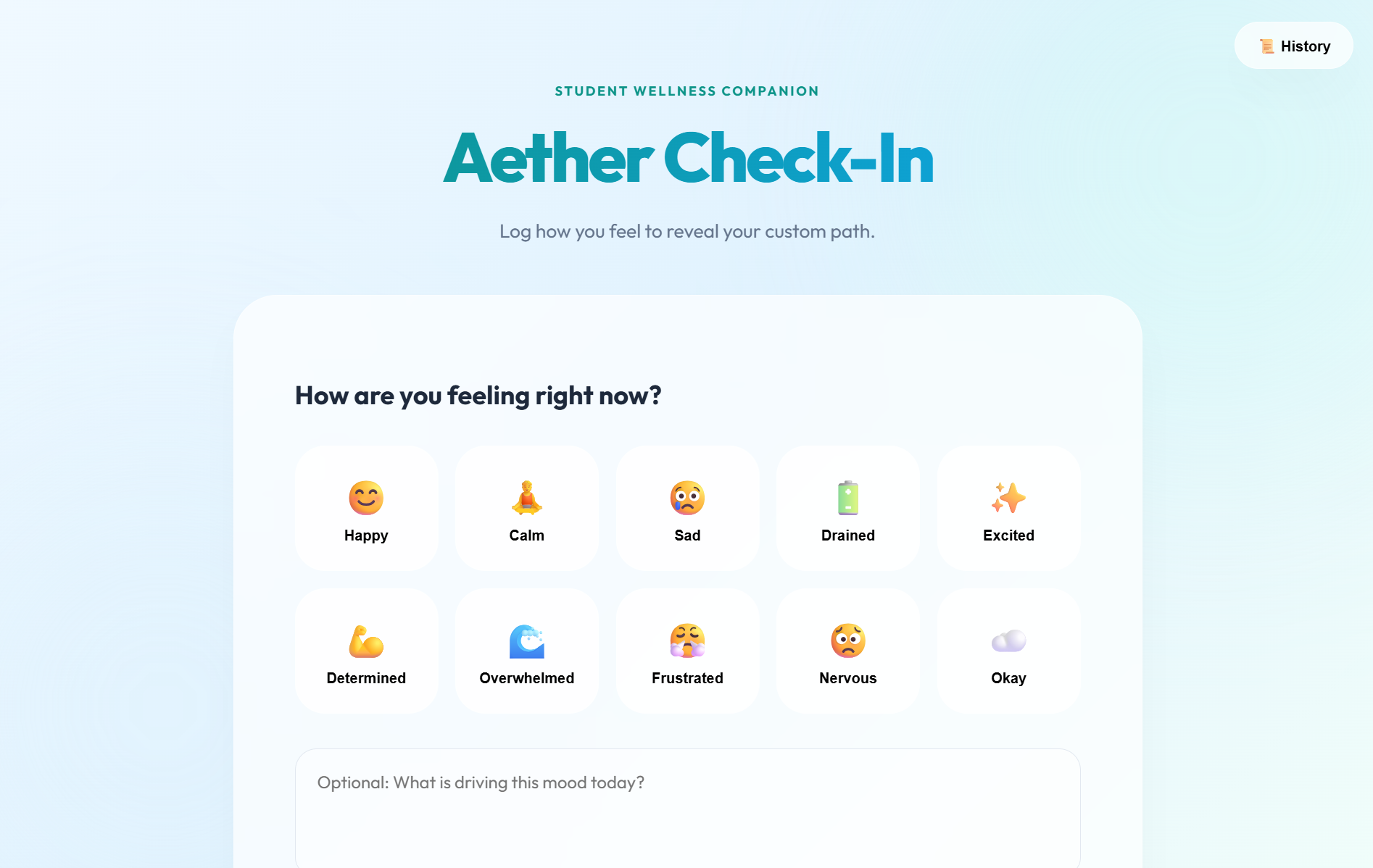
2. The Check-In A mood grid of 10 emotional states — Happy, Calm, Sad, Frustrated, Overwhelmed, Drained, Nervous, Okay, Excited, and Determined — lets you label exactly how you're feeling. An optional "Want to tell us more?" text box invites deeper context. The more you share, the more personalized your experience.
3. The Path Aether's AI responds with a carefully matched quote from a real philosopher, artist, or scientist — chosen to resonate with the theme of what you actually wrote, not just your mood label — alongside 3 tailored activities that are specific, actionable, and realistic for a student to do right now.
4. The Reflection After completing an activity, you can come back and log how your mood shifted. Over time, Aether builds a personal history of your emotional patterns and what actually helps you. Sessions can also be shared with a friend, counselor, or study group via a native share menu or clipboard fallback.
How We Built It
Frontend: Built with HTML5, CSS3, and Vanilla JavaScript with a Glassmorphism aesthetic and smooth transitions between stages. Every layout and animation decision was made with emotional intentionality — the UI is designed to feel like it breathes with the user. Activity cards use a dynamic Flexbox layout, and unDraw illustrations give each recommended activity its own visual story.
Backend: A Python Flask server handles all AI communication, mood logging, and database management. We used SQLite via Flask-SQLAlchemy to store mood logs, before/after mood comparisons, and timestamps.
AI: We integrated a local LLM using Ollama running Llama 3.2 to power the quote generation and activity recommendations. We spent significant time on prompt engineering — teaching the model to match quote themes to the user's personal note, avoid overused quotes and authors, and maintain a tone that feels warm and human rather than clinical.
Sharing: A sharing system detects browser capabilities and provides either a native mobile share menu or a clean clipboard fallback for unsupported environments.
Challenges We Ran Into
Prompt engineering was harder than expected. Getting the AI to consistently return emotionally intelligent responses took many iterations. The model kept repeating the same quotes regardless of mood and sometimes suggested quotes that had nothing to do with what the user wrote. We fixed this by writing an example-based prompt that teaches the model to match quote themes to the user's note specifically, and explicitly banning overused quotes and authors by name.
API quota limits. We started with the Gemini API but hit the free tier daily limit during testing. We switched to running a local model with Ollama which gave us unlimited calls and removed the dependency on external services entirely.
Browser security and sharing. The navigator.share API only works in secure https contexts, which caused silent failures during local development. We built a clipboard fallback to handle this gracefully.
The scroll jolt. Transitions between the four stages caused jarring layout jumps. We fixed this with smooth-scroll logic tied to the dynamic height of each incoming stage.
Layout consistency. Getting three activity cards to look polished across all screen sizes — especially centering the third card — required switching from CSS Grid to a dynamic Flexbox approach.
Accomplishments We're Proud Of
- The breathing exercise on launch is a small detail that completely changes the emotional tone of the whole experience
- The AI quote matching feels genuinely thoughtful — quotes resonate with what the user actually wrote, not just a generic mood label
- The four-stage flow creates a complete, intentional experience rather than just a collection of features
- The sharing system works cleanly across mobile and desktop with a graceful fallback
What We Learned
- Prompt engineering is a real skill. The difference between a generic AI response and one that feels human comes entirely down to how carefully you write your instructions. Using concrete examples inside the prompt was the biggest single improvement we made.
- The feel of an app matters as much as the code. The difference between a 1-second and a 4.5-second breathing exercise completely changes how the user arrives at the check-in. Small timing decisions carry real emotional weight.
- Scope discipline saves projects. We started with bigger ideas and kept cutting until we had something focused and completable. The final product is better for every feature we removed.
What's Next for Aether
- Streaks and reminders — building in daily check-in streaks and gentle reminders to encourage consistency and long-term emotional awareness
- Moonlight mode — a dark theme for late-night check-ins
- Intentional soundscapes — optional lo-fi background audio for users who want ambient sound during their session
- Deeper mood insights — patterns like "you feel Overwhelmed most on Sundays" or "activities improve your mood 80% of the time"
- Community check-ins — sharing sessions with a trusted friend, counselor, or study group. Long term, Aether could serve as a lightweight mental health check-in tool for classrooms and campus communities
- Export for reflection — letting users download a summary of their emotional journey over time, useful for journaling or therapy
Built With
- css
- flask
- html5
- javascript
- json
- ollama
- python
- sqlalchemy
- sqlite
- tailwind
- vanilla


Log in or sign up for Devpost to join the conversation.