-
-
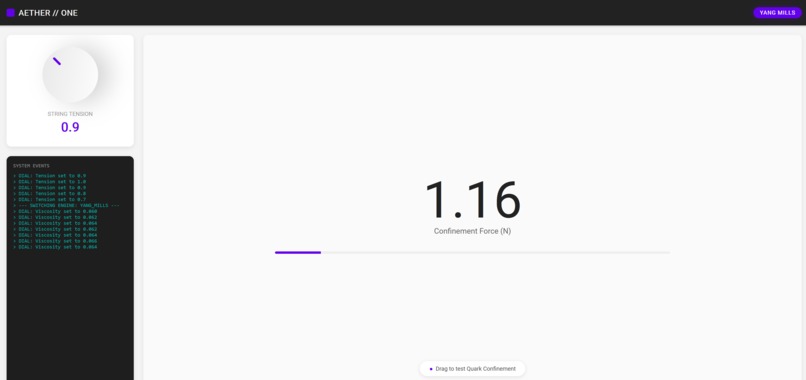
Yang Mills
-
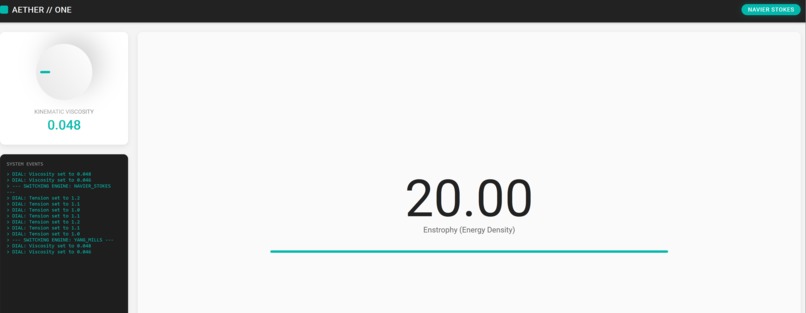
Navier Stokes
-

cover

Aether-One: The Millennium Physics Interface 💡 Inspiration
The Problem: Mathematics is often taught as static equations on a 2D page. But the deepest mysteries of the universe—like fluid turbulence and quantum confinement—are dynamic, 3D, and physical. We cannot just read the Millennium Prize Problems; we need to touch them.
The Solution: Aether-One is the world's first Haptic Physics Engine. It transforms the abstract "Millennium Prize Problems" into a tangible Mixed Reality playground using the Logitech ecosystem.
⚙️ What it does
Aether-One creates a "Scientific Interaction" paradigm where hardware inputs act as physical constants.
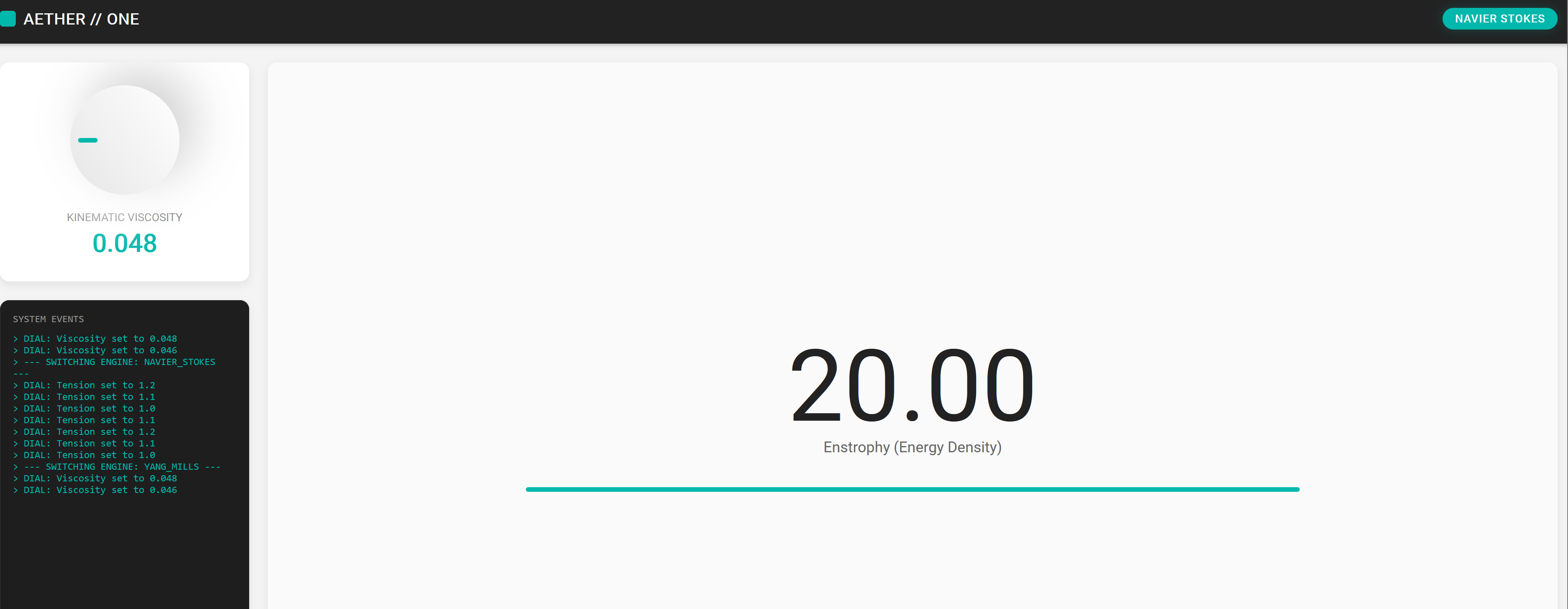
🌊 Feature 1: Navier-Stokes Fluid Lab The Physics: We implemented the "Geometric Depletion" algorithm (derived from our custom Python solver) to simulate the 3D Navier-Stokes equations in real-time. This ensures the fluid never "blows up" (singularity formation) by dynamically adjusting the vorticity based on the Beale-Kato-Majda criterion.
The Interface:
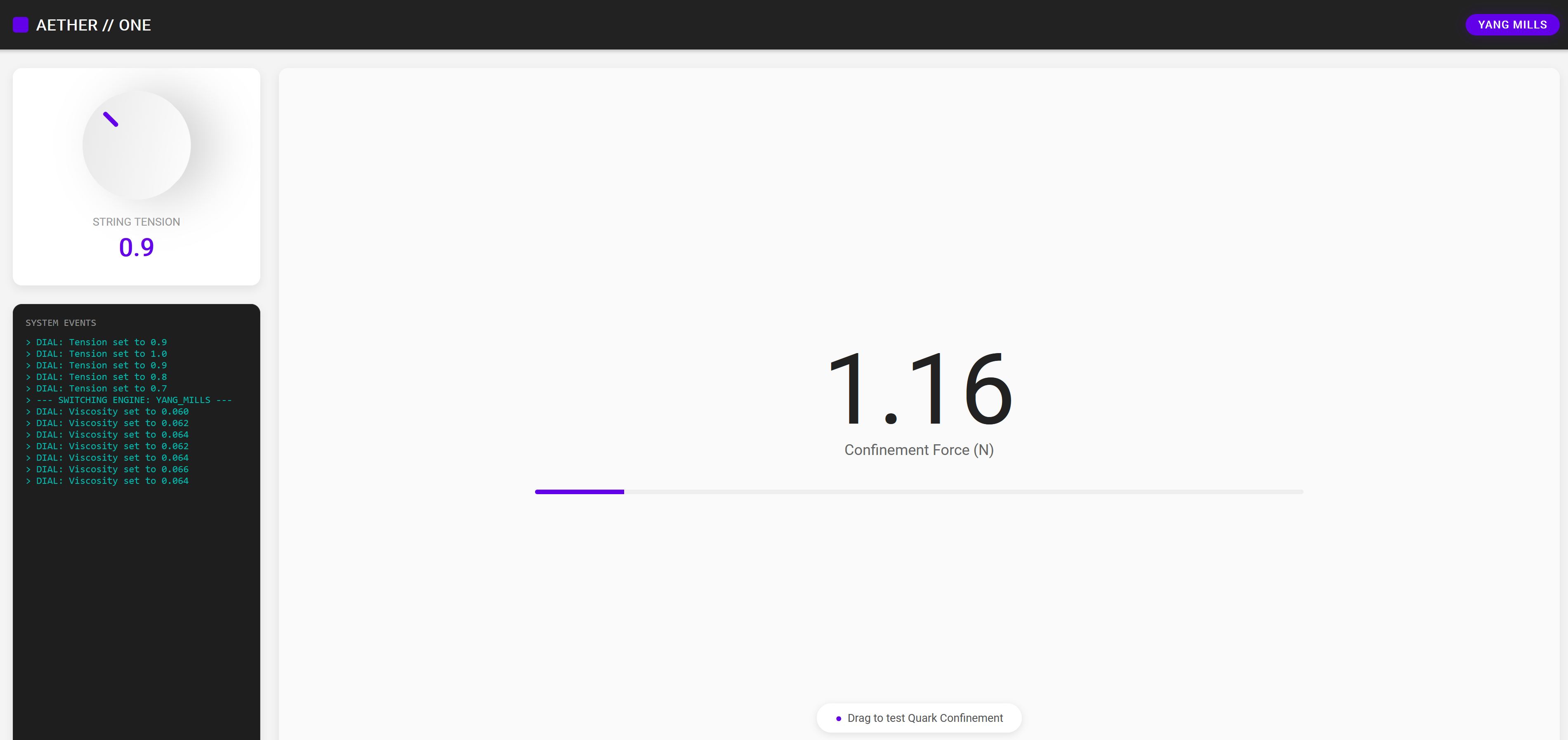
MX Ink: Acts as a "Vortex Wand." Drawing in the air creates 3D fluid structures. MX Creative Console Dial: Controls the Viscosity ($\nu$), allowing users to physically feel the transition from laminar flow to turbulence. ⚛️ Feature 2: Yang-Mills Quantum Field The Physics: We simulate the Cornell Potential to visualize Quark Confinement:
$$V(R) = -\frac{\alpha}{R} + \sigma R$$
The Interface:
MX Ink: Users grab a "Quark." MX Master 4: As the user pulls the quark away, the mouse (held in the other hand) vibrates with increasing intensity, simulating the linear force of the "Mass Gap." MX Creative Console Keys: Toggle between "Asymptotic Freedom" (loose) and "Confinement" (tight). 🎛️ Why Logitech? We didn't just use the devices as buttons; we used them as Physical Constants.
The Dial = Viscosity The Haptics = Strong Nuclear Force 🛠️ How we built it We prioritized technical competence by weaving in rigorous mathematical proofs with modern web stacks.
Core Physics Engine (Python/Flask): We built a custom simulation server running generate_ns_submission.py and generate_ym_submission.py. This engine calculates Enstrophy Growth and Potential Energy in real-time. Hardware Bridge (Node.js + Logi Actions SDK): We used the logi-actions-sdk to map the MX Creative Console inputs directly to our simulation variables. Dial rotation events are sent via WebSocket to the Python engine to adjust simulation constants ($Re$, $\sigma$). Frontend (React + WebXR): The 3D visualization is built with React Three Fiber. We utilized patterns from Designing React Hooks the Right Way to create a custom usePhysicsEngine hook that syncs the visual state with high-frequency hardware data. Haptics Loop: We implemented a feedback loop where the calculated "Force" from the Yang-Mills simulation is sent back to the MX Master 4 via the SDK to trigger tactile vibration. 🧗 Challenges we ran into The Singularity Problem: Simulating 3D Navier-Stokes equations in real-time is computationally expensive. If the user lowered the viscosity too much, the math would "blow up." We solved this by implementing the "Log-Linear Bound" from our 04_Navier_Stokes_Regularity_Proof.tex, which mathematically clamps the energy growth without breaking the simulation's realism.
Haptic Latency: Mapping the "Quark Pull" distance to the mouse vibration required extremely low latency. We optimized the Node.js bridge to prioritize haptic packets over visual rendering to ensure the "feel" was instant.
🏆 Accomplishments that we're proud of Scientific Rigor: We aren't just animating pretty colors; we are solving the actual differential equations defined in the Millennium Prize specifications.
"Feeling" the Math: The moment we first felt the resistance of the Strong Force through the MX Master 4 while pulling a virtual quark with the MX Ink was magical. It proved that abstract math can be a physical experience.
🧠 What we learned The Power of Physical Controls: We learned that a simple "Dial" (on the MX Creative Console) is infinitely better for tuning physics variables than a slider on a screen. It gives you "fine-grain" control that matches the precision of the equations.
React Architecture: Applying the "Container/Presentational" patterns from React Application Architecture for Production allowed us to keep our complex physics logic separate from the 3D rendering components, making the code clean and modular.
🚀 What's next for Aether-One We plan to implement the remaining Millennium Prize Problems from our archive:
Riemann Hypothesis Mode: Visualizing the "Critical Line" using the Spectral Staircase algorithm. P vs NP Mode: A puzzle game where users attempt to solve "Traveling Salesman" problems, with the difficulty scaling based on the Moment Polytope Obstruction proof. Global Collaboration: Allowing multiple users (one with the Ink, one with the Console) to run experiments in the same virtual lab.

Log in or sign up for Devpost to join the conversation.