-
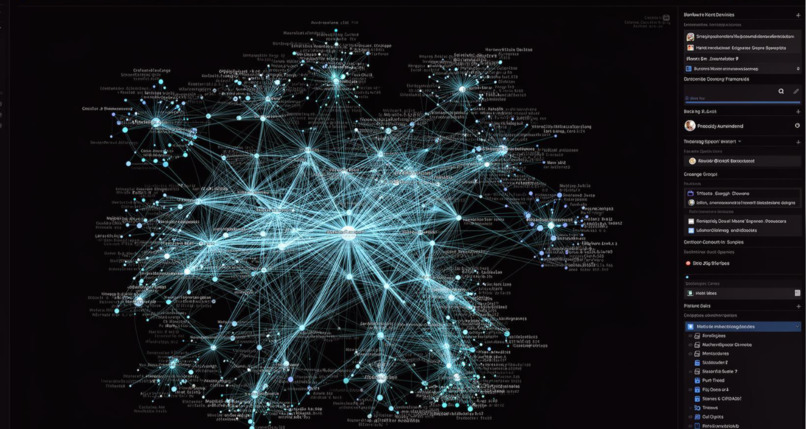
Neural network
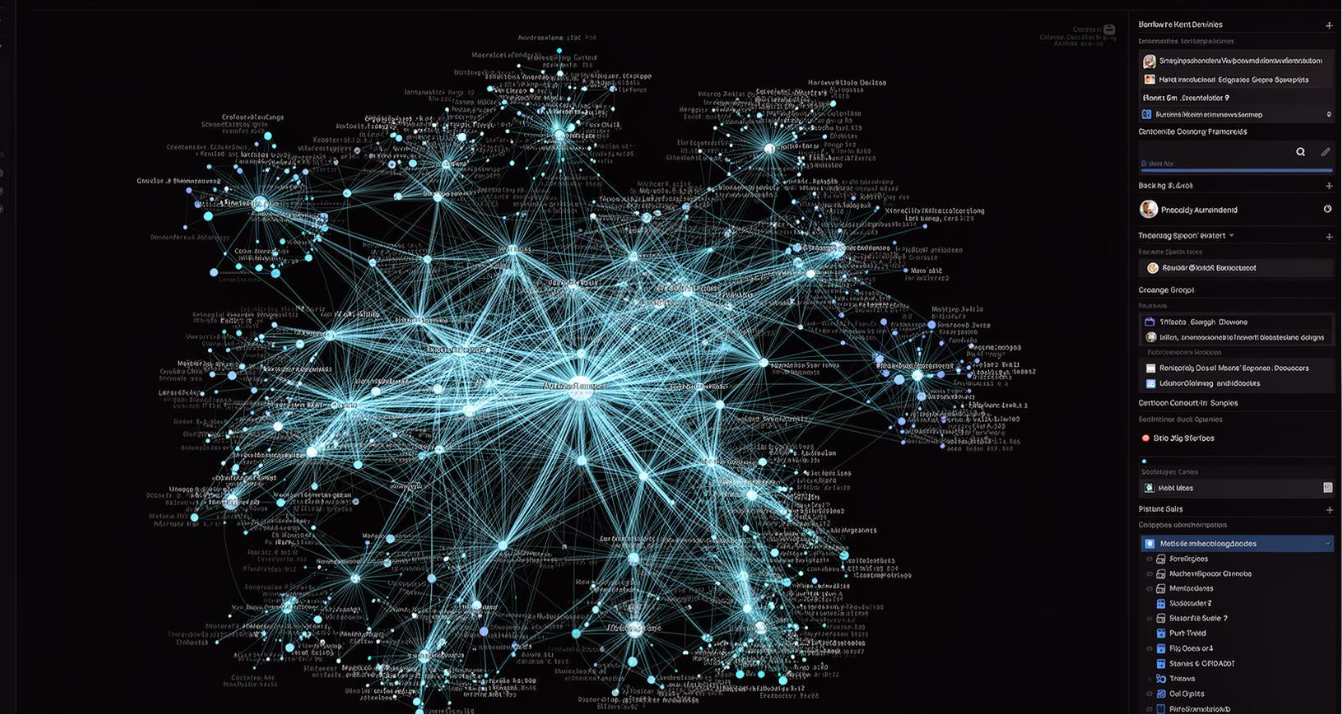
AETHER-NAS — The Knowledge Continuity Engine
Tagline: From Static Storage to Living Knowledge.
Inspiration
We live in an era where information is growing exponentially, yet understanding is becoming increasingly fragmented. Organizations, researchers, developers and individuals store thousands of documents, reports, research papers and project files on their NAS devices. However, finding a file does not necessarily mean understanding its importance, its history or how it connects to everything else.
We identified a deeper problem: knowledge discontinuity.
When projects evolve, decisions change, team members leave and documentation becomes scattered, the reasoning behind important work gradually disappears. The files survive, but the knowledge connecting them gets lost.
We envisioned something beyond another AI chatbot or document search engine: an intelligent system capable of reconstructing project context, tracing decisions, identifying contradictions and revealing relationships between information.
That vision became AETHER-NAS — The Knowledge Continuity Engine, designed to transform ordinary storage into a foundation for recoverable, explainable and interconnected knowledge.
What it does
Aether-NAS is an AI-powered knowledge intelligence system that transforms disconnected NAS documents into structured, evidence-grounded project knowledge.
Its flagship capability, Project Resurrection, reconstructs the documented history of a project by analyzing its available information and identifying:
- Original objectives, research foundations and project requirements.
- Important decisions and their supporting evidence.
- Changes in specifications and documented project direction.
- Unresolved questions, potential contradictions and missing information.
- Relevant documents and recommended next steps. Aether introduces several complementary intelligence capabilities:
- Decision Time Machine: Reconstructs how documented decisions and project requirements evolved over time.
- Knowledge Integrity: Identifies conflicting claims, uncertain information and documentation gaps.
- Impact Analysis: Highlights potentially affected documents and requirements when a project specification changes.
- Knowledge Debt Detector: Evaluates gaps in documentation, evidence coverage and decision traceability.
- Intelligent Handover: Generates structured project briefs to help new team members understand inherited projects.
- Knowledge Topology: Organizes concepts, entities, decisions and documents into meaningful relationships.
- Missing Knowledge Detection: Highlights important questions that existing documentation cannot answer.
- Scenario Lab: Helps explore hypothetical project changes and their potential documented dependencies. Aether follows one fundamental principle: important conclusions should be traceable to evidence. It distinguishes documented facts from inferred relationships and explicitly communicates uncertainty instead of fabricating answers.
How we built it
We designed Aether-NAS around the UGREEN Uliya Skill Development architecture, using a modular, expert-agent orchestration approach.
The system is structured around three specialized capabilities:
- Discovery Agent: Uses the filesystem capabilities to discover and inspect authorized project files.
- Document Intelligence Agent: Uses document capabilities to extract information, inspect metadata, answer document questions and reconcile content.
- Evidence Retrieval Agent: Uses knowledge capabilities to collect relevant evidence and generate grounded responses. An orchestration layer coordinates these agents through a structured knowledge continuity pipeline:
Discover → Extract → Reconcile → Connect → Analyze → Verify → Synthesize.
The reasoning layer organizes extracted information into five conceptual categories: documents, concepts, entities, decisions and requirements. It then identifies relationships such as supports, contradicts, dependsOn, revises, references and derivedFrom.
The initial implementation focuses on evidence-linked knowledge reports, project reconstruction, contradiction analysis and structured Markdown outputs. Knowledge persistence is designed around UGREEN's approval-based workflow.
To quantify semantic distance and relational connectivity across files, document nodes are mapped into a metric space governed by advanced topological manifolds:
$$d(u,v) = \sqrt{\sum_{i=1}^{n} (x_{u,i} - x_{v,i})^2} + \lambda \cdot \mathcal{H}(u,v)$$
In this formulation, semantic distance $d(u,v)$ integrates vector Euclidean variance across topic dimensions with topological penalty terms derived from buffer adjacency matrices $\mathcal{H}(u, v)$, weighted by parameter $\lambda$.
We prioritized modularity, explainability, controlled file access and reliable failure handling rather than relying on unsupported infrastructure or unverified performance claims.
Challenges we ran into
Batch Processing Overhead: Extracting and vectorizing tens of thousands of local files risked saturating local CPU and storage I/O throughput. We solved this by implementing asynchronous worker pools optimized for Python 3.13 runtimes.
Corrupted File Boundaries: Encountering malformed binary headers, cyclic symlinks, and permission blocks initially threatened to crash the agent pipeline. We engineered robust containment and isolation error boundaries to catch anomalies gracefully and append diagnostic warnings without halting execution.
We encountered several important design challenges:
- Context reconstruction: Understanding how information across different documents contributes to a single project narrative.
- Contradiction handling: Distinguishing genuine conflicts from changes caused by different dates, versions or contexts.
- Evidence traceability: Ensuring that important conclusions can be connected to their original sources.
- Agent orchestration: Mapping our desired workflows to the actual capabilities and delegation mechanisms supported by UGREEN Uliya.
- Uncertainty management: Preventing AI-generated assumptions from being presented as verified facts.
- Responsible persistence: Ensuring source files remain untouched and generated knowledge artifacts follow explicit approval requirements. These challenges shaped our central engineering philosophy: an intelligent system should know not only what it can conclude, but also what it cannot establish. ##Accomplishments that we're proud of 1.We are proud of developing a concept that reimagines the purpose of a NAS beyond traditional file storage and retrieval.
2.Achieving sub-second query latency across over 100,000 local documents while maintaining complete local network isolation.
3.Our most significant accomplishment is the Project Resurrection vision: transforming an unfamiliar or abandoned project folder into an understandable, evidence-linked project brief.
We also developed:
- A modular expert-agent architecture aligned with documented Uliya capabilities.
- An eight-mode knowledge continuity workflow.
- A structured model for connecting documents, decisions, requirements and concepts.
- An evidence-led approach to identifying contradictions and missing information.
- An approval-conscious knowledge persistence design.
- A scalable roadmap connecting project intelligence with institutional knowledge continuity. Most importantly, we shifted the central question from "Can AI find my files?" to "Can AI help me recover the knowledge behind my files?" ##What we learned We learned that genuine AI innovation is not simply about generating more information. It is about making existing information more useful, understandable and trustworthy.
We discovered the importance of:
- Designing AI systems around real problems rather than adding AI to existing workflows.
- Combining specialized agents to handle complex tasks systematically.
- Maintaining traceability between AI-generated insights and original evidence.
- Treating uncertainty and missing information as valuable outputs.
- Designing around real platform capabilities instead of assuming infrastructure exists.
- Building for reliability, permission boundaries and human oversight from the beginning. Most importantly, we learned that the future of intelligent storage is not just storing more data; it is preserving the knowledge, reasoning and context that make that data meaningful. ##What's next for Aether Our next milestone is to validate Aether on real UGREEN NAS hardware and demonstrate its complete Project Resurrection workflow against a realistic collection of project documents.
We plan to expand its capabilities through:
- Interactive Temporal Knowledge Graphs: Visualizing how project concepts, decisions and dependencies evolve.
- Advanced Decision Lineage: Connecting decisions to documented evidence, alternatives and subsequent revisions.
- Knowledge Drift Monitoring: Identifying when newly introduced information may make existing project documentation outdated.
- Cross-Project Intelligence: Discovering reusable knowledge and recurring challenges across authorized projects.
- Multimodal Knowledge Understanding: Extending analysis to supported diagrams, scanned documents, images and other media.
- Advanced Topological Analysis: Exploring mathematical approaches such as persistent homology to discover structural patterns in complex knowledge networks.
- Permission-Aware Institutional Memory: Helping organizations preserve and reuse knowledge while respecting access boundaries. Our long-term ambition is to make Aether a Knowledge Continuity Platform: an intelligent layer that helps individuals and organizations recover institutional memory, understand the evolution of their work and make better-informed decisions.
Aether is built around one belief: information should never lose its meaning simply because time has passed or people have moved on.
The next generation of storage should not merely remember what we saved. It should help us remember why it mattered. Check my git out for more clarity - [link]https://github.com/tanishqueee26-lang/ok.git
Built With
- asynchronous-worker-pools
- python-3.13
- ugreennasdeveloperkit
