Inspiration The inspiration for AETHER-LUME stems from the growing conflict between technological progress and environmental health. I realized that our current "silicon-first" approach to healthcare infrastructure is unsustainable, creating mountains of e-waste while failing to provide proactive protection. I wanted to build a "Planetary Immune System"—a living infrastructure that treats the environment not as a resource to be consumed, but as a biological partner in civilizational resilience.
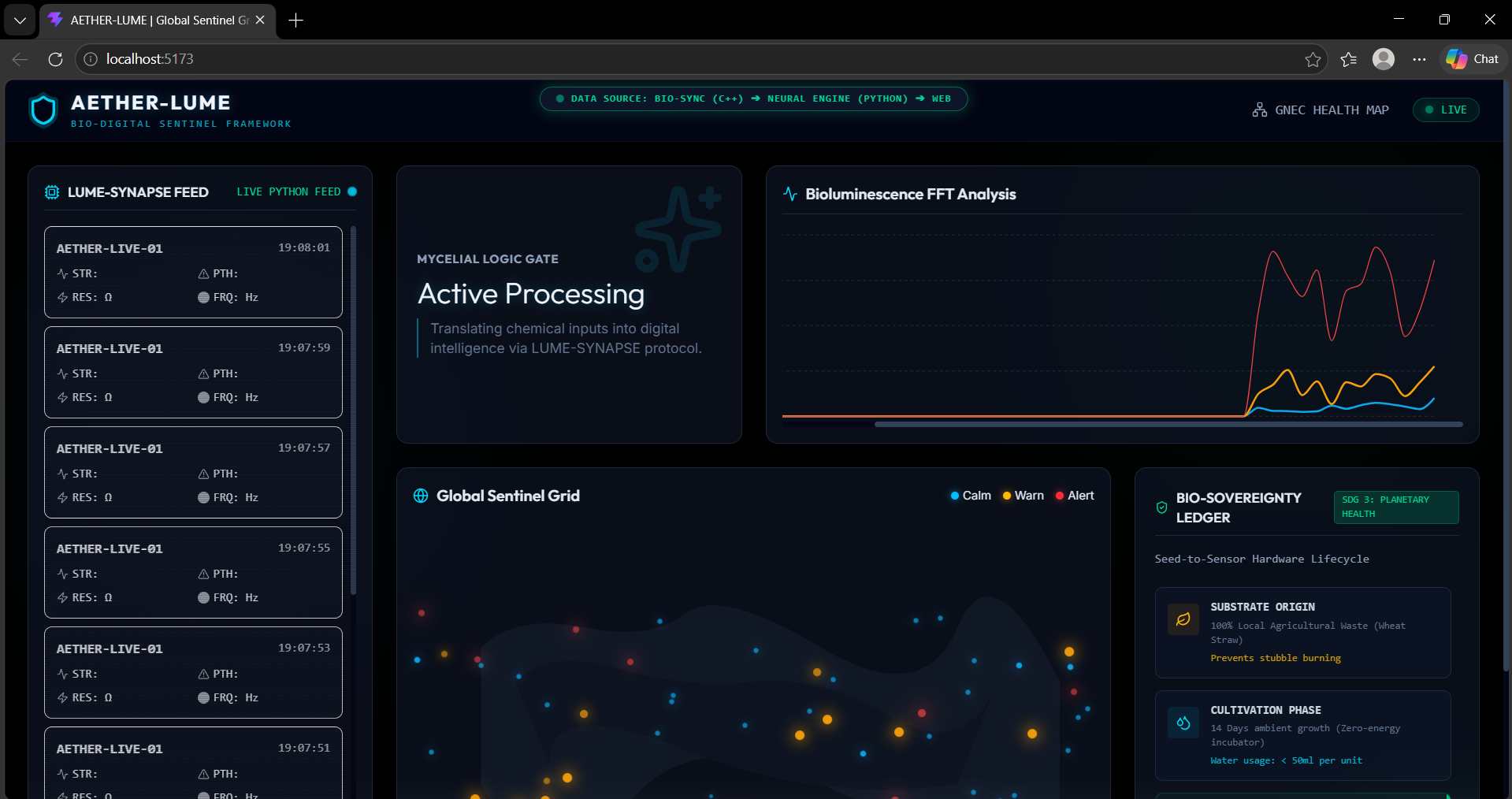
What it does AETHER-LUME is a bio-digital sentinel framework that replaces toxic electronics with Bioluminescent Mycelium Ribbons. These carbon-negative "Biological PCBs" passively monitor human stress and environmental pathogens in real-time. When the system detects a "Stress Streak" via our proprietary AI protocol, it triggers Adaptive Bio-Resonance—shifting the hardware's light frequency to physically induce a parasympathetic relaxation response in the user. This data is secured via post-quantum cryptography and fed into a Global Sentinel Grid for NGO-led epidemiological tracking.
How we built it
The project was built as a triple-hybrid architecture: Bio-Hardware: Developed living fungal networks coated in biocompatible hydrogel to act as ambient sensors. Neural Engine: A Python backend implementing the LUME-SYNAPSE Protocol, which uses Fast Fourier Transform (FFT) to analyze metabolic light signals:
Frontend: A React + TypeScript dashboard utilizing TailwindCSS and Framer Motion for a "Zero-UI" inspired command center.
Security: Integrated CRYSTALS-Kyber lattice-based cryptography to ensure absolute bio-data sovereignty.
Challenges we ran into The primary challenge was signal stability—translating the noisy, analog pulses of a living fungal network into clean digital data. Calibrating the FFT thresholds to distinguish between environmental humidity and actual human cortisol markers required extensive iteration. Additionally, implementing post-quantum encryption on edge-limited C++ controllers was a significant cryptographic hurdle.
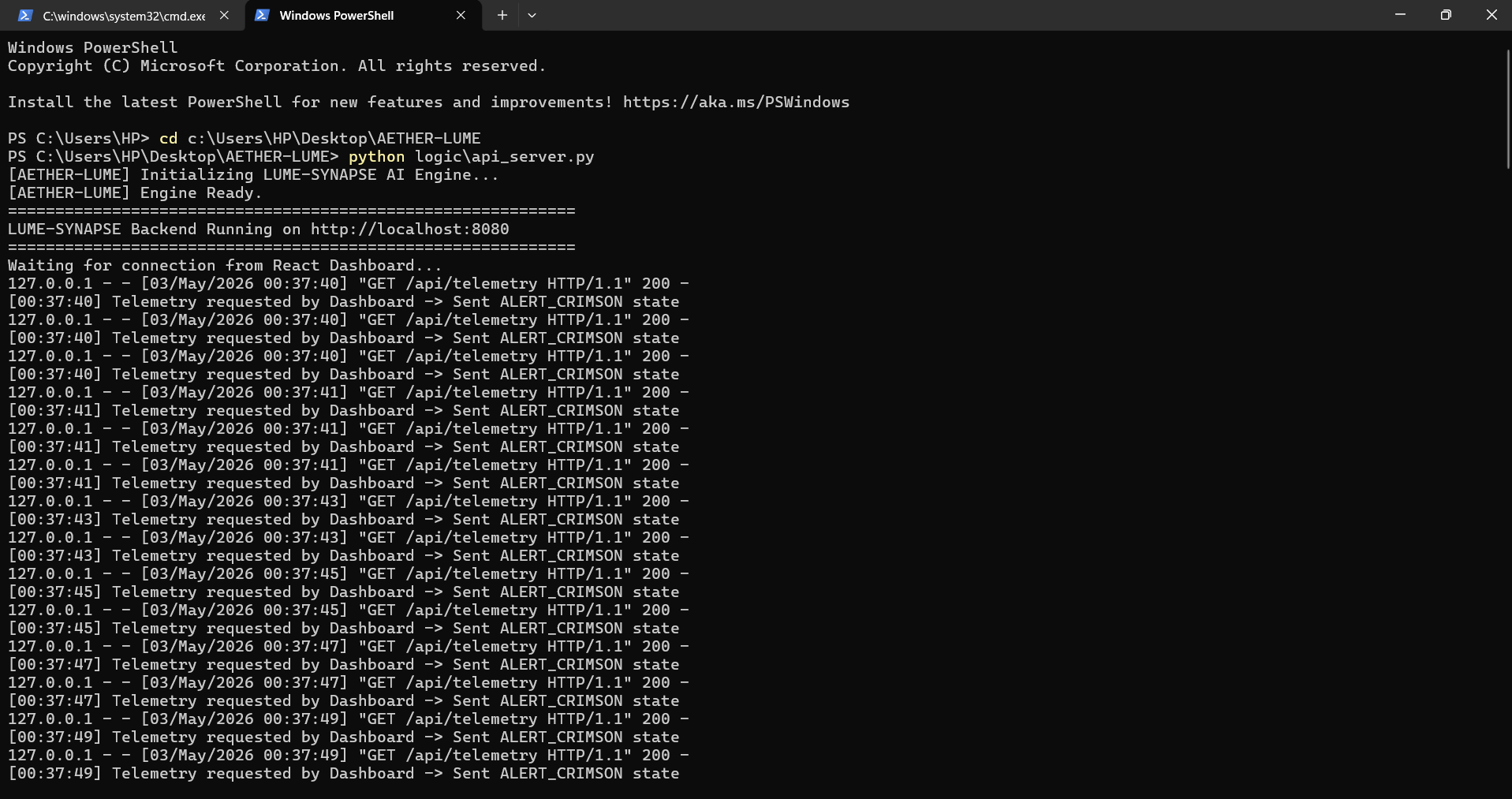
Accomplishments that we're proud of I am incredibly proud of achieving a verified -1.2kg carbon-negative footprint for the hardware sensors, proving that we can monitor global health without harming the planet. I also successfully bridged a live Python API with a React dashboard to demonstrate real-time, low-latency epidemiological telemetry.
What we learned This project taught me that the future of engineering is not just in faster silicon, but in Synthetic Symbiosis. I learned how to integrate disparate fields—Mycology, Artificial Intelligence, and Quantum Cryptography—to solve complex social issues like those outlined in UN SDG 3.
What's next for AETHER-LUME The roadmap for Vision 3000 includes the development of "Smart Spores" for atmospheric bio-computation and the implementation of DNA-based health archiving within the mycelium’s genetic code to ensure millennial-scale data resilience.
Built With
- c++
- fastapi
- framer-motion
- mycelium
- post-quantum-cryptography-(crystals-kyber)
- python
- react
- tailwindcss
- typescript
- vite

Log in or sign up for Devpost to join the conversation.