-
-
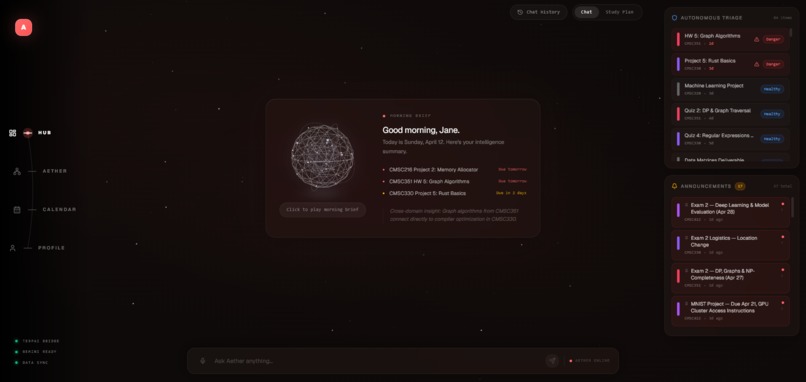
Hub
-
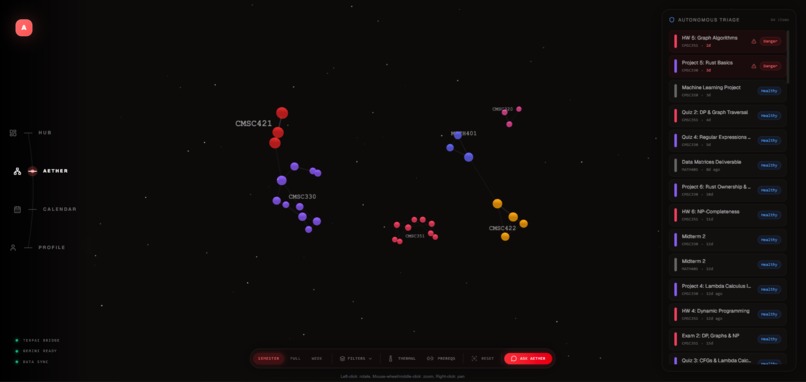
Aether Network
-
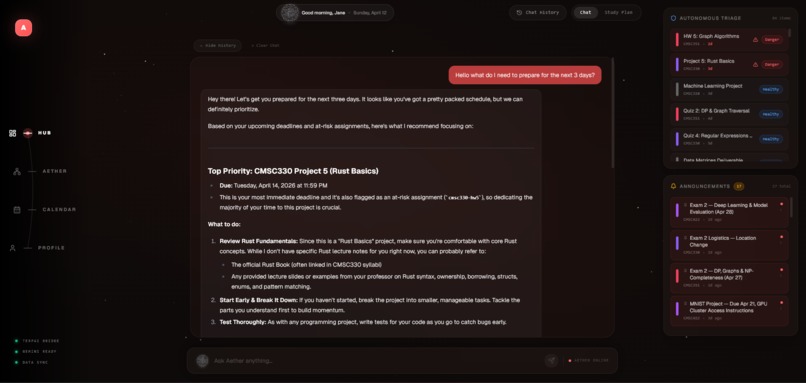
TerpAI Agent
-
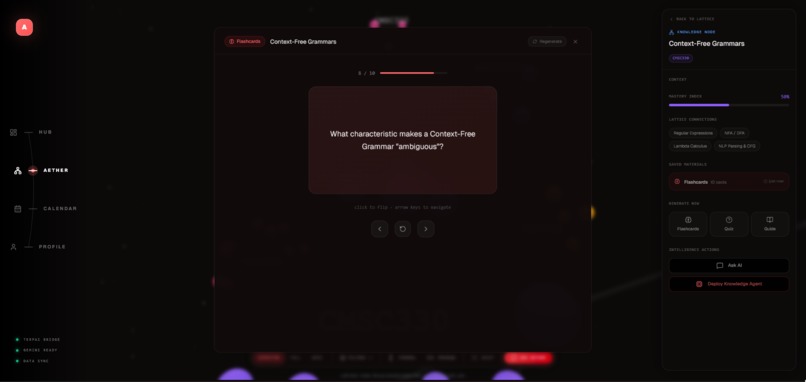
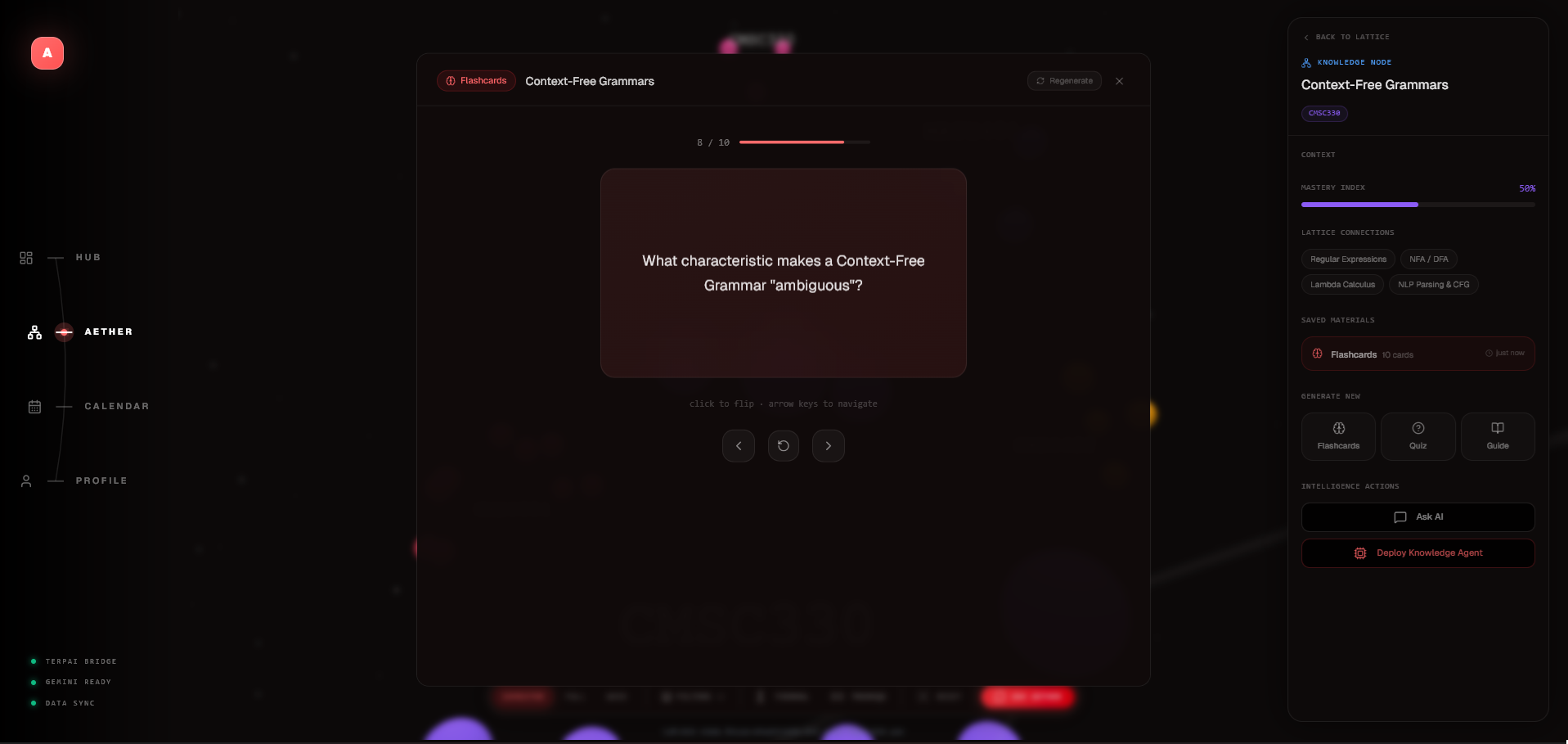
Flashcard Artifact
Aether Intelligence: The Autonomous Student OS
Inspiration
Students today are drowning in a sea of notifications, dead-end dashboards, and disjointed information. Between emails, LMS platforms, and project trackers, the "intelligence" of our academic life is scattered. We were inspired by the idea of an Autonomous Intelligence OS—a single, unified Command Center that doesn't just list your tasks, but navigates them for you. We wanted to build the "Jarvis" for academia.
What it does
Aether is an intelligent command center designed to turn academic chaos into autonomous clarity:
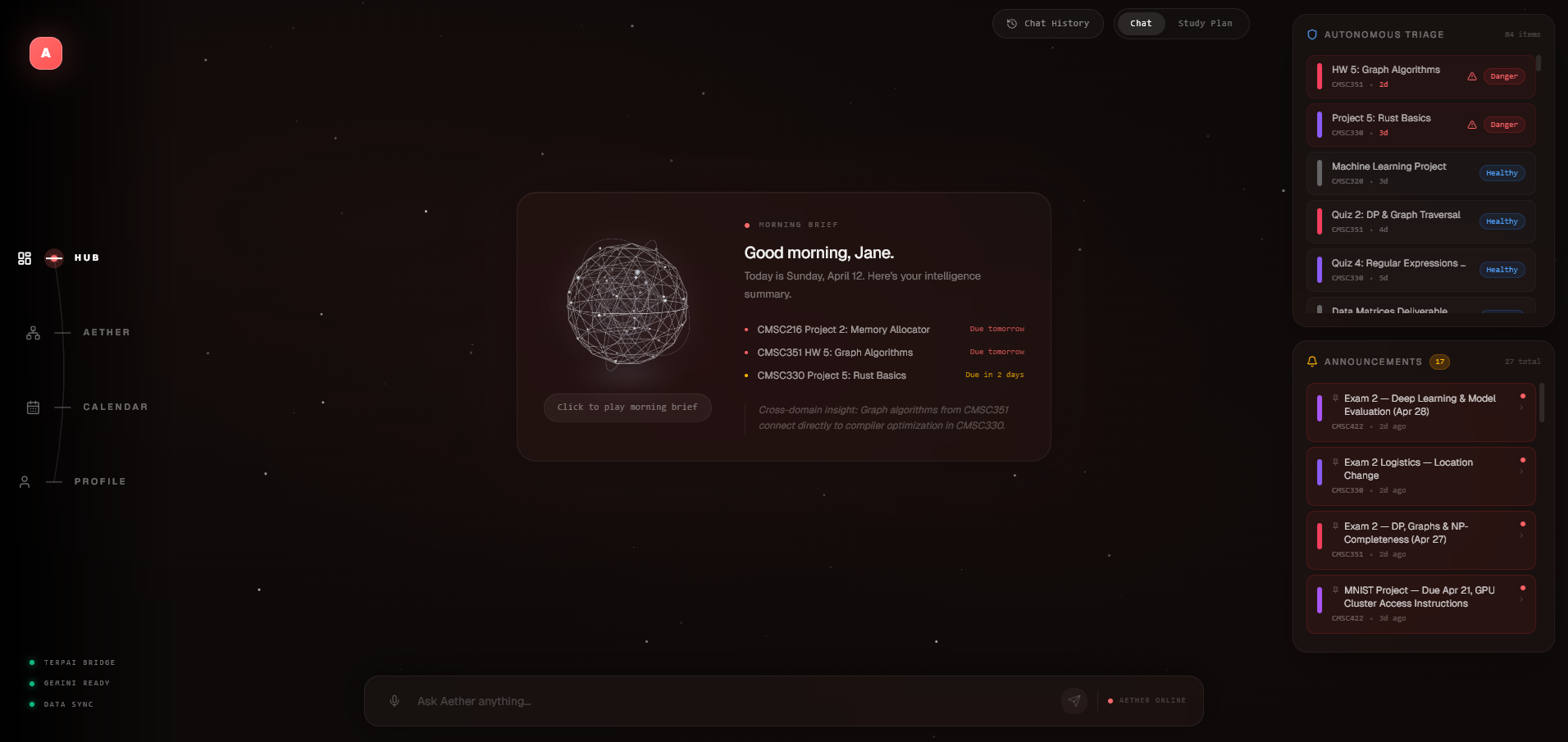
- Morning Brief: A personalized dashboard that summarizes your day, highlights upcoming deadlines, and provides cross-domain insights.
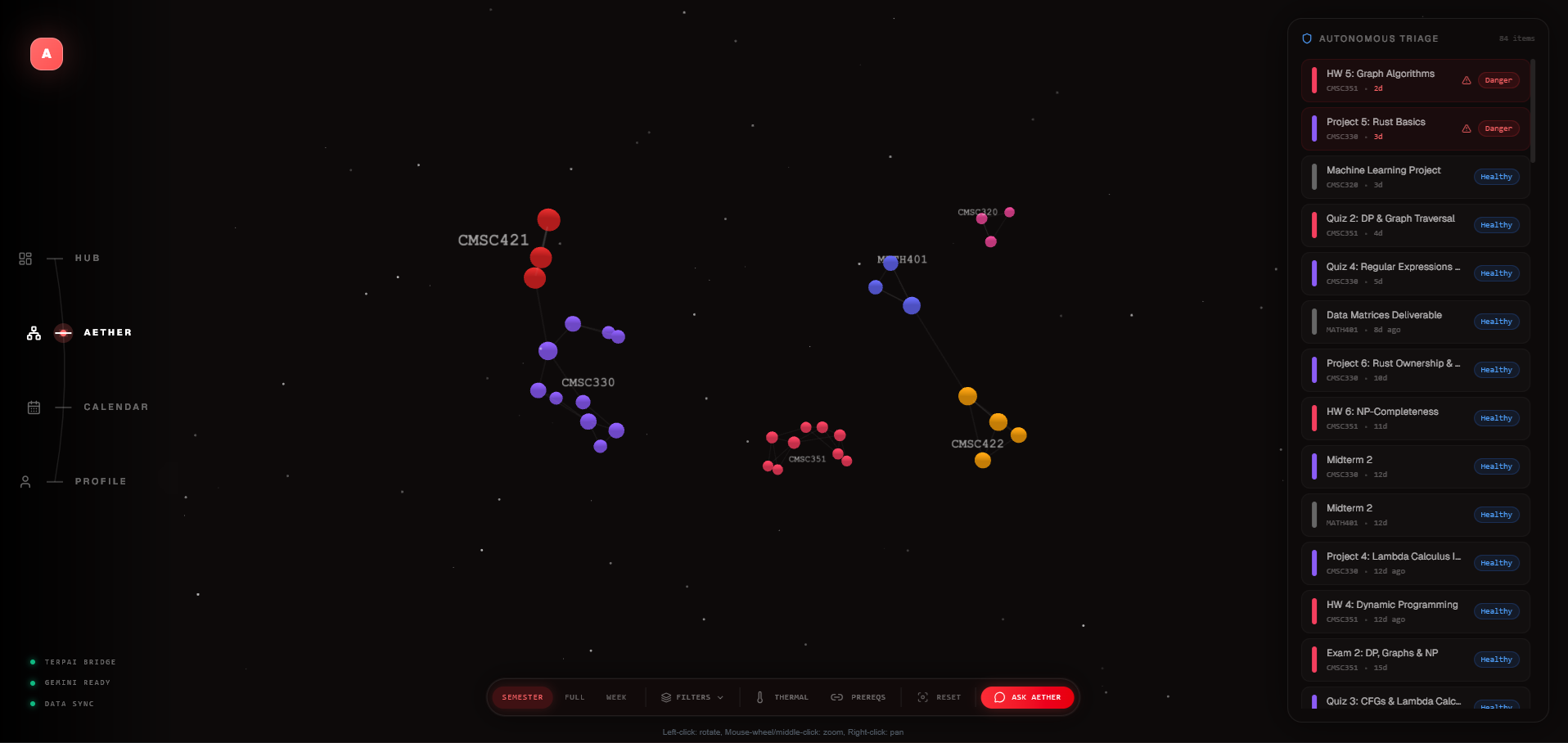
- Autonomous Triage: An AI-powered engine that scans your academic ecosystem and "triages" assignments into Healthy or Danger states based on priority and time.
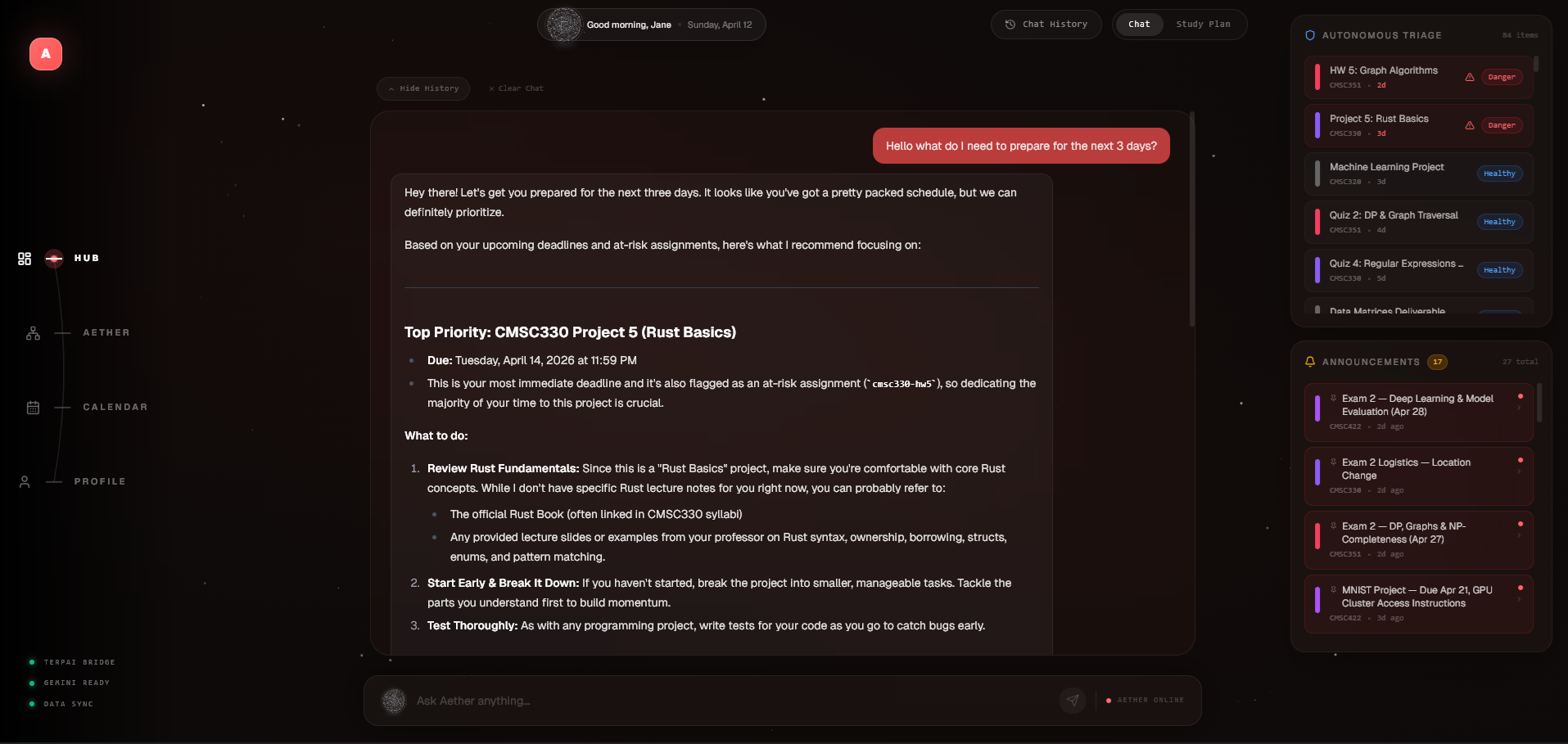
- Fluid Workspace: A state-driven interface that seamlessly transitions between a high-level briefing and a deep-focus AI chat environment.
- Aether Orb: A visual AI core that anchors the experience, providing real-time feedback and high-performance animations.
How we built it
- Intelligence Layer: Powered by Google Gemini for deep reasoning and TerpAI Ghost-Pilot for complex academic automation.
- Backend: A robust FastAPI architecture orchestrating multiple AI agents, including ElevenLabs TTS for voice-first briefings and Playwright-driven falbacks for data extraction.
- Frontend: A premium React experience built with Vite, Tailwind CSS, and Framer Motion.
- Design System: A custom "Atmospheric" UI using mesh overlays, glassmorphism, and interactive particle systems (
@tsparticles).
Challenges we ran into
- State-Driven Geometry: Implementing the "Pill" transition required complex layout calculations to ensure the interface could move from a full dashboard to a compact top-bar without layout jitter or performance hits.
- Orb Animation: Scaling the Aether Orb while preserving its interactive glows and high-performance SVG filters was a significant mathematical challenge.
- Information Density: Balancing a "Premium Minimalist" aesthetic with the high information density needed for academic triage required multiple rounds of design iteration.
Accomplishments that we're proud of
- Fluid UI Transitions: The transition from the "Morning Brief" to the "Chat-focused workspace" is entirely seamless, using the top-bar Pill as a persistent navigation anchor.
- Visual Identity: Creating a "wow" factor through atmospheric backgrounds, mesh gradients, and micro-animations that make a productivity tool feel alive.
- The "Triage" System: Successfully mapping raw task data into a high-visibility, color-coded health system for academic performance.
What we learned
- Layout Animations: We mastered the use of
framer-motion's Layout API to handle structural shifts in the DOM. - Agent Orchestration: We learned how to bridge multiple specialized AI agents (scraping, reasoning, speech) into a single, cohesive user persona.
- Human-Centric AI Design: That the most effective AI isn't just smart—it's accessible, persistent, and visually calming.
What's next for Aether
- Voice-First Interaction: Full bidirectional voice support for hands-free "Command Base" briefings.
- Predictive Learning: Implementing predictive analysis to estimate how long a specific student will take on an assignment based on complexity and historical data.
- Collaborative Study War-Rooms: Shared AI-driven spaces for team projects and peer-to-peer accountability.
Built With
- css
- elevenlabs-tts
- fastapi
- framer-motion
- google-gemini-api
- pdfplumber
- playwright
- python
- radix-ui
- react
- react-force-graph
- tailwind-css
- terpai
- three.js
- typescript
- vite
- zustand


Log in or sign up for Devpost to join the conversation.