Inspiration
W## Inspiration
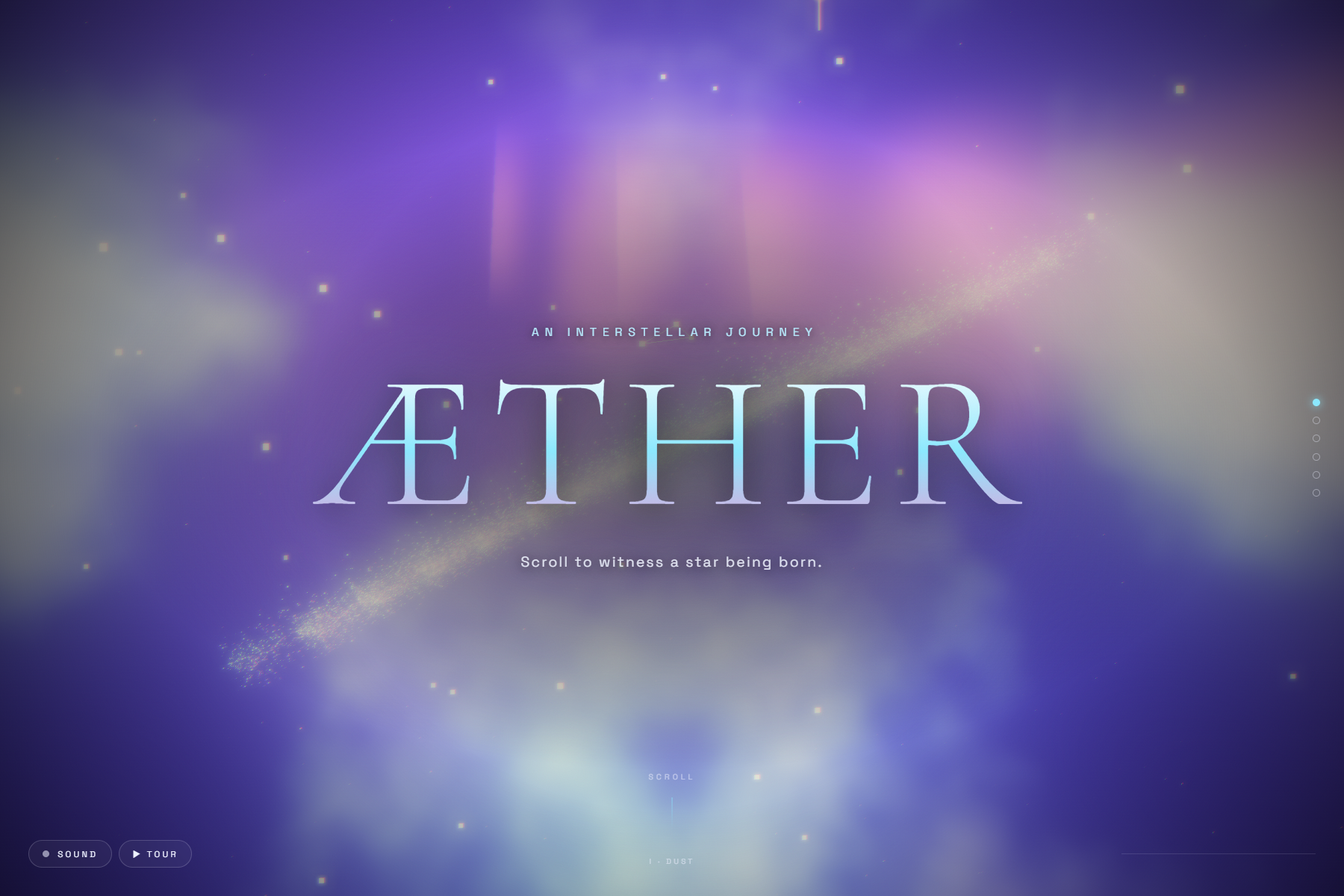
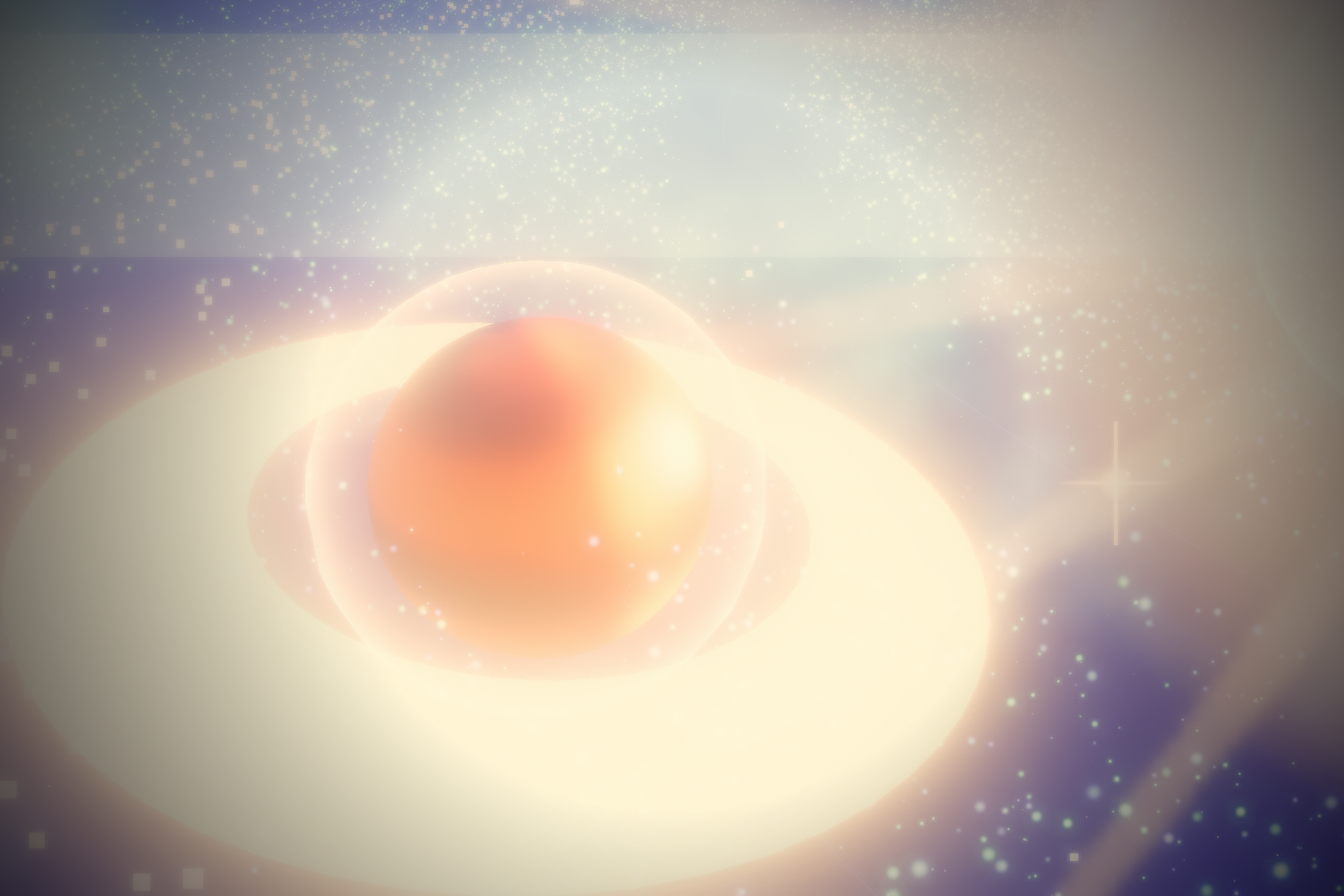
Most of the web is rectangles. We wanted to build something that makes people stop scrolling and whisper "wow" — so we chose the most awe-inspiring story we know: the birth of a star. ÆTHER turns your scrollbar into a cosmic timeline, carrying you from a spiral galaxy, through a collapsing core and a supernova, to a newborn, living planetary system you can explore.
What it does
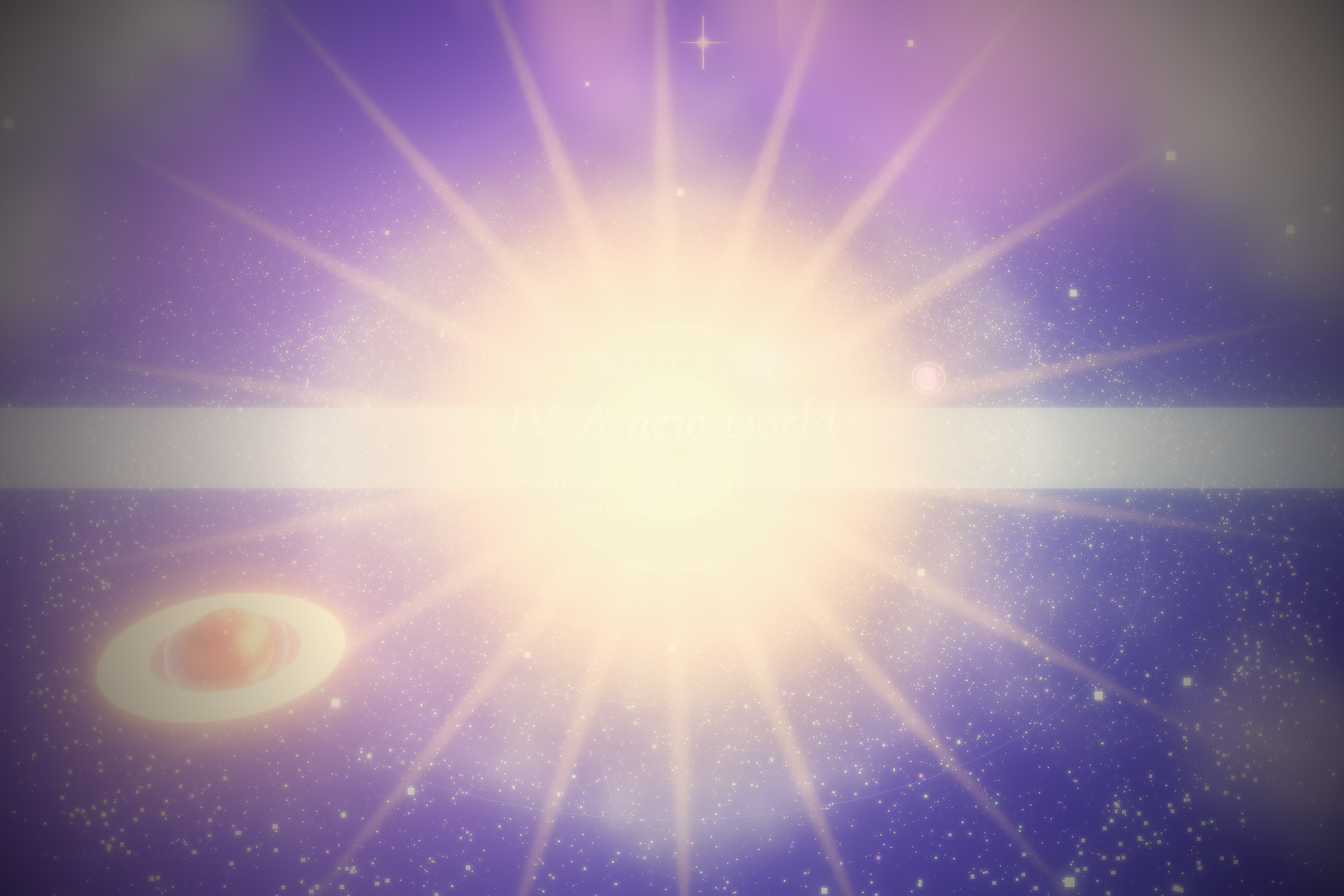
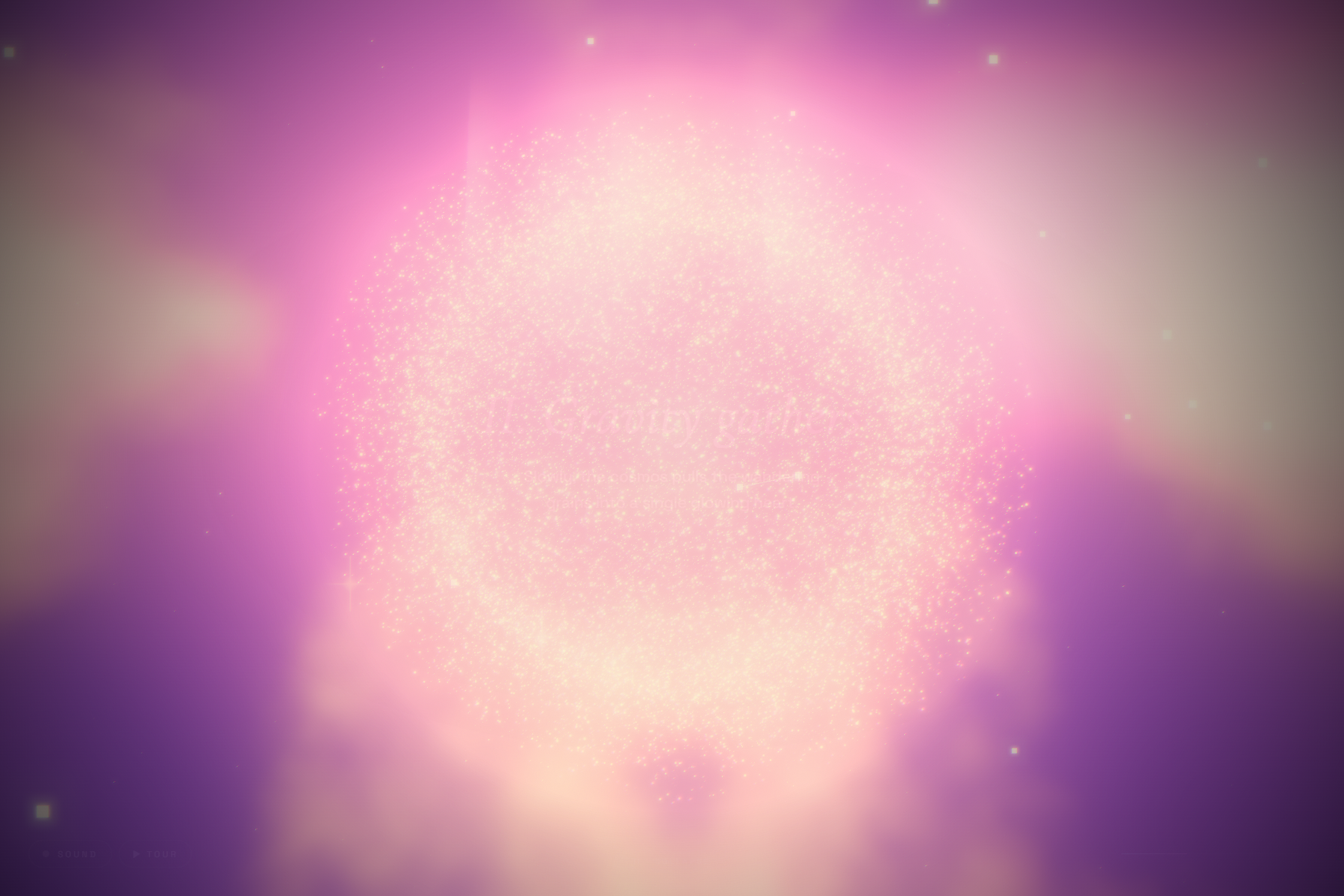
As you scroll, 46,000 GPU particles continuously morph between four shapes — galaxy → collapsing core → supernova → protoplanetary disk — in one continuous, cinematic shot. A real star ignites with a procedurally simulated surface; planets form with day/night city lights, drifting clouds and ringed moons, and you can click any world to read its story. Generative music plays live and the visuals dance to it. Move the mouse and the whole cosmos bends toward your cursor; click and space ripples with shockwaves and meteors. It ends with a cinematic fly-through of a newborn planet and its rings.
How we built it
Everything is real-time WebGL via Three.js — not a single image or video.
- The morph is a piecewise smoothstep between into vertex attributes: $$\mathbf{p}(s)=\operatorname{lerp}\big(\mat(3s-k)\big),\quad S(x)=3x^2-2x^3$$
- Motion uses divergence-free curl noise, $\mathbf{v}=\nabla\times\boldsymbol{\psi}$, so particles flow like fluid.
- A screen-space volumetric light-scattering pass builds god rays by marching toward the star and accumulating brightness with exponential decay: $$L=\sum_{i=0}^{N} d^{\,i}\,w\;\mathrm{tex}!\left(\mathbf{uv}-i\,\Delta\right)$$
- The soundtrack is synthesized in the Web Audio API (a filtered drone plus a wandering pentatonic melody); a live FFT spld/treble that drive particle size, aurora intensity and chromatic aberration.
- Post-processing: UnrealBloom → god rays → cholor grade, over a procedural fbm nebula sky and a temperature-accurate starfield.
Challenges we ran into
- Keeping 46k morphing particles at 60 fps: all animation runs on the GPU, and an adaptive-quality system scales resolution and drops the heaviest passes if the frame rate falls.
- Balancing a stack of additive effects (bloom, god rays, aurora, flares) without blowing the frame to white — solved with an HDR tone curve and a split-tone grade.
- Building a self-contained star: procedural s darkening, so the sun looks alive with zero downloaded textures.
Accomplishments that we're proud of
- A single continuous shot that reads as one story — galaxy to living world — with no cuts, loads, or image assets. It's 100% procedural math.
- Audio and visuals that are genuinely coupled: the music we generate is the same signal that pulses the bloom and bends the l
- Interactive worlds — clickable planets with day/night cities, moons and lore — that reward exploration instead of just being watched.
What we learned
Custom GLSL (curl noise, fbm, fresnel, volumetric scattering), the Web Audio graph and real-time FFT analysis, EffectComposer pos above all, restraint: the "wow" comes from a coherent palette and pacing, not from piling on effects.
What's next for ÆTHER — Birth of a Star
A shareable procedural seed so every visitspheric refraction on the planets, a one-click cinematic auto-tour export, and a WebXR / VR mode so you can stand inside the supernova.
*Built with Three.js. Everything you see is math.*hat it does

Log in or sign up for Devpost to join the conversation.