
Inspiration
Generative-video demos often stop after producing one impressive clip. Real music-video production begins after that: music must be analyzed, visual identity must remain consistent, failed jobs must be recoverable, clients must review individual shots, and every asset needs a clear provenance record.
We built Aeternus MV Forge to make generative media behave like a reliable production system instead of a slot machine.
What it does
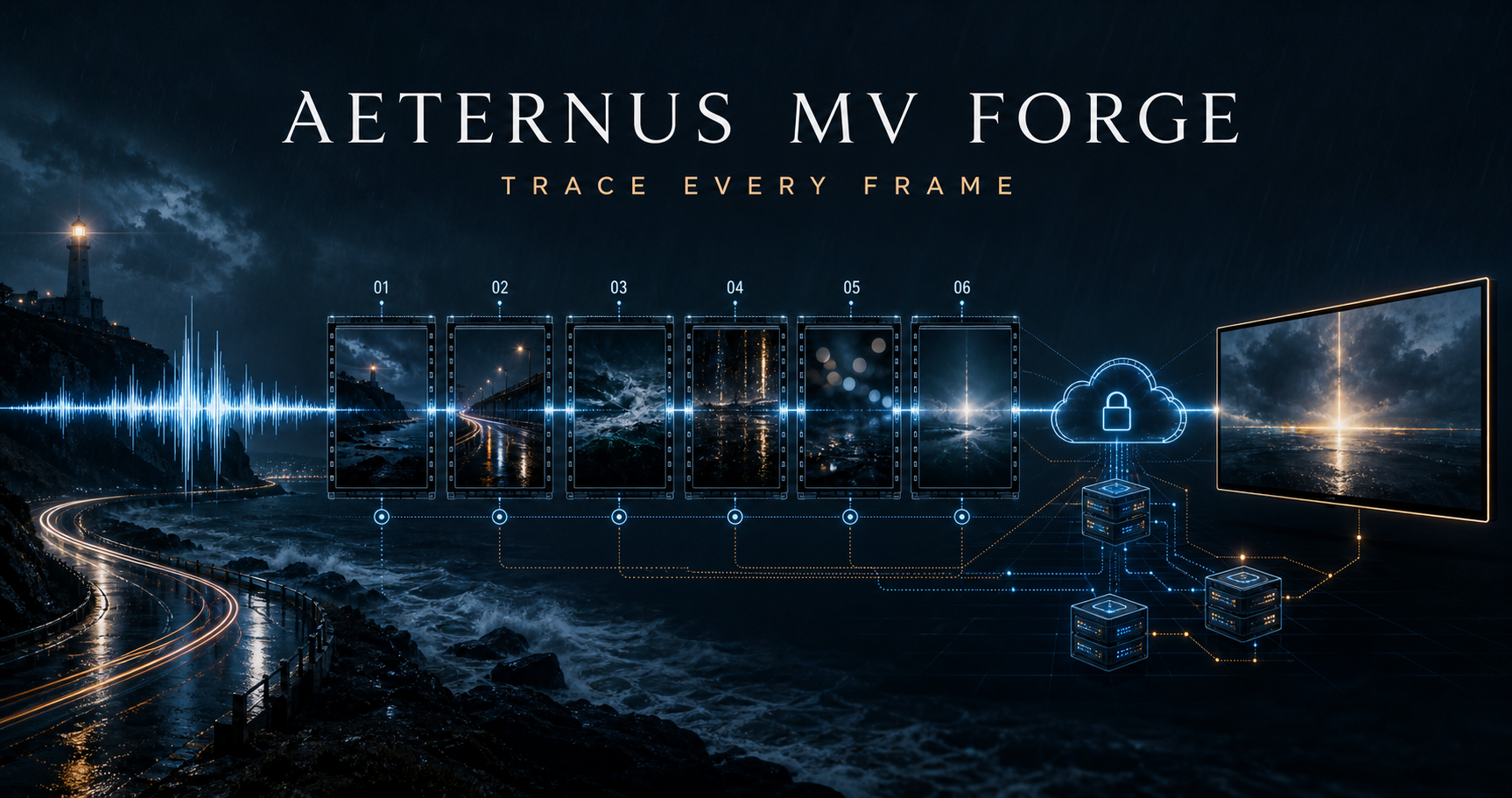
Aeternus MV Forge transforms licensed music and authorized visual references into a reviewable AI-assisted music video.
It analyzes the media, creates a six-shot storyboard, processes every shot as an independent job, records prompts and model information, performs quality checks, and requires human approval before final rendering. Approved shots are assembled into an H.264/AAC MP4 with FFmpeg.
The system also records the rights basis, provider events, retries, fallbacks, file hashes, storage paths, and audit history for every production.
How we built it
- Genblaze orchestrates the AI provider workflow and storage pipeline.
- NVIDIA NIM using
nvidia/nemotron-3-nano-omni-30b-a3b-reasoninggenerates the structured six-shot storyboard. - NVIDIA Cosmos3 Nano is attempted as the hosted video provider through Genblaze.
- Backblaze B2 stores source media, analysis results, storyboard plans, keyframes, clips, QC artifacts, manifests, and final exports.
- FastAPI and SQLite provide project, job, review, consent, usage, idempotency, and audit APIs.
- FFmpeg, Pillow, and OpenCV provide media analysis, rendering, motion treatments, and technical quality checks.
- React provides the production interface and public judge experience.
- Render hosts the Python and FFmpeg backend.
How we used Backblaze B2
Backblaze B2 is the system of record, not merely a final download location. Every production uses a stable object hierarchy:
projects/{project-id}/input — source audio and references
projects/{project-id}/analysis — media analysis
projects/{project-id}/storyboard — Genblaze and NVIDIA plans
projects/{project-id}/shots/{shot-id} — keyframes, clips, manifests, and QC
projects/{project-id}/output — final MP4 export
Each manifest records the provider, model, prompt, parameters, input and output hashes, elapsed time, cost estimate, parent run, and fallback reason.
How we used Genblaze
Our live storyboard workflow uses a Genblaze pipeline named aeternus-nvidia-storyboard-director. It calls NVIDIA Nemotron to produce a structured shot plan and persists the resulting plan and manifest to Backblaze B2.
Shot jobs also attempt NVIDIA's hosted Cosmos3 Nano provider through Genblaze. If the upstream service is unavailable, Aeternus records the failure and applies a disclosed deterministic motion fallback using the owner's authorized reference material.
Challenges we ran into
The hosted Cosmos3 Nano endpoint returned a raw 404 during our production run. We chose not to hide the failure. The system records the failed provider event and model before switching to the disclosed fallback renderer.
The free production server also has a strict memory limit. Concurrent FFmpeg jobs caused a restart, so we constrained FFmpeg resources, processed media through a single worker, and stored all durable artifacts in B2.
Accomplishments that we're proud of
- Completed a real Genblaze and NVIDIA storyboard workflow.
- Produced and approved six traceable shots.
- Stored production inputs, manifests, QC artifacts, and final media in Backblaze B2.
- Rendered a verified 30-second H.264/AAC competition cut.
- Preserved an honest provider failure and fallback trail.
- Added consent, audit, review, idempotency, provenance, and cost-control foundations suitable for a commercial product.
What we learned
Reliable generative media depends on more than one model. It requires durable inputs, isolated jobs, provider observability, human approval gates, and honest provenance.
Backblaze B2 makes the production relationships persistent, while Genblaze makes the AI provider workflow explicit and traceable.
What's next for Aeternus MV Forge
Next, we plan to add authenticated client workspaces, Postgres metadata storage, managed background queues, additional Genblaze providers, visual-identity scoring, browser-based timeline editing, team approvals, and commercial billing for agencies and independent music-video creators.

Log in or sign up for Devpost to join the conversation.