Inspiration
Air traffic controllers can track every plane in the sky down to the meter, yet they are completely blind to the most dangerous aerodynamic hazard in terminal airspace: wake turbulence. Every heavy jet leaves behind invisible, counter-rotating wingtip vortices that act like horizontal tornadoes, capable of violently rolling a following aircraft minutes after the leader has passed.
At closely spaced parallel-runway hubs like San Francisco International Airport (KSFO), runways 28L and 28R sit just 750 feet apart. Even a light crosswind can blow a heavy jet's wake directly into the path of the plane landing next to it, forcing controllers to rely on rigid, worst-case distance buffers that choke runway capacity and cause cascading flight delays. We asked: What if controllers could actually see the air, not just the aircraft?
What it does
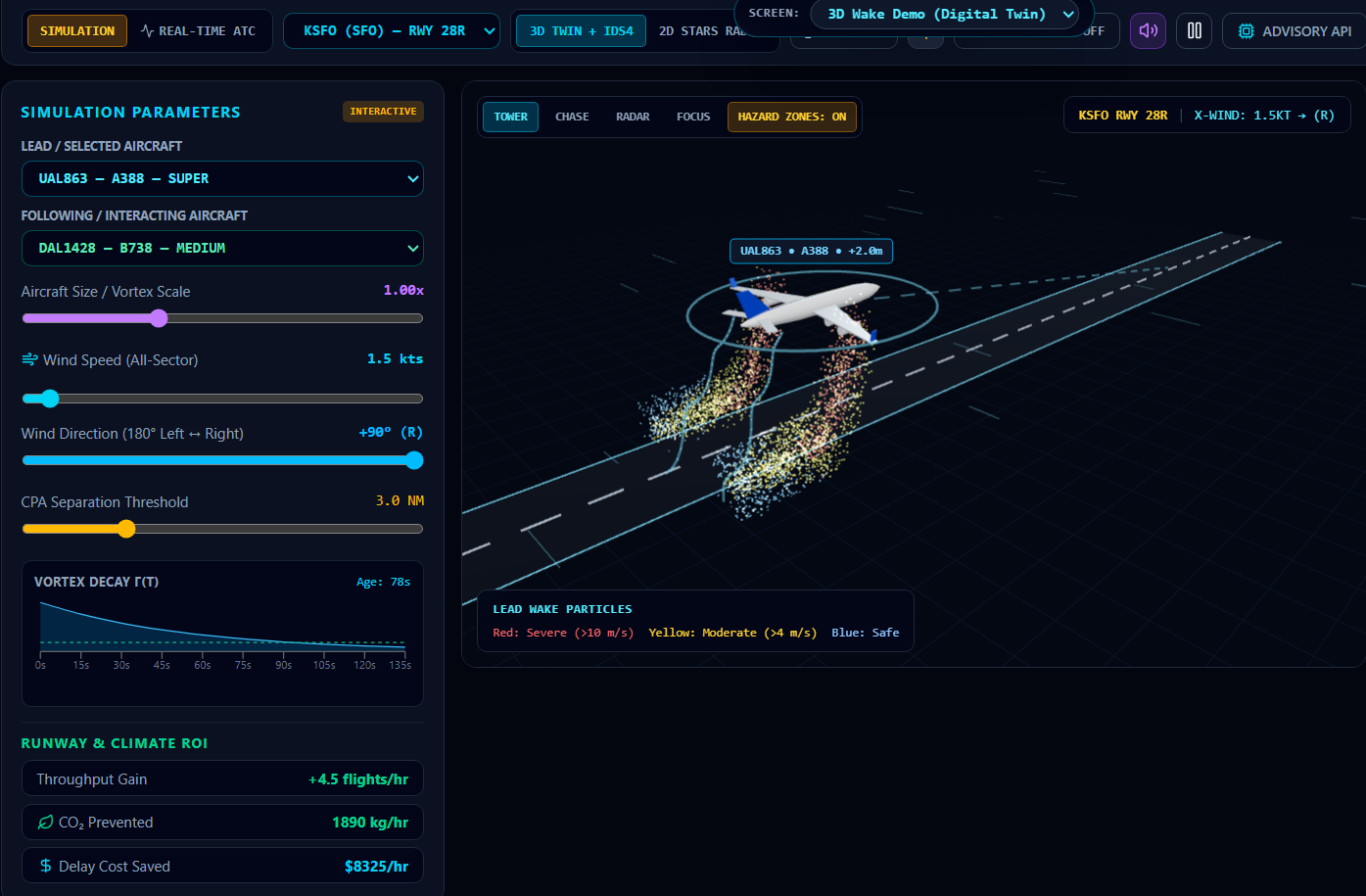
Aero-Sonar is an interactive 3D Airspace Digital Twin and Airport Surface Radar built with React, JavaScript/TypeScript, Three.js, and HTML5 Canvas, and deployed on Google Cloud Compute Engine, that makes invisible wake turbulence visible from 50 nautical miles out to the gate:
- 3D Wake Vortex Digital Twin: Simulates how invisible wingtip vortices sink, drift, and decay in real time, integrating OpenSky Network API traffic telemetry to compute Closest Point of Approach (CPA) and dynamic separation advisories between parallel approaches.
- Multi-Scenario & Fleet What-If Simulator: Lets controllers test different aircraft categories and live atmospheric scenarios by adjusting wind speed ($0\text{--}30\text{ kts}$), $180^\circ$ crosswind direction, CPA separation thresholds, and vortex scale, dynamically predicting fuel cost saved, carbon emissions reduced ($\text{CO}_2$), overall runway throughput, and flight delays avoided.
- KSFO Surface Movement Radar (ASDE-X): Replicates San Francisco International Airport’s four intersecting runways, taxiways, and terminals in a live 60 FPS tower display, complete with red runway occupancy alerts, live METAR/QNH weather telemetry, three tactical zoom insets, and Day/Night radar modes.
- Interactive Tower Clearance Controls: Lets controllers click any active aircraft on final approach, holding short, or taxiing and issue real-time commands (Cleared Takeoff, Line Up & Wait, Hold Short, and Go Around) that immediately update runway occupancy and aircraft kinematics.
How we built it
We started by studying the core physical factors that govern wake turbulence: how an aircraft’s size, weight, and wingspan generate vortex strength, and how that turbulence sinks, drifts, and decays over time. From there, we mapped how a trailing aircraft is affected by crosswinds and spacing, turning that aerodynamic theory into a two-part glass cockpit:
- Turning Fluid Dynamics into 3D Visuals: Instead of drawing fake animations behind planes, we translated real aerodynamic wake theory into a multi-slice 3D physics engine built with React, JavaScript/TypeScript, and Three.js. Every aircraft generates a trailing vortex pair whose initial strength depends on its weight, speed, and wingspan: $$\Gamma_0 = \frac{M \cdot g}{\rho \cdot V \cdot b_0}$$ Meanwhile, rotational wind swirl follows the Burnham-Hallock vortex model: $$v_\theta(r) = \frac{\Gamma}{2\pi r} \cdot \left[\frac{r^2}{r^2 + r_c^2}\right]$$ As the wake sinks toward the runway ($w = \frac{\Gamma}{2\pi b_0}$), it rebounds laterally off the ground, fades over time ($\Gamma(t) = \Gamma_0 \cdot e^{-t/\tau}$), and drifts with our $180^\circ$ crosswind so controllers can literally see where danger moves.
- Measuring When a Wake Becomes Dangerous: In aviation, a wake is only hazardous if it can overwhelm the next plane's controls. We implemented a Follower Induced Roll Hazard ($\text{RDIR}$) index that compares peak vortex spin against the trailing aircraft's roll authority, automatically triggering a hazard alert whenever $\text{RDIR} > 1.0$: $$\text{RDIR} = \frac{v_{\theta,\text{peak}} \cdot b_{\text{follower}}}{2 \cdot V_{\text{follower}} \cdot p_{\text{max}}}$$
- Building a 60 FPS KSFO Tower Radar: To mirror how controllers actually manage ground and approach traffic at San Francisco International Airport, we engineered a custom HTML5 2D Canvas ASDE-X radar running at 60 FPS. It models SFO's four intersecting runways, taxiways, and live METAR weather, complete with red runway-occupancy highlights, three corner zoom insets, and interactive tower clearance buttons.
- Live Data, What-If Economics & Cloud Deployment: We connected the OpenSky Network API for real-time Bay Area flight telemetry (with smooth dead-reckoning interpolation and simulated traffic fallback), added an impact calculator that converts tighter safe spacing into delays avoided, fuel saved, and $\text{CO}_2$ reduced, and deployed the entire platform on Google Cloud Compute Engine.
Challenges we ran into
- $180^\circ$ Bidirectional Crosswind Math: Separating Wind Speed ($0\text{--}30\text{ kts}$) from vector sign so ground-effect rebound and Closest Point of Approach (CPA) hazard zones trigger symmetrically from both sides of the runway centerline.
- Hand-Crafting KSFO’s Exact Runway Geometry: Mapping SFO’s four intersecting runways (
10L/28R,10R/28L,01L/19R,01R/19L), horseshoe terminals (A-G), and taxiways in 2D Canvas while keeping aircraft locked to centerlines during landing rollout, hold-short gating, and takeoff. - 60 FPS Multi-Scope Rendering: Decoupling 3D Burnham-Hallock particle physics and multi-inset radar draw loops from React re-renders via
requestAnimationFramerefs so neither view lags. - Smoothing OpenSky Telemetry: Adding velocity-vector dead reckoning and automatic fallback traffic so aircraft never freeze or jump when live ADS-B packets drop.
Accomplishments that we're proud of
- Real Aerodynamics Over Canned Animations: Every aircraft solves live Burnham-Hallock vortex swirl, mutual sinking, ground-effect rebound, and Follower Induced Roll Hazard ($\text{RDIR} > 1.0$) physics in 3D.
- What-If Impact & Sustainability Simulator: Adjusting wind speed, $180^\circ$ wind angle, CPA threshold, and vortex scale instantly predicts delays prevented, fuel saved, runway throughput gained, and $\text{CO}_2$ reduced.
- Interactive KSFO ASDE-X Tower Workstation: Full-bleed surface radar with red runway-occupancy alerts, Day/Night scopes, three corner zoom insets, and live clearance controls (Cleared Takeoff, Line Up & Wait, Hold Short, Go Around).
- Live on Google Cloud: Deployed end-to-end on Google Cloud Compute Engine so anyone can test real-time airspace scenarios directly in the browser.
What we learned
- Airspace Capacity Is Really a Wind-Geometry Problem: Static separation buffers treat every weather condition like the worst-case scenario; modeling real crosswind drift showed us that small shifts in wind angle often clear adjacent runways safely, turning invisible aerodynamics into measurable fuel, $\text{CO}_2$, and delay savings.
- Domain Constraints Drive Better UI Design: Studying how real FAA ASDE-X tower displays use restrained color hierarchies (keeping the field muted so red runway-occupancy alerts and active target blocks pop immediately) taught us that in safety-critical tools, clarity beats visual noise every time.
- Physics Engines Belong Outside the UI Lifecycle: Keeping high-frequency Burnham-Hallock particle advection and multi-inset canvas rendering locked at 60 FPS required separating continuous $dt$ math from React’s declarative state updates.
What's next for AEROSONAR
- Live NOAA METAR & AWOS Wind Feeds: Streaming real-time airport anemometer data directly into the 3D wake transport engine so vortex drift automatically mirrors live runway weather without manual slider input.
- Dynamic RECAT Sequencing Recommendations: Adding an intelligent tower assistant that suggests safe, dynamic spacing intervals across Super, Heavy, Large, and Small aircraft pairs based on live $\text{RDIR}$ roll-hazard decay.
- Multi-Airport Digital Twin Expansion: Scaling our runway-geometry and geodetic projection engine beyond KSFO to other high-congestion parallel-runway hubs like KLAX, KATL, and KJFK.
Built With
- 3d-visualization
- ads-b
- aerodynamics
- air-traffic-control
- aviation
- digital-twin
- fluid-dynamics
- gemini
- google-cloud
- google-cloud-compute-engine
- html5
- javascript
- opensky-netwrok-api
- physics-simulation
- radar
- react
- react-three-fiber
- sustainability
- tailwindcss
- three.js
- typescript
- vite
- webgl


