-
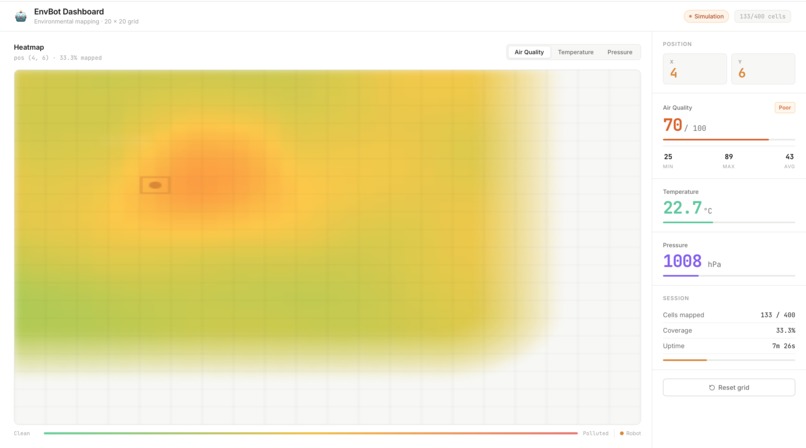
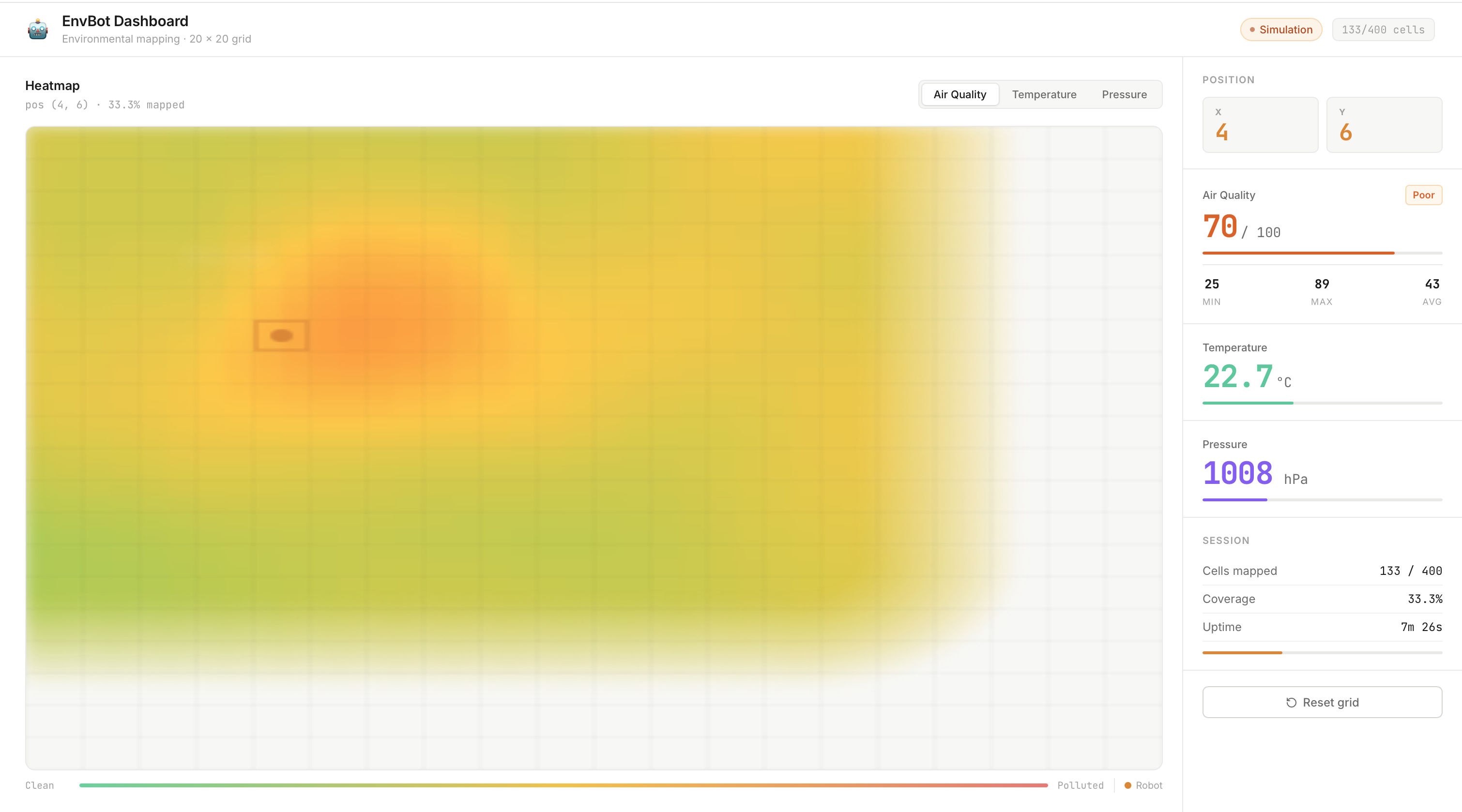
Picture of Project Website running
Inspiration
Every year, thousands of first responders and industrial workers are blindsided by invisible airborne threats to the human body. Of these: chemical/gas leaks, stagnant carbon dioxide, and toxic VOCs are most likely to be left undetected due to the static single point focus of traditional sensor technology. Sensors on walls simply fail to flag the alarms on harmful gases just a few meters away.
What it does
AeroQual is an low cost autonomous sensory unit designed to patrol and map out rooms for potentially harmful gas clusters. It serves as an alternative to expensive contemporary semi-permanent sensor and alarm arrays set up throughout an enclosed location.
The AeroQual Mapper then sends this vital data instantly and over real-time to a software dashboard providing convenient data access for supervisors and safety experts in industry and healthcare alike. The dashboard displays heat maps of room temperature, air quality index, and humidity, all fed into a trained machine learning heuristic designed to identify common industrial chemicals and gases harmful to the human body.
How we built it
A hardware prototype of 2 ESP32-S3s (one designated sensory processor & one hosting the dashboard) managed a sonar including a HC-SR04P Ultrasonic Sensors & a SG90 continuously revolving servo paired with a pathfinding algorithm for fully-autonomous hands-off operation; alongside a sensor array consisting of a CCS811 Air Quality Sensor, 101020008 Moisture Sensor, and a temperature sensor. We used the ESP32s inbuilt ESPNOW protocol for high-speed real time data delivery and processing which was passed into an Arduino Uno R3 for industrial interfacing, alongside being passed into a frontend webapp dashboard to display continuously updated heat maps from the sensory unit.
Challenges we ran into
Most of our issues centered around using Motor Control PWM with the ESP32s to control the ultrasonic sensors at a reasonable accuracy. Additionally, we faced issues in implementing an SMA (Simple Moving Average) to smooth our Air Quality Data.
Accomplishments that we're proud of
The amount of low-level protocol utilized in our project, avoiding the usage of high level abstractions in data protocol and hardware interfacing is something we're proud to say we achieved with this project.
What's next for AeroQual
In the future, we hope to expand AeroQual's pre-existing capabilities with a far more advanced sensory array, capable of large-scale environmental monitoring in far larger enclosed spaces. Specifically, we plan to expand the existing single-unit model to a multi-agent autonomous network to achieve this. Additionally, to ensure complete autonomy we plan to implement an automatic recharging system.
Built With
- arduino
- c++
- esp32-s3
- javascript

Log in or sign up for Devpost to join the conversation.