-
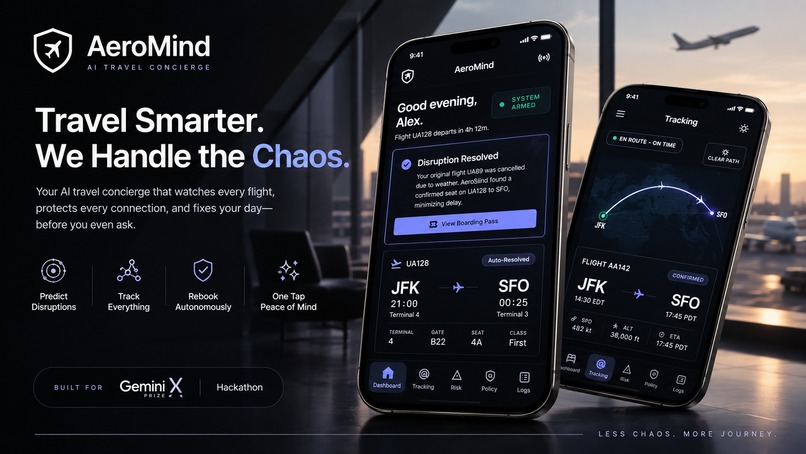
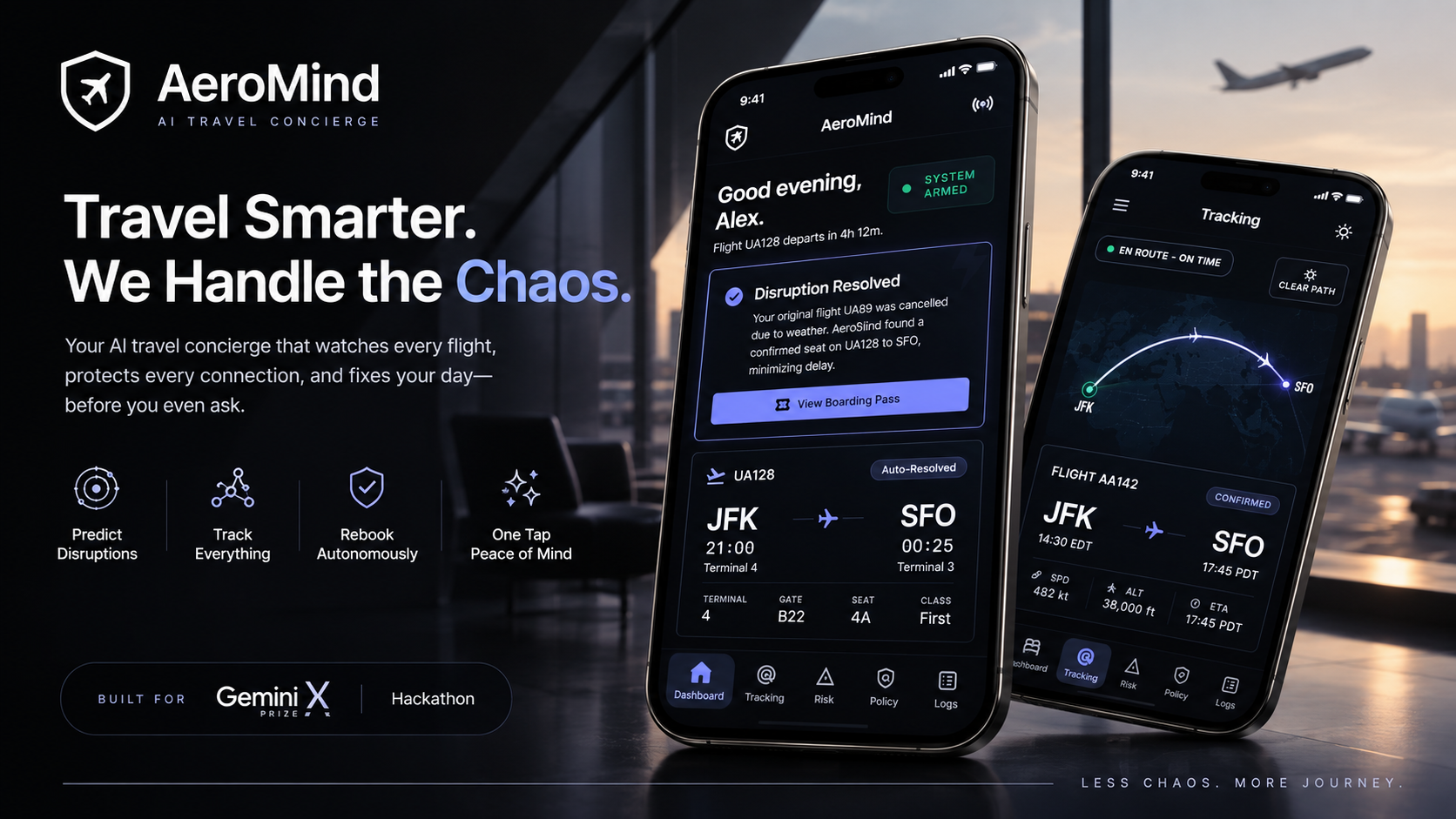
Less Chaos. More Journey.
-
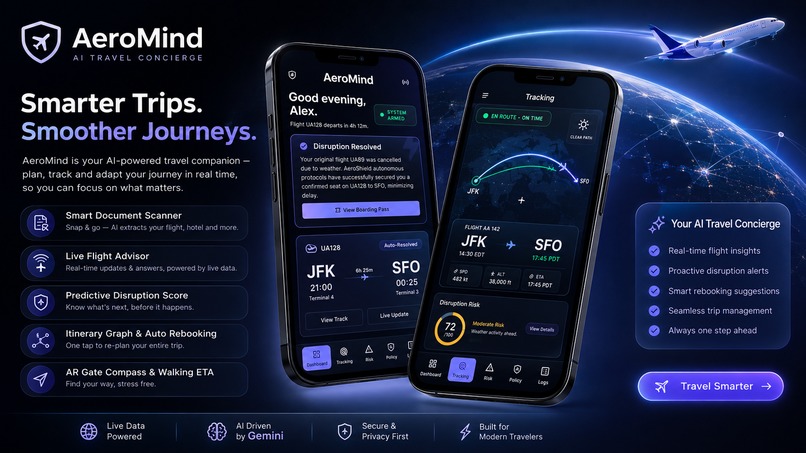
AeroMind
-
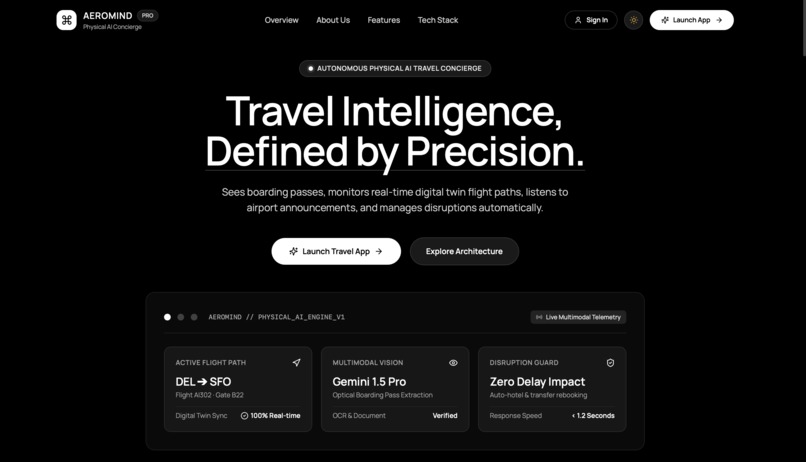
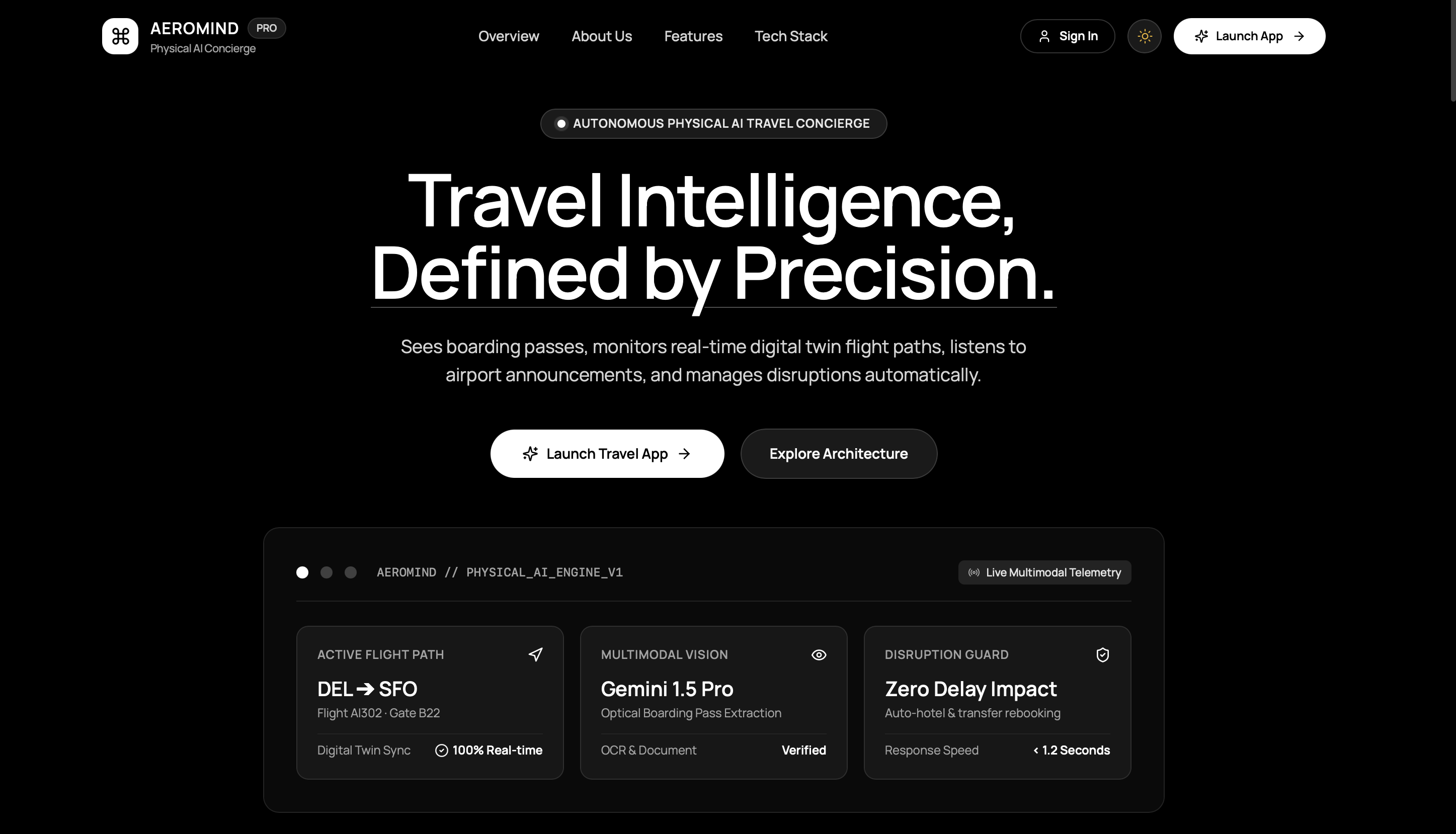
Dark theme landing
-
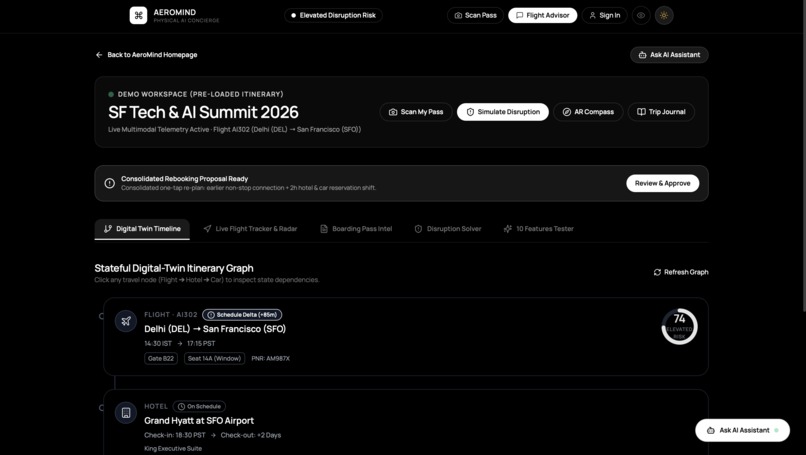
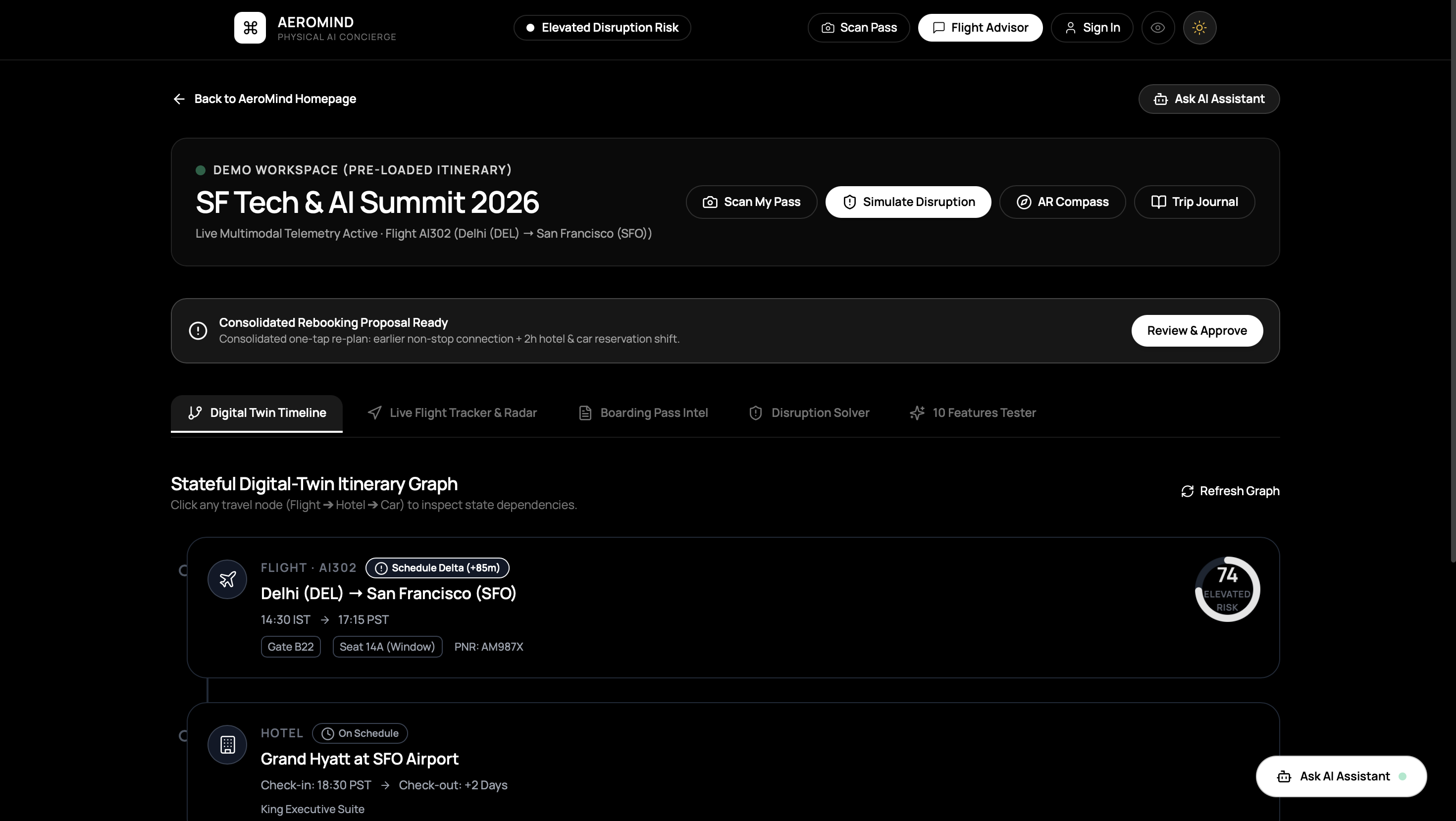
Demo workspace for user guidance
-
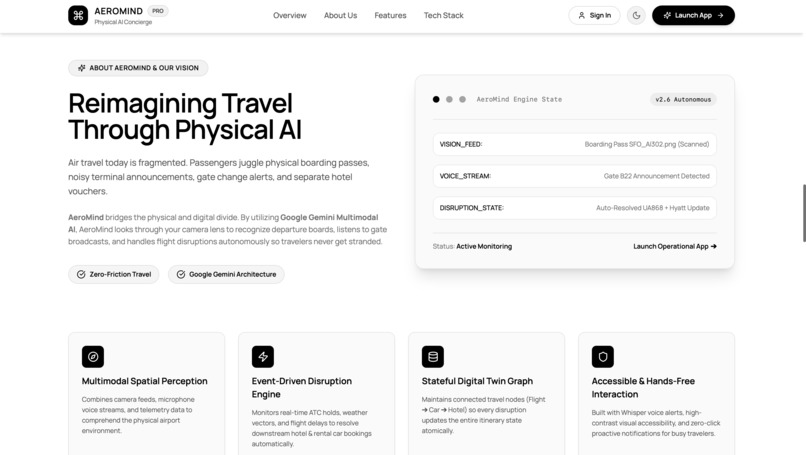
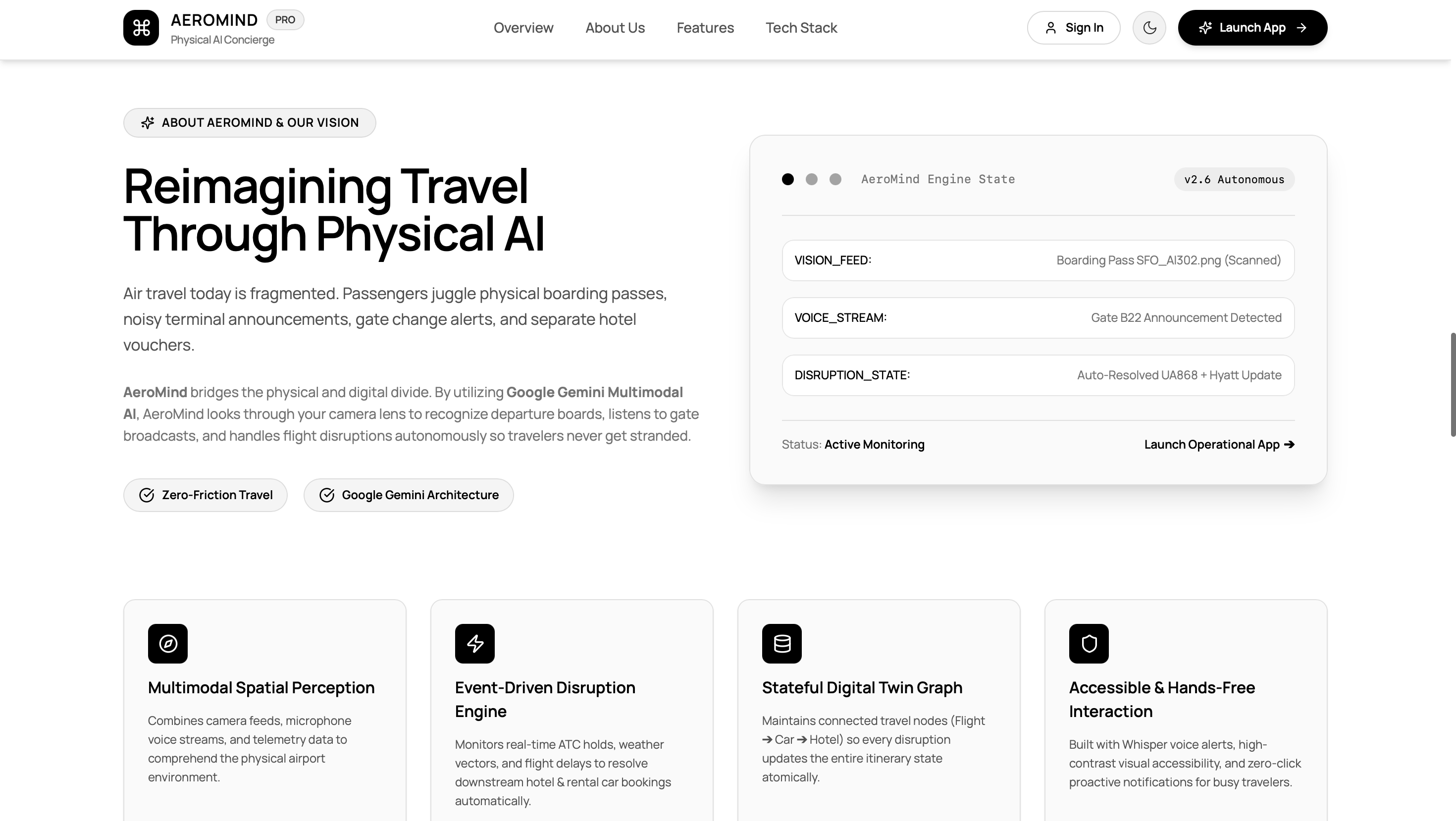
What we do
-
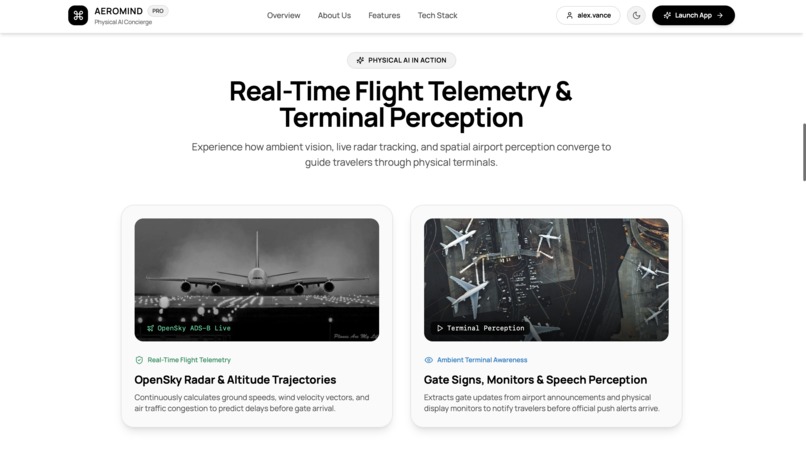
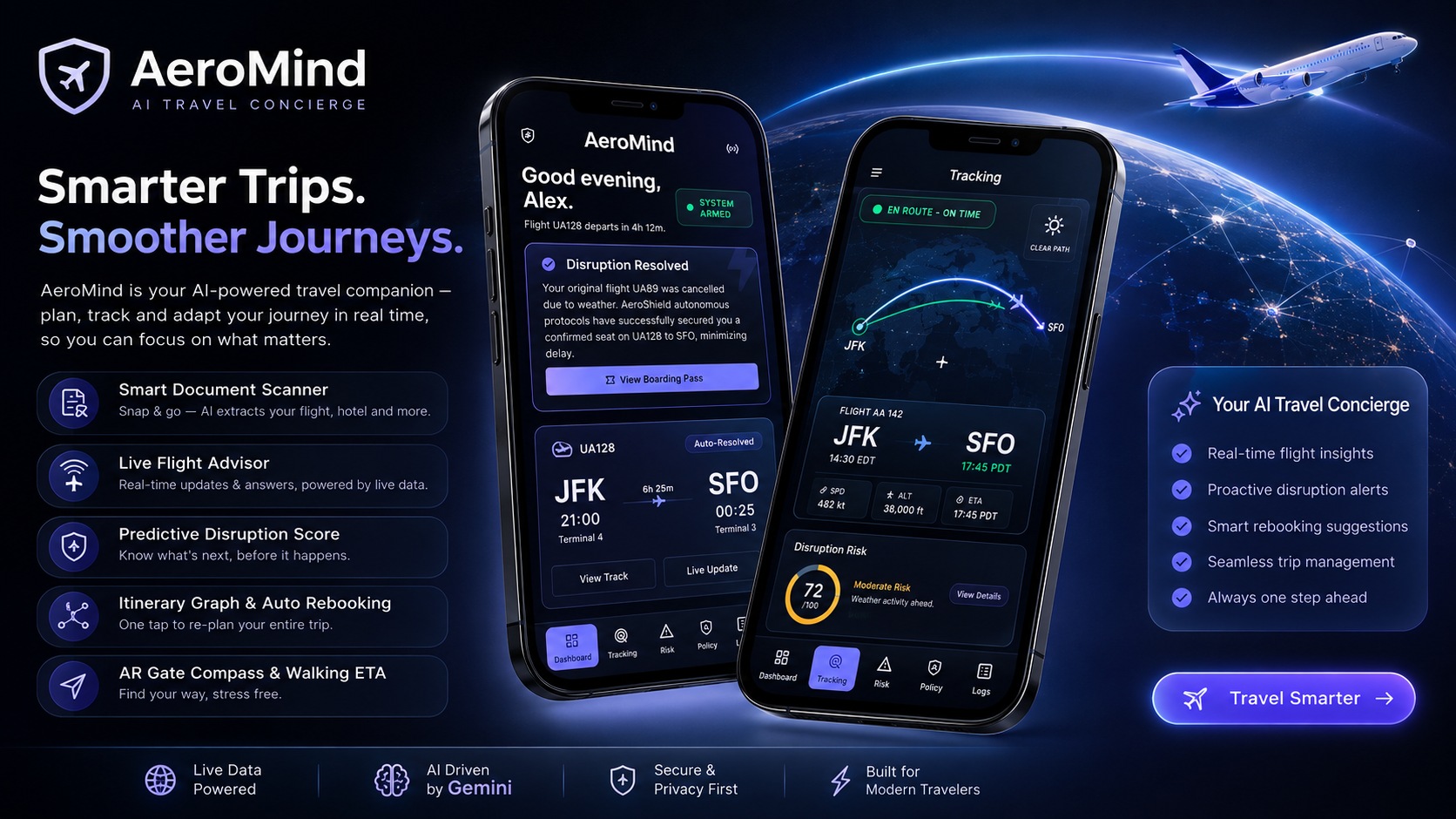
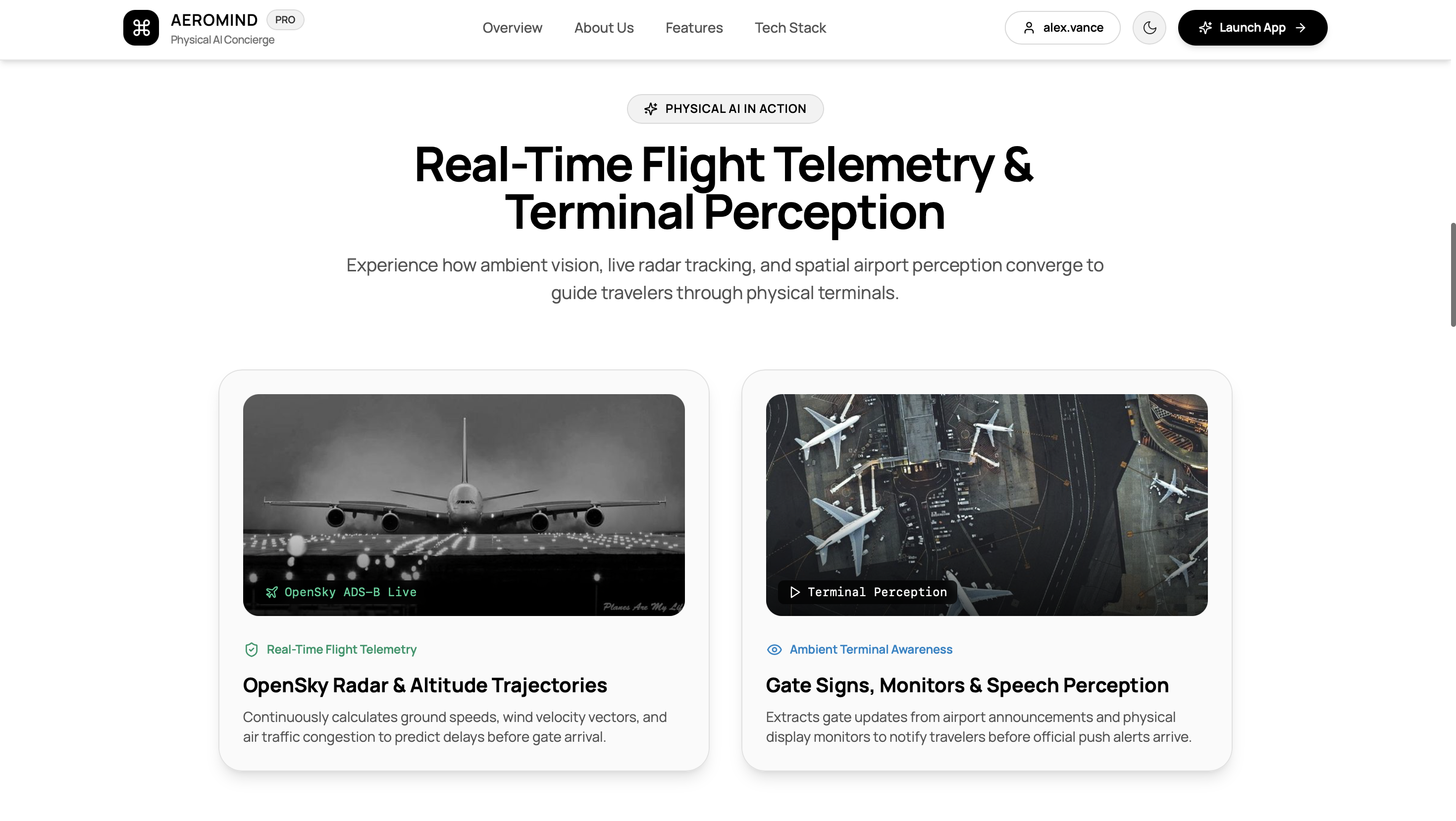
Our speciality
-
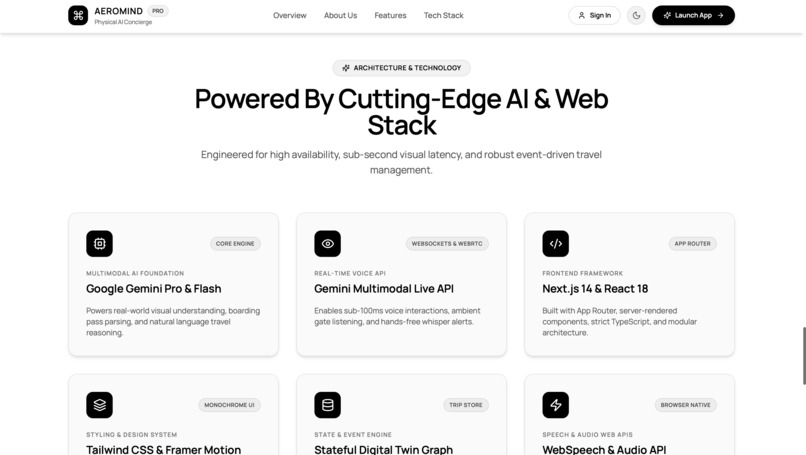
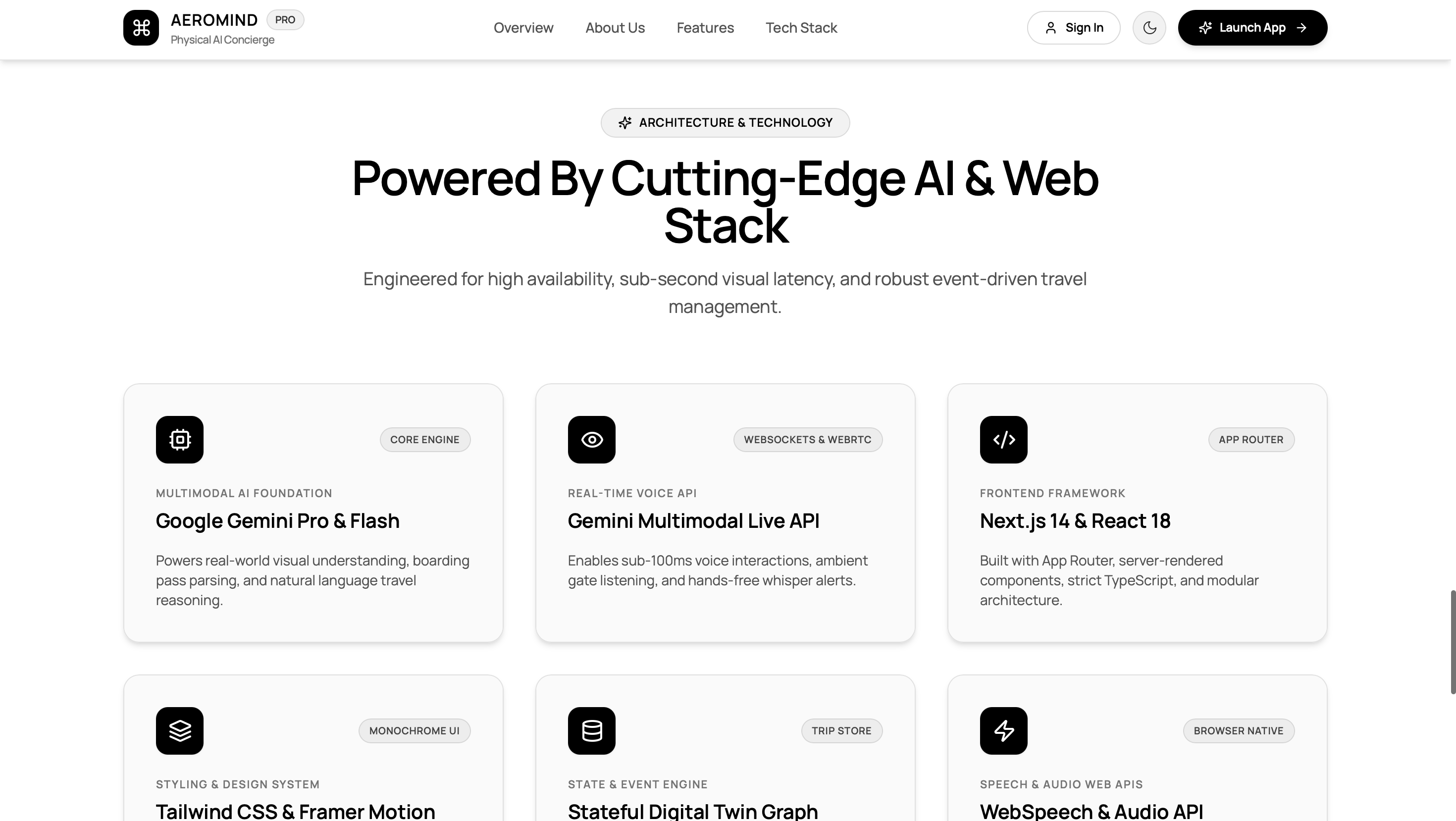
AeroMind's techstack
-
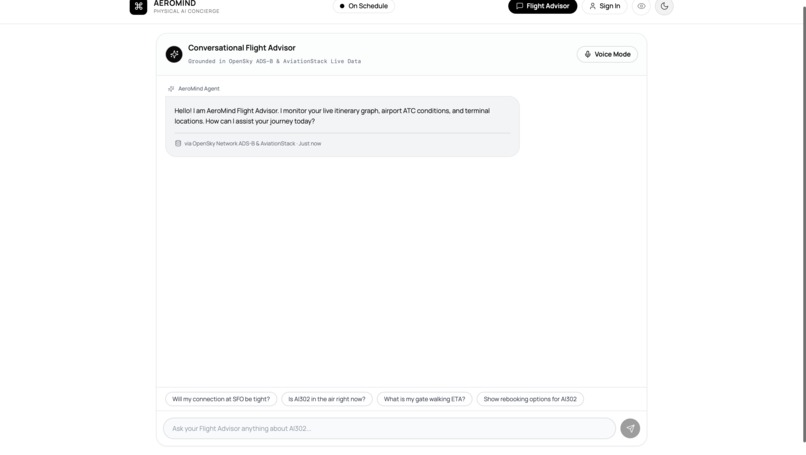
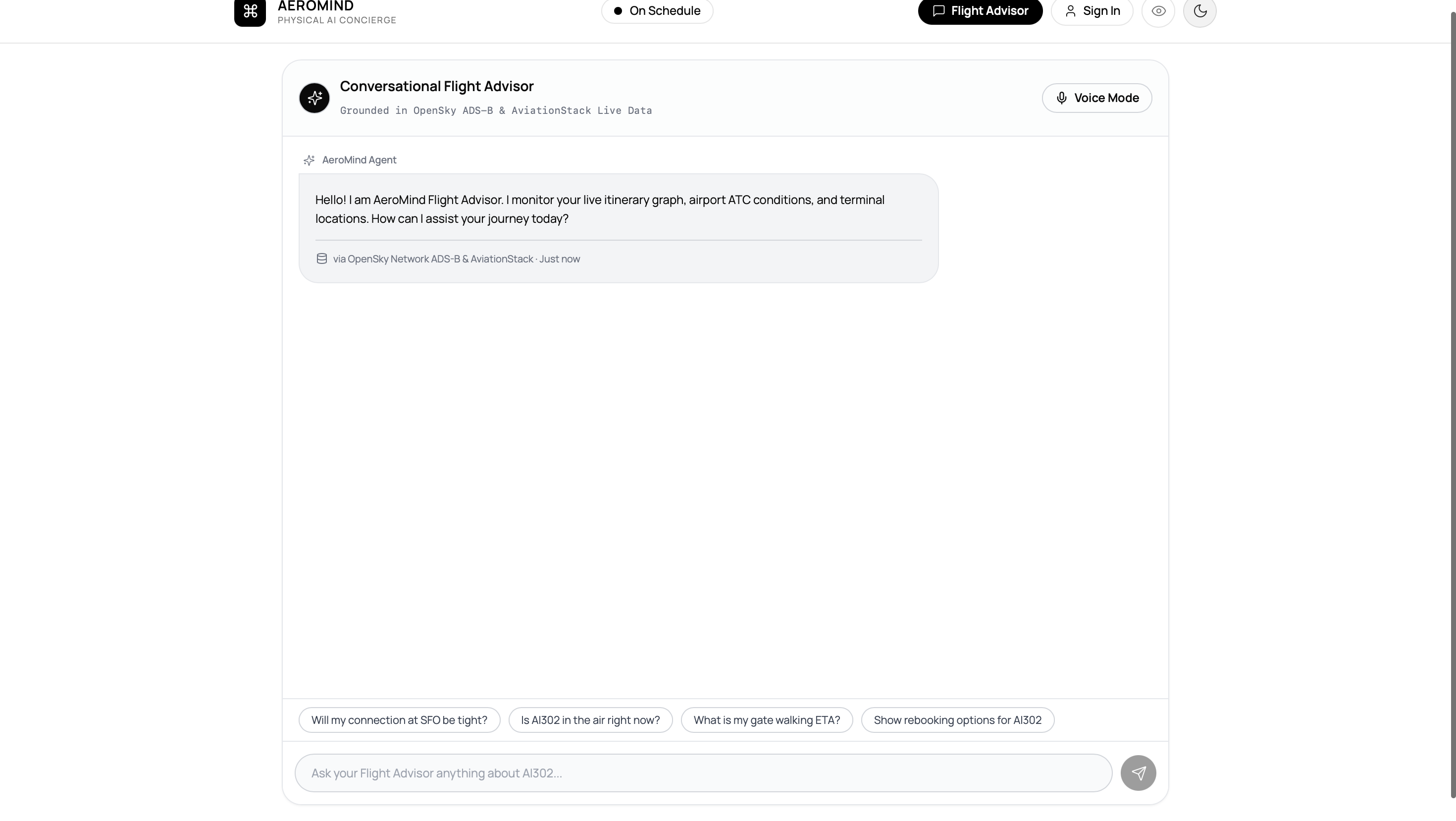
AeroMind AI bot
-
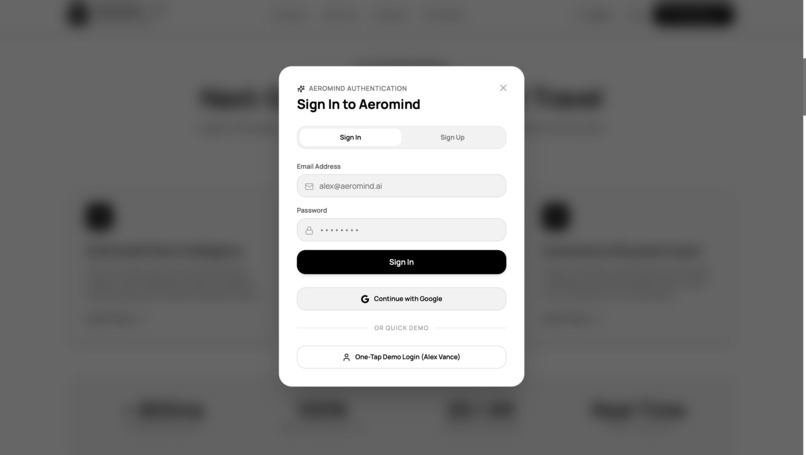
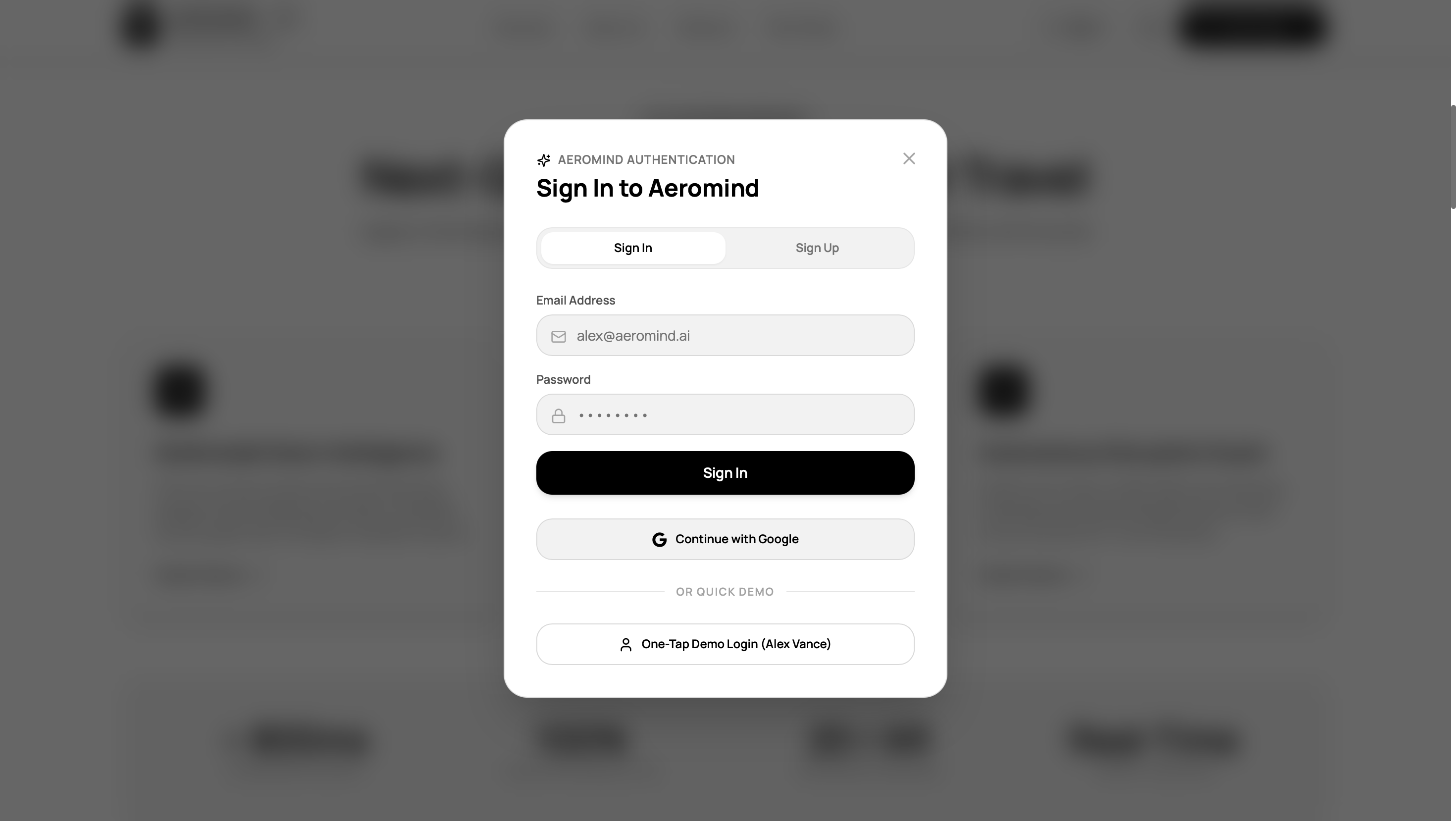
User login/ sign up page
AeroMind
Inspiration
Every frequent flyer knows the same story: a boarding pass in one app, a hotel confirmation in an email, a gate change buried in a push notification you didn't see, and a car rental you have to fix yourself when the flight above it slips. Airports are one of the last places where "smart" technology still means five disconnected apps and a stressed-out human doing the integration work in their head. We wanted to know what travel looks like if an AI agent actually owns the itinerary end-to-end — reading your documents, watching your flight before the airline says anything is wrong, and fixing the whole day (not just the one leg) with a single tap of approval. That question became AeroMind, built for the Gemini X Prize Hackathon as a "physical AI" concierge rather than another chatbot bolted onto a booking site.
What it does
AeroMind is a multimodal travel concierge that turns a trip into a living, connected graph instead of a pile of separate bookings:
- Boarding Pass & Document Vision Scanner — snap or upload a boarding pass and Gemini Vision extracts flight number, date, PNR, seat, and gate, auto-populating the itinerary.
- Real-Time Conversational Flight Advisor — a persistent chat/voice surface (
/advisor) that answers questions like "Will my connection be tight?" or "Is AI302 in the air?" with grounded, cited answers pulled live from OpenSky ADS-B data and AviationStack, not hallucinated guesses. - Predictive Disruption Score — a 0–100 risk score per flight leg, computed from live ATC congestion, weather severity, current delay minutes, and historical on-time performance, shown as an animated ring gauge that pulses once risk crosses 60.
- Digital-Twin Itinerary Graph — every trip is modeled in Firestore as dependency nodes (
dependsOn: flight → hotel → car → meeting). One disruption triggers a graph traversal that flags every downstream node as affected, not just the flight. - Autonomous Rebooking with Human Approval — the agent ranks alternative flights by cost, time, carbon footprint, and comfort, and proposes one consolidated re-plan across flight + hotel + car. Nothing is booked until the traveler taps "Approve."
- Gate-Change Whisper Alerts & Walking ETA — ambient voice nudges paired with a walking-ETA-vs-boarding-time countdown.
- AR Gate Compass — a camera overlay with a device-orientation-driven directional arrow for wayfinding through unfamiliar terminals.
- Post-Trip AI Journal — an auto-compiled, scroll-animated story of the trip generated from scanned documents and timeline events.
- Voice Navigation — tap-to-speak browser commands ("open the advisor", "scan my pass", "go to dashboard") routed instantly through the native Web Speech API against a fixed phrase grammar. Fully client-side: no AI call, no network round-trip, no latency.
- Voice Assistant — a push-to-talk spoken conversation, grounded in the same live flight data as the text advisor. Gemini Live is the primary provider; if the session fails to connect, it transparently falls back to the Deepgram Voice Agent API with the same audio pipeline and UI. Both providers can invoke live tool calls (
get_flight_status,search_flights) mid-conversation, and the panel shows which provider is currently live.
How we built it
The frontend is a React 18 + Vite + TypeScript single-page app styled with Tailwind CSS and Framer Motion, deliberately built around a strict monochrome (#0A0A0A / #FFFFFF) design system with Poppins typography — letting motion, weight, and iconography (Lucide) carry state instead of color badges. Firebase/Firestore backs authentication and the itinerary data model (users, trips, legs, events, rebooking proposals, and a shared flight-status cache).
On the AI side we run a dual-provider model: Gemini (gemini-3.1-flash-lite, via @google/genai) is the primary engine for both text reasoning and vision (boarding-pass parsing), with Groq (gpt-oss-120b for text, a Qwen vision model for fallback OCR) as an automatic failover so a single provider outage never breaks the demo. A small Express/TypeScript API server (server/) wraps flight search, live flight status, boarding-pass parsing, and the advisor chat endpoint behind this provider-abstraction layer, with request logging middleware for observability. The disruption score is a weighted formula — 0.40·ATC + 0.25·Weather + 0.20·Delay + 0.15·HistoricalOTP — computed independently in both the server and a Firebase Cloud Functions layer intended for background polling. A unified flight adapter implements a three-tier fallback chain (shared cache → live API → mock fixtures) so the app degrades gracefully instead of crashing when external flight APIs are rate-limited or unreachable.
Voice is split into two deliberately independent systems. Voice Navigation (src/lib/voiceNav/) is pure client-side command routing — the browser's native SpeechRecognition transcript is matched against a keyword grammar (commands.ts) and dispatched either as a react-router-dom navigation or an in-page action via a small action bus, with zero AI involvement. Voice Assistant (src/lib/voice/) is a real spoken conversation: voiceAssistantOrchestrator.ts first tries the Gemini Live API (ai.live.connect() from @google/genai, 8s connect timeout) and, on failure, transparently retries against the Deepgram Voice Agent API (@deepgram/sdk) over the same audio pipeline and UI. Provider API keys never reach the browser — the client calls POST /api/voice/token (server/src/lib/mintVoiceToken.ts), which exchanges the real GEMINI_API_KEY/DEEPGRAM_API_KEY for a short-lived, single-use token (a 60s-window authTokens.create() for Gemini, a 60s-TTL JWT via Deepgram's /v1/auth/grant) before the browser opens the provider WebSocket directly. Both voice providers share the same function-calling tool declarations and the same flight-status/search backend routes as the text advisor, and are instructed to disclose mock-fixture data as demo data rather than presenting it as live.
Challenges we ran into
- Grounding an LLM in real-time data without letting it hallucinate. The Flight Advisor needed every answer to be traceable to an actual tool call and timestamp, not a plausible-sounding guess — this shaped the function-calling schema (
get_live_flight_status,search_alternative_flights,propose_rebooking,approve_rebooking,get_walking_eta) from the start. - Making disruption cascade correctly. A delay on one flight leg has to propagate through the
dependsOngraph to hotel and car nodes without over- or under-triggering — tuning the graph traversal and the 60-point alert threshold took iteration. - Free-tier API reliability. OpenSky and other open flight-tracking sources have rate limits and coverage gaps, which pushed us toward the shared Firestore flight cache and the multi-tier fallback-to-mock-fixtures design so a hackathon demo never dies on a flaky third-party API.
- Keeping "autonomous" actually safe. An agent that can rebook flights is powerful and risky — we had to draw a hard line so the agent can search and propose on its own but never execute a booking without an explicit one-tap human approval.
- Provider failover under time pressure. Wiring Gemini as primary with Groq as a silent fallback for both text and vision meant handling partial failures (empty responses, bad keys, timeouts) without surfacing broken UI mid-demo.
- Real-time voice without leaking secrets. A spoken conversation needs the browser to hold a live WebSocket to Gemini Live or Deepgram directly (no server relay for audio latency reasons), but the raw provider API keys can never touch client code. That forced an ephemeral-token minting flow — the server exchanges a real key for a single-use, 60-second token per session — adding real security-engineering surface to what looked like a "just add voice" feature.
- Two voice systems that must never be confused. Tap-to-speak navigation ("open the advisor") and push-to-talk conversation ("will my connection be tight?") both live in the mic UI, so keeping Voice Navigation (instant, client-only, zero AI) cleanly separate from the Voice Assistant (AI-grounded, provider-backed) — in code, in UX, and in latency expectations — took a deliberate architectural split rather than one blended "voice mode."
Accomplishments that we're proud of
- A genuinely multimodal agent — vision (document scanning), conversational reasoning grounded in live data, and physical-world context (AR wayfinding, walking ETA) — rather than a single chat window wrapped around a prompt.
- The digital-twin itinerary graph, which reframes disruption recovery as a whole-day re-plan (flight + hotel + car in one approval) instead of three separate broken bookings the traveler has to fix manually.
- A resilient architecture with automatic AI-provider failover and a tiered data-fallback chain, so the demo stays stable even when external services aren't.
- A working spoken-conversation Voice Assistant with Gemini Live as primary and automatic Deepgram fallback — including a proper ephemeral-token flow so no provider key is ever exposed to the browser — alongside a completely separate, zero-latency Voice Navigation layer for instant browser commands.
- A distinctive, consistent monochrome design system with real motion and typographic craft, executed across every screen instead of a handful of hero shots.
- Shipping a working end-to-end slice — scan → live status → predictive risk → proposed rebooking → approval — in hackathon time.
What we learned
- Human-in-the-loop approval isn't a UX afterthought for an agentic system — it's the core trust mechanism that makes autonomous booking acceptable at all.
- Designing for graceful degradation (cache → live → mock) early made every other feature easier to demo and debug, because no downstream component ever had to special-case "the API is down."
- A strict, opinionated design system (no accent colors, one typeface) is a force multiplier for a small team — it removes an entire category of decisions and still reads as polished.
- Grounding matters more than model choice: citing the data source and timestamp behind every AI answer builds more user trust than a marginally better model would.
What's next for AeroMind
- Move from push-to-talk to proactive voice: let the Gemini Live session interject unprompted ("your gate just changed") instead of only responding when the mic is held.
- Expand the voice tool-calling surface beyond
get_flight_status/search_flightsto cover rebooking proposals and approval, so a trip can be re-planned entirely by voice. - Move disruption polling into Cloud Scheduler + Pub/Sub for true background monitoring even when the app is closed, rather than client-triggered checks.
- Real AR indoor wayfinding using Gemini Vision to read wall signage as anchor points, paired with Google Maps Platform indoor routing.
- Co-traveler sync for group trips, with shared live maps and divergence alerts ("your companion is stuck at security").
- Carbon- and comfort-aware ranking refinements, plus an airport crowd/security-wait predictor for personalized "leave by" recommendations.
- Offline-first Firestore persistence so the itinerary and last-known flight status stay usable in airport dead zones.
- Real payment/booking-API integration behind the existing approval gate, moving from proposal-only to fully executed rebooking.


Log in or sign up for Devpost to join the conversation.