-
-
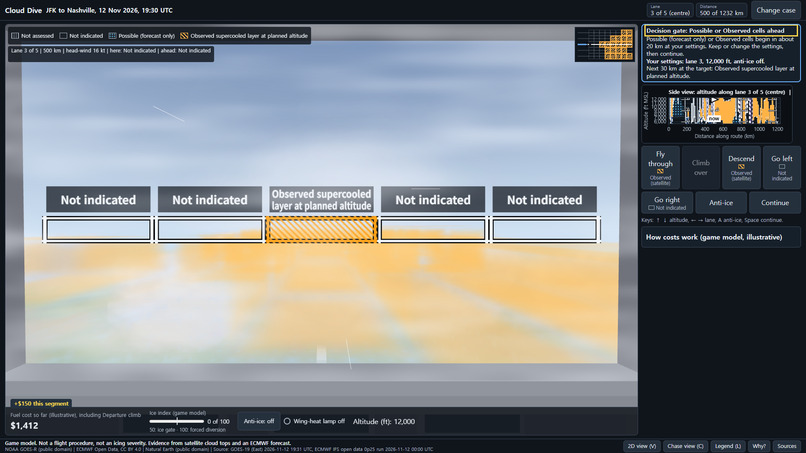
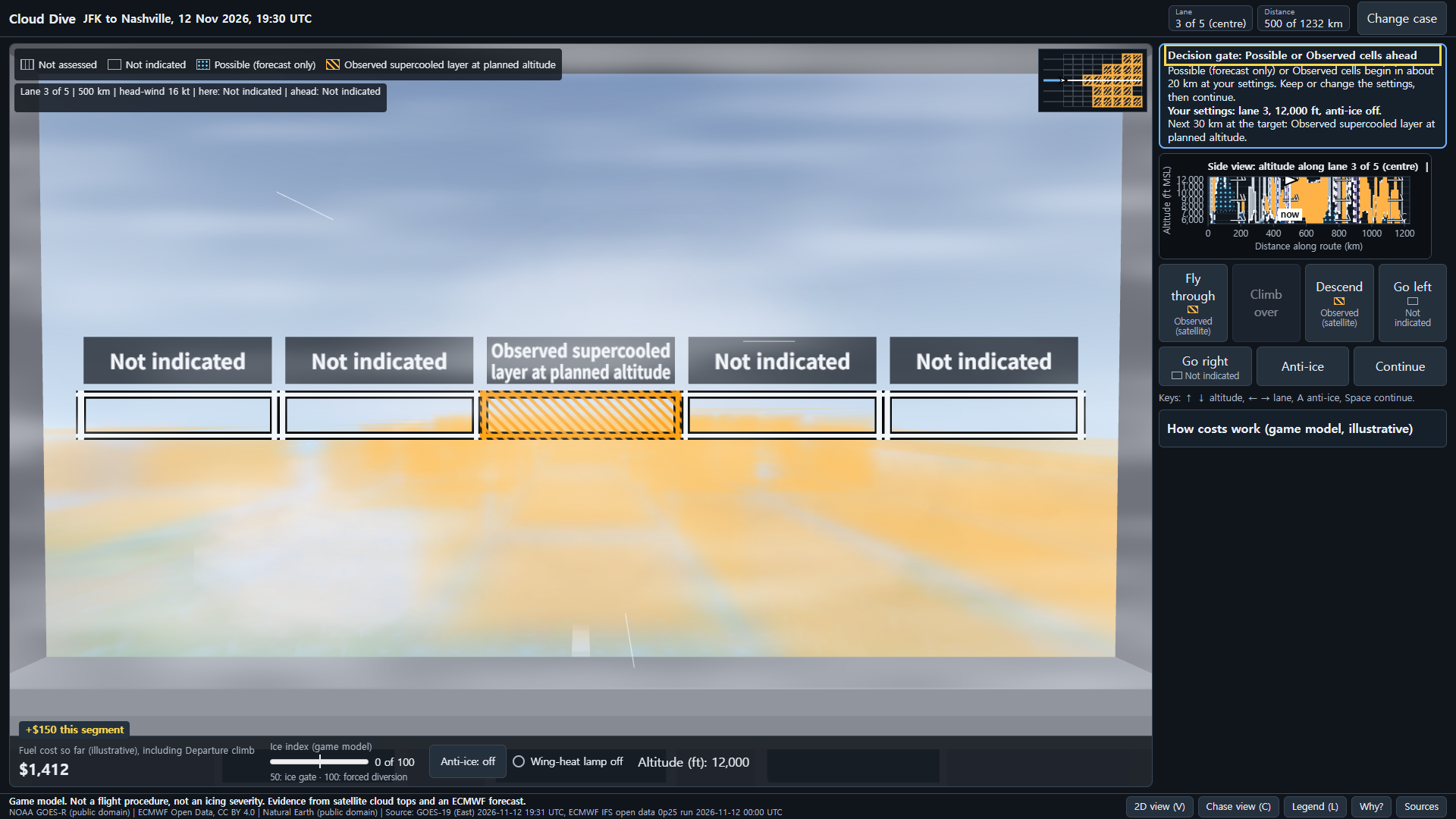
Decision gate in the 3D cockpit: five lanes ahead, each labelled with its evidence level, each choice with a dollar price.
-
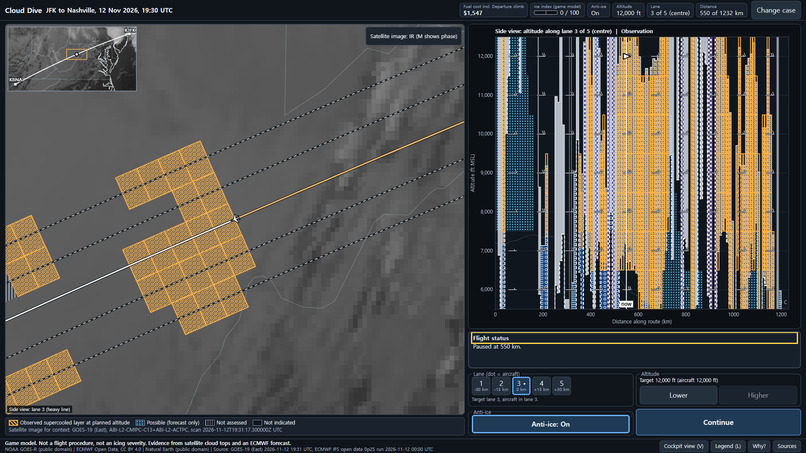
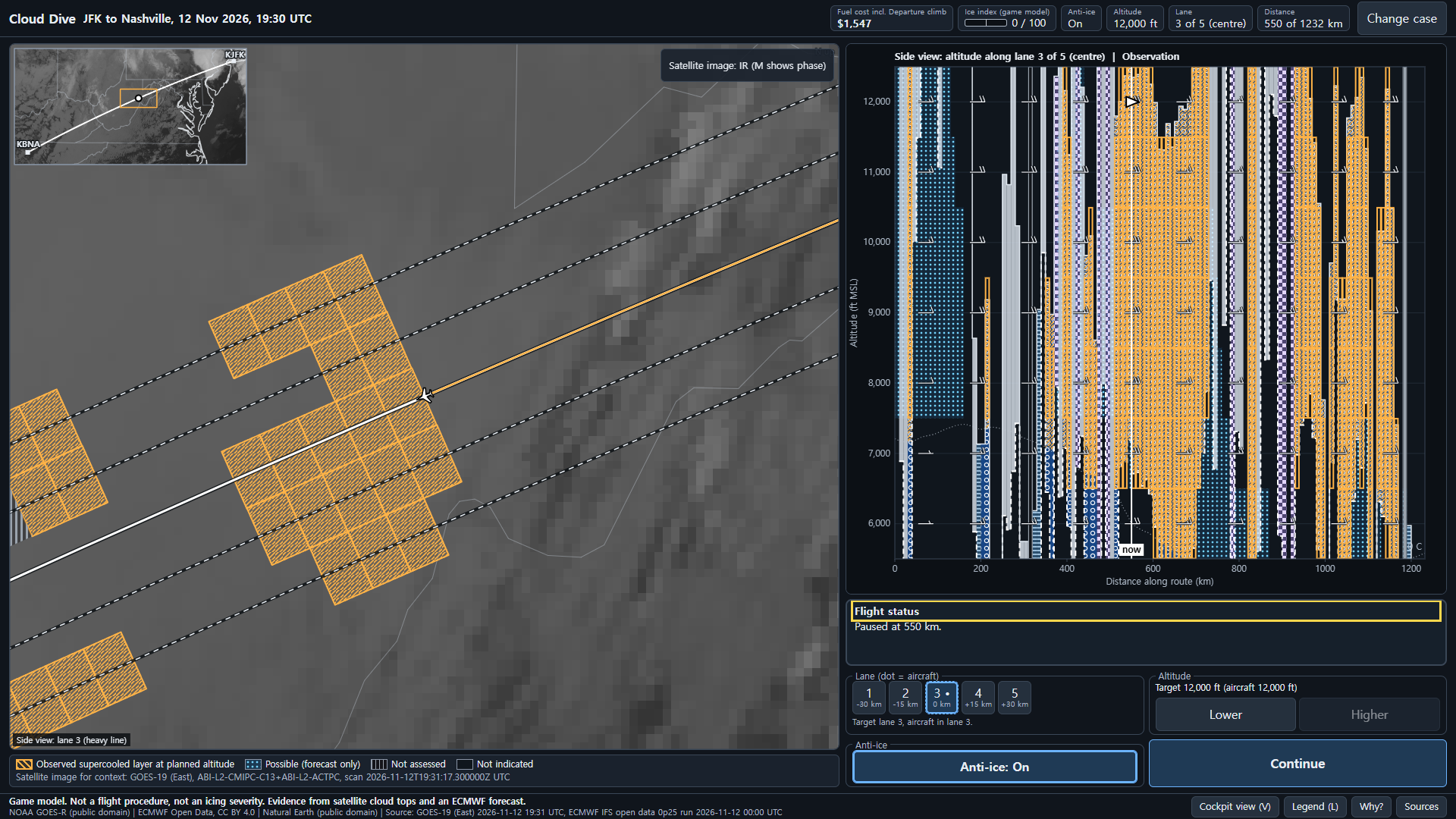
Map view: GOES-19 infrared image with the flight lanes and the observed layer cells. Side view shows altitude.
-
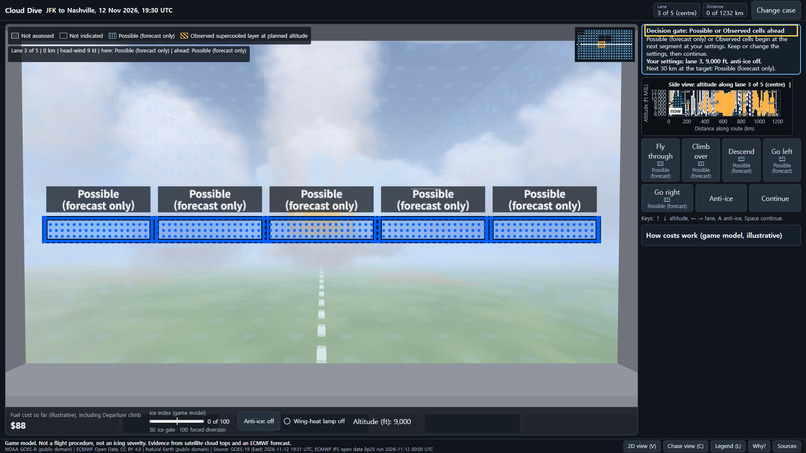
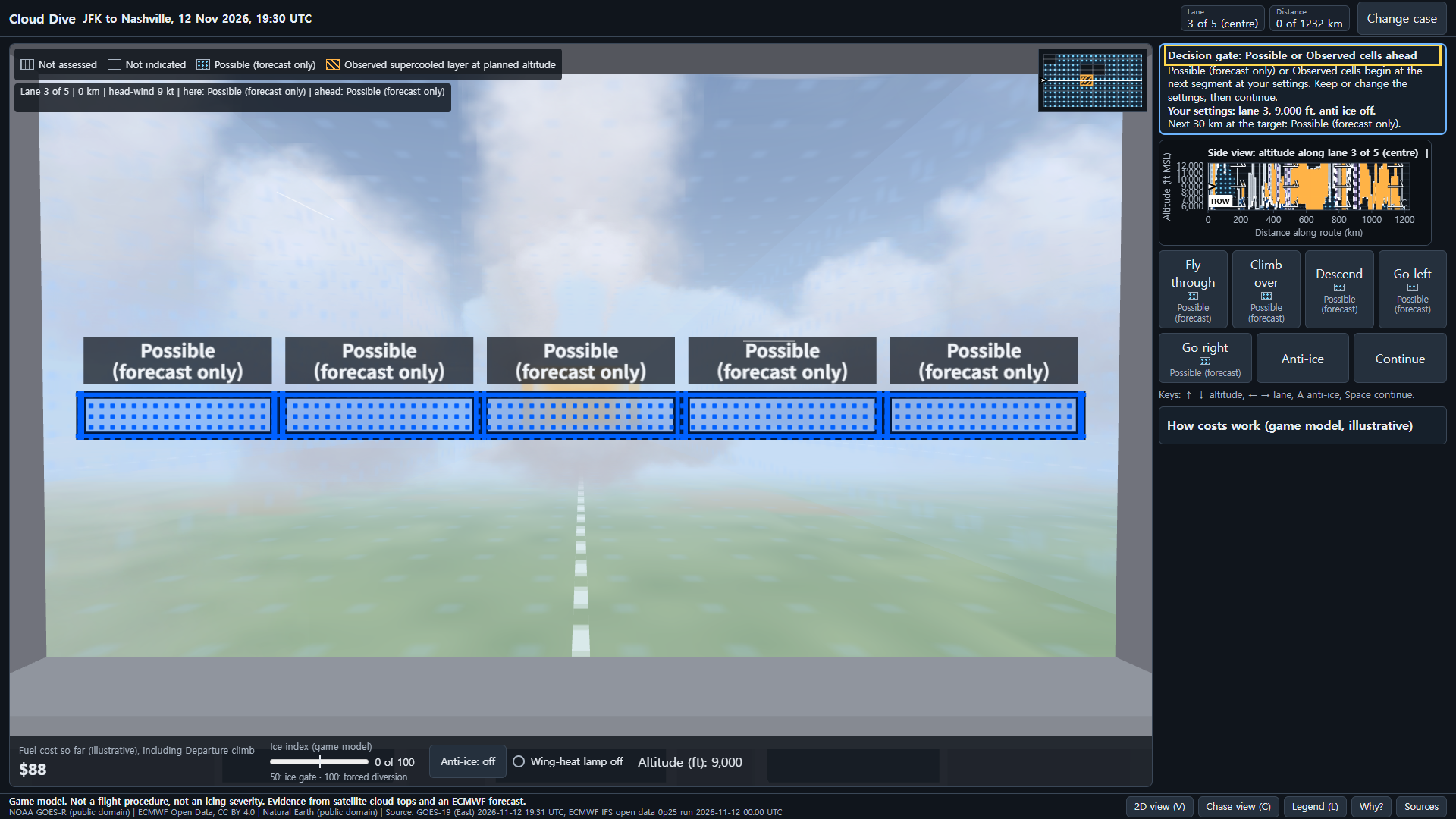
First gate on JFK to Nashville: forecast-only cells ahead. Lane, altitude and anti-ice set before continuing.
-
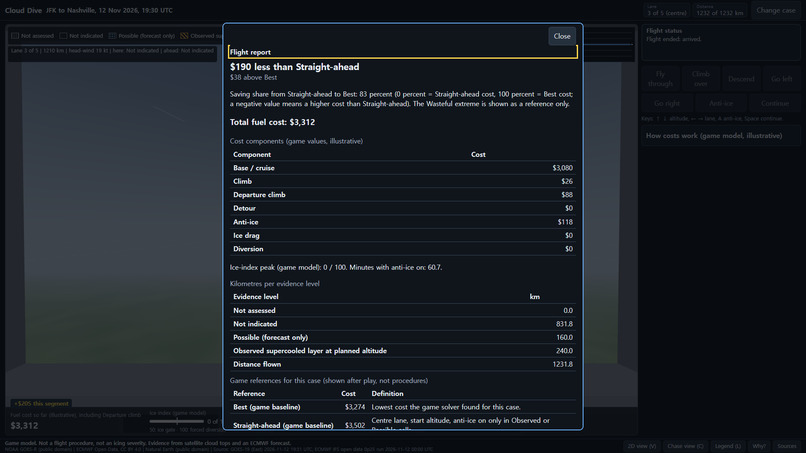
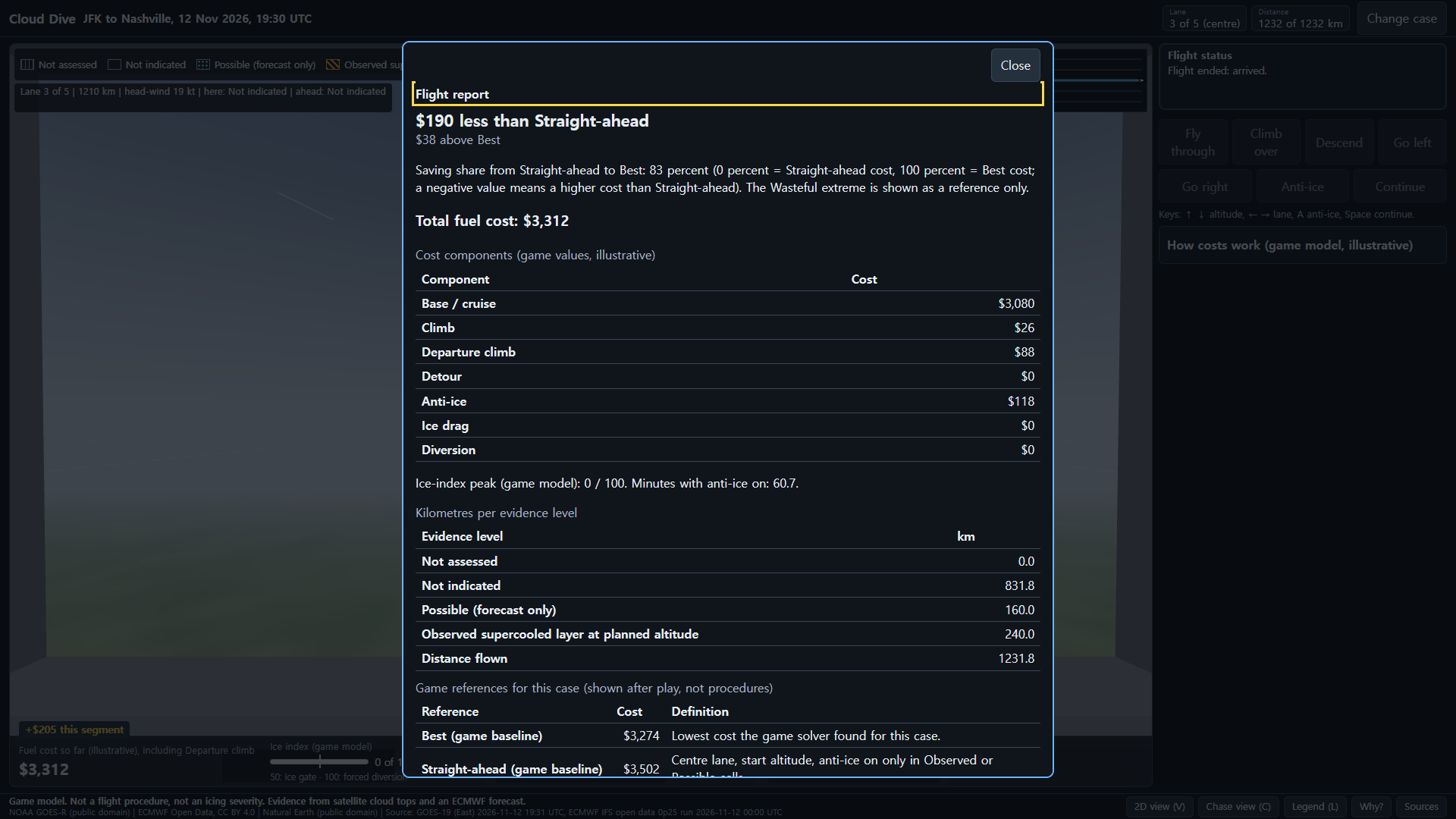
Flight report: $3,312 total fuel cost, $190 less than Straight-ahead, $38 above Best. Cost parts and kilometres per evidence level.
Inspiration
Icing matters to flights, and avoiding it costs money: a longer path, a climb, or anti-ice fuel. The data that hints at icing is public, but it is easy to say more than it supports. A geostationary satellite sees only the top of the highest cloud. A cloud base from a statistical method is an estimate. A forecast rule is not an observation. We wanted a game that is fun to play and honest about each of these limits.
What it does
Cloud Dive is a fuel-cost game on real data. A regional jet flies a real route on a real day, for example New York (KJFK) to Nashville (KBNA) on 12 November 2026 at 19:30 UTC, through cloud measured by GOES-19 and an ECMWF forecast.
- Cruise fast-forwards until the route approaches a cell with Possible (forecast only) or Observed supercooled layer at planned altitude evidence. Then the game stops at a gate.
- At a gate you choose lane, altitude and anti-ice. Each choice shows the evidence ahead at the settings it would set. A choice's cost is not shown before you make it, and no choice is recommended.
- Costs follow stated game rules (illustrative values): every kilometre burns fuel, a climb costs climb fuel, a lane change makes the path longer, anti-ice costs fuel per kilometre, and flying on without it raises a game ice index that adds drag. At 50 the game stops at an ice gate; at 100 the flight ends in a diversion.
- The report itemizes the cost and compares it with three game references computed by an exact solver. After the flight only, it replays Best (game reference, not a procedure) gate by gate next to your flight.
- Hot-seat play lets several people fly the same day on one device.
Under the game sits a deterministic evidence engine: it reads GOES cloud-top height, phase, optical depth and particle size, estimates the cloud base (Noh et al. 2017), corrects for parallax, and labels each route cell with one of four levels: Observed supercooled layer at planned altitude, Possible (forecast only), Not indicated, Not assessed. No language model, no randomness and no network call take part in the decision. Each case is pre-computed into one static file, so the game needs no backend. The same engine feeds a dispatcher cross-section view in the repository.
How we built it
- Data build (Python, offline): GOES-R ABI Level-2 products and ECMWF Open Data are sampled along five lanes of a corridor, turned into evidence cells, cost tables (OpenAP) and solver references, and written into one case file per day (KJFK-KBNA: 4,375 cells, 124 KB).
- Game (vanilla JavaScript, no build step): a pure engine checked against the Python reference (parity test), a 2D view, and a three.js cockpit with takeoff, climb, cruise, gates and the report.
- Kiro: one spec with 25 requirement groups and 36 correctness properties, steering for the science rules, six hooks, a custom wording agent in Kiro IDE and Kiro CLI, the Playwright MCP server and the BrowserStack power. Details are in "How Kiro was used".
Challenges we ran into
- Saying only what the data supports. A word list catches the banned terms, but not a sentence that presents a forecast-only cell as icing evidence. A custom agent now reviews the prose files the word test does not scan.
- Gates that re-fired. Stating a correctness property showed that a gate fired at every step while approaching a cloud; the spec now announces each entry once.
- Phones. The gate buttons sat below the fold on a phone, and on a real Galaxy S25 Ultra the Continue button sat 6 pixels below it after the climb. Both were found by tools, not by eye.
- Recording the demo honestly. The video takes are played with real key presses and clicks. That found a bug: after a mouse click on a gate button, the keyboard stopped working.
Accomplishments that we're proud of
- The Best reference replays to its stored cost on every case, and the JavaScript engine matches the Python reference on two of the three cases over 60 random scripts each (dollars to 1e-9 relative).
- A property test found a real counterexample (a caption splitter that broke its two-line promise) before the final video.
- 323 Python tests and 265 Node tests pass (2026-11-19; re-run on the frozen build). The cockpit view held about 60 frames per second, the limit of the 60 Hz display, measured on one desktop PC.
What we learned
Put the rules where the code is. A steering file that loads with the game code, a hook set up to run the wording test on save, and an agent that reads the prose turned "be careful with the wording" into checks that run without anyone remembering them. Writing properties into the design found gaps before any test ran.
What's next
More case days and routes, and an evaluation of the evidence levels against independent reports before any claim beyond "evidence" is made.
Limits
Game model. Not a flight procedure, not an icing severity. The ground is flat. The ice index is a game state, not an icing model. Costs are illustrative. The corridor and lanes are illustrative, not airways. Frame rate was measured on one desktop PC. Accuracy has not been evaluated.
Built With
- blender
- browserstack
- canvas
- ecmwf
- ffmpeg
- github
- goes-18
- goes-19
- hypothesis
- javascript
- kiro
- netcdf4
- numpy
- playwright
- pyproj
- python
- three.js
