OMNI AI: Omni-Agentic Intelligent Automation System
Inspiration
The inspiration behind OMNI AI was to develop an intelligent automation platform that could bring multiple AI capabilities together in one place. People often use different applications for learning, scheduling, task management, communication, financial organization, and engineering projects. I wanted to explore how a centralized AI system could simplify these activities by coordinating specialized AI agents through a master orchestrator. My vision was to create a practical, scalable, and user-friendly solution that demonstrates the potential of multi-agent AI systems in everyday life, education, productivity, and engineering.
What I Built
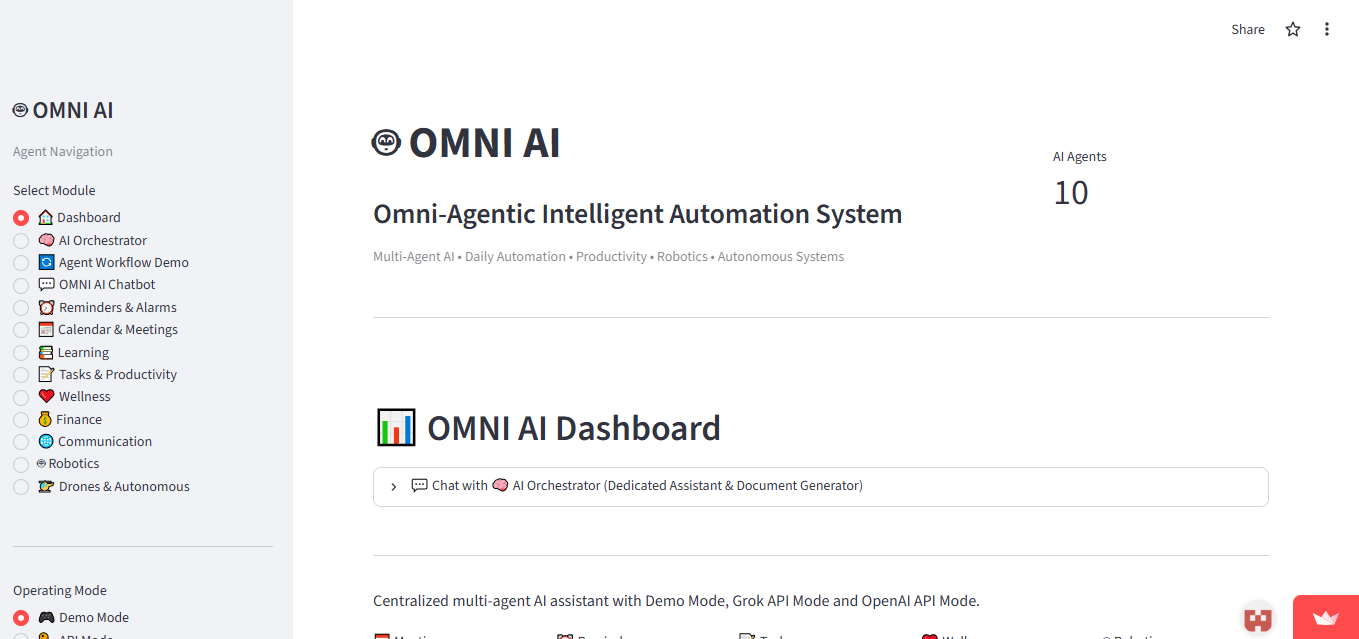
I developed OMNI AI, an Omni-Agentic Intelligent Automation System, using Python and Streamlit. The platform features a central AI Orchestrator that analyzes user requests and routes them to specialized agents. Its 10-agent architecture includes the AI Orchestrator, Daily Reminder Agent, Health and Wellness Agent, Calendar and Schedule Agent, Learning and Education Agent, Productivity and Task Agent, Finance and Expense Agent, Information and Communication Agent, Robotics Agent, and Drones and Autonomous Systems Agent.
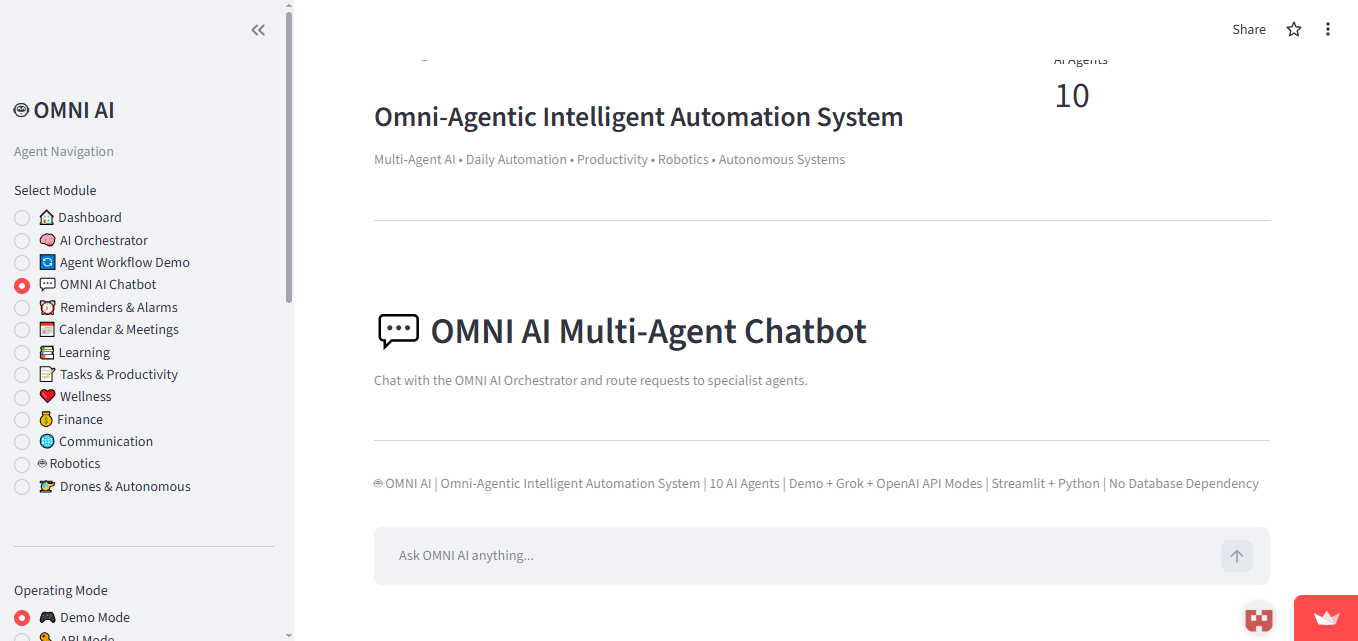
The application supports both Demo Mode and API Mode, allowing users to explore the agentic workflow without an API key or connect to an external AI service using a configured API key. Its capabilities include chatbot interaction, task organization, scheduling, reminders, study planning, expense tracking, communication drafting, robotics project planning, and autonomous drone system design.
How I Built the Project
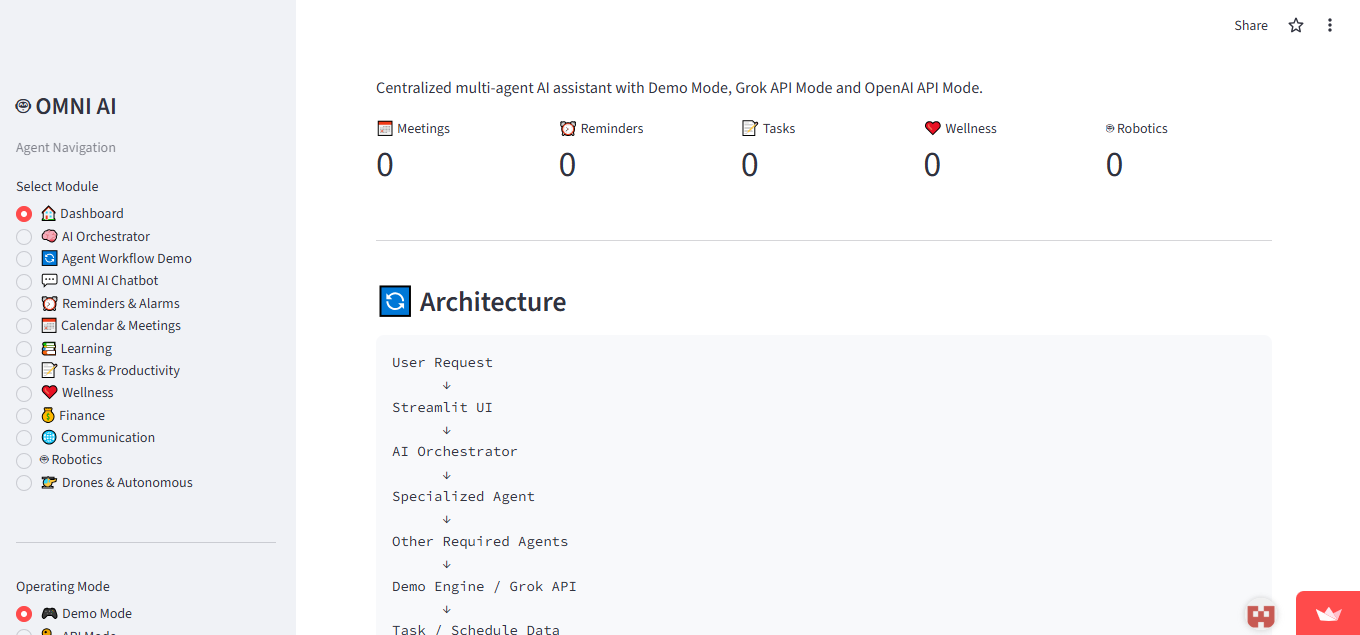
I built OMNI AI using Python for the application logic and Streamlit for the interactive web interface. I designed the system around a master orchestrator and specialized agents, using keyword-based request detection to select the appropriate agent. I integrated API communication to support AI-generated responses and developed a demo engine to showcase workflows without requiring an external API connection.
I used Streamlit Session State to manage temporary application data, Requests for API communication, and Streamlit Autorefresh to support periodic notification checks. I also prepared the project structure, dependencies, configuration for API secrets, and deployment workflow for GitHub and Streamlit Community Cloud. Security was an important consideration, particularly keeping API credentials out of public source code.
Challenges I Faced
One of the main challenges was designing a unified interface for different tasks while keeping the system modular and understandable. Each specialist agent needed to support a distinct category of requests, while the central orchestrator had to route those requests to the most relevant agent. Implementing keyword-based routing also highlighted the limitations of simple detection when user requests are ambiguous or contain multiple objectives.
Another challenge was supporting both demo and API modes while maintaining a consistent user experience. I also had to consider temporary data storage, notification timing, API configuration, and secure deployment. Since the current version stores application data primarily in Streamlit Session State rather than a persistent database, maintaining information across sessions remains an area for future improvement.
What I Learned
Building OMNI AI strengthened my understanding of multi-agent architecture, request routing, API integration, Python application development, and Streamlit deployment. I learned how a central orchestrator can coordinate specialized agents and how modular design makes a complex application easier to extend and maintain.
I also learned that building an effective AI application involves more than connecting an API. It requires thoughtful workflow design, reliable handling of user requests, secure credential management, clear user interaction, and realistic evaluation of what the system can currently do. The project helped me identify opportunities for more advanced agent coordination, persistent storage, retrieval-augmented generation, and external service integration.
Future Improvements
My next goal is to evolve OMNI AI into a more capable automation platform by introducing persistent database storage, advanced multi-agent collaboration, retrieval-augmented generation, and integrations with tools such as email, calendars, and workflow automation services. I also envision expanding its robotics and drone capabilities through IoT connectivity, telemetry, and external APIs, with appropriate safety controls and human oversight.
These improvements would help move OMNI AI from a demonstration of agentic workflows toward a more robust platform for practical intelligent automation.
Conclusion
OMNI AI represents my effort to explore how multiple specialized AI agents can work together through a centralized intelligent system. This project was not only an opportunity to build a functional application but also a valuable learning experience in AI orchestration, software engineering, and intelligent automation. My ultimate goal is to make AI more accessible and useful by bringing diverse capabilities together in one unified platform.
Project: OMNI AI
Team: AI MARKHORS
Team Leader: Engr. Bilal Mehmood
Team Member: Engr. Aqsa Zehra
Domain: Agentic AI
Year: 2026
© 2026 Engr. Bilal Mehmood / AI MARKHORS. All rights reserved.
Built With
- grokaiapi
- openaiapi
- python
- streamlit


Log in or sign up for Devpost to join the conversation.