-
-
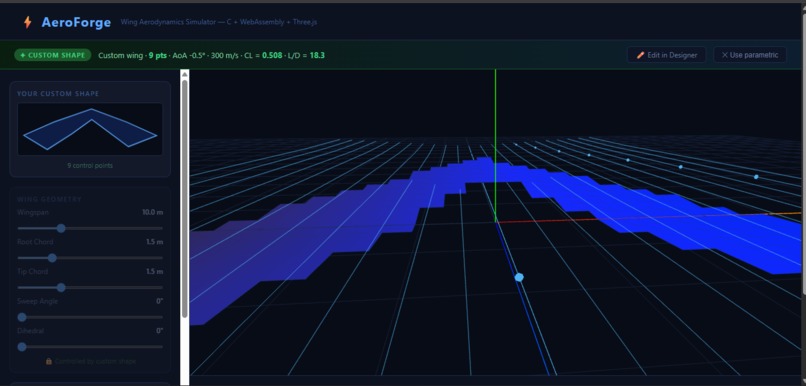
First wing simulation
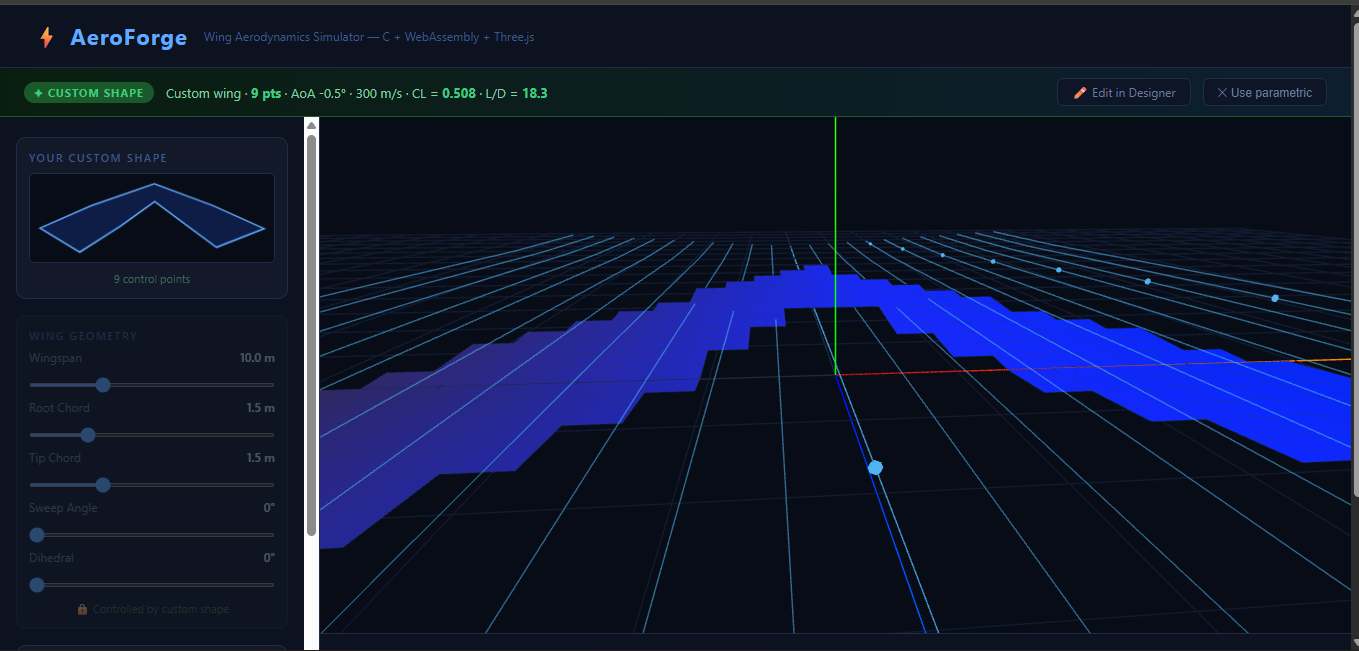
Inspiration
Aircraft aerodynamics is a fascinating part of engineering, but learning it practically can be difficult. Professional aerodynamic simulation software can be expensive, complex, and demanding in terms of computing resources. For students, especially those working with limited hardware and infrastructure, this creates a barrier between learning aerodynamic theory and actually experimenting with aircraft designs.
I wanted to build something different: a tool where an engineering student could open a browser, design a wing, run a simulation, and immediately see how their design performs.
That idea became AeroForge.
What We Built
AeroForge is a browser-based aerodynamics simulator focused on aircraft wing analysis.
The current system allows users to work with wing geometry and run aerodynamic calculations using a Vortex Lattice Method (VLM) solver implemented in C. The computational engine is compiled to WebAssembly, allowing the aerodynamic calculations to run as part of a modern web application.
The goal is to create an interactive environment where students can experiment with aerodynamic parameters rather than simply reading theoretical equations or relying on precomputed examples.
The simulation produces important aerodynamic metrics such as:
- Lift coefficient ($C_L$)
- Drag coefficient ($C_D$)
- Lift-to-drag ratio ($L/D$)
- Wing and simulation parameters
A backend service also provides the infrastructure required to connect the simulation workflow with the web application and manage project data.
How We Built It
The aerodynamic computation forms the core of AeroForge.
The VLM solver was written in C because the project is intended to combine computational efficiency with the ability to reuse the same physics engine across different environments.
The C-based solver is compiled to WebAssembly, allowing it to interface with the browser without requiring students to install traditional engineering simulation software.
The broader application uses web technologies and a Node.js backend, with MongoDB Atlas used for data persistence.
The development workflow also incorporates Agent Orchestrator (AO) to help break the engineering work into tasks, delegate implementation work, review changes, and iterate on the system.
This was particularly useful because AeroForge combines several different areas of engineering: numerical computation, systems programming, WebAssembly, backend development, and frontend visualization.
Challenges
One of the biggest challenges was connecting a numerical aerodynamic solver written in C with a browser-based application.
The problem was not simply implementing the equations. The complete system needed to move information between the wing-design interface, the backend, the simulation engine, and the results displayed to the user.
Debugging this interaction required understanding both the underlying aerodynamic calculations and the software architecture around them.
Another challenge was keeping the project focused. AeroForge can potentially grow into a much larger platform involving machine learning, AI-assisted design, and accelerated simulation. Building everything simultaneously would make the project unnecessarily complex, so we focused first on establishing a working physics-based simulation foundation.
What We Learned
Building AeroForge has required learning across multiple layers of engineering.
We learned more about:
- Vortex Lattice Methods and aerodynamic modelling
- Numerical computation in C
- Compiling C applications to WebAssembly
- Browser-to-WASM integration
- Backend API architecture
- MongoDB data persistence
- Connecting multiple software components into one workflow
- Using AI agents as part of an engineering development process
One of the biggest lessons was that building a scientific application is not only about getting the equations right. The surrounding software architecture, data flow, testing, and user experience are equally important.
What's Next
AeroForge is being developed toward an AI-assisted aerodynamic design platform.
The next stage is to use the VLM solver to generate aerodynamic training data and develop a machine-learning surrogate model capable of providing much faster predictions. An AI advisory layer could then help students interpret simulation results and suggest potential design improvements.
The long-term vision is to combine physics-based simulation, machine learning, and AI assistance into a single educational platform that makes computational aerodynamics more accessible to students, particularly in resource-constrained environments.
For this hackathon, however, the focus is on the foundation: building a working browser-based aerodynamic simulation system and using Agent Orchestrator to accelerate the engineering workflow.
Built With
- agent-orchestrator
- atlas
- c
- css
- express.js
- html
- javascript
- mongodb
- node.js
- vortex-lattice-method
- webassembly


Log in or sign up for Devpost to join the conversation.