-
-
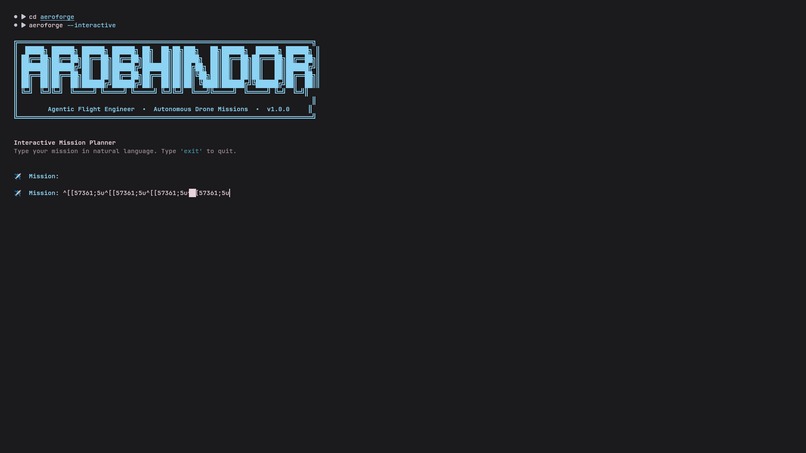
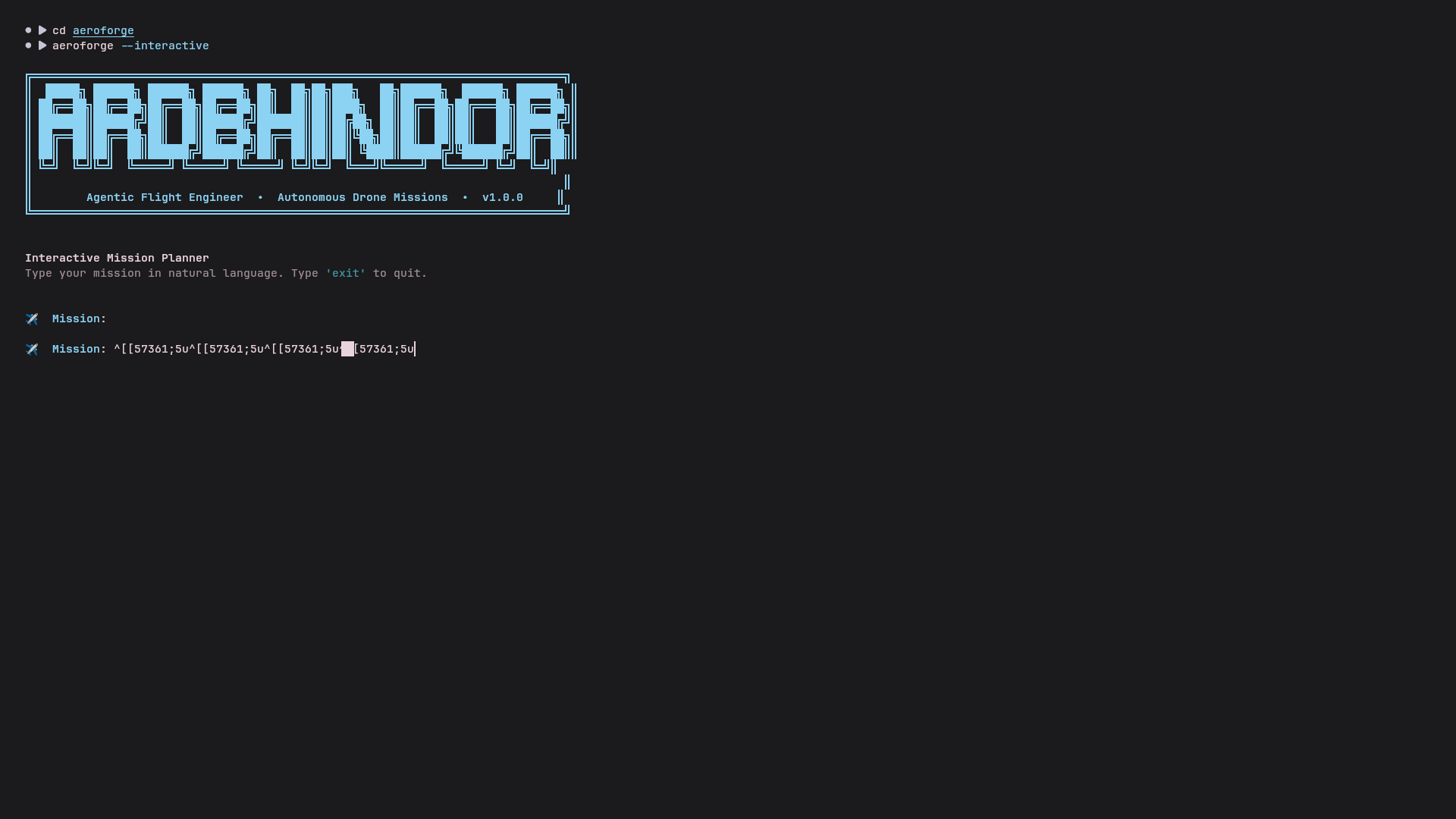
this is the interface of the cli agent
-
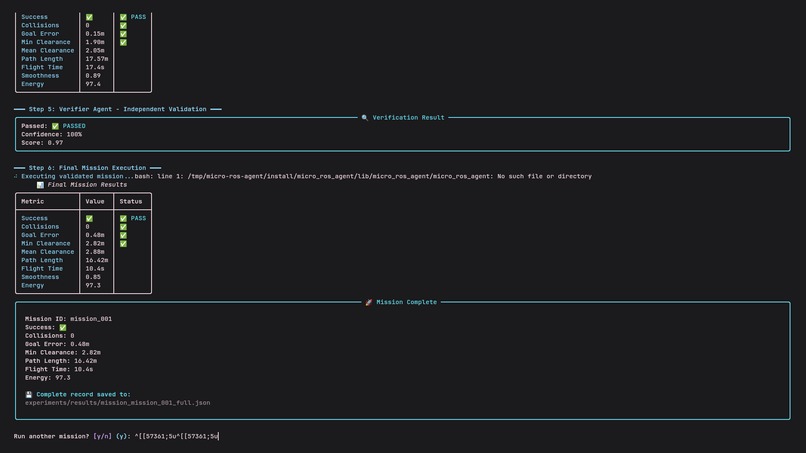
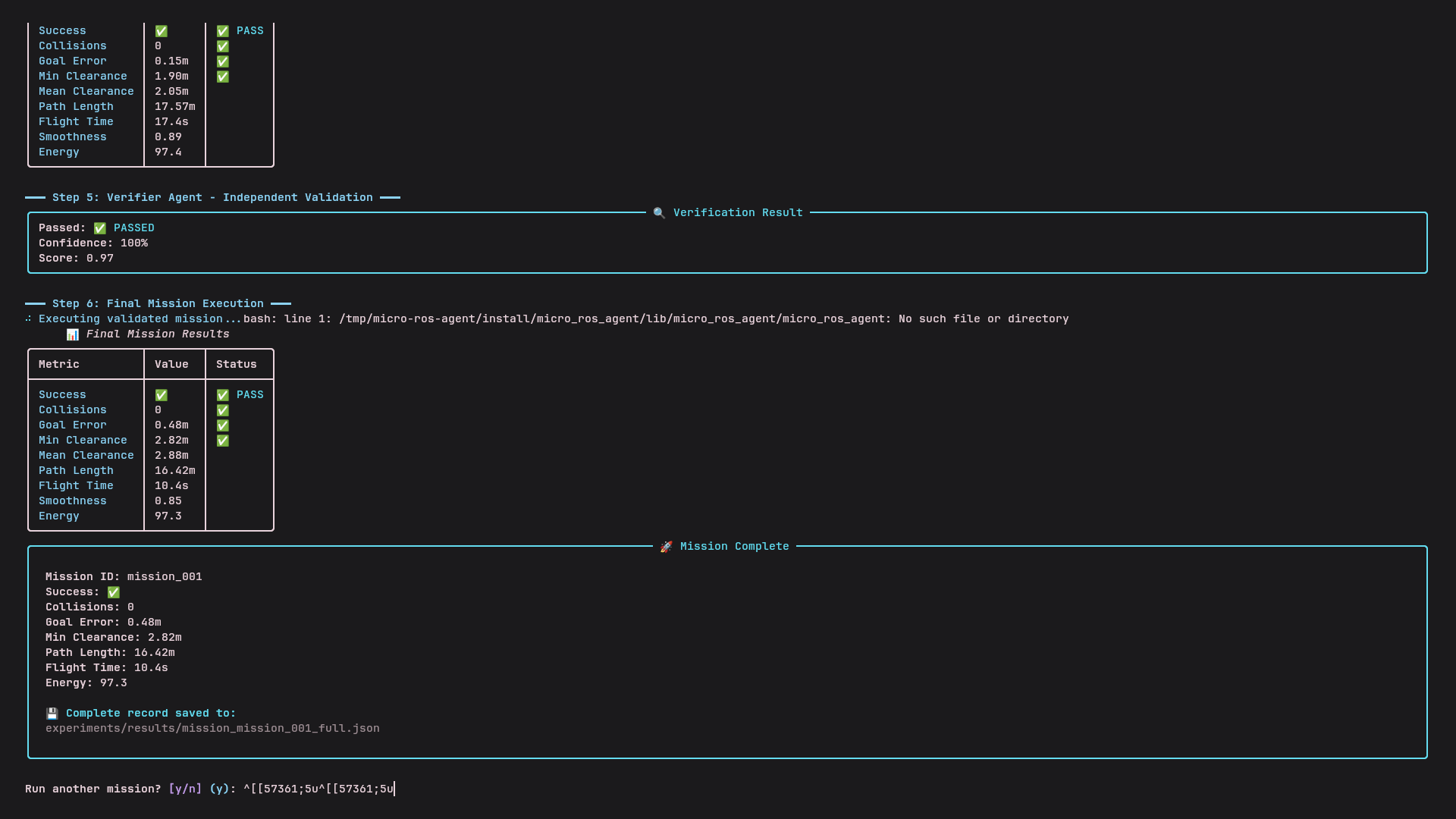
results from the simulation
-
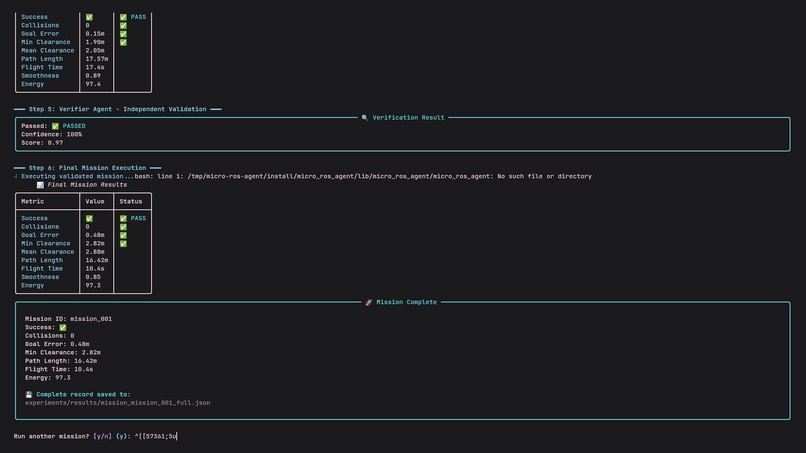
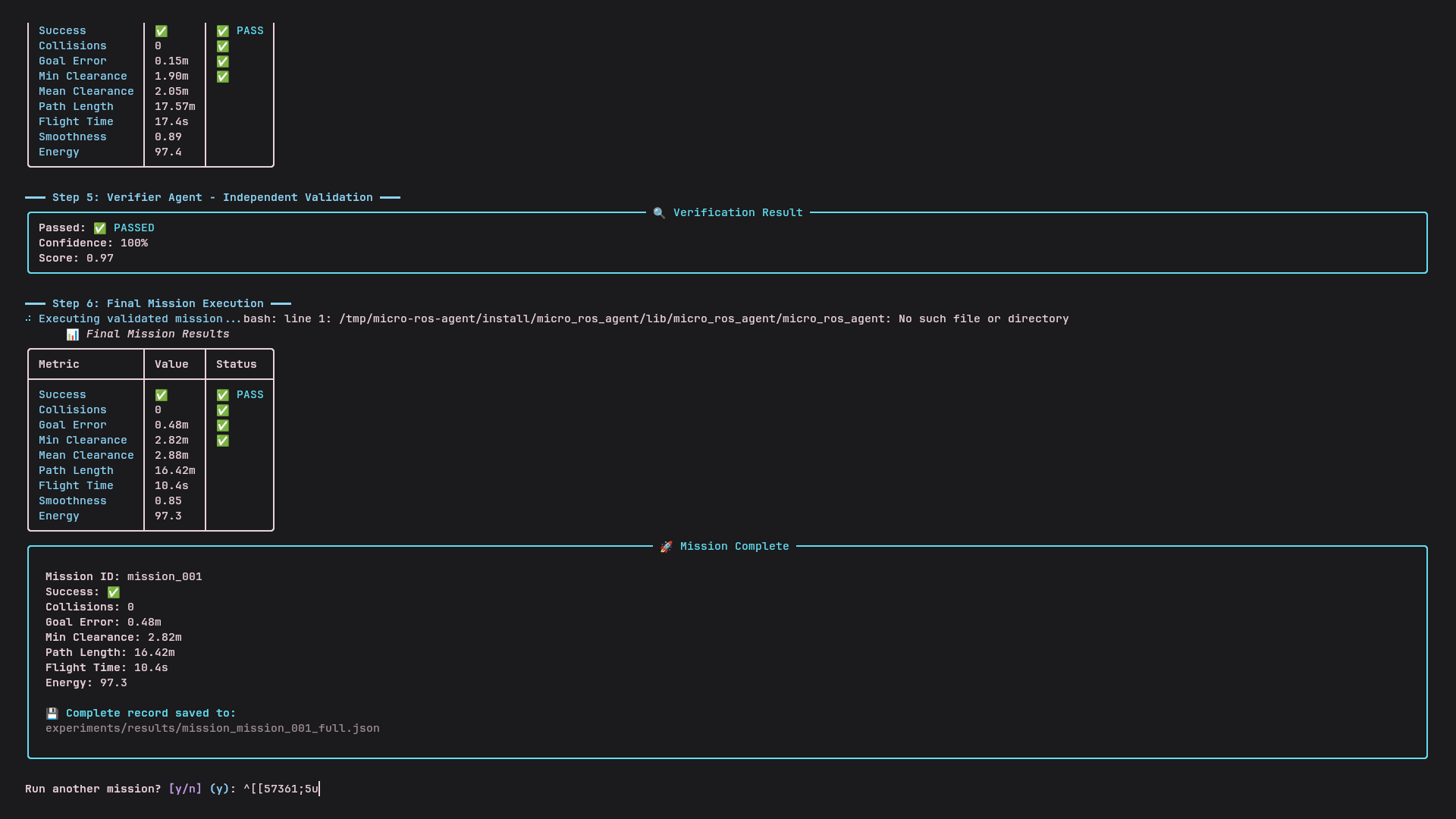
results from the simulation and generates a json file of that particular mission
-
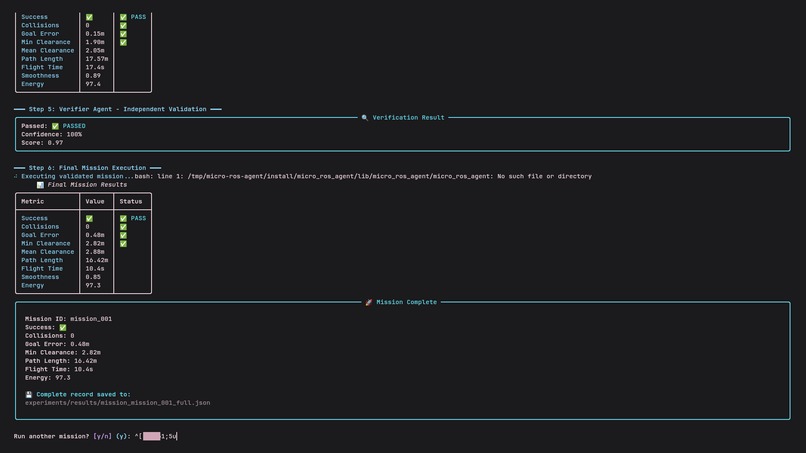
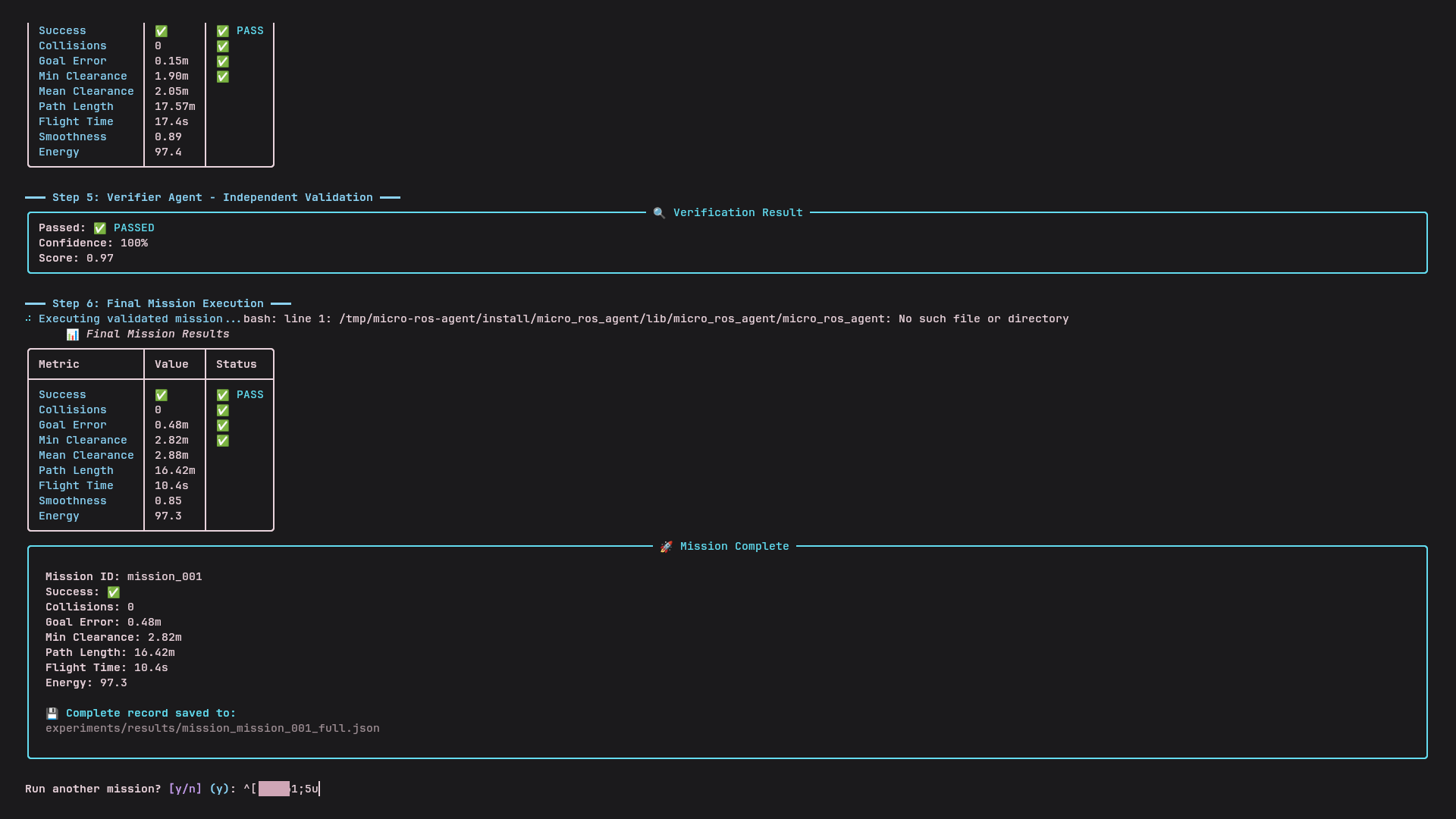
results from the simulation
Inspiration
I work in automation and robotics engineering, with a focus on autonomous drones and aerial robotics. My work involves delivery-drone workflows, obstacle avoidance, GPS-denied navigation, firmware behavior, sensor fusion, and simulation.
The difficult part is rarely just writing one controller. A mission can involve many decisions: which sensors are available, whether the environment is known, which planning or learning strategy is appropriate, how safe the clearance should be, how to test failure cases, and how to verify that the result is actually acceptable.
In practice, this process takes time. A small mistake in perception, tuning, or mission logic can turn into a failed simulation or, on hardware, a costly crash. I kept thinking: what if an engineer could describe the mission in plain language, and an AI system could turn that intent into a structured, testable, safety-aware autonomy workflow before anyone risks a real drone?
That question became AeroForge.
## What It Does
AeroForge is an agentic flight-engineering assistant for drone-autonomy experimentation.
A user describes a mission, such as flying between coordinates, avoiding obstacles, using a camera, or prioritizing safety and energy efficiency. AeroForge then:
- Converts the request into a structured mission specification.
- Selects an autonomy strategy, such as MPC, RRT*, PPO, SAC, or a hybrid approach.
- Creates an experiment configuration with constraints, reward settings, and evaluation criteria.
- Runs an iterative simulation-oriented experiment cycle.
- Verifies safety and performance metrics independently.
- Produces a mission record and a clear preflight/deployment-oriented handoff.
The goal is not to replace robotics engineers. It is to remove repetitive setup and first-pass experimentation so engineers can spend more time improving real hardware, validating sensor behavior, and making better autonomy decisions.
## How I Built It
AeroForge is built as a Python CLI with five specialized agents:
- Mission Analyst transforms natural-language requirements into a typed
MissionSpec. - Autonomy Architect scores available classical, reinforcement-learning, and hybrid strategies.
- Experiment Engineer configures and iterates experiments with bounded parameter changes.
- Verifier Agent independently checks safety and performance thresholds.
- Crash Analyzer is designed to inspect PX4 ULog failures and recommend constrained corrective actions. The log analyzer is also a custom built which give what all issue and how it has to be fixed .
The system uses Pydantic schemas to keep mission, experiment, environment, and metric data structured. The CLI presents each stage clearly, while the output includes a complete JSON experiment record for traceability.
For learning-based autonomy, AeroForge supports PPO and SAC workflows with a 36-dimensional observation design, continuous velocity actions, reward shaping, checkpointing, and evaluation logic. The project is designed around PX4 SITL, Gazebo, ROS 2, and sensor-driven drone simulation.
## Challenges We Faced
The biggest challenge was balancing ambition with safety. Autonomous drones should not expose unrestricted actuator control to an LLM. AeroForge therefore keeps a safety boundary: the agent plans, configures, tests, and verifies within a simulation-first workflow, while safety-critical flight control remains inside the established PX4 stack.
Another challenge was making agent decisions explainable. A strategy should not be selected as a black box, so AeroForge exposes the mission specification, strategy scores, reward configuration, metrics, verifier results, and final experiment record.
We also learned that reliable drone autonomy is not one algorithm. It is a system problem involving sensing, planning, control, testing, failure analysis, and human review. Building AeroForge pushed us to model those steps as a connected engineering workflow instead of isolated scripts.
## What We Learned
This project reinforced that the most valuable use of AI in robotics is not simply generating control commands. It is helping engineers reason through complex workflows, test assumptions earlier, document decisions, and identify unsafe outcomes before hardware is involved.
AeroForge is currently a simulation-first prototype. The next step is replacing prototype simulation paths with fully connected PX4/Gazebo runs, validating policies across richer scenarios, and keeping a human approval gate before any hardware deployment.
## Future Vision
AeroForge can become a practical engineering copilot for aerial robotics teams: an assistant that understands a mission, knows the available vehicle and sensors, proposes a test strategy, runs repeatable simulation experiments, explains failures, and prepares a disciplined handoff for real-world validation.
The vision is safer iteration, fewer preventable crashes, lower development cost, and more time for engineers to focus on the parts of robotics that need human judgment most.
About the video
The attached video shows I tried to integrate it with the drone once with that i came to know that we have to make this model more smarter and advanced the integration between simulation and hardware would be different . Currently working on that solution
Built With
- automation
- cli
- comupter-vision
- drone
- gemini
- google-cloud
- multi-agentsystem
- ppo
- px$
- px4
- pydantic
- python
- pytorch
- reinforcementlearning
- rich
- robotics
- ros2
- sac
- sitl
- stable-baseline3

Log in or sign up for Devpost to join the conversation.