-
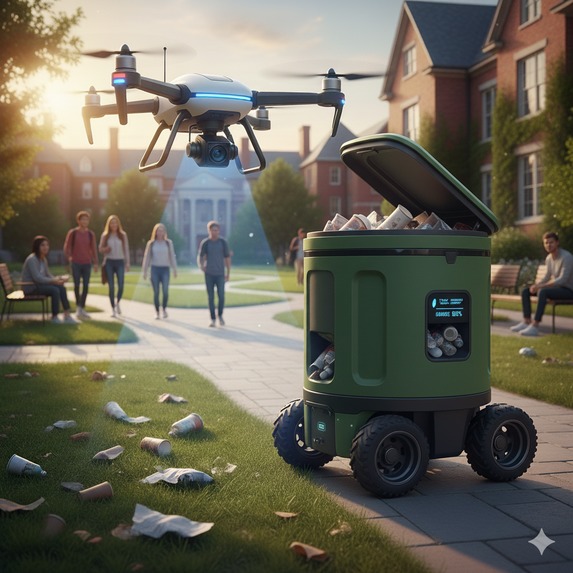
An AI Generated model of our project

Inspiration
The main inspiration for this project came from an observation I made while travelling around campus for the past few months. I noticed that our campus streets are swept only once a day, and it isn't fair to ask the sweepers to clean up every time someone throws trash. This inspired me to design a fully autonomous system that requires no human support for its operation and can keep the campus clean 24/7.
What it does
Our project is a two-part system that automates cleaning:
The Drone (The "Spotter"): An AI camera-equipped drone flies over the campus to find trash and mark its exact GPS location.
The Robot (The "Collector"): It sends that location right away to a ground robot, which then drives there on its own, avoids obstacles, and picks up the trash.
It's a 'find-and-collect' system that keeps the campus clean 24/7, all on its own.
How we built it
Our plan for building this is in three steps, the first of which is the most important: the AI.
Step 1: Making the "Spotter" (the drone and AI) Collecting Data: This is the most important thing to do. To avoid false positives, we would first walk around campus and take thousands of pictures of things that are not trash, like rocks, leaves, and lost bags.
Training an AI Model: We would use this dataset to teach a Computer Vision model. We would pick an efficient model like YOLO (You Only Look Once) because it can run in real time. We would teach it to draw a box around trash and not pay attention to anything else.
Hardware: We don't have to make a drone from scratch. We would attach a simple camera to a ready-made drone, like a DJI or a similar GPS-enabled quadcopter.
Step 2: Making the "Collector" (the robot that moves on the ground) Base Platform: Using an open-source robotics platform would save us time. The robot's "brain" would be the Robot Operating System (ROS). We would put it together using a base like a TurtleBot or another autonomous ground vehicle (AGV) kit.
To help the robot find its way around, we would make a map of the paths on campus (like making a map for a video game) and use a LIDAR sensor and ultrasonic sensors. This, along with the drone's GPS coordinates, would let it find the trash while avoiding students and other things that might get in the way.
Mechanism: We would connect our vacuum/sweeper collection tool to the front of this base. When it got to the right GPS location, it would turn on.
Step 3: Making the "Brain" (the Integration Server) Communication: The two robots need to be able to talk to each other. We would make a very basic cloud server with something like Firebase or a simple Python API.
The Process: This is how the system would work:
The AI in the drone sees trash.
It sends the GPS coordinates to our server.
This is added to the Server's "to-do list."
The Ground Robot keeps asking the server, "Is there a new job?" It downloads the coordinates and starts to navigate when there is.
Challenges we ran into
There are two main challenges we ran into
The AI brain comes first. How can we be sure that the drone can tell the difference between a student's lost water bottle and a trash can? We can't let the robot throw away people's things. Our answer is a "double-check" system. The drone sees something that might be trash, then it gets a closer look to make sure it's really trash before sending the robot.
Second, the people. What happens when school is over? The paths on campus are flooded. A basic robot would just stop and block everyone. So, we'd tell it to be "polite." It will pull over to the side, wait for the crowd to pass, and then get back to work.
Accomplishments that we're proud of
To be honest, we are most proud of two big things.
First, we didn't just say, "A drone finds trash." We are proud that we have built a full system from start to finish. We have planned out the whole process: how the AI finds the trash, how the server makes a "to-do list" from it, and how the ground robot gets the right orders. It's a complete, useful plan.
Second, and more importantly, we're proud that we didn't run away from the tough problems.
We wanted to know, "What happens when there are a lot of paths?" and we fixed it with "polite navigation," so the robot just sits there.
What we learned
We learned that the problem is a lot bigger than just picking up trash. We thought at first, We'll just use a drone to find it and a robot to get it. But then we ran into real life problems right away . What about the students? What about the stairs? What if the robot wants to take someone's lunch? We found out that the real problem isn't just the technology; it's getting it to work safely and politely with people in a complicated, human environment.
What's next for Aeroclean botX
We need to build the working model, and we need to focus all of our efforts on training the AI with real campus images so that we can prove the concept with one drone and one robot on one path. After that works, we'll add more ships to the fleet and make our server "brain" smart enough to handle them all. In this second phase, we'll also add important features like recycling sorters on board and begin designing new models that are specifically made for indoor spaces like food courts and all-terrain models for grassy quads.
