-
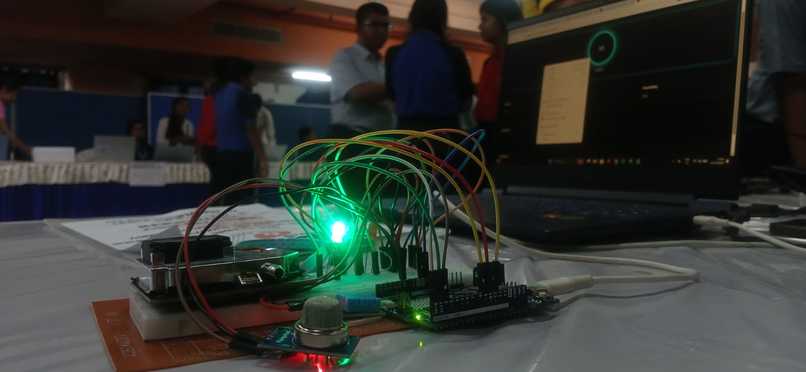
prototype
-
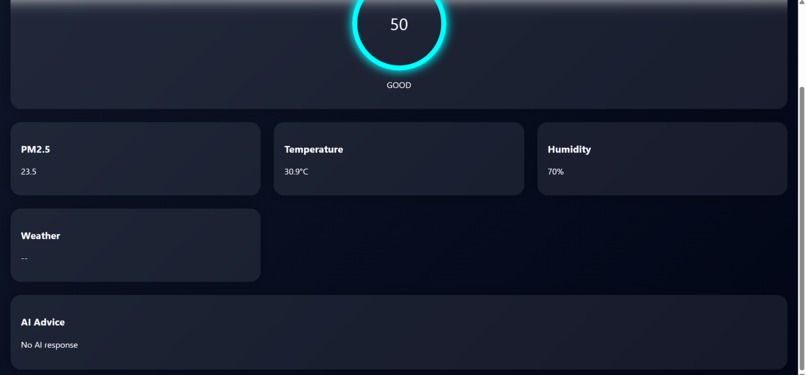
dashboard
Project Story — AERIS AI: Smart AQI & Health Monitoring System
Inspiration
Air pollution is one of the most significant yet invisible environmental challenges affecting millions of people daily. While AQI information is available through government dashboards and weather platforms, most systems are generalized, delayed, and difficult for ordinary users to interpret in a meaningful way. Numbers alone rarely help people understand what action they should take to protect themselves.
The idea behind AERIS AI emerged from a simple question:
What if environmental monitoring could move beyond displaying raw numbers and instead provide real-time, localized, actionable intelligence?
The motivation was to bridge the gap between environmental sensing and decision-making. Rather than simply measuring air quality, the goal became building a system capable of translating sensor data into meaningful recommendations that people could immediately understand and act upon.
This led to the development of AERIS AI — an intelligent, IoT-enabled air quality monitoring platform designed to provide real-time environmental awareness through sensing, cloud connectivity, location awareness, and AI-driven health insights.
What AERIS AI Does
AERIS AI is a smart environmental monitoring system that continuously measures air quality and environmental conditions in real time.
The system collects:
- PM2.5 concentration using the SDS011 laser particulate sensor
- Temperature and humidity using a DHT sensor
- Air quality and gas trends using the MQ-series gas sensor
- Geographical location data through GPS integration
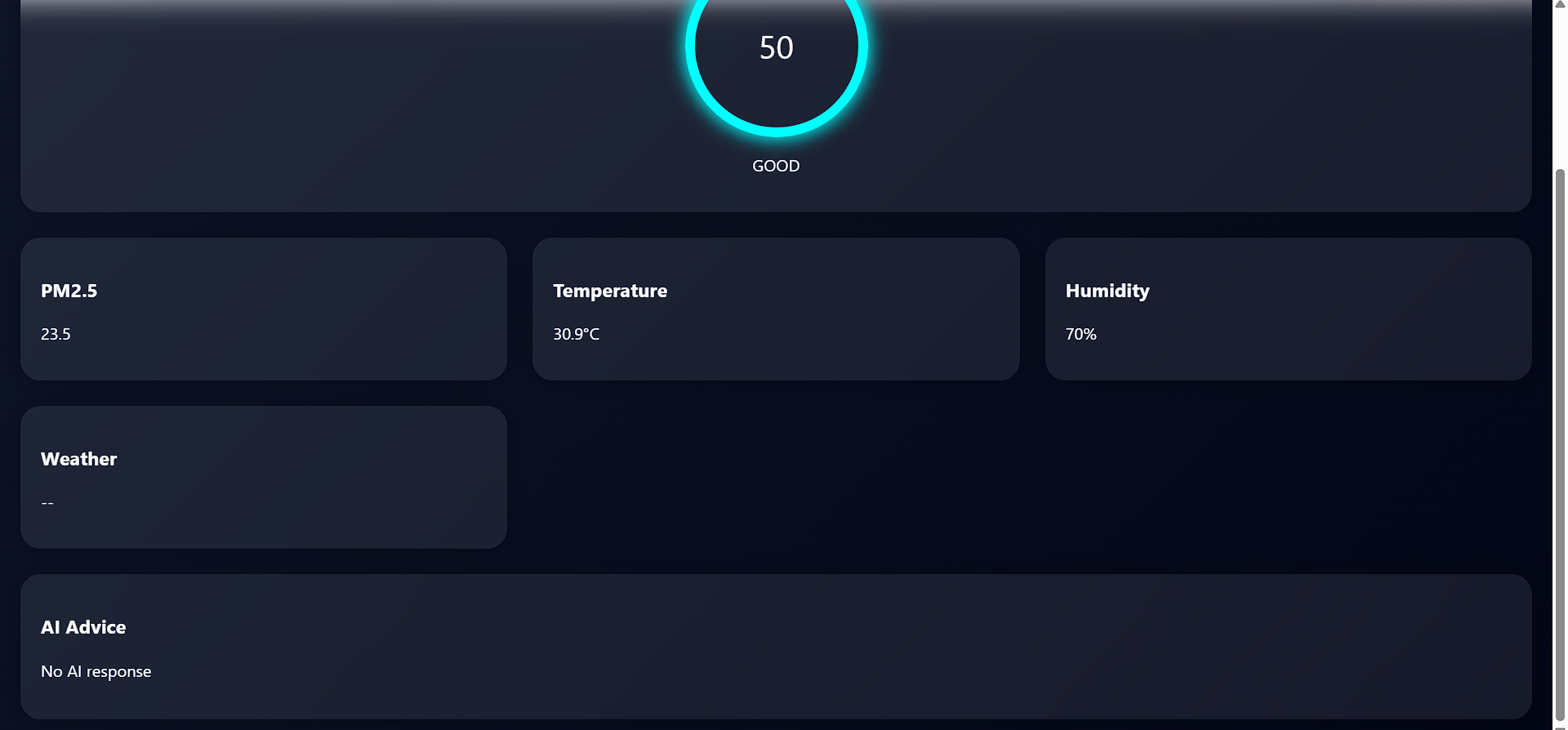
These readings are processed to estimate AQI and transmitted to a cloud database for real-time visualization through a responsive web dashboard.
However, AERIS AI goes beyond monitoring.
Using AI-assisted logic, the system converts environmental measurements into context-aware health recommendations, helping users understand what the readings mean and how they should respond.
Instead of displaying:
AQI = 165
The system explains:
Air quality is unhealthy. Outdoor exposure should be minimized, especially for sensitive groups.
This shift — from data presentation to actionable intelligence — became the central philosophy of the project.
How We Built the Project
The project evolved through multiple stages of prototyping and iteration.
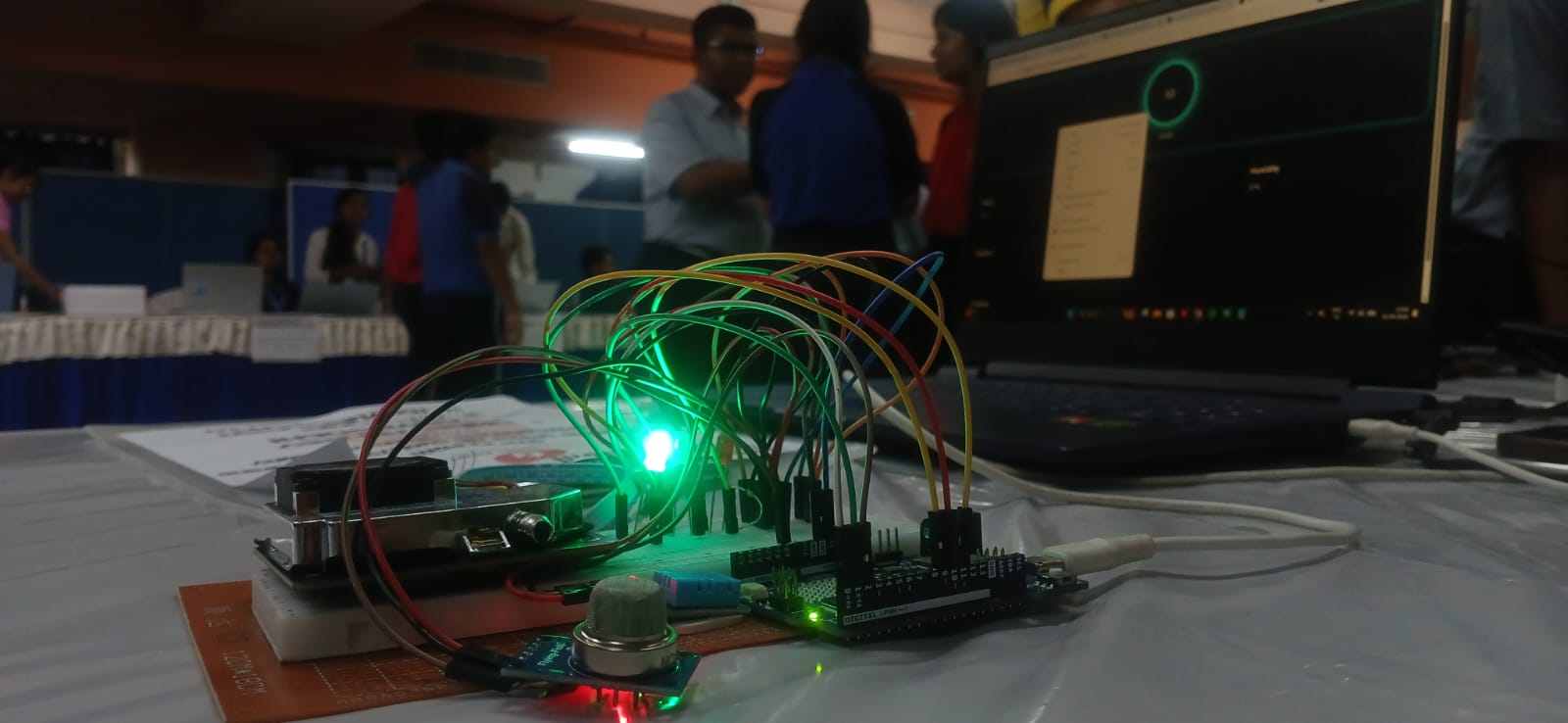
The initial version was built around an Arduino-based architecture using particulate, environmental, and gas sensors to collect data. Early prototypes successfully monitored PM2.5, temperature, humidity, and gas readings while visualizing them through cloud services.
However, limitations soon became apparent.
The first challenge was latency. Traditional cloud dashboards introduced delays that affected the real-time nature of monitoring. To improve responsiveness and scalability, the system architecture was redesigned around a more efficient workflow involving real-time cloud synchronization.
The upgraded version integrated:
- Arduino UNO R4 WiFi for wireless communication and real-time connectivity
- SDS011 for PM2.5 detection
- DHT sensor for environmental monitoring
- MQ-series sensor for gas trend analysis
- GPS module for spatial environmental awareness
- Firebase Realtime Database for low-latency synchronization
- A custom web dashboard for live visualization and monitoring
The architecture followed a simple but scalable pipeline:
Sensors → Microcontroller → Cloud Database → Live Dashboard → Intelligent Recommendation System
The web dashboard was designed to provide a modern monitoring experience with live AQI data, weather context, location awareness, visual indicators, and health guidance.
The objective was to make environmental intelligence accessible, understandable, and actionable.
Challenges We Faced
Building AERIS AI involved far more than assembling sensors together.
1. Sensor Calibration and Stability
One of the earliest technical challenges involved obtaining reliable PM2.5 readings from the SDS011 sensor. Sensor positioning, airflow conditions, initialization timing, and serial communication had to be carefully tuned before stable readings were achieved.
Similarly, gas sensors required warm-up periods and interpretation beyond raw values, since they are more suitable for trend analysis than exact measurements.
This process taught the importance of validating real-world hardware assumptions instead of relying solely on documentation.
2. Real-Time Data Synchronization
A major challenge was reducing delays between sensing and visualization.
Early cloud integrations introduced update latency, making the system feel less responsive. Migrating toward a real-time architecture required redesigning how data was structured, transmitted, and synchronized with the dashboard.
Implementing Firebase-based communication significantly improved responsiveness and reliability.
3. Hardware Communication and Integration
Integrating multiple serial devices — including particulate sensors and GPS — required careful debugging of communication protocols, baud rates, pin mapping, and synchronization logic.
Several iterations were necessary before stable multi-sensor integration was achieved.
This became an important lesson in systems engineering: building an integrated solution is often more difficult than making individual components work independently.
4. Translating Data into Intelligence
A key conceptual challenge was avoiding the trap of creating “just another sensor dashboard.”
The question shifted from:
“How do we display data?”
to:
“How do we make the data useful?”
This led to implementing health guidance and context-aware interpretation to improve usability and accessibility.
What We Learned
AERIS AI became much more than an electronics project.
It provided hands-on experience in:
- Embedded systems and sensor interfacing
- Real-time IoT system architecture
- Wireless communication and cloud integration
- Data visualization and dashboard design
- AI-assisted environmental interpretation
- Hardware debugging and systems integration
More importantly, it reinforced an engineering mindset:
Technology becomes valuable when it converts complexity into clarity.
The project demonstrated that effective engineering is not just about collecting data — it is about designing systems that help people make better decisions.
Future Scope
AERIS AI has strong potential for scalability.
Future improvements include:
- Distributed multi-device deployment for localized pollution mapping
- Smart city integration for environmental monitoring networks
- Predictive AQI forecasting using machine learning
- Mobile application integration with notifications and alerts
- GPS-based environmental heatmaps and pollution visualization
- Advanced personalization for health-sensitive users
The long-term vision is to move toward a platform capable of delivering real-time environmental intelligence at hyperlocal scale.
Conclusion
AERIS AI began as an attempt to measure air quality, but evolved into something more meaningful: a system focused on making environmental information understandable, actionable, and accessible.
By combining IoT sensing, cloud systems, real-time monitoring, and intelligent interpretation, the project aims to bridge the gap between environmental data and human decision-making.
At its core, AERIS AI is built on a simple idea:
People should not only know what the air quality is — they should know what to do about it.

Log in or sign up for Devpost to join the conversation.