-
-
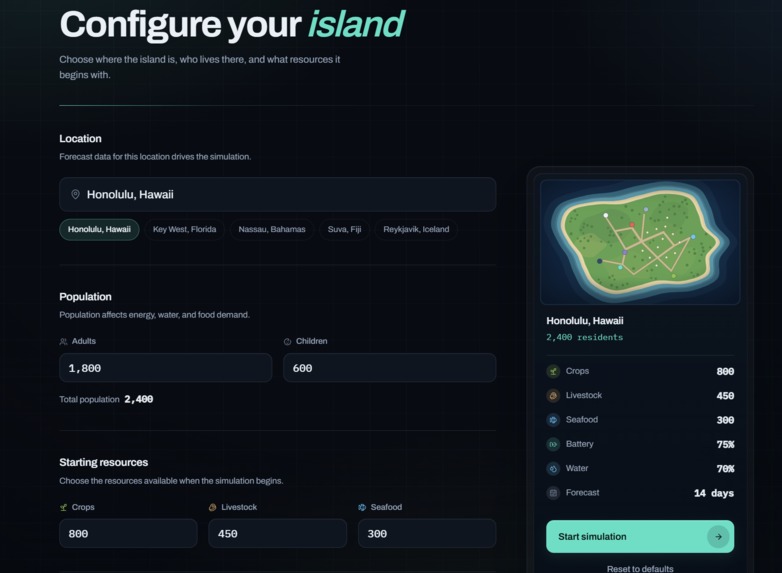
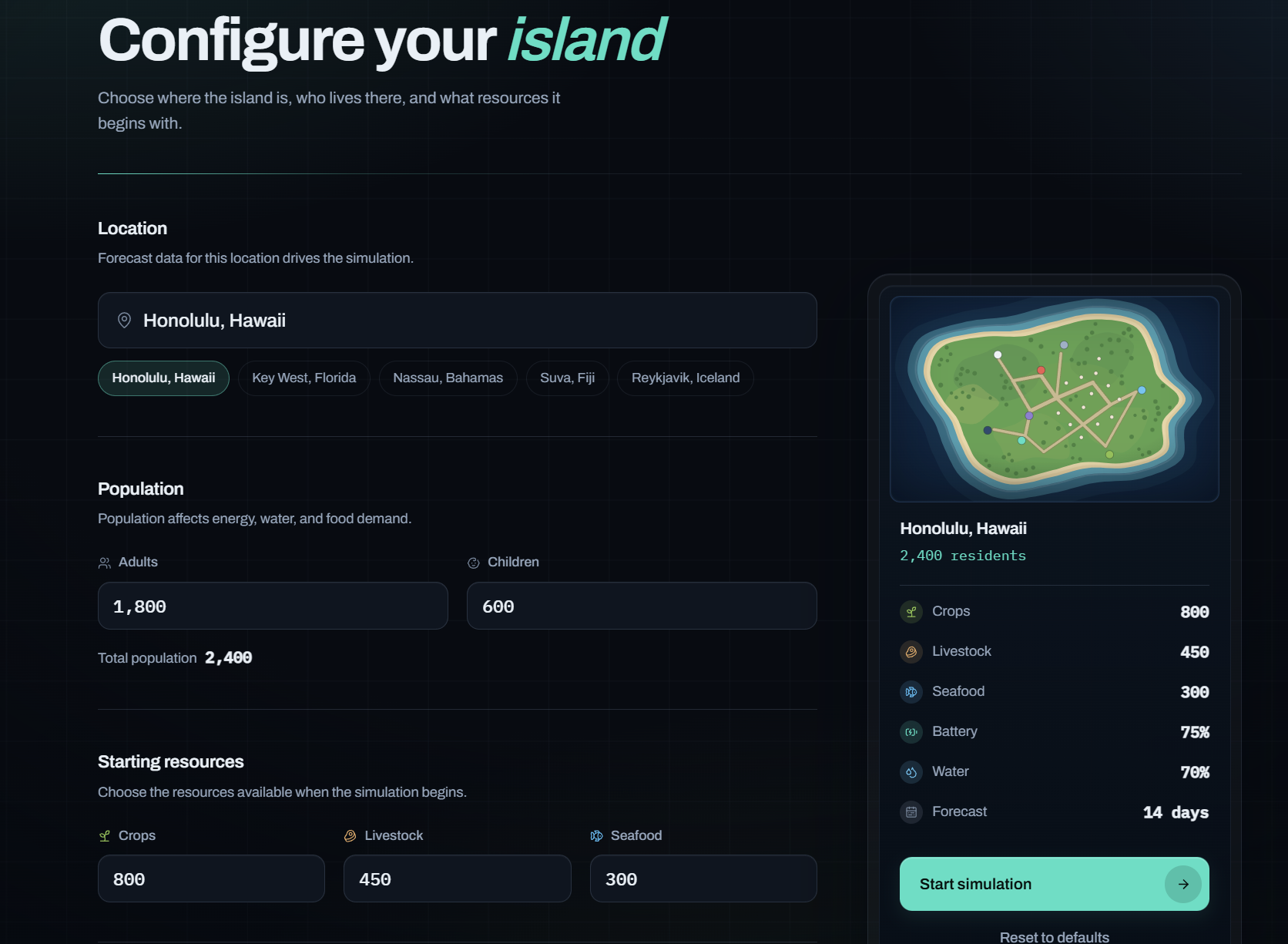
Homepage with inputs
-
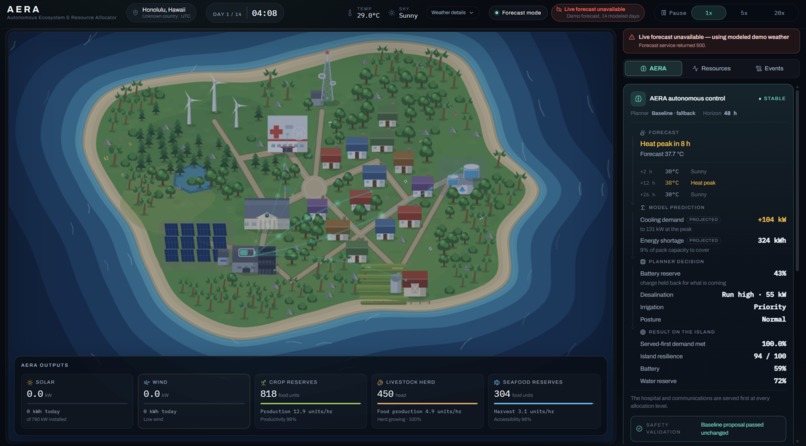
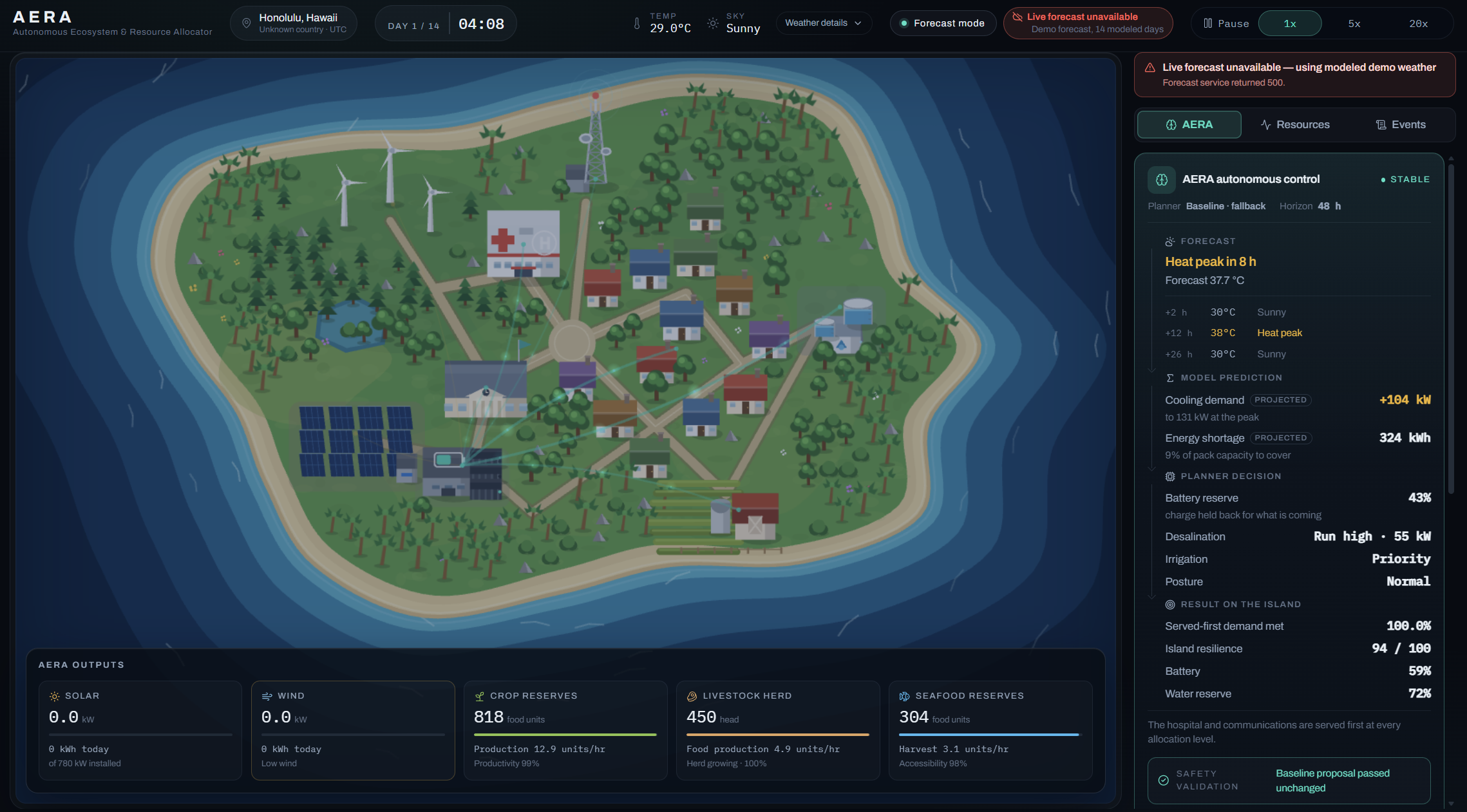
Simulation page with outputs
Inspiration
Isolated islands face a difficult resource problem: when electricity, clean water, or food becomes scarce, they cannot instantly import more from a mainland grid. Renewable energy helps, but it is also weather-dependent. Clouds reduce solar generation, extreme winds can shut turbines down, and heat waves increase cooling and water demand.
At the same time, hospitals, communications systems, homes, agriculture, and water infrastructure all compete for the same limited resources.
That led us to one question:
Can AI use environmental forecasts to prepare an island for shortages before they happen?
We created AERA — the Autonomous Ecosystem & Resource Allocator to explore that idea.
What it does
AERA is an interactive digital twin of an isolated island.
Users configure the island's location, adult and child population, starting crop reserves, livestock herd, seafood reserves, battery charge, water storage, and simulation length.
AERA then combines environmental forecasts with mathematical models to predict changes in:
- solar and wind generation
- heating and cooling demand
- battery storage
- drinking water and desalination
- agriculture
- livestock
- seafood harvesting
- critical infrastructure
- overall island resilience
The most important part is that AERA does not simply display these predictions.
The modeled state is given to an AI resource planner, which decides how the island should allocate its available resources. It can prioritize critical services, adjust battery strategy, run or defer desalination, move irrigation away from energy peaks, and reduce flexible loads when necessary.
Before any AI proposal can affect the simulation, it passes through a deterministic feasibility layer that checks physical constraints such as available generation, battery limits, facility capacities, and critical-service requirements.
The interface makes the process visible as:
Forecast → Prediction → AI Decision → Safety Validation → Result
We also built heat-wave, tropical-storm, drought, and grid-failure stress tests so AERA can be evaluated under difficult conditions without waiting for extreme weather to occur naturally.
How we built it
AERA was built with React, TypeScript, Vite, Phaser, Zustand, WeatherAPI, and the OpenAI API.
The system has three main technical layers.
Mathematical simulation
Weather data is first converted into the physical state of the island.
Solar generation depends on daylight, cloud coverage, panel temperature, and installed capacity.
Wind generation follows a turbine power curve: turbines produce no power below their cut-in speed, increase production as wind rises, reach rated output, and shut down during dangerously high winds.
Population and weather also affect demand. Higher temperatures increase cooling and water consumption, while colder temperatures increase heating requirements.
We model battery charging and discharging, desalination, rainfall collection, domestic water use, irrigation, crops, livestock, seafood accessibility, and food consumption.
Because all of these systems share the same island state, a single environmental event can create a chain reaction across energy, water, and food systems.
AI resource planner
The mathematical models describe what is happening and what is likely to happen next.
The AI planner receives a structured view of the island, including current energy generation, predicted demand, battery and water reserves, resource conditions, facility requirements, and upcoming forecast risks.
It then proposes the resource-management strategy.
This allows AERA to make decisions based not only on what is happening now, but also on what is expected to happen in the future.
Deterministic constraint validation
We did not want an AI model to have unrestricted control over infrastructure.
Every AI proposal is checked before execution.
The validator enforces constraints including:
- available energy
- battery capacity
- maximum battery charge and discharge rates
- facility power limits
- critical-service requirements when physically feasible
- nonnegative allocations
- resource availability
- infrastructure shutdown states
If the AI proposes something that violates an encoded physical constraint, AERA repairs the proposal before it reaches the simulation.
We also track whether AI proposals pass validation unchanged or require repair, giving us a measurable way to evaluate the feasibility of AI-generated control decisions.
Digital twin
We used Phaser to make the simulation visually understandable.
The island contains homes, a hospital, communications infrastructure, farms, desalination, solar panels, wind turbines, battery storage, and community facilities.
Residents commute to work and return home at night. Larger configured populations also create additional lightweight visual villagers so the island feels more populated without affecting the underlying mathematical model.
The visual simulation allows users to see the consequences of AERA's decisions instead of only reading numbers on a dashboard.
Challenges we ran into
One of our biggest challenges was keeping every system synchronized across accelerated simulation speeds.
Early versions had subtle problems where weather timelines, resident movement, battery calculations, and resource production behaved differently depending on whether the simulation was running at 1x or 20x speed.
We also found issues such as weather freezing around midnight, grid-failure effects oscillating, battery reserves becoming overly conservative, crop production collapsing because of incorrect scaling, and seafood reserves increasing without meaningful limits.
Another major challenge was integrating the AI planner into the existing simulation.
Our first isolated implementation used temporary planner interfaces that did not perfectly match the final application. During integration, we discovered mismatched field names, forecast information being removed during sanitization, and AI allocations that could have been silently rejected by the validator.
Instead of forcing that implementation into the application, we rebuilt the integration around AERA's real planner contracts and added regression tests across the complete pipeline.
Accomplishments that we're proud of
We're proud that AERA became much more than an animated island.
The environmental data, mathematical models, AI planner, deterministic validator, resource systems, and digital twin all operate as one connected system.
Some accomplishments we're especially proud of include:
- building an AI planner that makes actual resource-allocation decisions
- creating a deterministic feasibility layer between the AI and the simulation
- supporting simulations lasting up to 14 days
- combining energy, water, food, weather, population, and infrastructure models
- clearly separating live WeatherAPI data from modeled forecast extensions
- creating realistic stress tests for heat waves, storms, droughts, and grid failures
- building a living Phaser digital twin with population-dependent activity
- providing a deterministic baseline planner and automatic fallback if the AI is unavailable
- exposing why AERA made its decisions rather than hiding the process
- building approximately 200 automated tests across the simulation, planner, weather timeline, resource models, and interface logic
One feature we're particularly proud of is measuring how much the deterministic constraint layer has to modify AI proposals before execution. Instead of simply trusting an AI-generated control action, AERA can quantify whether that proposal was already feasible.
What we learned
The biggest lesson we learned is that autonomous AI systems need more than an intelligent model.
AERA works because several different components have clearly separated responsibilities:
environmental data → mathematical prediction → AI decision-making → deterministic validation → observable result
The mathematical layer gives the AI a structured representation of the physical world.
The AI provides flexible strategic decision-making across many interacting variables.
The deterministic validator ensures that encoded physical constraints cannot simply be ignored.
We also learned how important testing is for simulations. Many of our hardest bugs did not crash the program — they produced believable but incorrect numbers. Long-duration tests, deterministic scenarios, planner contract tests, and edge-case testing helped us find issues that would have been difficult to notice visually.
Finally, we learned that explainability is just as important as automation. AERA shows users what environmental risk it identified, what the models predicted, what the AI decided, whether the validator changed anything, and what happened afterward.
What's next for AERA - Autonomous Ecosystem & Resource Allocator
AERA is currently a simulation rather than a production utility controller.
A real deployment would require calibrated physical sensors, infrastructure-specific models, uncertainty estimates, redundant control systems, stronger safety guarantees, and extensive real-world testing.
Future versions could connect AERA directly to real island sensor networks, incorporate probabilistic weather uncertainty, model more detailed microgrid hardware, expand long-term resource planning, and run controlled AI-versus-baseline experiments under identical environmental conditions.
The long-term idea behind AERA is simple:
AI should not wait for a resource crisis to happen. It should anticipate what is coming, choose a strategy ahead of time, explain its decision, and operate within clearly defined physical constraints.
Built With
- artificial-intelligence
- css3
- digital-twin
- energy-management
- forecasting
- html5
- mathematical-modeling
- openai-api
- optimization
- phaser.js
- react
- renewable-energy
- rest-api
- simulation
- typescript
- vite
- vitest
- weatherapi
- zustand


Log in or sign up for Devpost to join the conversation.