-
-
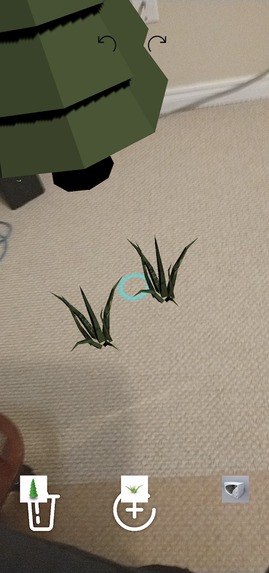
UI
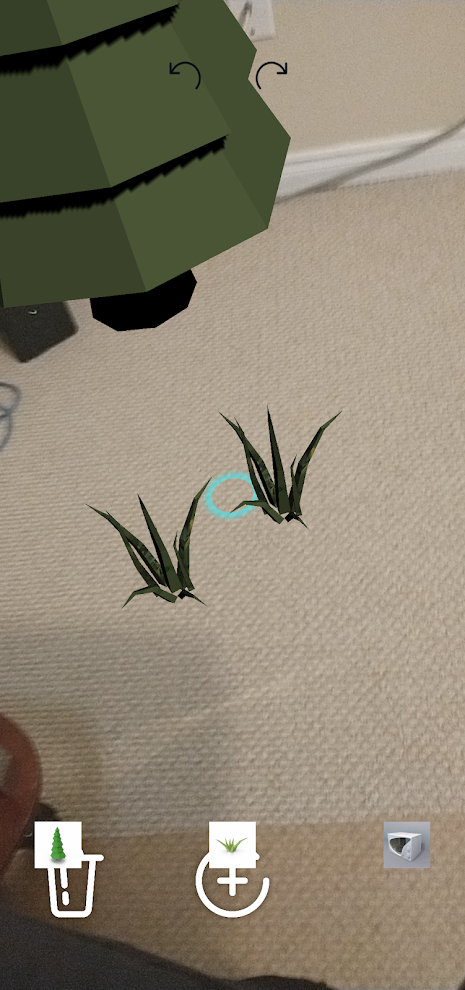
Inspiration
During the Covid-19 pandemic, humans have decreased their relative carbon footprint due to the less frequent use of vehicles, this marks an accidental but welcoming change to our lifestyles. However, our team at Ramen. Co believes that even though the use of vehicles will not further go down, it is important to remind citizens of the world that carbon emissions are still a problem in our society and there are other ways to solve the problem without making sacrifices such as the limited use of vehicles.
What it does
AER allows users to perform landscaping and domestic design while monitoring their impact on the environment. The mobile application allows users to place down appliances in the 3-dimensional environment that is seen through the camera. The users are also able to place down plants such as grass and trees for planning out a garden or their backyard. Furthermore, the application allows the user to easily modify their design using productivity tools such as undoing their last change, deleting an object, as well as modifying an item’s position. As objects are placed a score is generated that estimates the decrease/increase in carbon footprint by using region-specific data.
How we built it
The application is built on the Unity Engine. We used C# scripts to control and process the user’s input. These scripts allow users to select and control items to add and modify objects. We also designed animations to make the application more welcoming and intuitive. The backend implementation of the application uses data structures to organize region-specific CO2 intensity as well as bit manipulation techniques to respond to the user’s actions efficiently.
Challenges we ran into
There were many obstacles in this project. Monitoring our timeline and ensuring that we have a viable plan was one of the most difficult tasks. While dealing with the tight schedule, we also ran into numerous problems with our implementation of the productivity functions. These functions are especially difficult since they required the use of multiple advanced data structures to store the user actions in the memory to undo and redo the placement and rotation of objects. Additionally, it was difficult to increase the speed at which the device identifies a surface using raycasting to detect collisions from a distance.
Accomplishments that we're proud of
We are proud of learning to use Unity AR in a short period of time to implement a fully functional app with a sleek user interface. Additionally, we were able to add several different mechanisms in our user interface and connect them very quickly to the C# backend. Most importantly our team was able to find debugging tools such as ADB to successfully apply 3D hit detection to select and destroy objects.
What we learned
We learned how to use Unity AR and debug an android mobile application using ADB. In addition, we learned how to program using a new language (C#) as none of the team members have experience in programming using this language. The pressure applied by the time constraint made us cooperate more closely and maintain constant communication about our progress. We also learned about the impact of various plants and appliances on the environment as plants such as grass actually impact the environment negatively due to fertilizers and the emissions from cutting grass.
What's next for AER (Augmented Ecological Rift)
We would like to expand the database of landscaping objects and appliances available on the mobile app to evaluate our impact on the environment. More importantly, we would like to use location-specific data to educate people about the effects of using renewable energy sources for powering appliances and compare with other people from around the world. Finally, we would like to continue working on optimizing the design of the application to give the users a more intuitive and pleasant experience.


Log in or sign up for Devpost to join the conversation.