-

Aequalis - A Next-Gen Platform for Better Price Equity
-
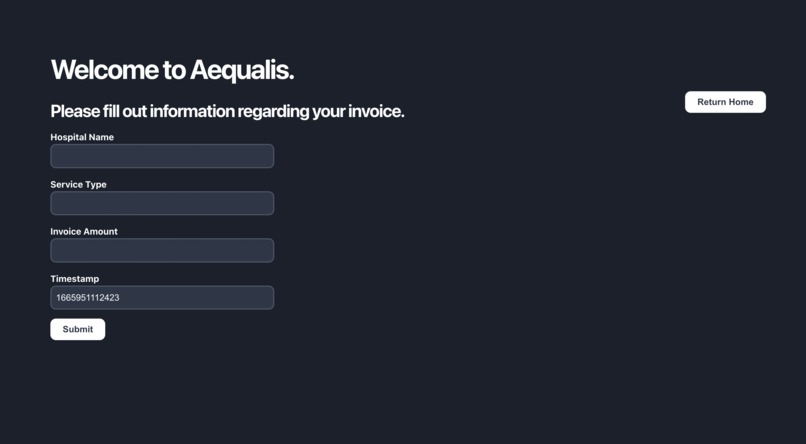
Internal Invoice Filing Platform
-
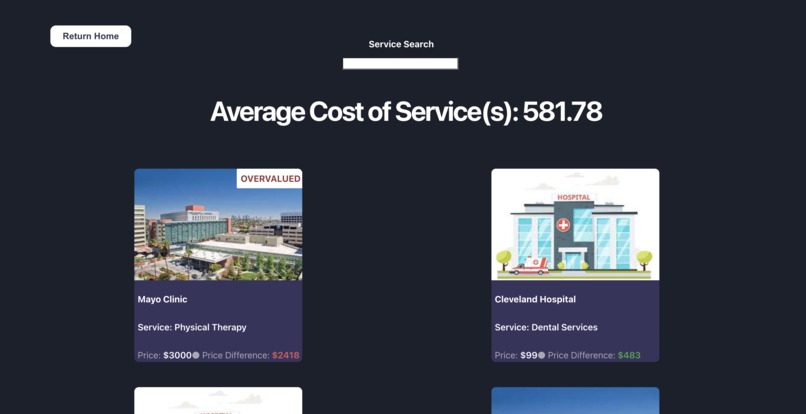
Public Price Visualizer

Inspiration
From news reports on rising domestic medical costs to economic research reports on US healthcare systems, the element of equity in medical costs has been at the forefront of scrutiny and concern amongst government agencies, public health groups, and the general public.
Indeed, the pricing of healthcare services is an enigmatic pipeline that emerges from complex intermediaries and contracts, which in turn medical bills into arcane numbers that are virtually impossible to understand for the recipient. Furthermore, many pricing methodologies are held by medical institutions as proprietary information.
The combination of legal layers and mechanical convolution renders most brute-force attempts to dissect the components of a medical bill meaningless due to the amount of protection information required.
If we can't decompile medical bills, how do we ensure hospitals aren't price-gouging their customers?
This is where the concept of Aequalis was born. As we further explored the property of immutability and transparency of blockchain networks, we were fascinated by the potential of P2P validation schemes in tracking and monitoring medical invoices.
With this inspiration, we set out to create an open-source platform designed to identify price-gouging and enforce equity in medical costs between medical institutions.
What it does
Aequalis is an open-source price-referencing platform striving to diminish the unfair pricing of medical services by providing access to a database of medical invoices, the entries of which are two-factor-authenticated via Solana contracts.
Internal Invoice Filing Platform Designed to interact with representatives from medical institutions, the invoice filing platform collects past medical invoices and deploys key information, such as the type of services and amounts charged, onto the Solana blockchain network through a smart contract. Copies of such data are simultaneously uploaded into an open-source Cockroach database. The two information storage can validate each other's completeness and accuracy via unique hashcode authentication.
As the invoice profiles are immutable once uploaded, the platform ensures that medical institutions take the proper responsibility for uploading the correct information - all thanks to the immutable, transparent nature of Solana contracts.
Public Price Visualizer This page is kept readily available to the general public. Upon loading, the user can access the suggested average pricing of a medical service, which is calculated from all relevant medical invoices inputted by medical institutions. More importantly, the user can also examine each medical institution's pricing relative to the average price.
As such, if any service provider is conducting price-gouging or any sort of unreasonable pricing, the public could easily recognize such behaviors and utilize the immutable data provided by Aequalis as concrete evidence for their claim.
How we built it
Frontend Frameworks: React.js, Formik Backend Frameworks: Flask, CockroachDB, Solana
Internal Invoice Filing Platform Upon receiving input from the user, the form packages field values and delivers them to the backend Flask API. To minimize runtime delay, payload values are packaged into JSON objects and sent as payloads to both the Solana network and CockroachDB simultaneously. The consistency of data between the two storages is maintained by verifying that each entry maps to exactly one counterpart in the other storage with the same hashcode.
Public Price Visualizer Medical pricing data is first queried from CockroachDB utilizing a GET HTTP request. Subsequently, we parsed through every query that involved the particular service we wanted to search into (default being all entries) and extrapolated the price of each. Then, we took the average price, assessed each entry, and deemed a product was overpriced if it was greater than a particular threshold above the mean.
Challenges we ran into
We had a few file version-control issues throughout our building process. Some tedious bugs were created due to pulling a teammate's code from our GitHub Repository from one of our machines to another, and there were also times when we would lose our code.
This was also our first time utilizing BlockChain technology, which led to us staying after Solana's workshop for extra help and clarifications.
Accomplishments that we're proud of
We integrated our first blockchain technology within our application. We are also proud of integrating many of our skills from different technologies into a coherent and well-designed project.
What we learned
We learned that git push/pull processes should be used frequently to maintain good version control. In addition, members should agree on an overall file structure and maintain good habits of containing their code to avoid unnecessary merge conflicts. We all personally learned the importance of system design and how delegating tasks prompts an efficient work environment.
In addition, we learned a lot about debugging for both frontend and backend features, which are quite different from each other. Learning how to decompose non-obvious errors and gradually narrowing down error zones was a very difficult but very meaningful process.
We also learned the unique challenges of dealing with transparency and had to deliberate how to represent this transparency in an easily accessible and understandable form to the public.
What's next for Aequalis
The journey of Aequalis does not stop here. Some immediate developmental improvements would be creating a multi-query Form to extrapolate even more precise information and reorganizing medical institutions by criteria such as geographic locations to support further expansion of clients.
We also plan to expand our frontend to be more secure for the internal side since it should only be available to hospitals attempting to document a recent transaction between themselves and a patient.
Finally, since Aeqalis is very scalable due to its dependency on transparency, we can expand other industries, not just those limited to healthcare. Finally, we would also provide a "Review" Section that provides justifications or arguments against or for a particular service. Therefore, if one hospital's service is overly priced for a "just" reason, previous consumers of said service can either confirm or deny the extensive price. Ultimately, we hope that Aequalis will be able to help policymakers and the general public to better uphold price equality and transparency across the healthcare industry and other sections alike.
Built With
- cockcroachdb
- flask
- formik
- javascript
- postgresql
- python
- react
- rust
- solana

Log in or sign up for Devpost to join the conversation.