-
-
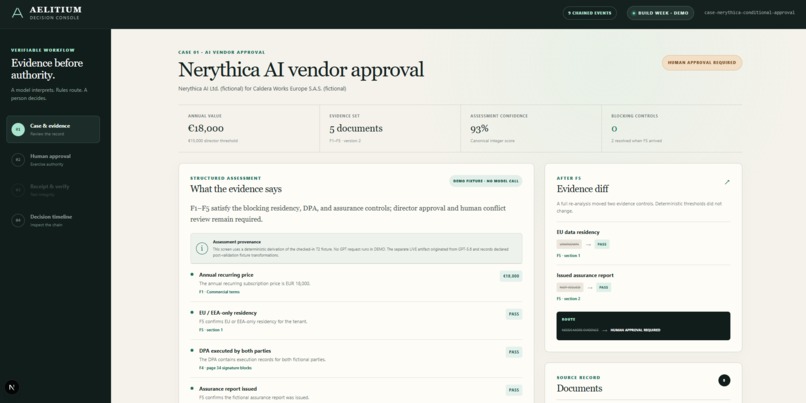
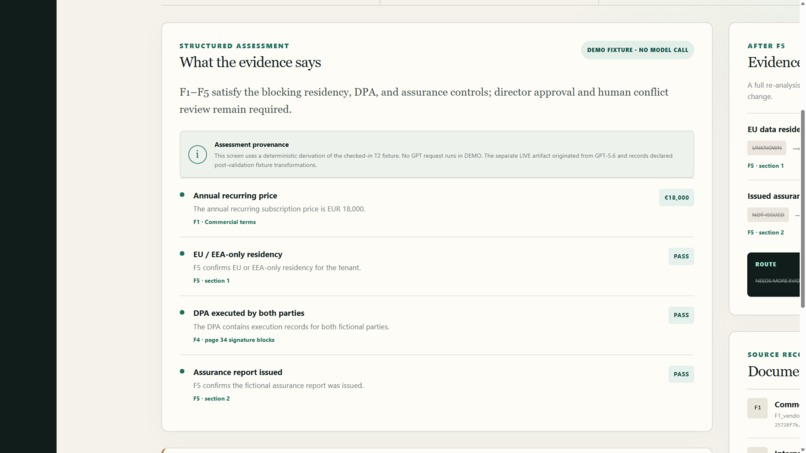
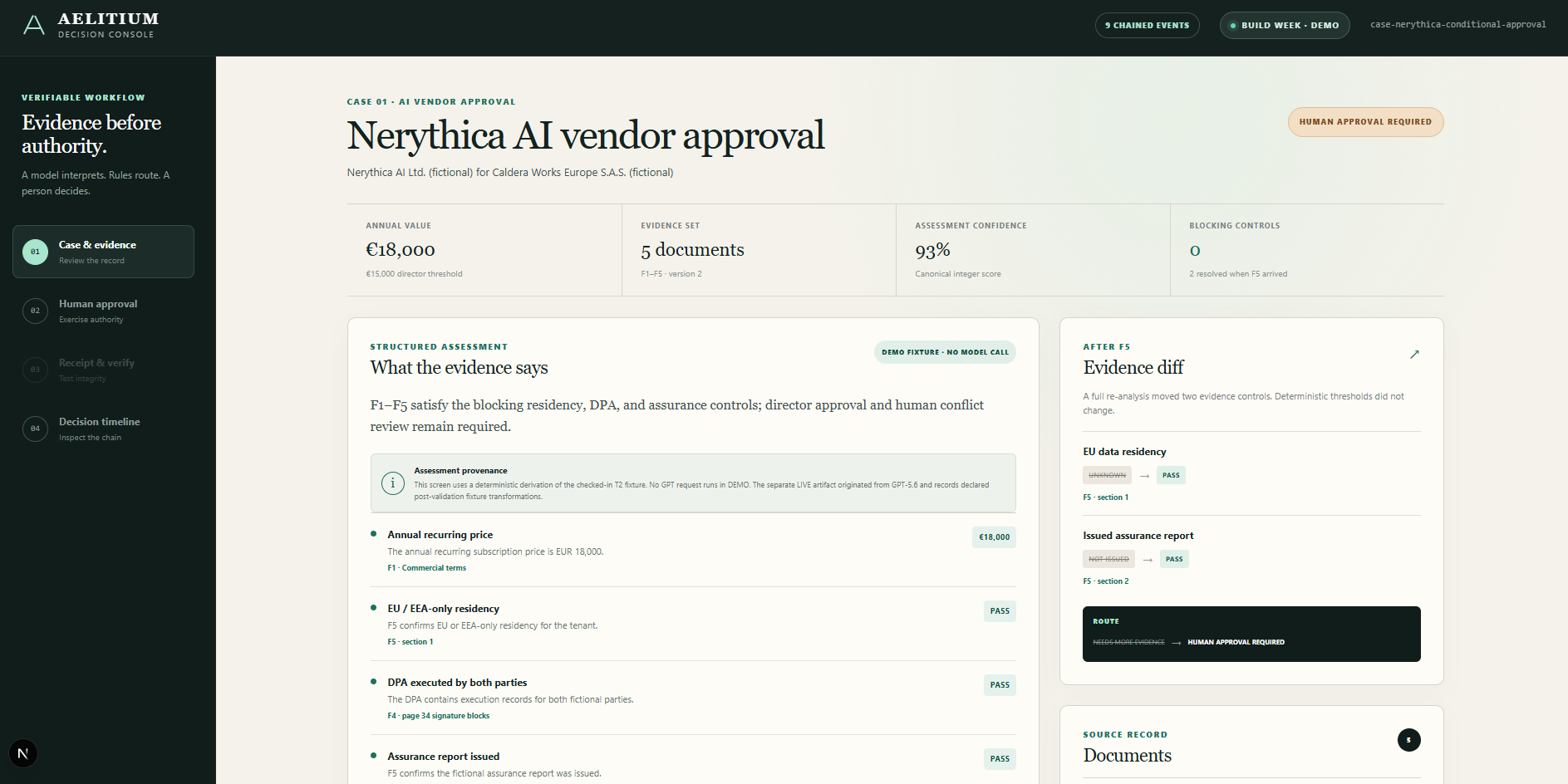
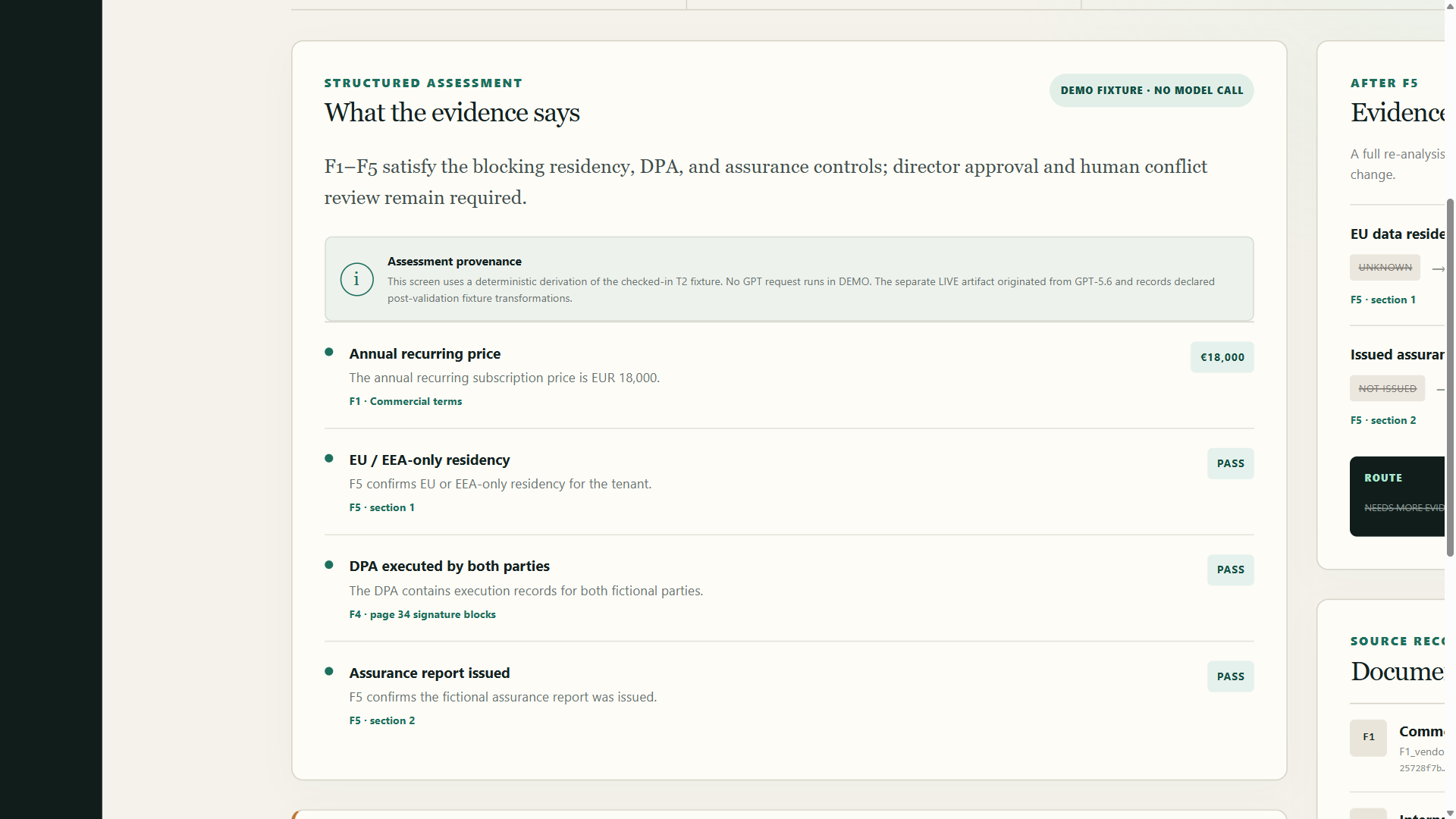
Evidence-driven assessment from five documents. Deterministic controls route the case to human approval before any decision is recorded.
-
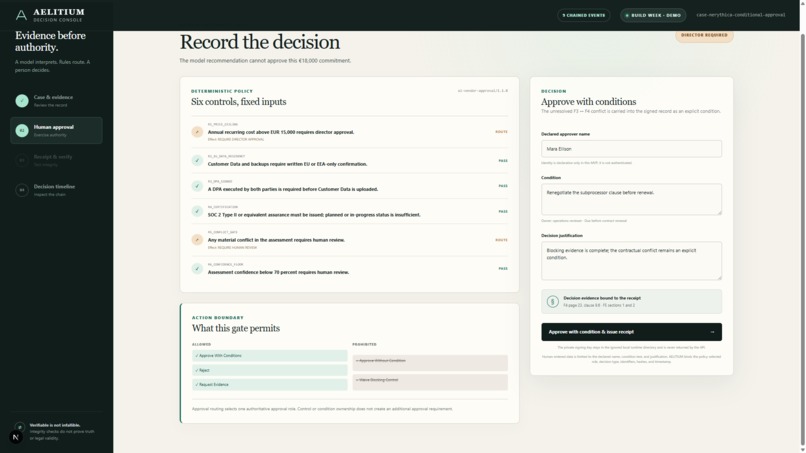
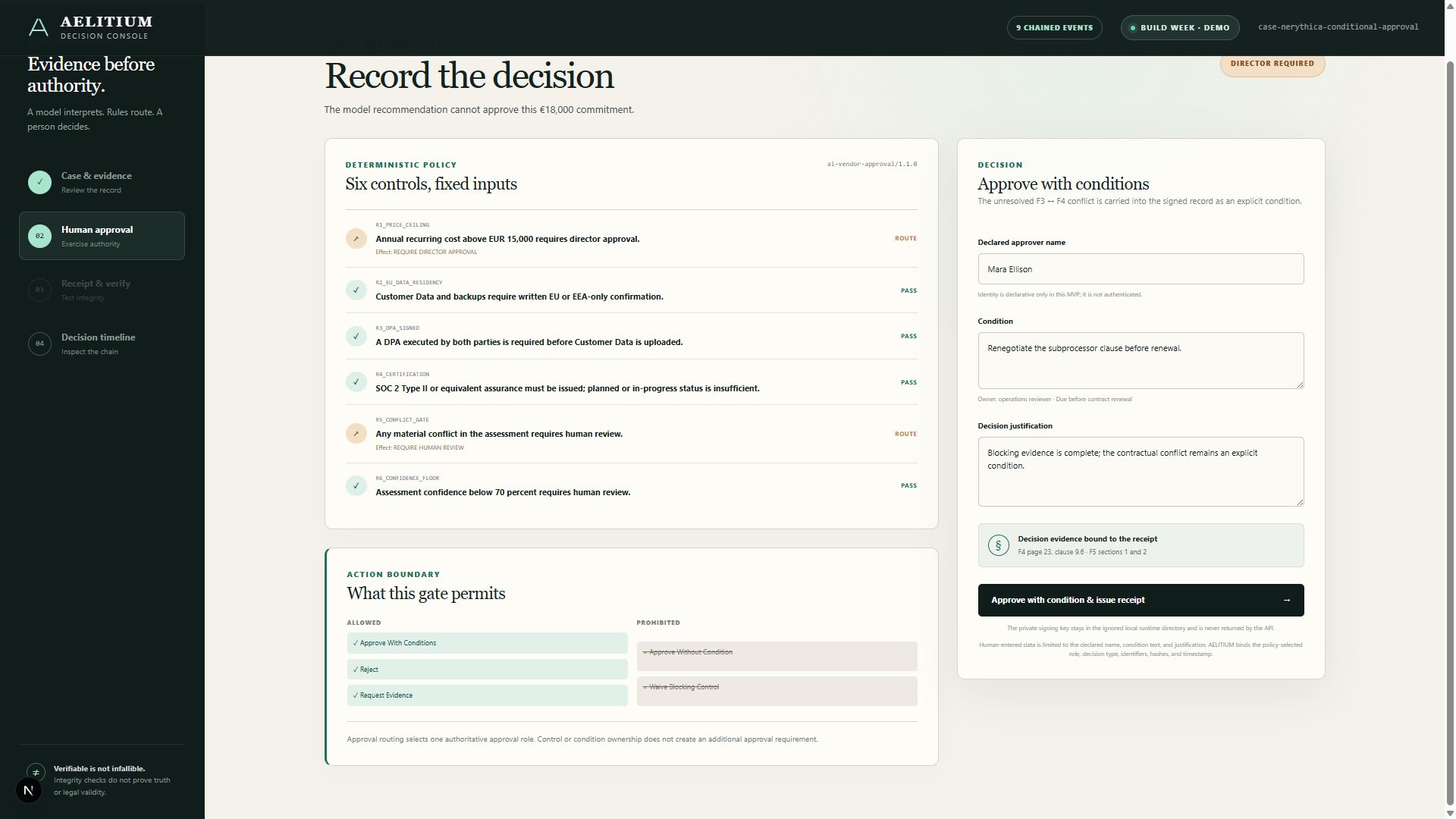
Policy selects the required approver. A human records the final decision, justification, and approval conditions
-
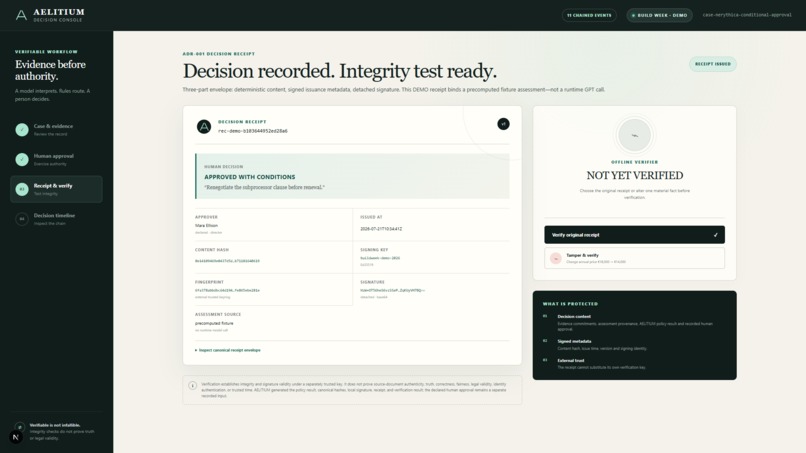
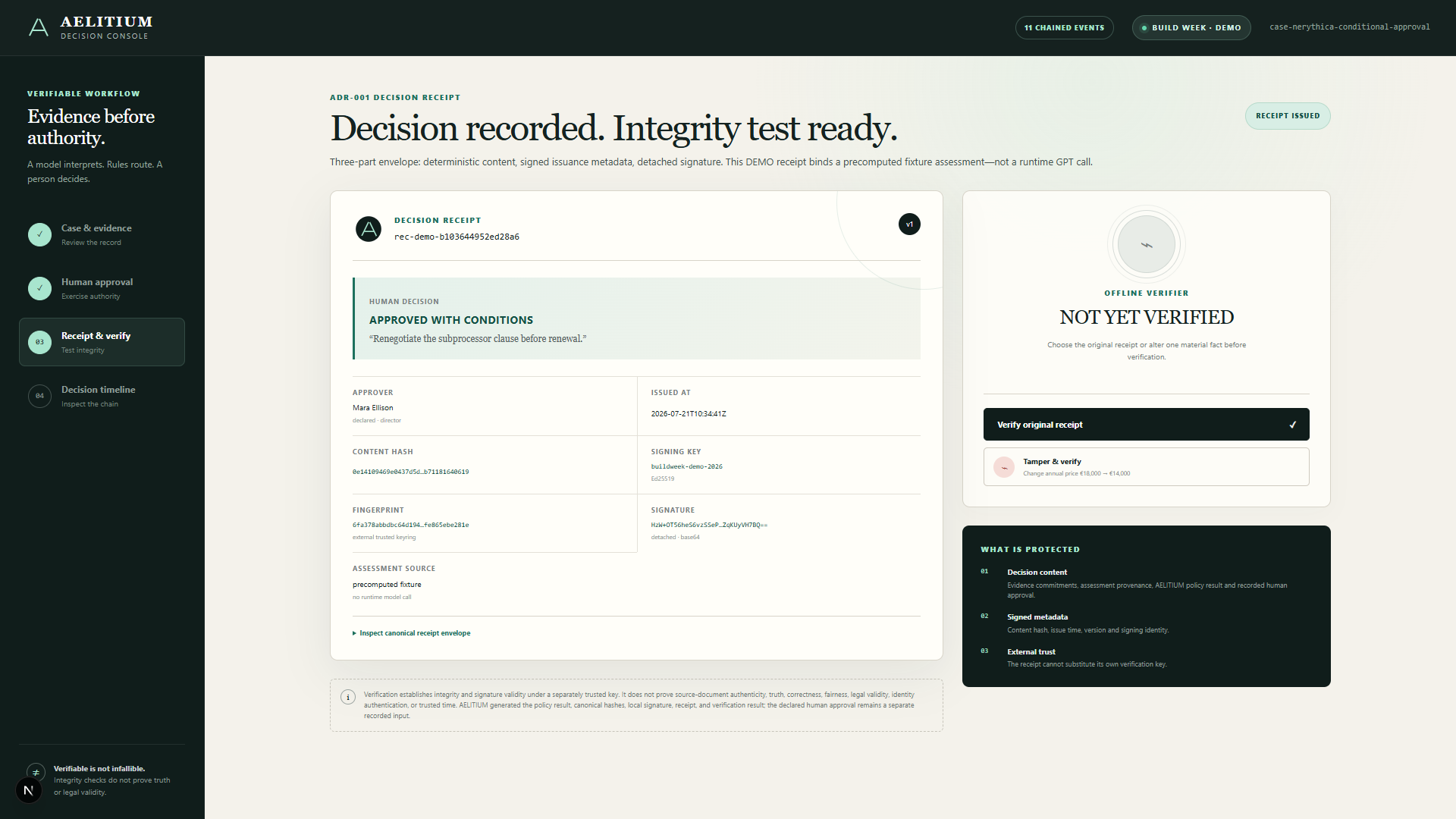
A signed Decision Receipt binds the assessment, policy result, and recorded human decision for independent verification.
-
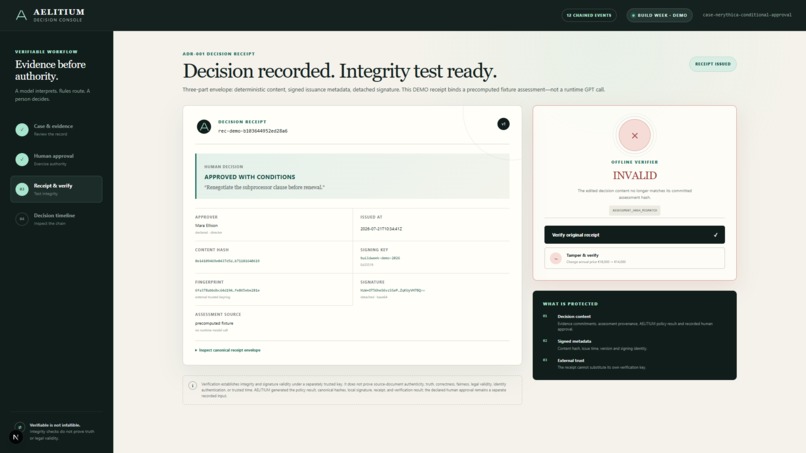
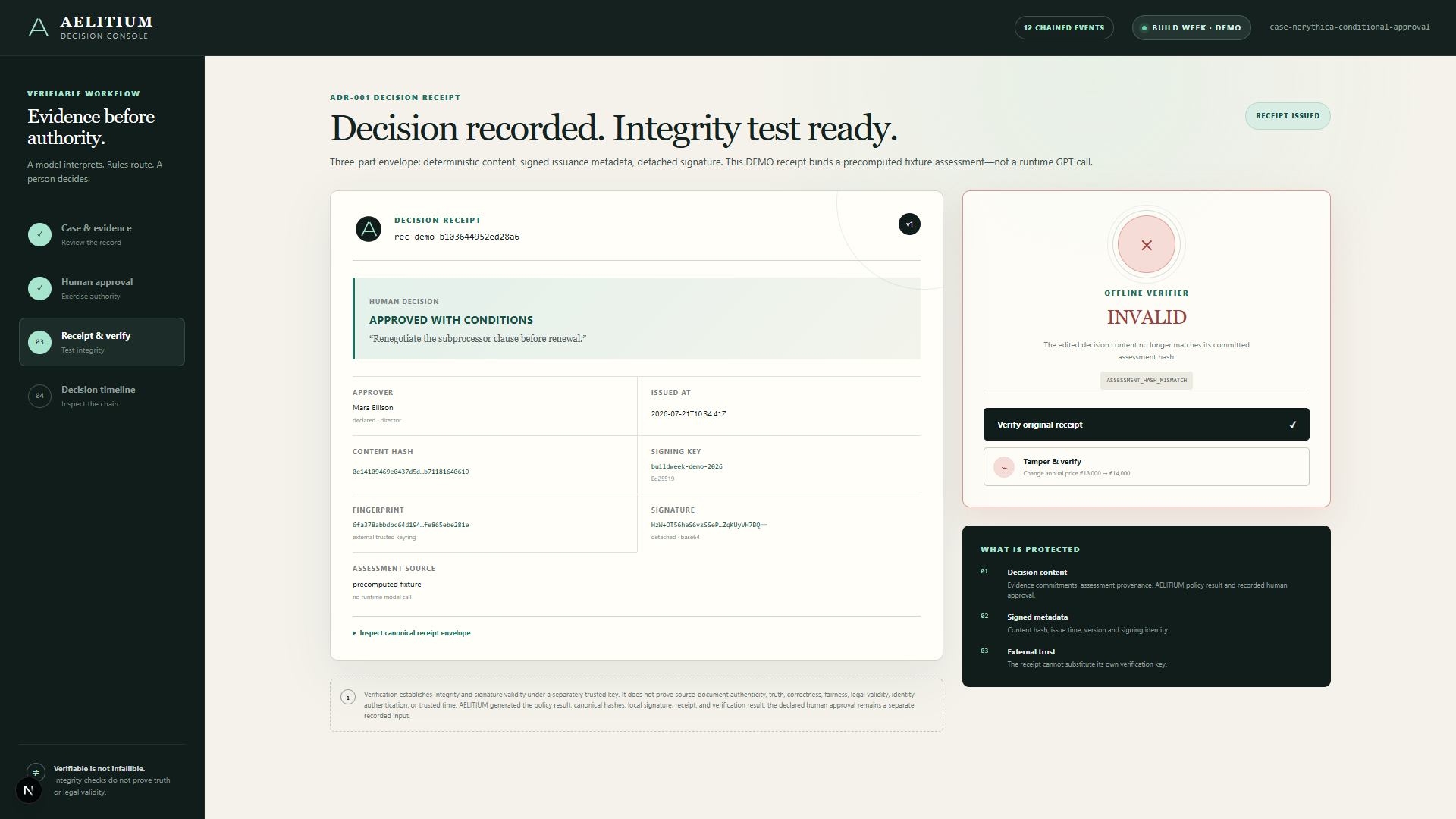
Changing a protected field breaks the committed hash. Independent verification detects tampering immediately.
-
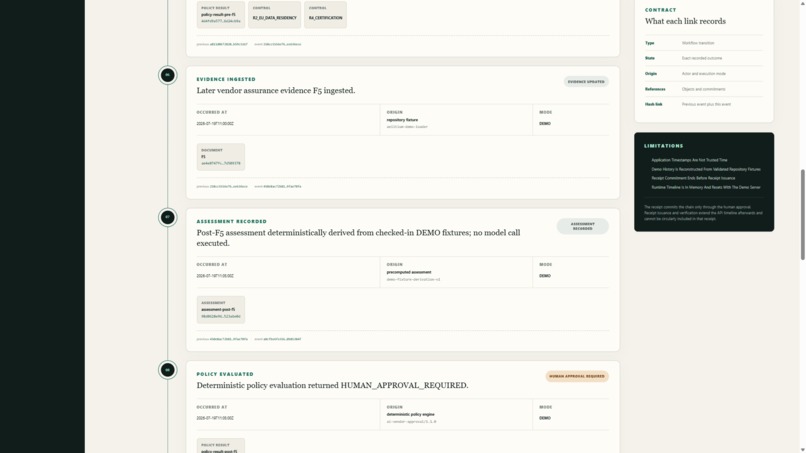
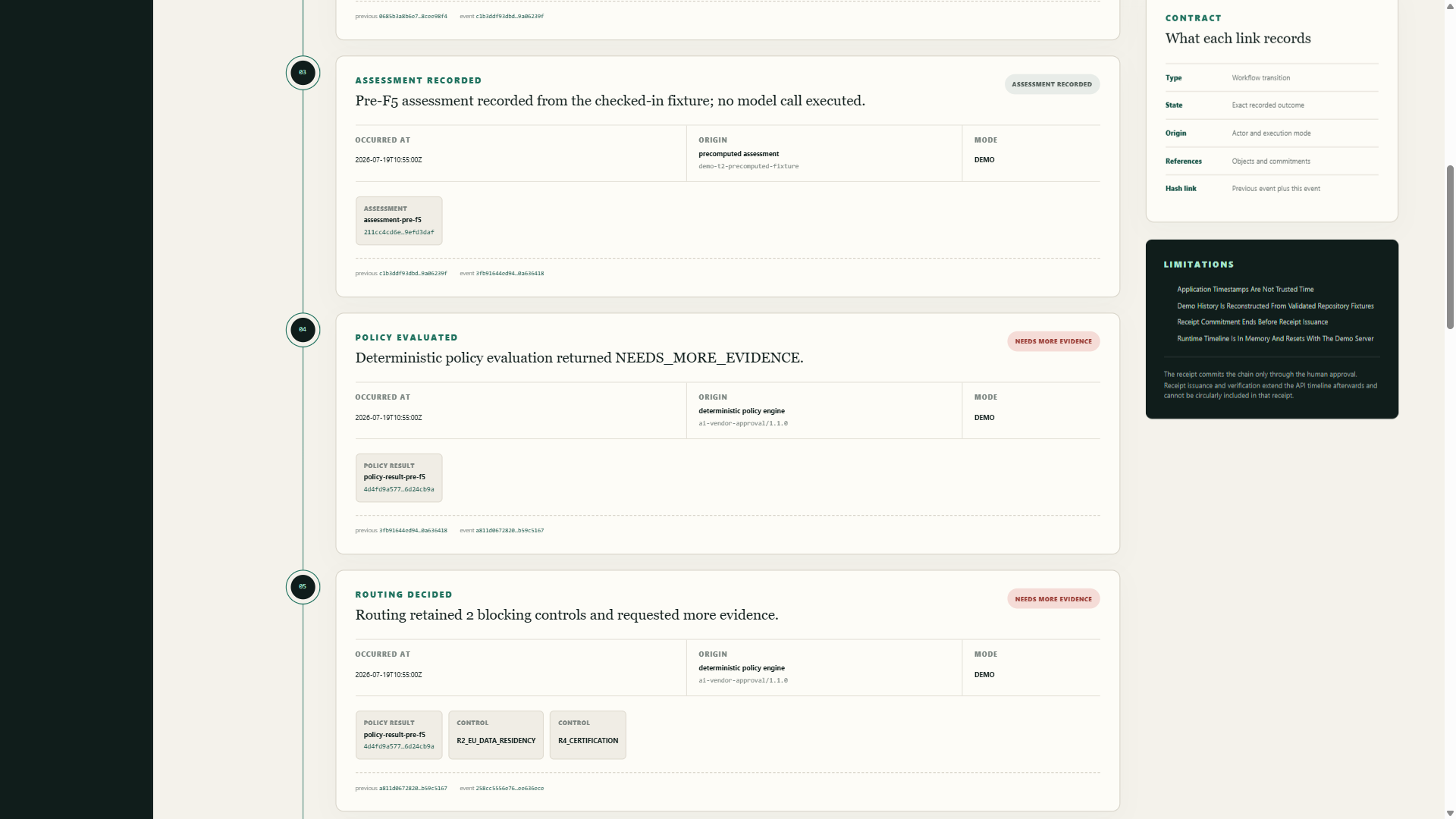
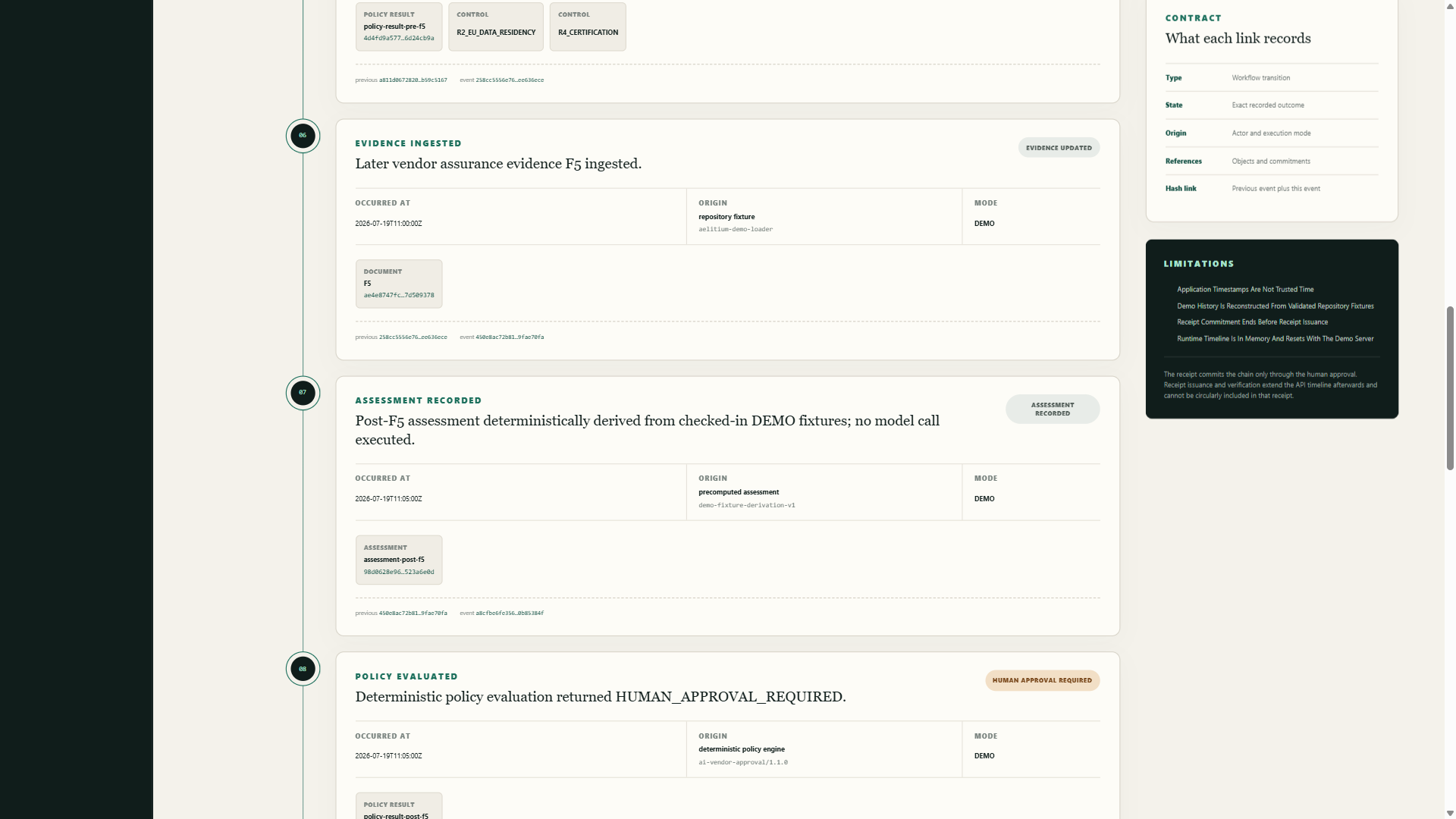
Hash-linked timeline showing the complete workflow, from evidence ingestion through approval, receipt issuance, and integrity verification
-
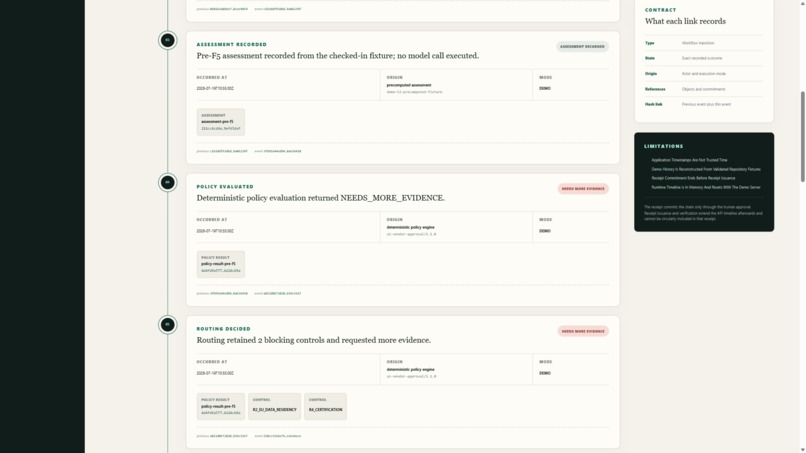
Policy decisions are fully traceable. Each routing step records why evidence required more review before human approval.
-
Integrity verification becomes part of the audit trail, recording both successful verification and detected tampering as chained events.
Inspiration
Enterprise AI vendor approval routinely takes months. Most of that time is spent cross-checking documents that nobody fully reads and reconstructing decisions that were never properly recorded. We didn't want a faster way to skim documents. We wanted decisions that could prove themselves afterwards.
What it does
AELITIUM turns an operational decision, approving a fictional AI vendor, into a verifiable workflow.
GPT-5.6 analyzes five documents (proposal, internal policy, security questionnaire, a 34-page DPA and an assurance letter) and produces a structured assessment with facts, citations, missing evidence and conflicts, including a subprocessor clause hidden on page 23 of the DPA that contradicts the security questionnaire.
Deterministic policy rules, not the model, decide the routing. Because the €18,000 proposal exceeds the €15,000 approval threshold, director approval becomes mandatory and the interface prevents approval while blocking evidence still exists.
The final decision, including the approval, conditions and justification, is sealed into a three-part signed receipt (decision content, signed payload and detached Ed25519 signature). The receipt can be verified independently using only the public key.
If a single value is modified afterwards, for example changing the price to €14,000 so that it falls below the approval threshold, offline verification immediately returns INVALID.
The product also makes its trust boundary explicit. Tamper-evident does not mean truthful. Verifiable does not mean correct. Signed does not mean legally valid. The receipt proves what evidence existed, which rules were executed, who made the decision and whether the record has been altered since.
How we built it
The project followed a specification-first workflow using Codex and GPT-5.6 with explicit approval gates.
I designed the architecture, specifications, validation rules and acceptance criteria. Codex implemented the requested components through iterative development under explicit approval gates, with every stage reviewed before progressing.
The system includes a FastAPI backend, a generic policy engine where policy packs are data rather than executable code, an ADR-001 receipt envelope using Ed25519 signatures, and deterministic fixtures including a 34-page DPA with the conflicting clause placed on page 23.
GPT-5.6 runs live through the Responses API using Structured Outputs. The response is validated against a canonical backend schema before entering the workflow.
Challenges we ran into
One of the most valuable engineering lessons came from the first live GPT-5.6 run. Structured Outputs guaranteed the response structure, but not our domain contract. The model returned uppercase identifiers that satisfied the JSON Schema but violated our canonical contract, and one constrained field contained prose instead of a valid token.
Canonical validation rejected the response before it entered the workflow. We introduced a versioned prompt and strengthened canonical validation, preserving provenance while rejecting non-conforming output, and a subsequent live run passed with a recorded canonical hash.
This was a good reminder that defence in depth should not just exist in documentation. It should protect the system when something unexpected happens.
Accomplishments that we're proud of
We built a workflow where every critical stage has a single responsibility and can be independently verified. GPT-5.6 interprets evidence, deterministic rules make routing decisions, humans retain approval authority, and cryptographically signed receipts make later verification possible.
The project shows that trustworthy AI systems are built through layered verification rather than relying on model output alone.
What we learned
We learned that trustworthy AI systems are built by separating responsibilities rather than increasing prompt complexity. GPT-5.6 interprets evidence, deterministic policy rules enforce governance, humans retain decision authority, and cryptographic receipts preserve an independently verifiable record.
Separating responsibilities between GPT-5.6, deterministic policy rules and human approval made the system easier to understand, validate and audit.
What's next for AELITIUM - Verifiable Decision Workflows
Next steps include a shared fact-key catalog between model output and policy packs, real approver identities, stronger authentication and additional decision domains. The engine is domain-agnostic, AI vendor approval is simply the first workflow.
Built With
- codex
- cryptography
- ed25519
- fastapi
- gpt-5.6
- json-schema
- next.js
- openai
- python
- react
- sqlite
- structured-outputs
- tailwindcss
- typescript

Log in or sign up for Devpost to join the conversation.