-
-
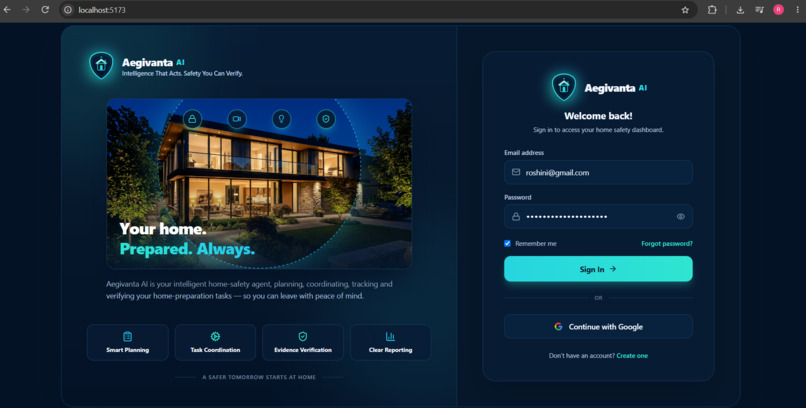
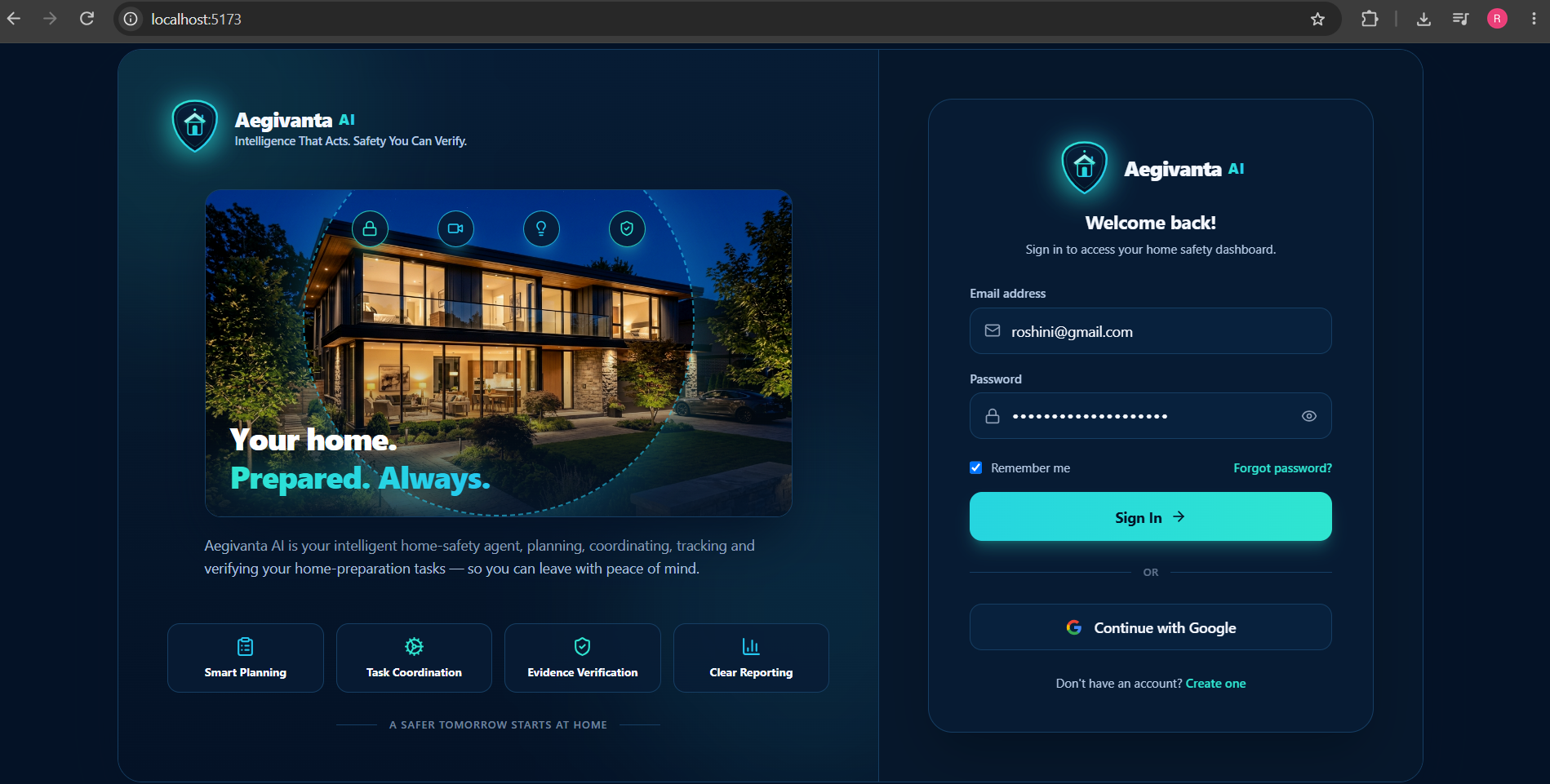
Provides secure access to the Aegivanta AI platform through a user-friendly authentication interface.
-
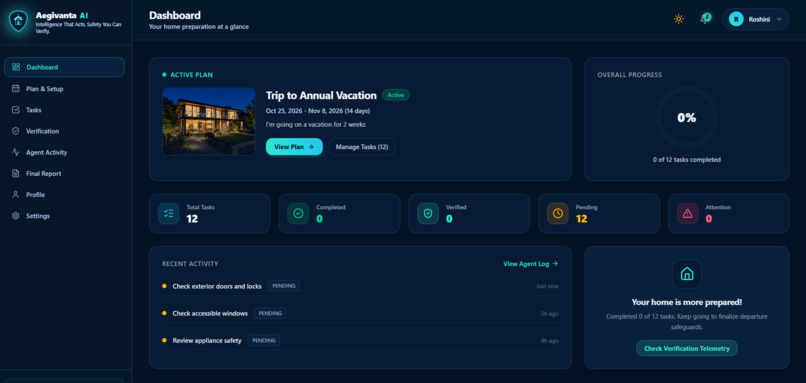
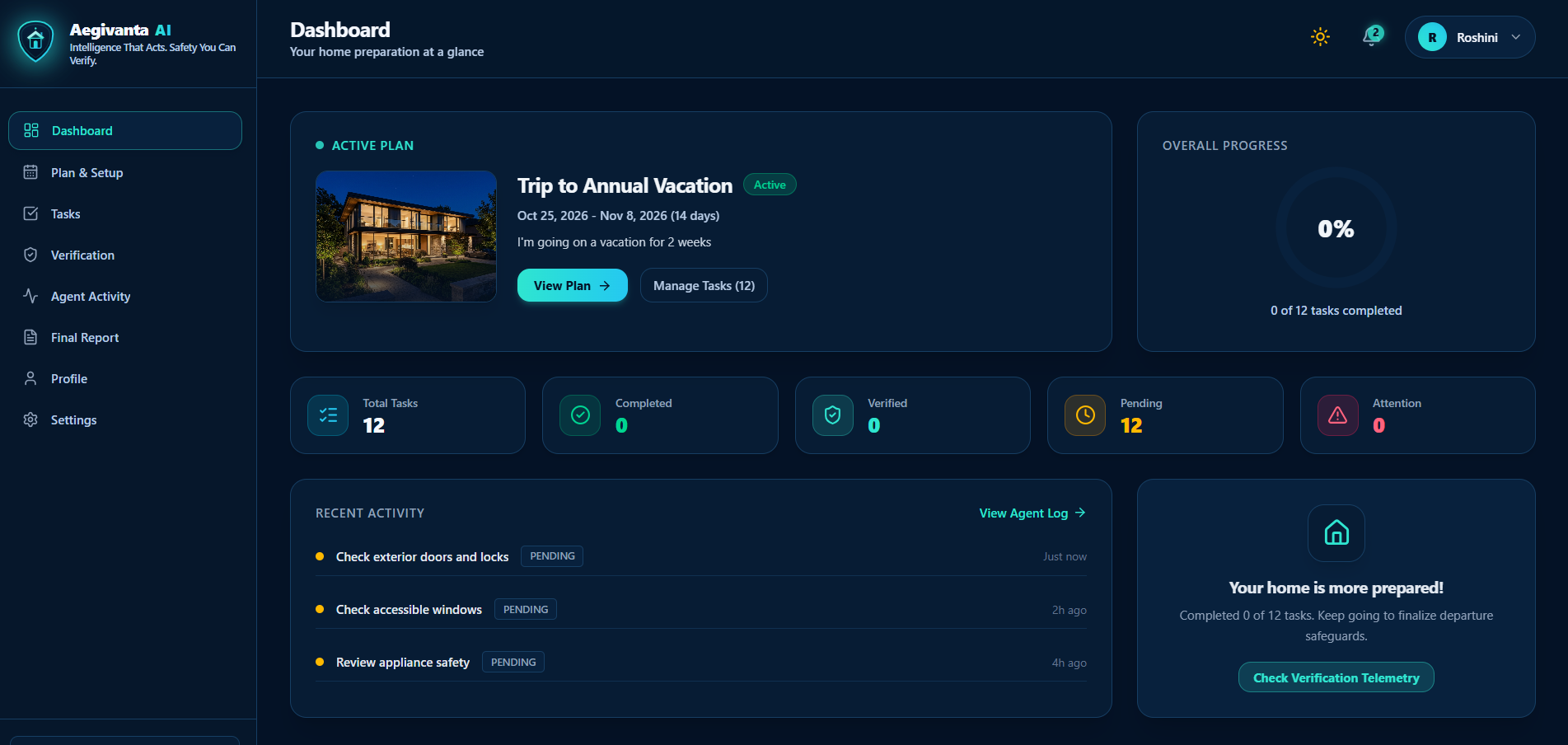
Home Dashboard: A centralized dashboard providing real-time visibility into home safety, task progress, and departure readiness.
-
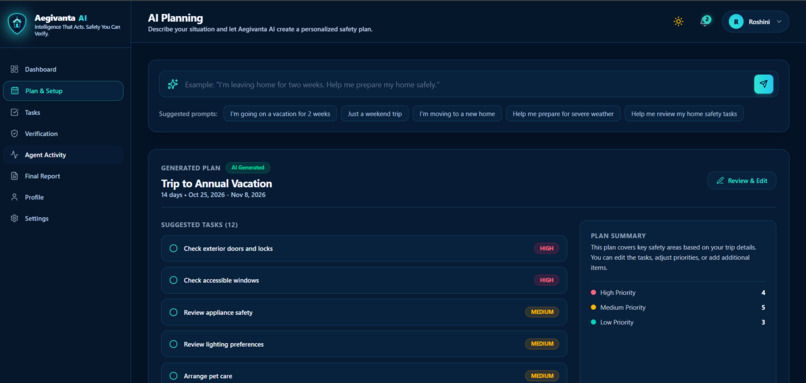
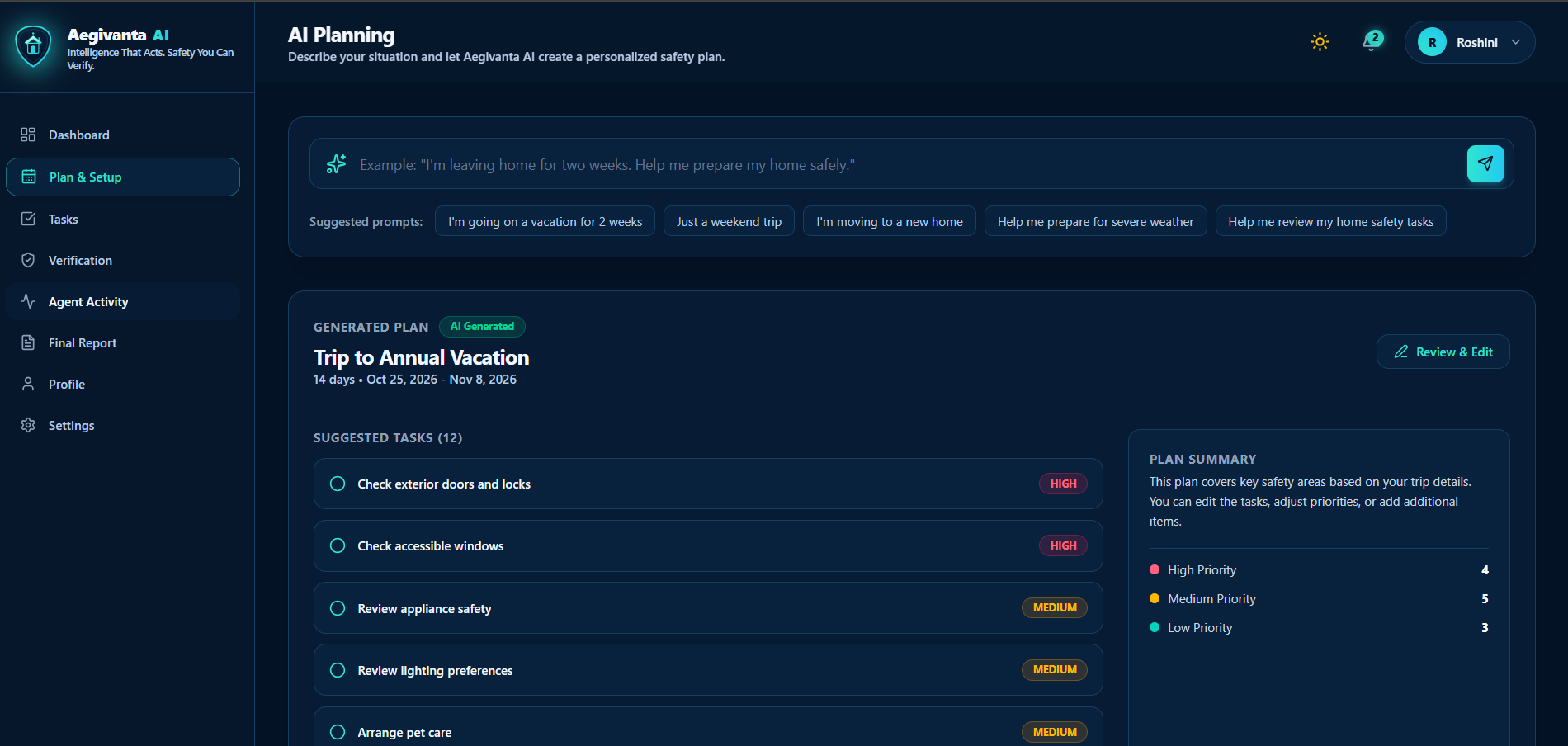
AI Planning – Plan & Setup: Generates personalized home-preparation plans based on travel schedules and individual safety needs.
-
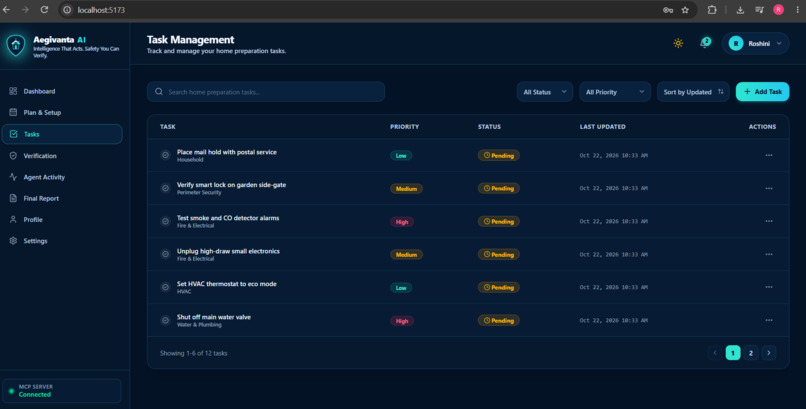
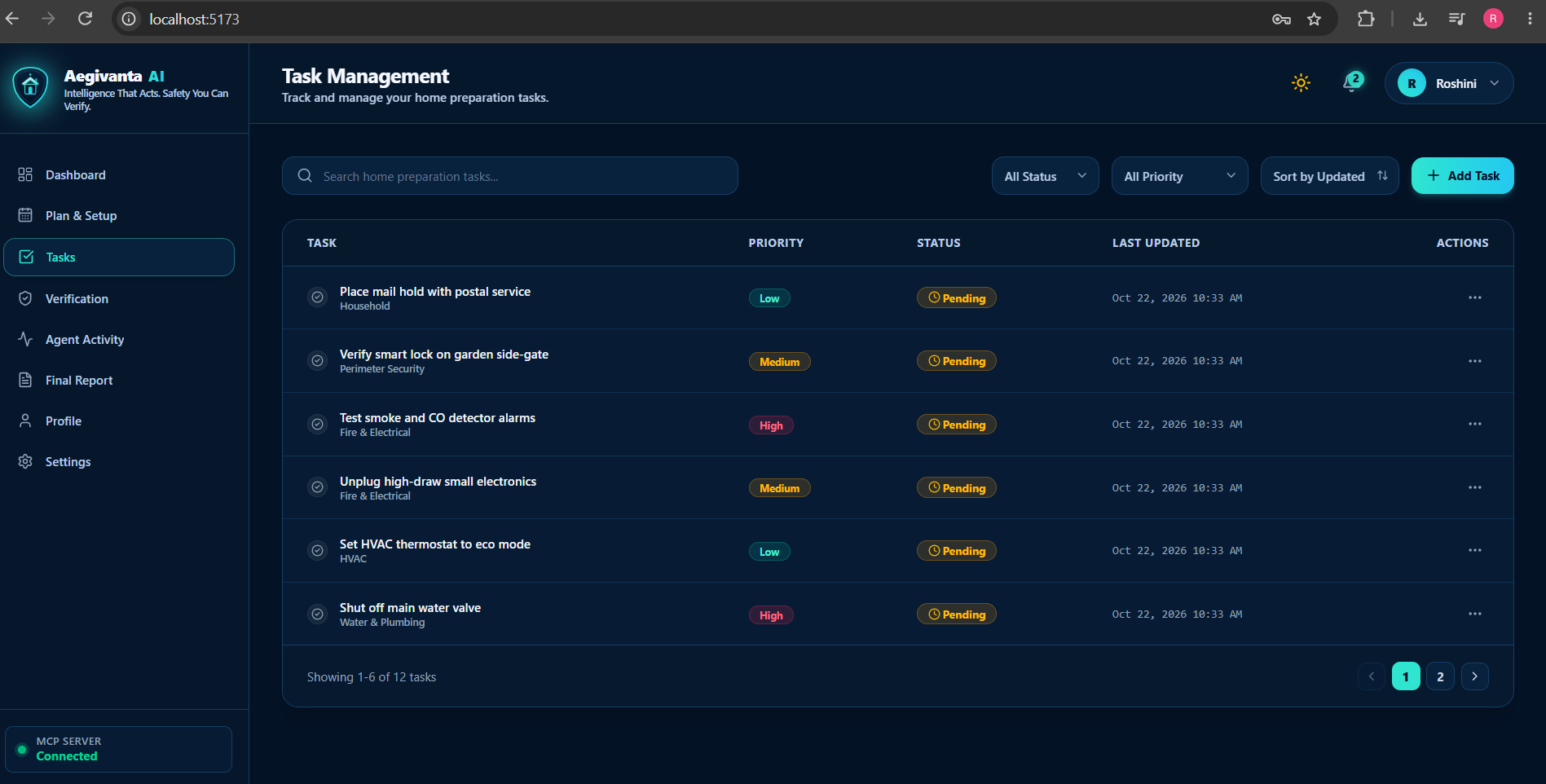
Task Management: Organizes home-safety activities with priority levels, status tracking, and efficient task management.
-
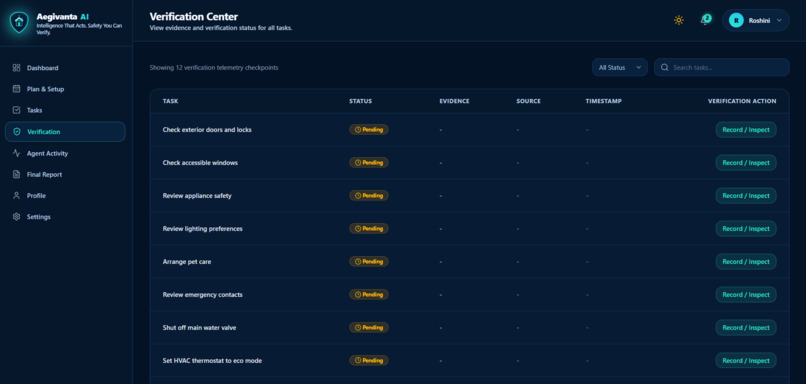
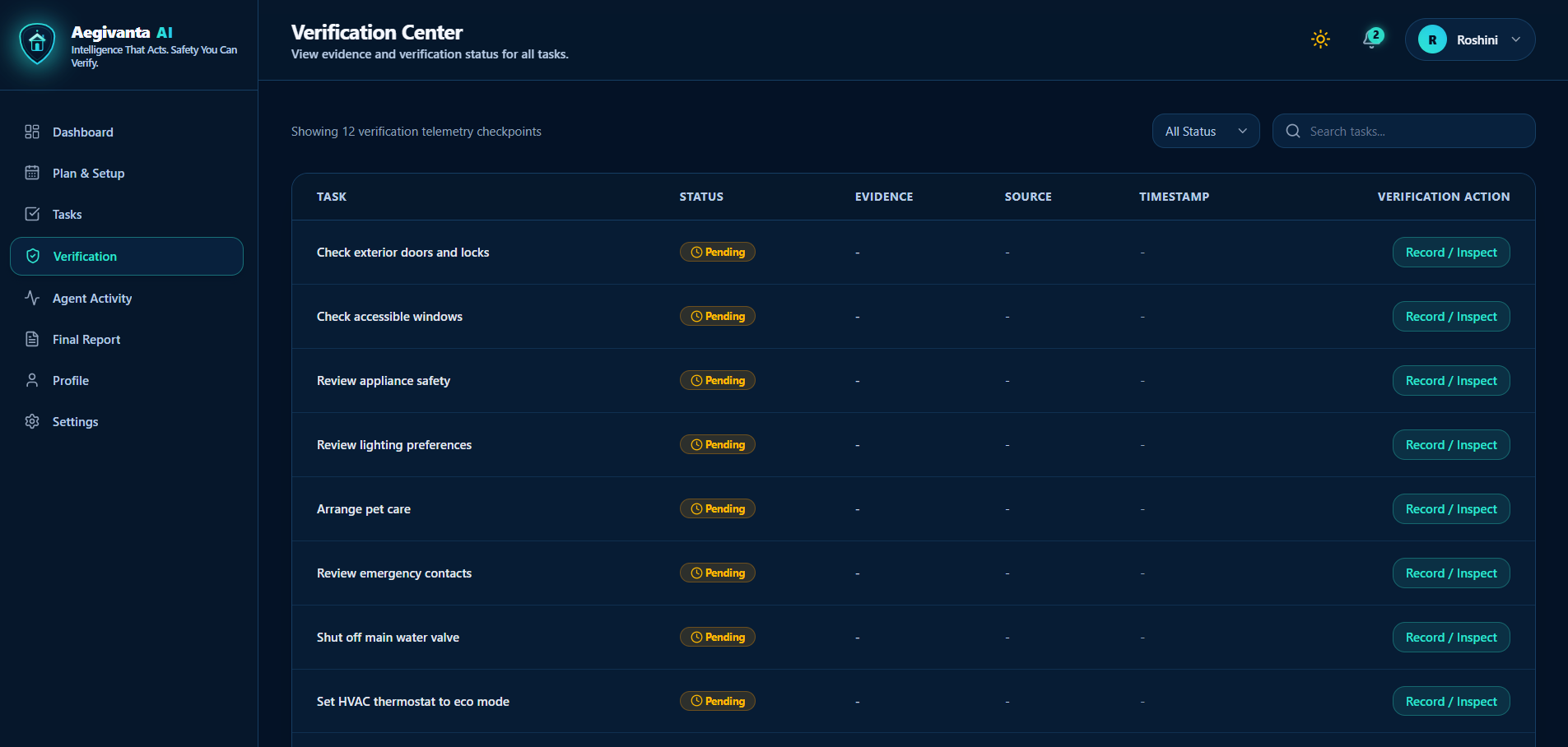
Verification Center: Tracks safety checkpoints and supporting evidence to help verify home-preparation tasks.
-
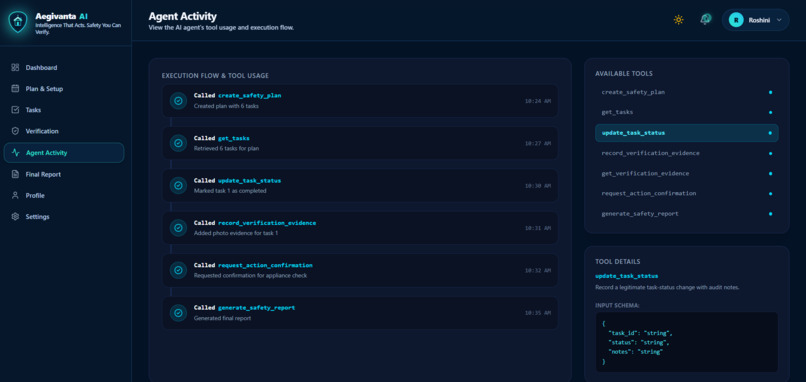
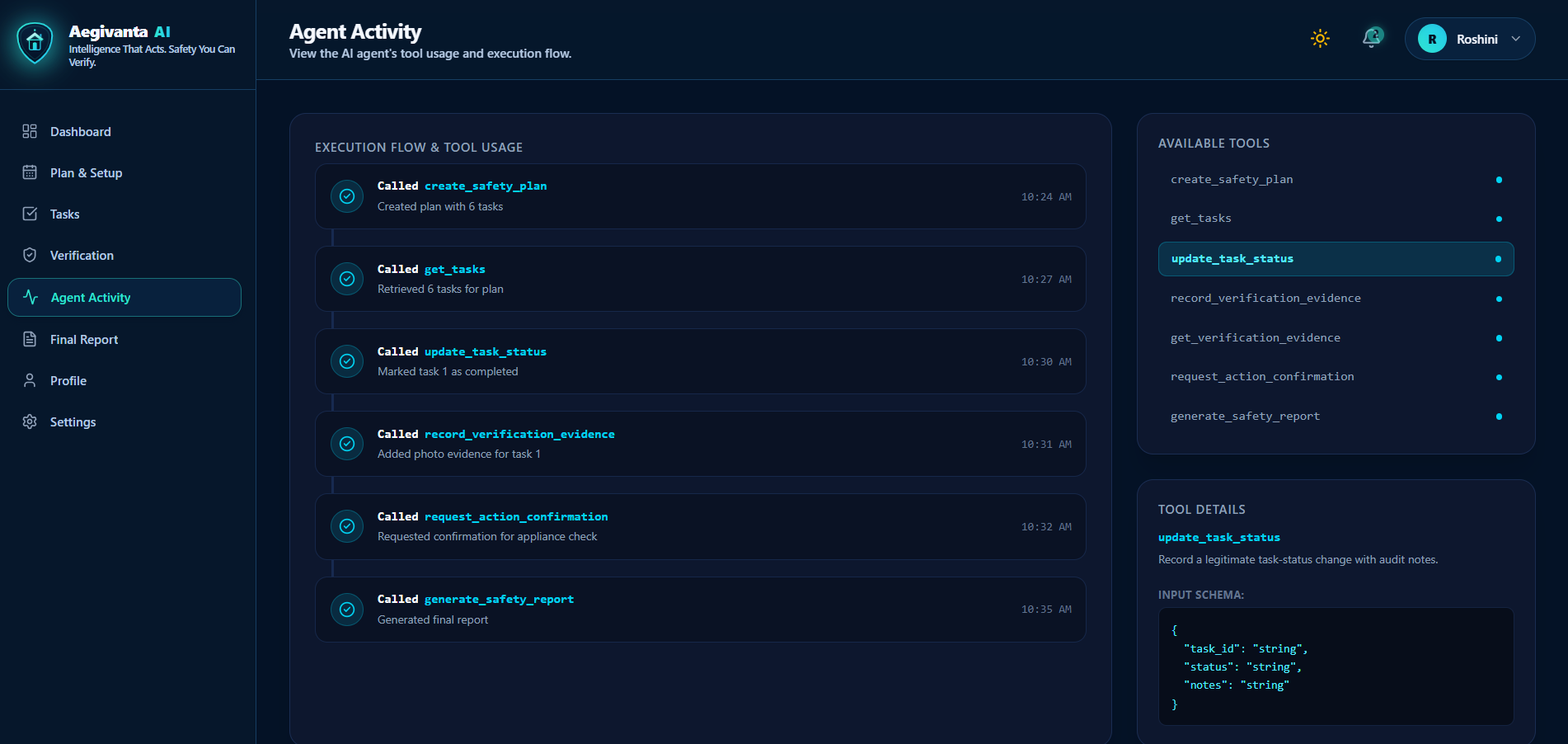
Agent Activity: Provides transparent insights into AI agent operations, tool usage, and task execution history.
-
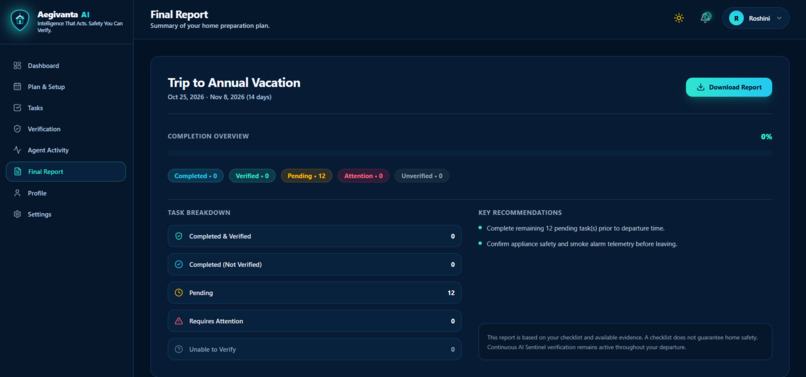
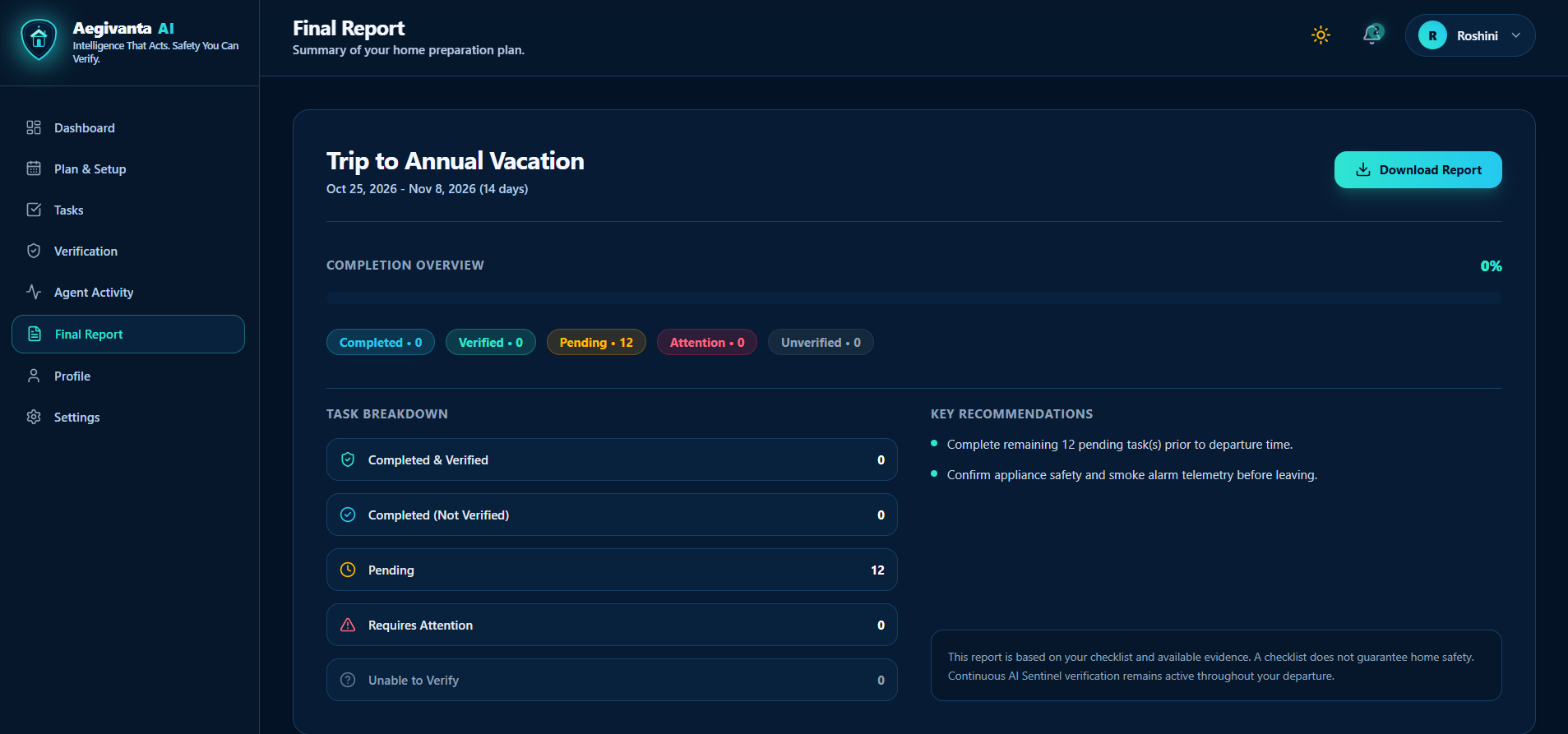
Final Report: Summarizes task completion, verification status, pending actions, and key safety recommendations in one report.
-
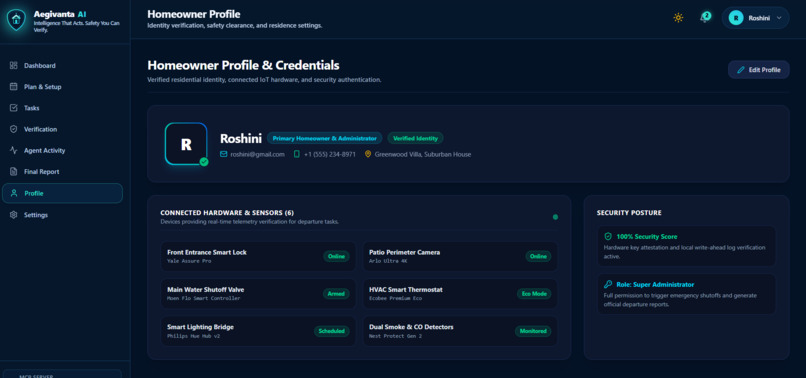
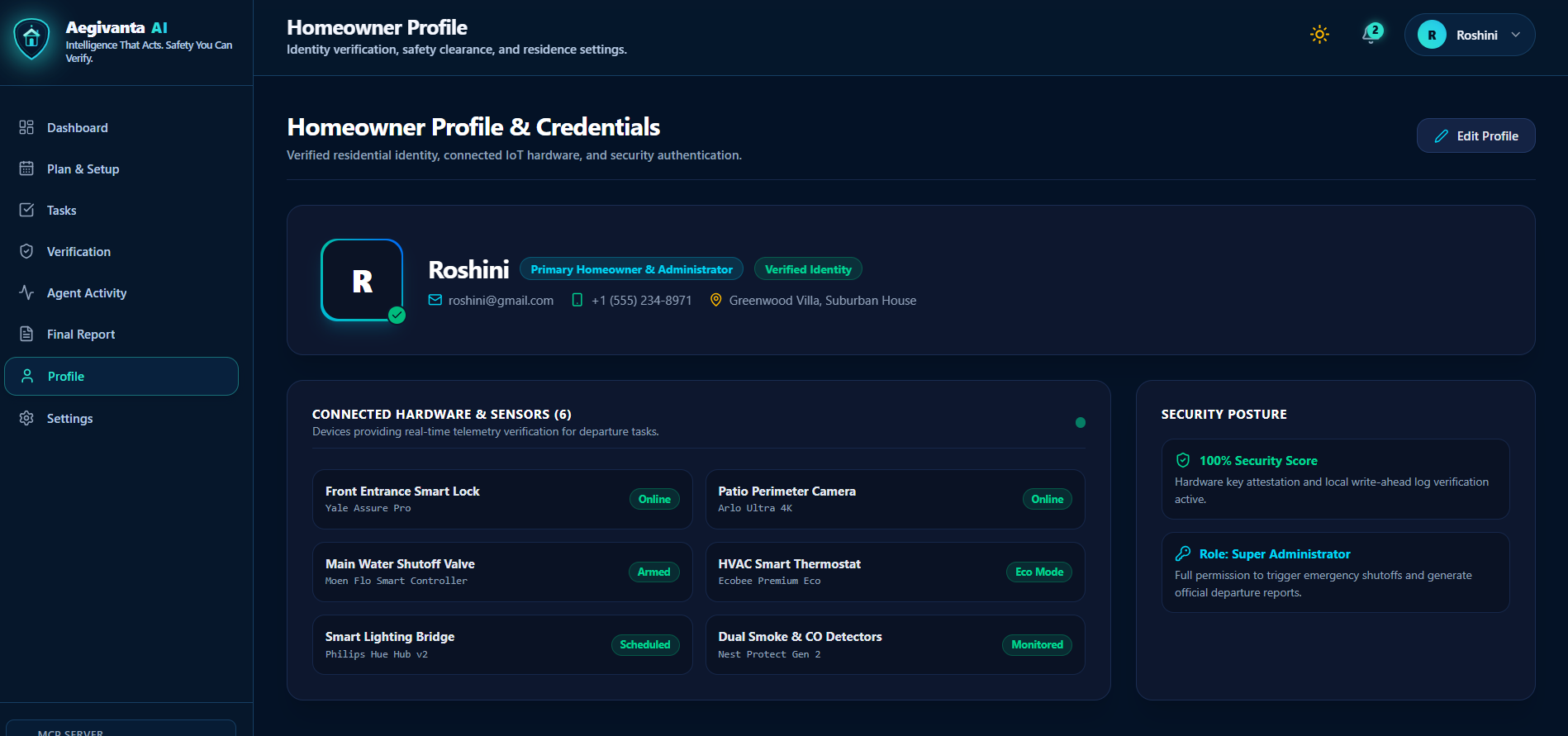
Home owner Profile: Manages homeowner credentials, connected smart-home devices, and security information.
-
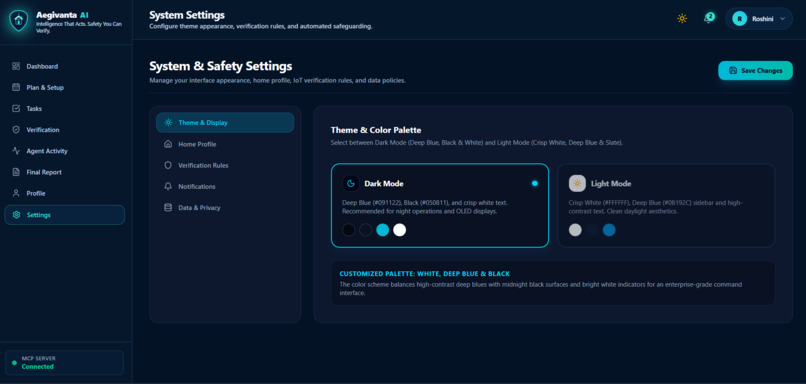
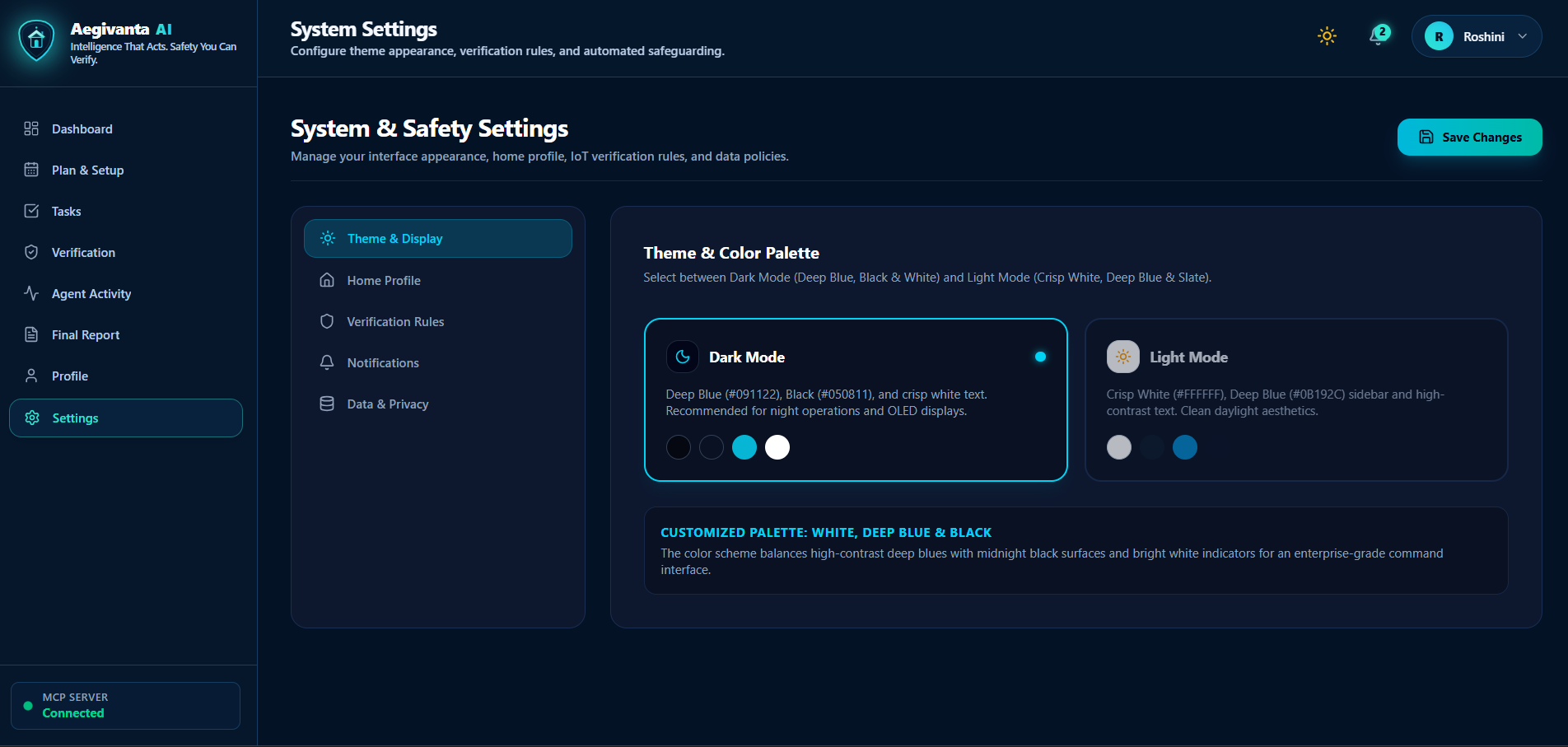
System Settings: Enables customization of themes, verification rules, notifications, and data privacy preferences.
Aegivanta AI: Your Intelligent Home-Safety Planning Agent
Inspiration
Preparing a home before leaving for a vacation can be stressful. Families often need to remember multiple responsibilities, from checking doors and windows to organizing appliances, managing essential tasks, and ensuring everything is ready before departure. When several family members are involved, important tasks can be forgotten, and it can be difficult to know what has already been completed.
We were inspired by a simple question: What if an intelligent AI agent could help families prepare their homes before they leave, organize their responsibilities, and keep track of their progress?
This idea led us to build Aegivanta AI, an AI-powered home-safety planning agent designed to make home preparation more organized, manageable, and less stressful. Our goal is to help families leave home with greater confidence by turning scattered responsibilities into a structured, trackable plan.
What It Does
Aegivanta AI helps users organize and monitor their home-preparation activities before travelling or leaving home for an extended period.
Its key capabilities include:
Intelligent Planning: Helps users organize home-preparation activities into a structured plan. Task Management: Creates and tracks individual tasks so users can monitor their progress. Evidence Recording: Allows users to record verification evidence associated with completed safety tasks. Confirmation Tracking: Records confirmations to support a more organized preparation workflow. Progress Monitoring: Helps users understand which tasks are completed and which still require attention. Report Generation: Generates reports that summarize the preparation plan and its status. AI Agent Integration: Connects AI-assisted workflows with application functionality through the Model Context Protocol (MCP).
Aegivanta AI is designed to support preparation and verification. It does not independently guarantee that a home is safe or physically inspect the property.
How We Built It
We built Aegivanta AI as a full-stack web application with a dedicated frontend, backend, database, and MCP integration.
Technology Stack
Frontend
- React 19
- TypeScript
- Vite
- Tailwind CSS v4
Backend
- Python
- FastAPI
- SQLAlchemy
- aiosqlite
Database
*SQLite for structured application data and persistent storage.
AI Agent and Integration
- Official Model Context Protocol (MCP) SDK
- Self-hosted MCP server using Streamable HTTP
- Tool-oriented workflows that connect the agent with application capabilities
- Deterministic fallback behavior when an external AI API key is unavailable
Application Architecture
The React frontend provides the interface through which users interact with Aegivanta AI. The FastAPI backend handles application logic and exposes API endpoints for managing plans, tasks, evidence, confirmations, and reports.
SQLAlchemy and SQLite provide data persistence. The MCP server exposes supported application functionality through a standardized tool interface, allowing compatible MCP clients to interact with the application.
We designed the application to work even when an external AI API key is unavailable by providing deterministic fallback behavior for supported workflows.
We also tested the backend and frontend integration, checked the API endpoints, and ran automated backend tests to validate core functionality.
What We Learned
Building Aegivanta AI helped us understand how to move beyond a conventional web application and develop an application with agent-oriented capabilities.
Our key learnings included:
MCP Integration: Understanding how the Model Context Protocol can connect AI agents with application tools and structured functionality. Full-Stack Development: Integrating a React and TypeScript frontend with a Python FastAPI backend. Database Management: Using SQLAlchemy and SQLite to persist application data. API Design: Organizing backend endpoints for plans, tasks, evidence, confirmations, and reports. Reliable Fallbacks: Designing deterministic fallback behavior so supported workflows remain available when an external AI API key is missing. Testing and Debugging: Troubleshooting dependencies, configuring frontend-to-backend communication, and testing the application's core functionality. User-Centered Design: Thinking about how technology can simplify everyday responsibilities and provide a clear view of task completion.
Most importantly, we learned that building a useful AI application requires more than adding a conversational interface. The agent must connect to meaningful application functionality and help users accomplish practical tasks.
Challenges We Faced
One of our main challenges was integrating the frontend, backend, database, and MCP server into a single working application.
- Frontend and Backend Integration
Configuring communication between the Vite development server and FastAPI required careful proxy configuration and debugging. We resolved the configuration issues and verified that the frontend could communicate with the backend.
- MCP Server Integration
We needed to expose application functionality through an MCP server rather than treating the project as a conventional chatbot. Implementing a self-hosted MCP endpoint helped us structure the integration around application tools and supported workflows.
- Dependency and Environment Configuration
Setting up the Python environment and resolving backend dependency issues required troubleshooting and testing. We addressed the issues encountered during development and validated the backend using automated tests.
- Reliable Application Behavior
We wanted supported workflows to remain usable even without an external AI API key. We therefore implemented deterministic fallback behavior, helping separate the application's core functionality from optional external AI services.
- Building a Practical User Experience
We also had to organize multiple preparation activities into a coherent workflow. By combining plans, tasks, evidence, confirmations, and reports, we created a structured approach to managing home-preparation responsibilities.
These challenges taught us the importance of modular architecture, integration testing, clear data management, and designing for reliable behavior.
What's Next
We envision expanding Aegivanta AI with additional capabilities, including:
- Personalized home-preparation checklists based on household needs.
- Voice-based interactions through compatible assistants.
- Optional smart-home integrations for supported devices.
- Reminders for unfinished preparation tasks.
- Improved evidence management and verification workflows.
- More detailed reports and a clearer overview of outstanding responsibilities.
These are potential future enhancements rather than claims about existing functionality.
Our Vision
Aegivanta AI represents our vision of making AI useful in everyday life by helping people organize important responsibilities before they travel.
We believe technology should reduce unnecessary stress, improve coordination, and help people make more informed decisions.
With Aegivanta AI, we aim to turn home preparation from a collection of scattered tasks into a structured, trackable, and more manageable experience.
Aegivanta AI — Prepare Smarter. Leave Confidently.
Built with curiosity, collaboration, and a passion for practical AI innovation by Roshini A
Built With
- 1.-react
- 2.-python
- 3.-sqlite
- angular.js
- api
- api.ai
- css3
- fastapi
- git
- github
- html5
- javascript
- python
- rest
- tailwind
- typescript
- vscode


Log in or sign up for Devpost to join the conversation.