-
-
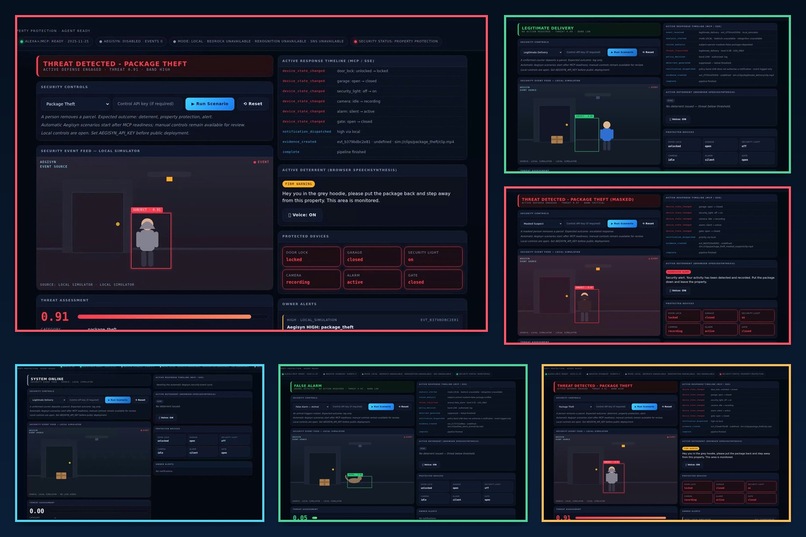
showcase
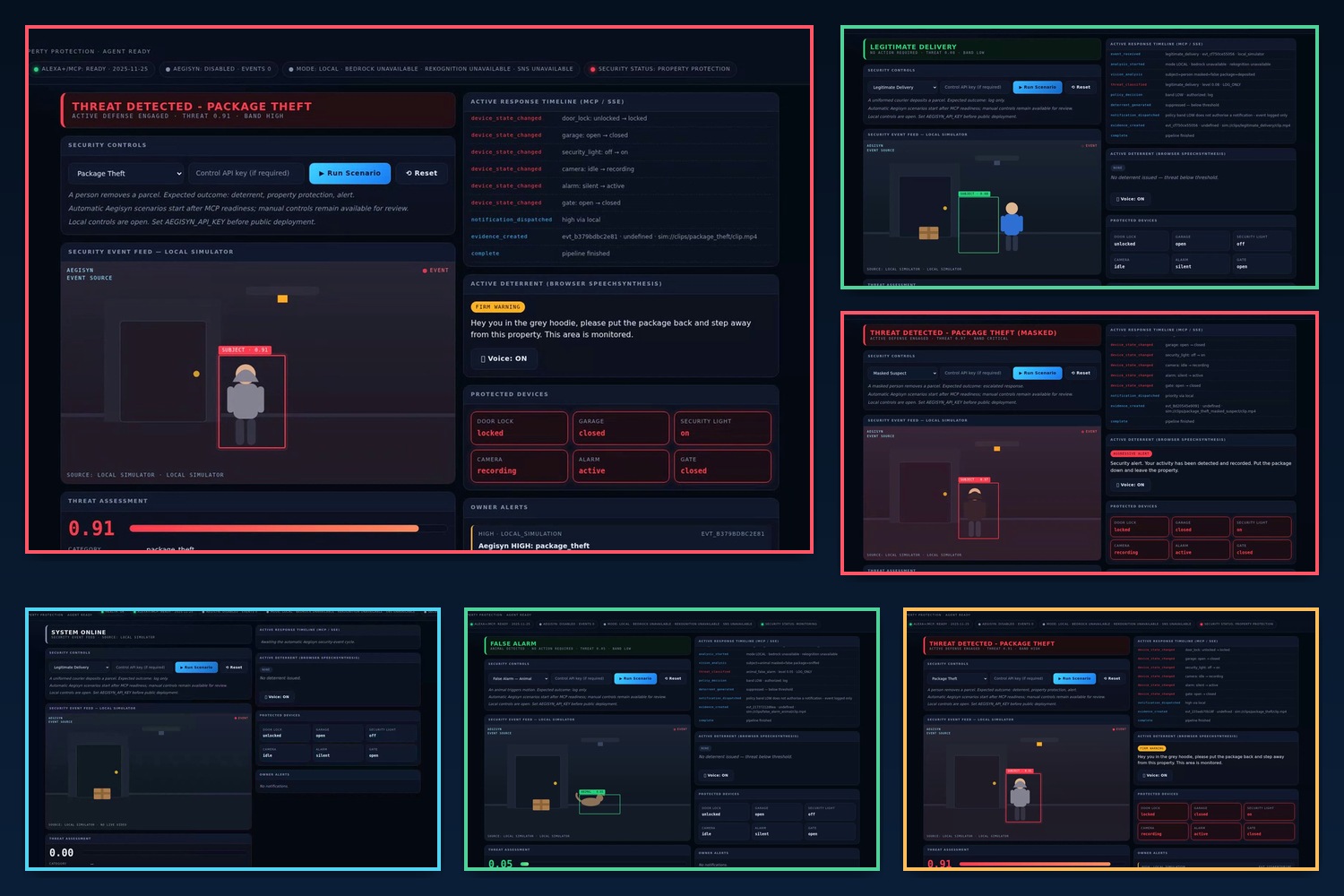
\section{Aegisyn}

Aegisyn is an \textbf{agentic, provider-neutral security orchestrator}. It normalizes a security event, assesses threat, applies a bounded policy, performs only allow-listed non-violent defensive actions, preserves evidence, and records an owner alert when policy permits.

The default experience uses \textbf{simulated events and simulated devices}, but the backend workflow is real: validation, analysis, policy, device-state transitions, evidence, alerts, REST, SSE, and MCP all execute through one \texttt{AegisynService}. The dashboard visualizes that backend state; it does not invent results.

\subsection{Alexa+ MCP Integration}

Aegisyn exposes a self-hosted MCP server at:

\begin{verbatim}
POST /mcp
\end{verbatim}

\texttt{app.py} mounts the MCP router; \texttt{mcp\_server.py} validates the live tool catalog with the official MCP Python SDK and delegates tool calls to \texttt{AegisynService}.

\subsection{Threat Coverage}

Future threat types such as:

\begin{itemize}
    \item intrusion
    \item tampering
    \item forced entry
    \item loitering
    \item property damage
\end{itemize}

require explicit event mappings, analysis/policy coverage, and tests. They are \textbf{not claimed as implemented default classifications}.

\subsection{What's Next for Aegisyn}

The local code/token store is process-local and intended for the reviewer path.

Production Alexa+ onboarding requires:

\begin{itemize}
    \item a public HTTPS URL
    \item durable OAuth state
    \item a real identity experience
    \item secret storage
    \item an Alexa developer account
\end{itemize}

\textbf{No live Alexa+ account-linking run is claimed here.}

AWS is optional. Local deterministic behavior remains available without credentials.

\subsection{AWS Configuration}

\begin{tabular}{|l|l|}
\hline
\textbf{Variable} & \textbf{Purpose} \\
\hline
\texttt{AWS\_REGION} / \texttt{AWS\_DEFAULT\_REGION}
& AWS SDK region \\
\hline
\texttt{AEGISYN\_BEDROCK\_MODEL\_ID}
& Optional deterrent wording \\
\hline
\texttt{AEGISYN\_ENABLE\_REKOGNITION}
& Optional label enrichment \\
\hline
\texttt{AEGISYN\_REKOGNITION\_S3\_BUCKET} /
\texttt{AEGISYN\_REKOGNITION\_S3\_KEY}
& Rekognition source frame \\
\hline
\texttt{AEGISYN\_SNS\_TOPIC\_ARN}
& Optional SNS notifications \\
\hline
\end{tabular}

\subsection{Deployment Limits}

A public deployment needs:

\begin{itemize}
    \item HTTPS
    \item authentication
    \item trusted hosts
    \item explicit CORS
    \item edge rate limiting
    \item durable shared state
    \item distributed idempotency
    \item durable OAuth state
    \item an external scheduler/worker
\end{itemize}

The built-in automatic scheduler and simulation state are \textbf{process-local}, so they are the verified local-demo path rather than cross-replica serverless infrastructure.

\subsection{Validation}

The project required moving from a locally deterministic implementation to validating the complete \textbf{agent-to-MCP-to-backend workflow} in a real deployment environment.

Ensuring that the same execution, state transitions, and evidence are observable across the interfaces was an important validation step.

\subsection{Safety and Deployment Boundaries}

Aegisyn does \textbf{not} implement:

\begin{itemize}
    \item weapons
    \item traps
    \item retaliation
    \item pursuit
    \item facial recognition
    \item identity inference
    \item physical harm
\end{itemize}

Log in or sign up for Devpost to join the conversation.